The Temple of Karnak is the largest and most spectacular temple complex of ancient Egypt, as well as one of the most impressive archaeological sites in the world. Located on the eastern bank of the Nile at Luxor, this incredible religious complex covers an area of over 100 hectares and represents the fruit of more than 2,000 years of construction, expansion and restoration by dozens of pharaohs.
A UNESCO World Heritage Site since 1979, the Temple of Karnak is dedicated to the god Amun-Ra, the supreme deity of ancient Egypt, and attracts millions of visitors from all over the world every year.
History of the Temple of Karnak
The history of the Temple of Karnak spans an extraordinary period of time: from the 12th Dynasty of the Middle Kingdom (around 1990 BC) to the Ptolemaic era (around 30 BC), for a total of almost 2,000 years of continuous construction.
The complex began as a modest sanctuary dedicated to the god Amun during the reign of Senusret I. It was, however, during the New Kingdom (1550-1070 BC) that Karnak reached its greatest magnificence. The most powerful pharaohs — Thutmose III, Hatshepsut, Amenhotep III, Seti I and Ramesses II — competed to leave their own mark on this sacred place.
Each new pharaoh wanted to surpass his predecessor in the magnificence of his own additions, creating an incredible architectural palimpsest that tells the history of ancient Egypt through stone.
What to See at the Temple of Karnak
The Avenue of the Sphinxes
Entry to the temple is through an evocative avenue flanked by ram-headed sphinxes (with the head of a ram, the animal sacred to Amun). This avenue connected the Temple of Karnak to the Temple of Luxor over a length of about 2.7 km.
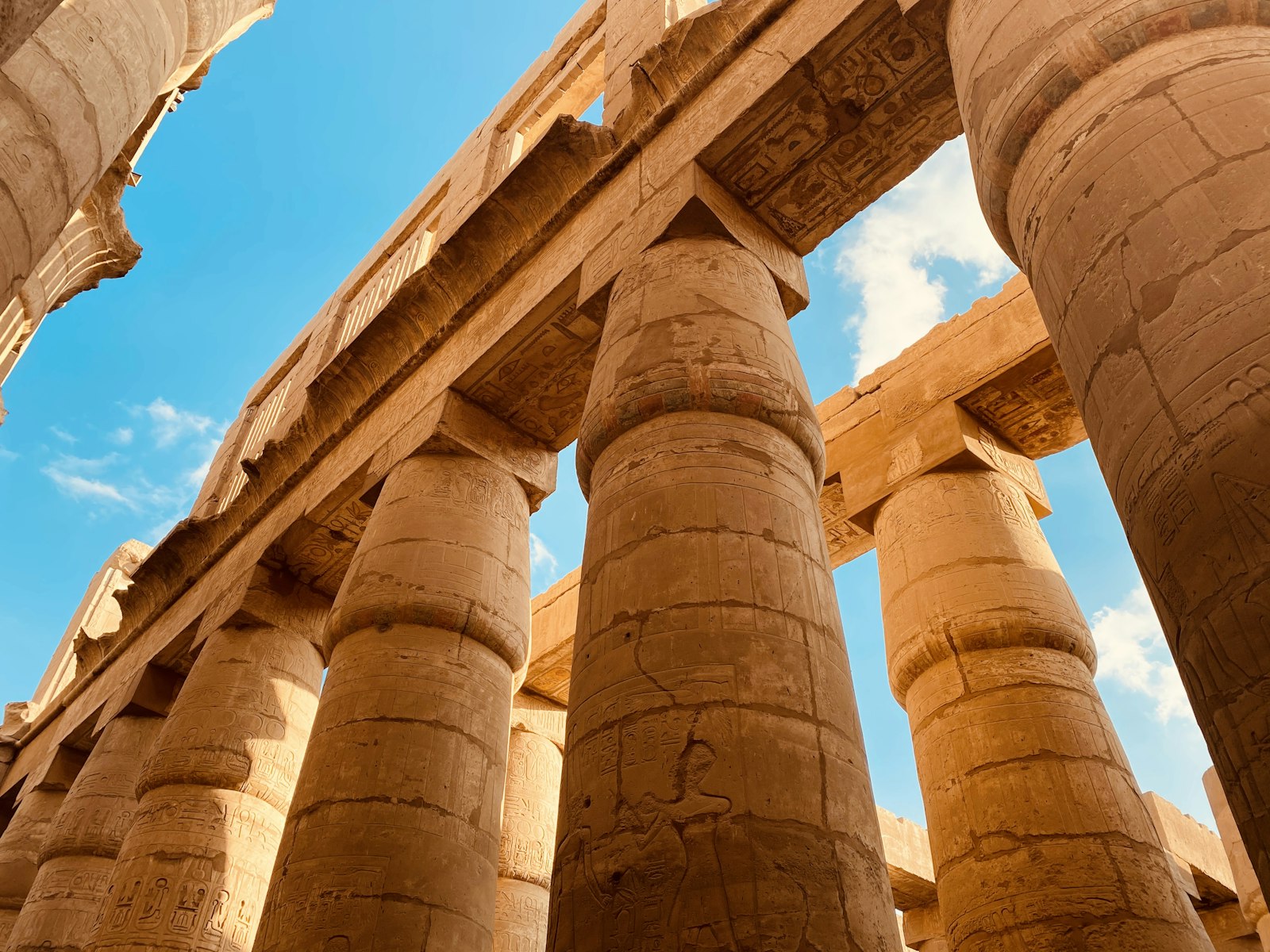
The Great Hypostyle Hall
The Hypostyle Hall is without doubt the highlight of the visit. This colossal hall measures 103 x 52 metres and contains 134 giant columns arranged in 16 rows. The 12 central columns are the most imposing: 23 metres high with a diameter of 3.5 metres. The lateral columns, 15 metres high, have papyrus-bud capitals.
The Obelisk of Hatshepsut
Erected by Queen Hatshepsut, 29.5 metres high and weighing about 320 tonnes, it is the second tallest obelisk in Egypt.
The Sacred Lake
A large rectangular basin (120 x 77 metres) where the priests purified themselves. On its banks stands the statue of the Sacred Scarab, around which one walks seven times for good luck.
How to Get to the Temple of Karnak
The Temple of Karnak is located about 3 km north of the centre of Luxor:
- By taxi: 5-10 minutes, about 30-50 EGP
- By horse-drawn carriage: A picturesque experience, 50-100 EGP
- On foot: 30-40 minutes along the Avenue of the Sphinxes
Tips for the Visit
- Arrive at opening at 6:00 to avoid the crowds
- Bring plenty of water
- The dawn light in the Hypostyle Hall is magical for photos
- Don't miss the evening Son et Lumière show
- Do not accept unauthorised guides
Did You Know?
- With its 100+ hectares, Karnak is larger than the Vatican City
- Each column of the Hypostyle Hall has slightly different decorations
- The temple is aligned with the sunset of the winter solstice
Frequently Asked Questions
How much time is needed to visit Karnak?
A minimum of 2-3 hours for the main areas, 3-4 hours for a complete visit.
Is the Son et Lumière show available in several languages?
Yes, the evening show is available in several languages.
Is it accessible to people with reduced mobility?
Partially. The main areas are relatively flat but some zones have uneven ground.