Abu Simbel is without doubt one of the most spectacular and moving archaeological sites in all of Egypt. Located in the far south of the country, just a few kilometres from the border with Sudan, this complex of two rock-cut temples was commissioned by the pharaoh Ramesses II (1279-1213 BC) as an eternal testament to his power and his devotion to the gods.
But Abu Simbel is also famous for another reason: in the 1960s, the temples were dismantled and rebuilt 65 metres higher up to save them from the waters of Lake Nasser, in one of the most extraordinary engineering feats of the 20th century.
History of Abu Simbel
The Great Temple was built between 1264 and 1244 BC and dedicated to the worship of Ramesses II himself and the gods Amun, Ra-Horakhty and Ptah. The facade is dominated by four colossal statues of the seated pharaoh, each about 20 metres tall, gazing at the eastern horizon with an expression of eternal majesty.
The Small Temple, located a short distance away, was dedicated to the goddess Hathor and to queen Nefertari, the favourite wife of Ramesses II. It is one of the very rare cases in which a pharaoh dedicated a temple to his own wife.
The Miracle of the Sun
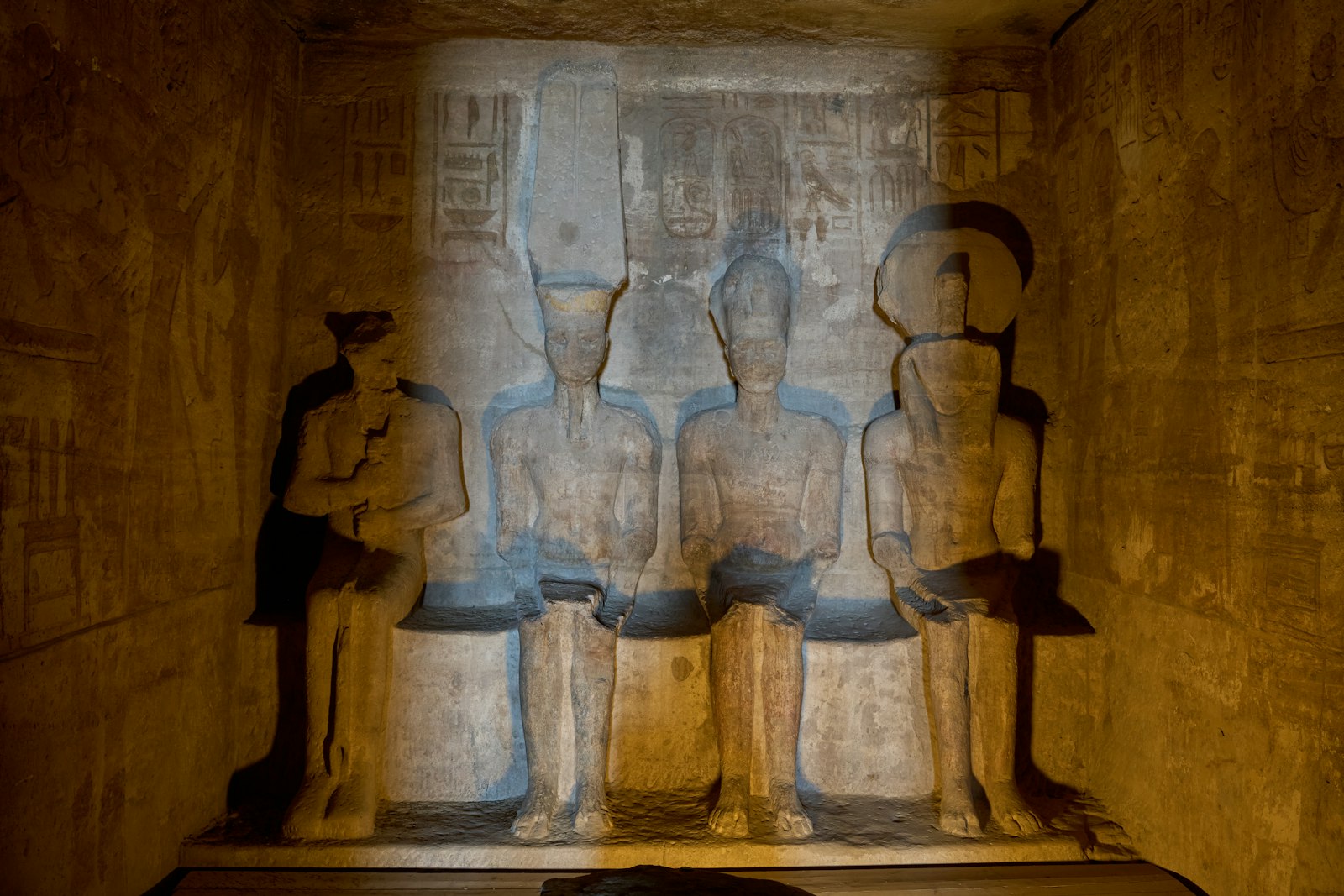
Twice a year, on 22 February and 22 October, a ray of sunlight penetrates the entrance of the Great Temple and travels the 65 metres of the inner corridor to illuminate the statues of the gods in the deepest sanctuary. Only the statue of Ptah, god of the underworld, always remains in shadow. These dates are thought to correspond to the birthday and coronation of Ramesses II.
The UNESCO Rescue
In the 1960s, the construction of the Aswan Dam threatened to submerge Abu Simbel beneath the waters of Lake Nasser. UNESCO launched an international campaign that led to the dismantling and reconstruction of the temples between 1964 and 1968. The entire mountain was cut into blocks of 20-30 tonnes and reassembled 65 metres higher, in a position that perfectly replicates the original orientation.
How to Get to Abu Simbel
Abu Simbel is located 280 km south of Aswan:
- ✈️ Flight from Aswan: 45 minutes (the most convenient method)
- 🚌 Convoy from Aswan: 3-3.5 hours, departing at 4:00 AM
- 🚢 Lake Nasser cruise: The most exclusive experience
Tips for Your Visit
- 🌅 Arrive at dawn for the best photographic light
- 📅 If possible, visit on 22 February or 22 October for the solar phenomenon
- 💧 Bring plenty of water
- ⏰ Plan at least 1.5-2 hours for both temples
Frequently Asked Questions
How far is Abu Simbel from Aswan?
About 280 km, reachable in a 45-minute flight or a 3-3.5 hour bus ride.
Is Abu Simbel worth visiting?
Absolutely yes. It is considered by many to be the most moving site in Egypt, even surpassing the pyramids.
Can you take photos inside?
Yes, photography is permitted inside both temples at no extra cost.