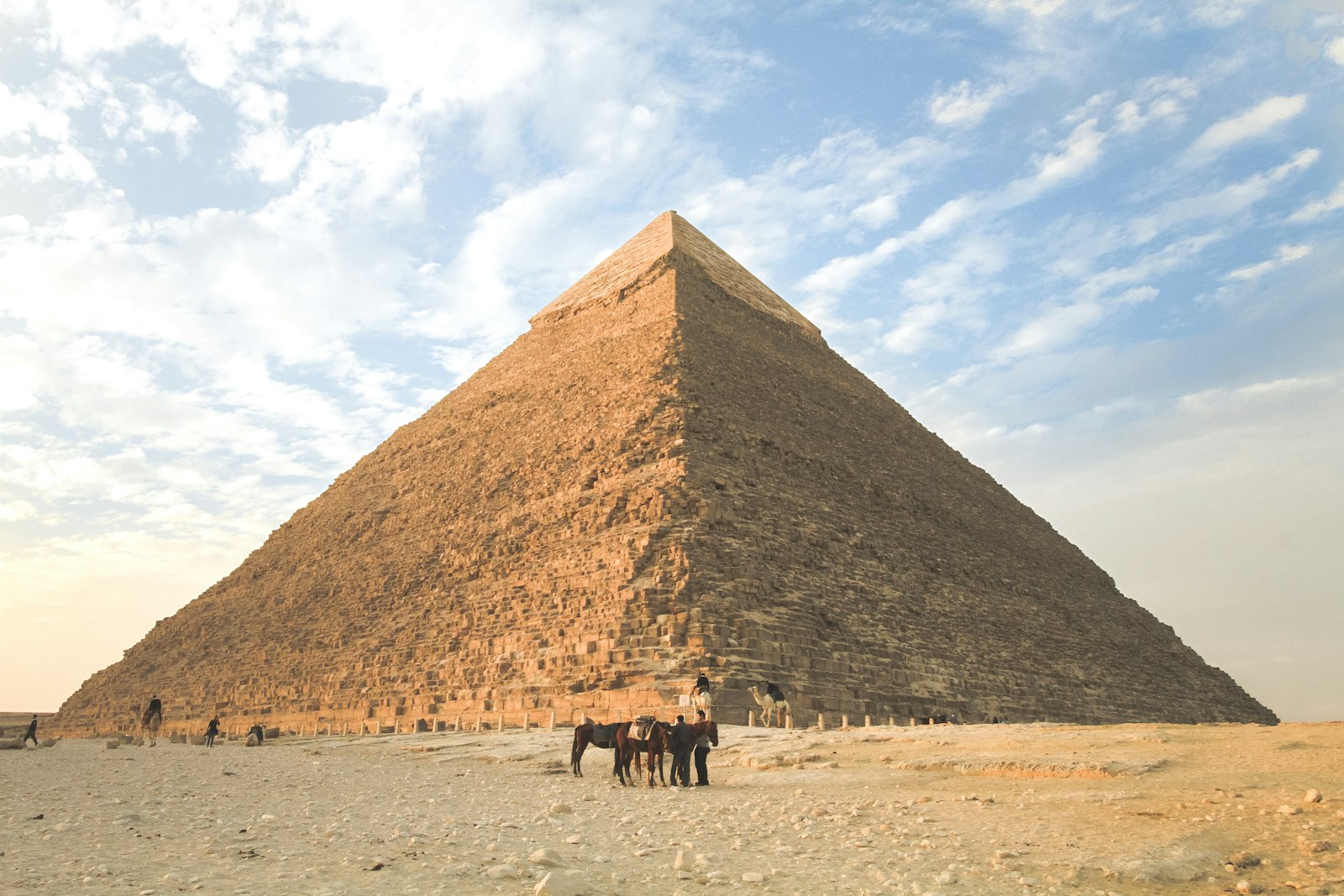
The Great Sphinx of Giza: the Eternal Sentinel of the Desert
The Great Sphinx of Giza is the oldest and largest monumental sculpture in the known world. At 73 metres long, 20 metres high and 19 metres wide, this colossal creature of stone — with the body of a lion and the head of a man — has watched silently over the Giza Plateau for more than 4,500 years. Its mysterious gaze, turned eastward toward the rising sun, has inspired wonder, reverence and endless speculation from the dawn of time to the present day.
Carved directly from a natural outcrop of limestone, the Sphinx was not built block by block like the pyramids, but hewn from the living rock of the plateau — a feat of engineering and sculpture unprecedented in the ancient world. Its original Egyptian name is unknown: the ancient Egyptians probably called it "Hor-em-akhet" (Horus on the Horizon), while the name "Sphinx" was given by the Greeks centuries later, associating it with the mythological creature of their own tradition.
History and Origins
Who Built the Sphinx?
The identity of the Great Sphinx's patron is one of the most debated questions in Egyptology. The prevailing theory, supported by the majority of scholars, attributes its creation to the pharaoh Khafre (Chephren) of the Fourth Dynasty, who reigned around 2558–2532 BC. This attribution rests on several converging elements: the position of the Sphinx within Khafre's funerary complex, its proximity to his Valley Temple, and the resemblance between the Sphinx's face and known statues of the pharaoh.
A minority of Egyptologists, however, have proposed alternative attributions. Some suggest the Sphinx was commissioned by Khufu (Cheops), the builder of the Great Pyramid, based on a controversial interpretation of the Inventory Stela, a late text that mentions the Sphinx in connection with Khufu. Others have proposed a far older dating, based on signs of water erosion on the walls of the enclosure, but these theories remain in the minority and are strongly contested in academic circles.
The Technique of Construction
The Sphinx was carved by exploiting a promontory of limestone that emerged naturally on the Giza Plateau. The builders began by digging a large U-shaped trench around the rocky outcrop, creating the profile of the lion's body. The rock extracted from the trench was probably used to build the temples adjacent to the Sphinx — an example of ingenious economy of materials.
The rock of the Giza Plateau is composed of several geological layers of varying hardness, which explains the uneven deterioration of the sculpture over the millennia. The Sphinx's head is carved from a harder, more compact layer of limestone, which is why it has been better preserved than the body, made of softer, more friable layers subject to greater erosion.
To protect and complete the surface, parts of the Sphinx were faced with additional blocks of limestone, particularly along the body and the paws. This facing, progressively lost over the centuries, has been the subject of numerous restorations in different eras, from ancient Egypt to the present day.
Description and Iconography
Anatomy of the Sphinx
The Great Sphinx has the crouching body of a lion — symbol of strength and royal power — with the forepaws stretched forward and the tail curled along the right flank. The head is that of a man wearing the nemes, the characteristic striped headdress of the Egyptian pharaohs, with a uraeus (the sacred cobra) on the brow, today almost entirely eroded.
The Sphinx's face, despite the damage suffered over the millennia, retains regal and serene features. The proportions of the head are significantly smaller than the body, an anomaly that has led some scholars to hypothesise that the head was re-carved in a later period, reducing its original size. This theory, though intriguing, is not universally accepted.
The Mystery of the Missing Nose
One of the most frequent questions about the Sphinx concerns its missing nose. Popular belief attributes responsibility to Napoleon Bonaparte's troops, who supposedly used the Sphinx as a target for artillery during the Egyptian campaign of 1798. However, this story is false: drawings and descriptions of the Sphinx predating the Napoleonic campaign clearly show that the nose was already absent.
The explanation most accredited by modern historiography dates back to the deed of Muhammad Sa'im al-Dahr, a 14th-century Sufi who, according to the historian al-Maqrizi, deliberately damaged the Sphinx's nose in protest against the idolatrous practices of Egyptian peasants who brought offerings to the statue to secure good harvests. Al-Dahr was subsequently executed for this act of vandalism.
Another possibility is that the nose deteriorated naturally over the millennia due to erosion, weathering and the intrinsic fragility of the limestone at that specific point. Traces of stone wedges found in the nose, however, suggest a deliberate act of removal, confirming the hypothesis of intentional vandalism.
The Nemes and the Uraeus
The nemes, the striped headdress worn by the Sphinx, is one of the most recognisable symbols of Egyptian royalty. This cloth, generally striped in blue and gold, fell at the sides of the face and formed a broad tail at the nape. On the Sphinx's brow there was originally a uraeus, the sacred cobra protector of royalty, of which only the cavity in the rock remains today. These iconographic elements confirm that the Sphinx represented a deified pharaoh, probably in his identification with the solar god Horus.
The Dream Stela
The Legend of Prince Thutmose
Between the Sphinx's forepaws stands the celebrated Dream Stela (or Stela of Thutmose IV), a slab of pink granite about 3.6 metres high erected around 1401 BC by the pharaoh Thutmose IV of the Eighteenth Dynasty. The inscription on the stela narrates a pivotal episode in the history of the Sphinx and the Egyptian monarchy.
According to the account, the young prince Thutmose, after a hunt in the desert, fell asleep in the shade of the Sphinx, which at that time was buried up to its shoulders in desert sand. In a dream, the Sphinx appeared to him in the guise of the god Horemakhet-Khepri-Ra-Atum and promised him the throne of Egypt if he freed its body from the sand that smothered it.
The prince kept his promise, had the Sphinx cleared of sand and, according to legend, did indeed become pharaoh as Thutmose IV. The Dream Stela was erected to commemorate this event and to legitimise his claim to the throne — particularly important since Thutmose was not the firstborn of his predecessor.
Historical Significance of the Stela
Beyond its narrative content, the Dream Stela is a historical document of enormous importance. It demonstrates that already by 1400 BC — more than a thousand years after its construction — the Sphinx was half-buried in sand and required maintenance. Moreover, it confirms that in the New Kingdom the Sphinx was venerated as a manifestation of the solar god, a cult that continued for centuries.
The inscription also contains a partially legible mention that many scholars interpret as "Khaf...", potentially a reference to Khafre as builder of the Sphinx. Although this reading is contested, it represents one of the most significant clues for the attribution of the Sphinx to Khafre.
Restorations and Conservation
Restorations in Antiquity
The Sphinx has required restoration work since antiquity. In addition to the restoration of Thutmose IV described on the Dream Stela, the Roman emperors added limestone blocks to the paws and chest to compensate for erosion. During the Roman period, the Sphinx was an important place of pilgrimage and worship, and altars and votive stelae have been found in the surrounding areas.
Modern Restorations
In the 20th and 21st centuries, the Sphinx has been the subject of numerous restoration campaigns, not always successful. In the 1980s, an attempt at restoration using modern cement caused more harm than good, as the cement trapped moisture in the rock and accelerated its deterioration. Subsequent restorations, carried out with techniques more respectful of the original material, used blocks of limestone similar to that of the Sphinx, integrating them with traditional methods.
Today the Sphinx is constantly monitored by a team of Egyptian restorers who intervene to limit the damage caused by wind erosion, atmospheric pollution from the nearby city of Cairo, and the rising water table, which carries mineral salts into the rock causing it to disintegrate.
Contemporary Threats
The main threats to the conservation of the Sphinx today are environmental. The atmospheric pollution produced by the megalopolis of Cairo, with its millions of cars and factories, accelerates the chemical erosion of the limestone. The rise of the water table, caused by agricultural irrigation and urban growth, brings moisture and salts to the base of the Sphinx. Mass tourism also represents a challenge, with the vibrations produced by heavy vehicles and the effects of the CO2 exhaled by millions of annual visitors.
The Unsolved Mysteries
The Secret Chambers
For centuries, legends have circulated about the existence of secret chambers beneath or inside the Sphinx. In 1991, the geologist Robert Schoch and the researcher John Anthony West conducted seismic studies that suggested the presence of cavities beneath the Sphinx. A subsequent survey by the University of Cairo using ground-penetrating radar identified anomalies beneath the forepaws and at the sides of the body, compatible with the presence of tunnels or chambers.
In 1998, Zahi Hawass, then director of the Supreme Council of Antiquities, explored a small tunnel behind the Sphinx's head and another beneath the body, finding both to be of natural origin or the result of earlier explorations. The question nevertheless remains open and continues to fuel both scientific research and the most fanciful speculation.
The Water Erosion Theory
One of the most controversial theories regarding the Sphinx is that proposed by Robert Schoch in the 1990s, according to which the vertical erosion marks on the walls of the Sphinx enclosure were caused by heavy rainfall, suggesting a dating far older than that commonly accepted, perhaps going back to the eighth or seventh millennium BC. This theory, though compelling, has been rejected by the majority of Egyptologists, who attribute the erosion to a combination of factors including underground moisture, wind erosion and cycles of salt crystallisation.
Tips for the Visit
How to Reach the Sphinx
The Sphinx stands in the eastern part of the Giza Plateau, at the foot of the pyramid complex. The most convenient access is the lower entrance near the village of Nazlet el-Simman, which leads directly to the area of the Sphinx and the Valley Temple. Alternatively, the Sphinx can be reached from the main entrance of the plateau, travelling on foot or by electric cart along the route from the pyramids.
The Ideal Moment
The best time to admire the Sphinx is early in the morning, when the light of the rising sun directly illuminates the statue's face — the very sun it was designed to greet. At that hour the crowds are smaller and the light is ideal for photographs. Avoid the central hours of the day, when the sun is at its zenith and temperatures can exceed 40°C in summer.
The Sound and Light Show
Every evening the Sphinx becomes the protagonist of the Sound and Light Show, during which luminous projections and a dramatic narration recount the history of the Giza Plateau. The show, available in several languages including Italian, offers a unique experience: to see the Sphinx illuminated in the darkness of the desert, with the pyramids in the background, is an unforgettable memory.
Practical Suggestions
Bring a good camera with a wide-angle lens to capture the entire Sphinx with the pyramids in the background. The most iconic photo spot is slightly to the south-east of the Sphinx, where you can frame the profile of the statue with the Pyramid of Khafre behind. Beware of street vendors and unauthorised "guides" who offer to lead you to panoramic spots in exchange for tips: find your way independently by following the official signage.
Facts about the Great Sphinx
The Sphinx was originally painted in vivid colours: the face was probably red, the nemes striped in blue and gold, and the body ochre. Traces of pigment have been found behind the ear and on the neck of the statue. For centuries, the Sphinx was buried in sand up to its shoulders or even up to its neck: it was finally freed only in 1936, after eleven years of excavation directed by the French archaeologist Émile Baraize. The Sphinx's ceremonial beard, today in fragments divided between the Egyptian Museum in Cairo and the British Museum in London, was probably added in a period later than the original construction.