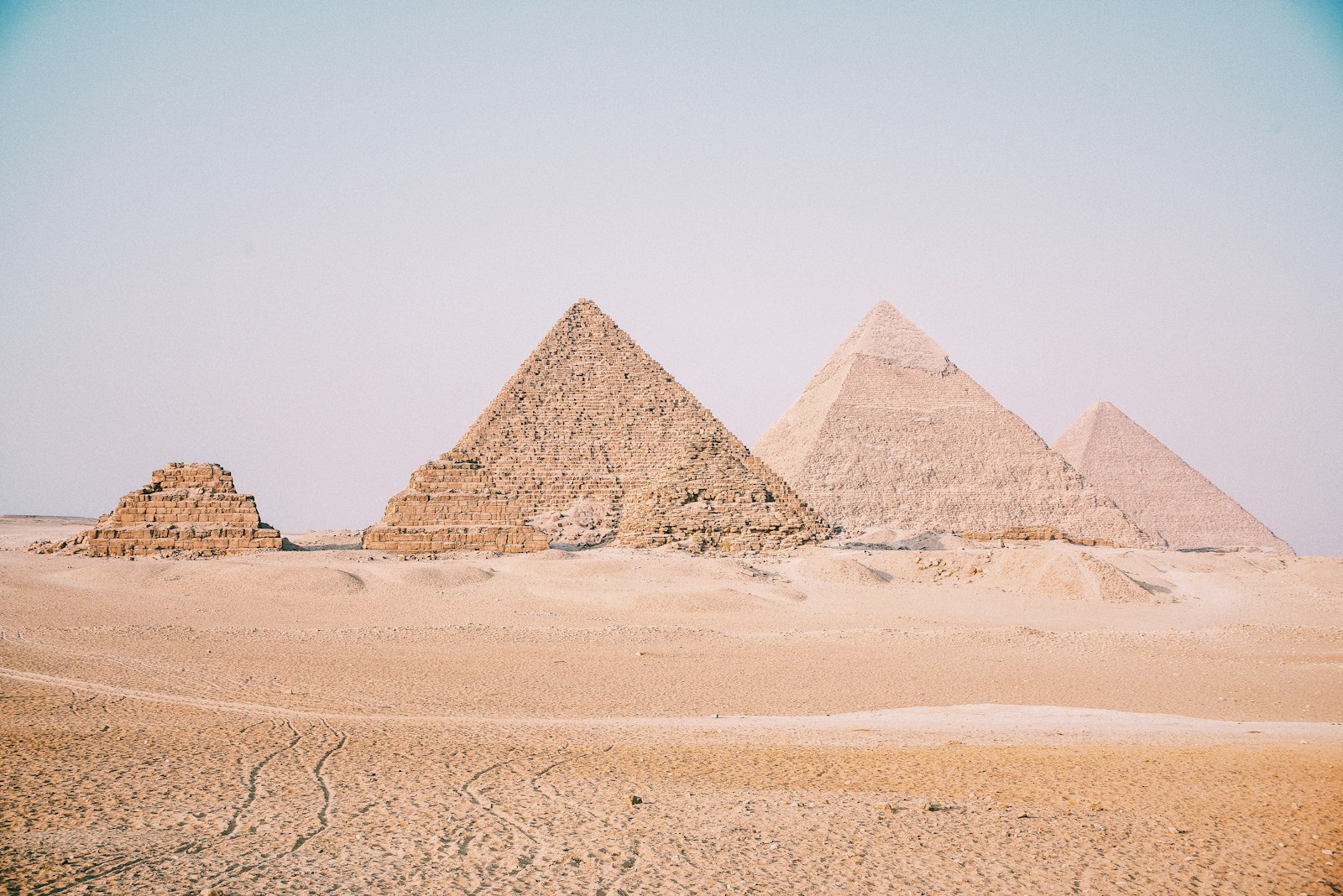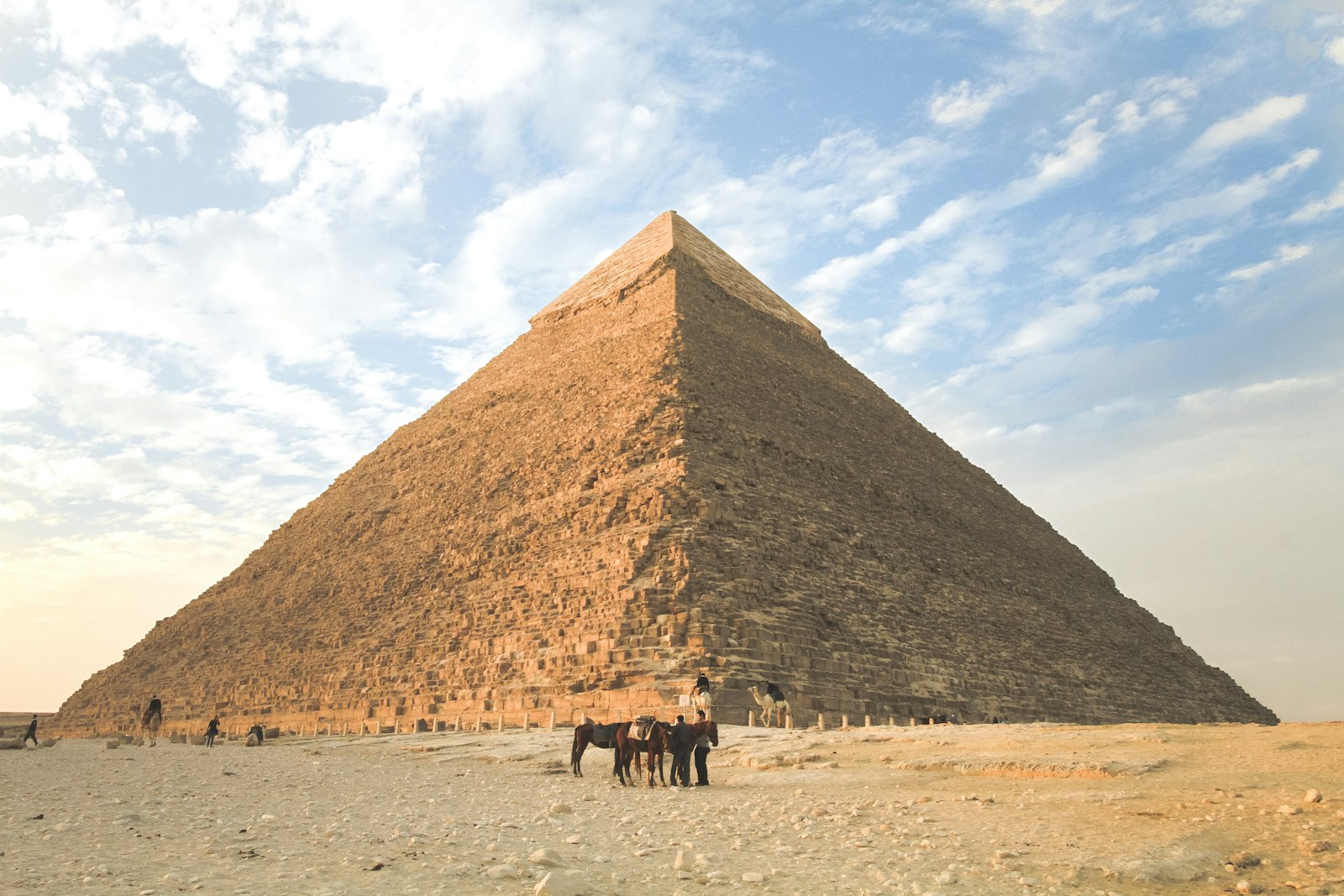
The Red Pyramid: the First True Pyramid of Ancient Egypt
The Red Pyramid, also known as the North Pyramid of Dahshur, represents a milestone in the history of world architecture. Located in the necropolis of Dahshur, about 40 kilometres south of Cairo, this imposing structure is universally recognised as the first smooth-faced pyramid successfully completed in the history of ancient Egypt. Built by the pharaoh Sneferu, founder of the 4th dynasty, around 2590 BC, the Red Pyramid is the third largest pyramid in Egypt after those of Khufu and Khafre at Giza, and its name derives from the characteristic reddish colour of the local limestone blocks that constitute its core.
Sneferu was probably the most prolific builder of pyramids in the entire Egyptian history. Before the Red Pyramid, he had already commissioned the construction of the Pyramid of Meidum and the Bent Pyramid, both considered architectural experiments that presented structural problems. The Red Pyramid represents the culmination of these efforts: the final solution that would establish the model for all the subsequent pyramids, including the famous pyramids of Giza.
History and Construction
The Ambitious Project of Sneferu
The pharaoh Sneferu reigned for about 24 years during the first half of the 26th century BC and invested immense resources in the construction of funerary monuments. The lessons learned from the structural problems of the Bent Pyramid, whose angle had to be modified during construction to avoid collapse, were fundamental for the project of the Red Pyramid. This time, the angle of inclination was calculated from the beginning: 43 degrees and 22 minutes, the same angle as the upper section of the Bent Pyramid, thus guaranteeing structural stability along the entire height of the construction.
The construction work lasted for about 17 years, as testified by the inscriptions in red ochre left by the workers on many blocks of stone. These inscriptions, which include dates referring to the years of Sneferu's reign, have allowed Egyptologists to reconstruct with remarkable precision the chronology of the construction, from the foundations to the summit. The data suggest that the pace of work was sustained but constant, with an average of about half a metre of height added every week.
Dimensional Characteristics
The Red Pyramid impresses for its monumental dimensions. The base is a square with sides of 220 metres, while the original height reached 105 metres, today reduced to about 104 metres. The overall volume is about 1.69 million cubic metres, making it the third largest pyramid ever built. The relatively gentle inclination of the faces, at 43 degrees compared to the 51 degrees of the Great Pyramid of Khufu, gives the structure a lower and more elongated profile that distinguishes it visually from the pyramids of Giza.
The name "Red Pyramid" derives from the colour of the local limestone blocks used for the core of the structure. Originally, the pyramid was clad with blocks of white Tura limestone, which gave it a brilliant appearance similar to that of the other great pyramids. Much of this cladding was removed in the Middle Ages to be reused in the construction of buildings in Cairo. At the base of the eastern facade some blocks of the original cladding are still visible, which allow one to imagine the magnificent appearance of the pyramid in its complete form.
The Pyramidion
One of the most significant elements found at the Red Pyramid is its pyramidion, the pyramidal stone that crowned the summit of the structure. Partially reconstructed from the fragments found at the base of the pyramid, this pyramidion is today exhibited at the entrance of the site and is one of the few original surviving examples. Made of limestone, it shows traces of a red colouring and confirms the dimensions and the angle of inclination of the pyramid.
Internal Structure
The Entrance and the Descent
The entrance to the Red Pyramid is on the north facade, at about 28 metres in height from ground level. A long descending corridor, about 63 metres long and inclined at 27 degrees, leads from the point of entrance towards the heart of the pyramid. The descent takes place through a relatively narrow passage, equipped today with a metal staircase to facilitate the route of the visitors. The experience is intense and evocative: as one descends, the temperature changes, the air becomes different and the silence of the monument envelops the visitor.
The First Chamber
At the end of the descending corridor one accesses the first chamber, situated at ground level. This room, oriented in a southerly direction, presents a magnificent ceiling of projecting corbels that rises for about 12 metres, creating an effect of false vault of extraordinary elegance. The construction technique, based on the overlapping of layers of progressively projecting blocks, is the same used in the Grand Gallery of the Pyramid of Khufu, confirming that the Red Pyramid served as an architectural laboratory for the subsequent constructions.
The Second Chamber
A short passage at floor level connects the first chamber to the second, which has dimensions and structure very similar to the first. This chamber too presents a corbelled ceiling of 12 metres, oriented in the same direction. The symmetry between the two chambers suggests a precise architectural planning and probably a symbolic meaning linked to duality, a fundamental concept in Egyptian cosmology.
The Burial Chamber
From the second chamber, a short ascending corridor reaches the main burial chamber, situated at a higher level, within the body of the pyramid itself. This chamber, also equipped with a high corbelled ceiling, is the most evocative environment of the entire structure. Despite thorough research, remains of the original burial of Sneferu have never been found in this chamber. Fragments of mummy found in the pyramid have been analysed, but it has not been possible to attribute them with certainty to the pharaoh.
The Context of Dahshur
The Royal Necropolis
Dahshur was one of the most important royal necropolises of the Old Kingdom and the Middle Kingdom. In addition to the Red Pyramid and the Bent Pyramid of Sneferu, the site hosts pyramids of sovereigns of the Middle Kingdom such as Amenemhat II, Senusret III and Amenemhat III. For centuries, Dahshur was a military zone closed to the public, opened to visitors only in 1996. This circumstance has preserved the site from mass tourism and from the damage that has struck other more accessible monuments.
The Historical Importance
The Red Pyramid is not only a funerary monument, but a fundamental document in the history of engineering. It demonstrates how the ancient Egyptians were capable of learning from their own errors and of progressively perfecting their construction techniques. The passage from the step pyramid to the smooth-faced pyramid was not a linear evolution, but a process characterised by experiments, failures and innovative solutions. The Red Pyramid represents the moment in which all these elements converge in a fully successful project.
The Experience of the Visit
Entering the Pyramid
One of the most extraordinary characteristics of the Red Pyramid is the possibility of visiting its interior without the long queues and the restrictions that characterise the Great Pyramid of Giza. Access to the interior is included in the entrance ticket to the site of Dahshur, and the number of visitors is generally much lower than at Giza. This allows one to live a more intimate and contemplative experience, immersed in the millennial silence of the structure.
The descent along the entrance corridor requires a certain physical form: the passage is low and inclined, and one must proceed bent over for several minutes. The characteristic odour of ammonia, due to the presence of bat guano accumulated over the centuries, is intense but generally tolerable. Once the internal chambers are reached, the effort is amply rewarded by the majesty of the spaces and by the unique sensation of finding oneself inside one of the most ancient great structures built by man.
Unique Atmosphere
Unlike Giza, where the urban context and the crowd can compromise the experience, Dahshur offers a practically uncontaminated desert landscape. The Red Pyramid rises solitary in the desert, with the silhouette of the Bent Pyramid visible in the distance. This atmosphere of isolation allows the visitor to perceive the original dimension of the monument, its relationship with the surrounding landscape and the powerful visual impact that it must have had when its white cladding shone under the sun.
Practical Tips for the Visit
How to Get There
Dahshur is located about 40 kilometres south of Cairo. The most practical way to reach it is to hire a car with a driver or a taxi for the entire day, combining the visit with that of the nearby Saqqara and of Memphis. Some organised tours include Dahshur in the itinerary, but most standard tours limit themselves to Giza and Saqqara. It is advisable to arrive at the opening of the site to enjoy the milder temperatures and the maximum tranquillity.
What to Bring
The visit to the Red Pyramid requires adequate preparation. Wear closed shoes with good grip for the descent and the ascent of the internal corridor. Bring with you abundant water, since at the site there are no refreshment points. A torch is useful to illuminate the details of the internal chambers. If you intend to enter the pyramid, dress in layers: the exterior can be very hot, but the interior is notably cooler.
Combining the Visits
An ideal day at Dahshur can include the visit to the Red Pyramid in the morning, followed by the Bent Pyramid and then by a transfer to Saqqara to visit the Step Pyramid of Djoser and the Serapeum. This itinerary allows one to retrace the evolution of pyramidal architecture from the origins to its classic form, offering a deep understanding of the constructive genius of the ancient Egyptians.
The Red Pyramid of Dahshur is a treasure often overlooked by the traditional tourist circuits, but it represents an unmissable experience for anyone who wishes to truly understand the history of the Egyptian pyramids. Its historical importance, the possibility of freely exploring its interior and the magical atmosphere of the desert of Dahshur make it one of the most rewarding destinations of the entire Egypt.