Luxor Temple: a Monumental Jewel on the Bank of the Nile
Luxor Temple is one of the most spectacular and best-preserved monuments of ancient Egypt. Located in the heart of the modern city of Luxor, on the eastern bank of the Nile, this majestic temple dominates the urban landscape with its imposing columns, massive pylons and colossal statues. Unlike most Egyptian temples dedicated to a specific deity, Luxor Temple was consecrated to the renewal of kingship and to the cult of the royal Ka, the divine vital principle that legitimised the power of the pharaoh.
Known to the ancient Egyptians as Ipet Resyt, that is "the southern harem", the temple represented the southern complement of the great complex of Karnak, to which it was connected by the celebrated Avenue of the Sphinxes, a processional way about 2.7 kilometres long. Every year, during the grandiose Festival of Opet, the sacred statues of Amun, Mut and Khonsu were carried in procession from Karnak to Luxor along this sacred avenue, in a ceremony that renewed the divine power of the pharaoh before the entire people.
History and Construction
The Origins under Amenhotep III
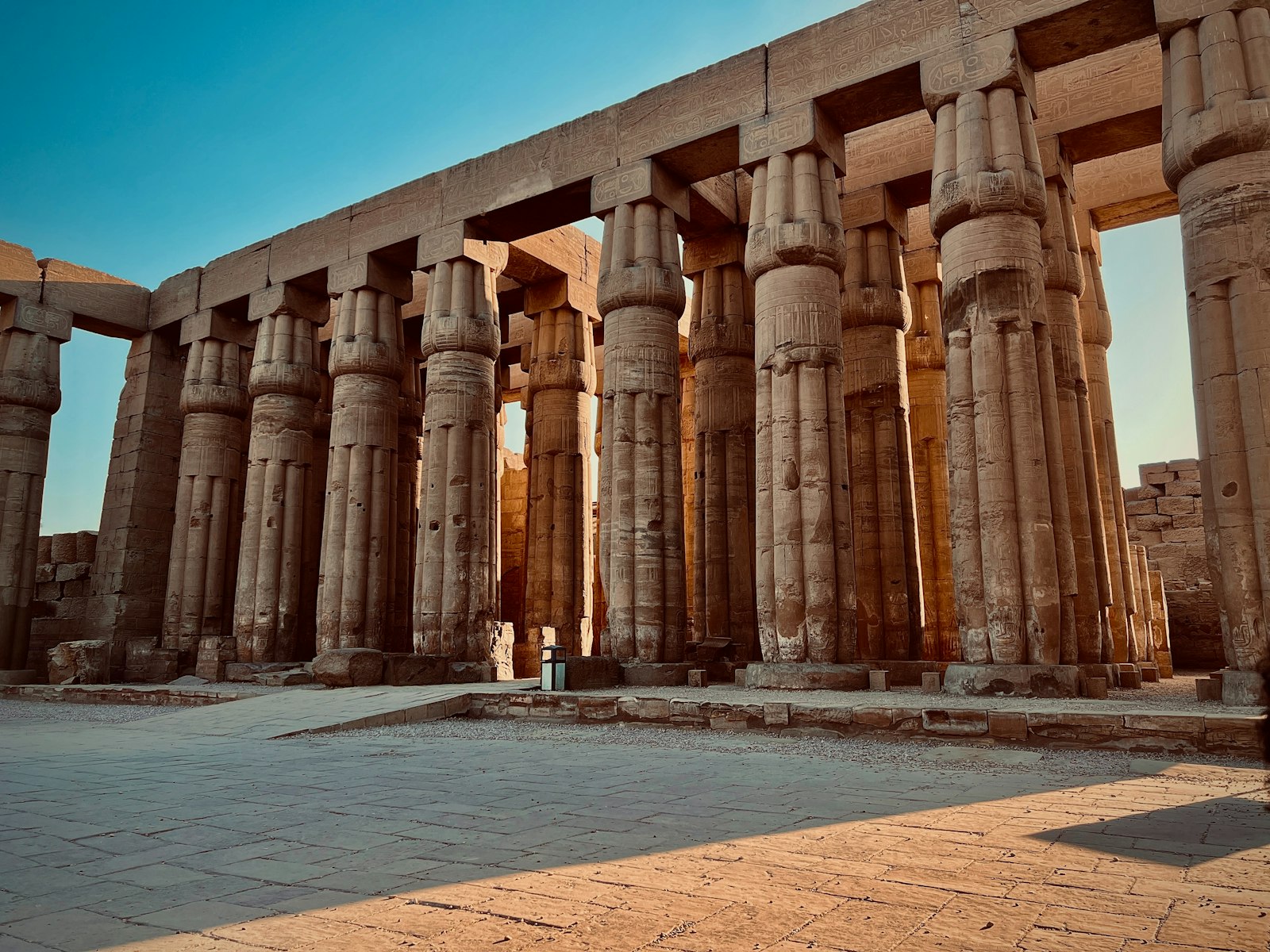
The construction of Luxor Temple was begun by the pharaoh Amenhotep III of the 18th Dynasty, around 1380 BC, during one of the periods of greatest prosperity and artistic splendour of ancient Egypt. Amenhotep III, known for his passion for monumental architecture, entrusted the design of the temple to his trusted architect, and the result was a masterpiece of elegance and harmony. The original part comprised the inner sanctuary, the offering hall, the hall of the sacred barque, the colonnaded vestibule and the magnificent court with its double colonnade of bundled papyrus columns.
The stylistic refinement of the portions built under Amenhotep III is immediately recognisable: the proportions are balanced, the decorations delicate and the columns achieve an elegance that represents the pinnacle of Egyptian temple art. The court of Amenhotep III, surrounded by a double order of columns with closed-papyrus capitals, is considered one of the most harmonious architectural spaces of all ancient Egypt.
The Additions of Ramesses II
About a century later, the pharaoh Ramesses II of the 19th Dynasty added to the temple a vast court, an imposing entrance pylon and numerous colossal statues. The style of Ramesses II was decidedly more massive and propagandistic than that of his predecessor: the new court was surrounded by a double colonnade and adorned with gigantic statues of the pharaoh standing and seated. In front of the pylon, Ramesses II had six colossal statues of himself erected (four seated and two standing) and two obelisks of pink Aswan granite.
The first pylon, about 24 metres high, was decorated with scenes of the Battle of Kadesh against the Hittites, one of the most celebrated military events in Egyptian history. The reliefs describe in great detail the phases of the clash, the charge of the war chariots and the supposed personal heroism of Ramesses II.
The Obelisk and Its Twin in Paris
Of the two obelisks originally erected by Ramesses II in front of the entrance pylon, only one is still in situ. The second obelisk was given to France in 1829 by the viceroy of Egypt Muhammad Ali Pasha and was transferred to Paris, where it was raised at the centre of the Place de la Concorde in 1836. About 23 metres high and weighing over 250 tonnes, the Parisian obelisk is today one of the most famous monuments of the French capital, a symbolic bridge between Egyptian civilisation and modern Europe. The obelisk that remained at Luxor, perfectly preserved, still bears hieroglyphic inscriptions celebrating the victories of Ramesses II.
The Great Processional Colonnade
An Architectural Masterpiece
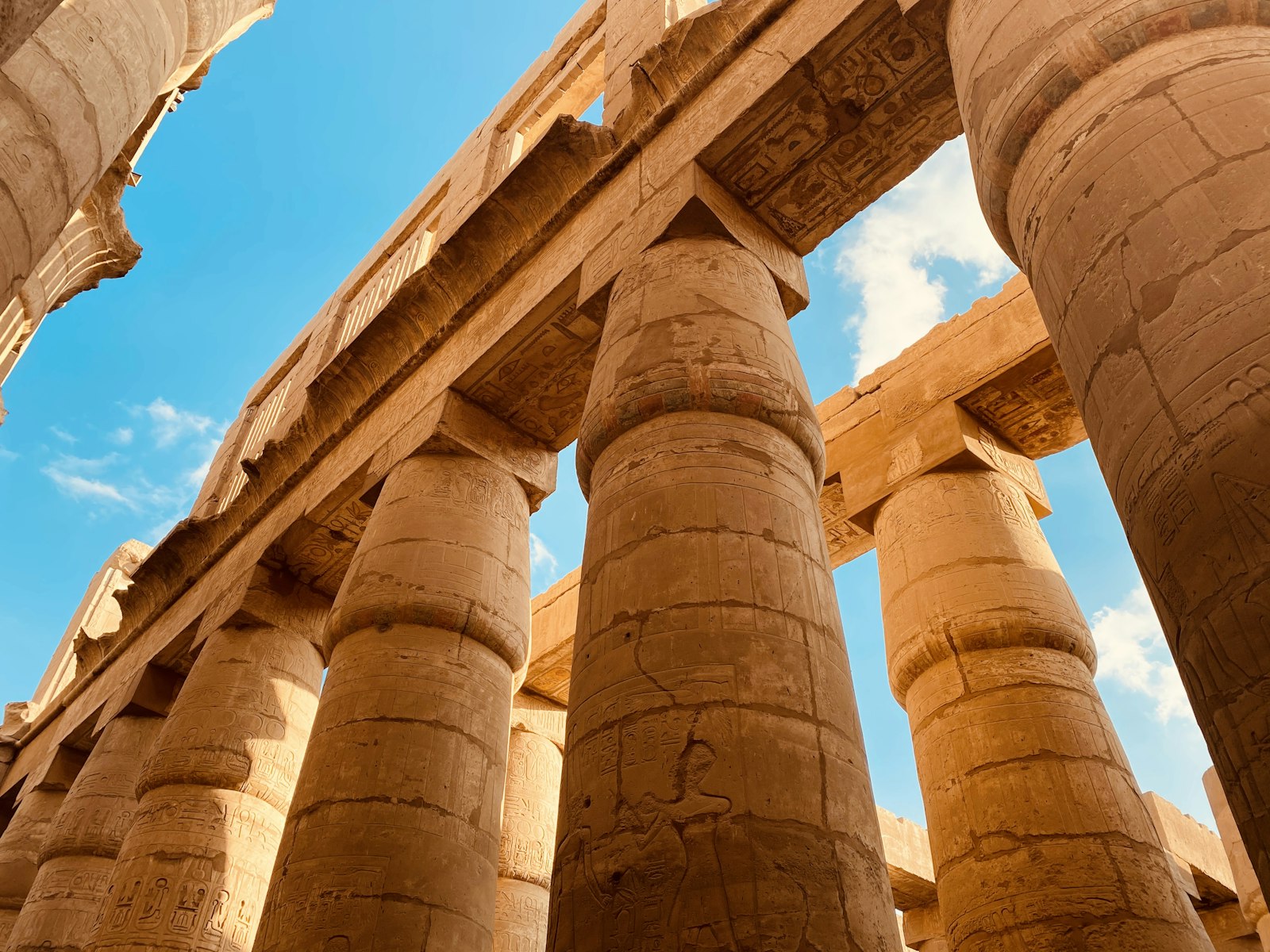
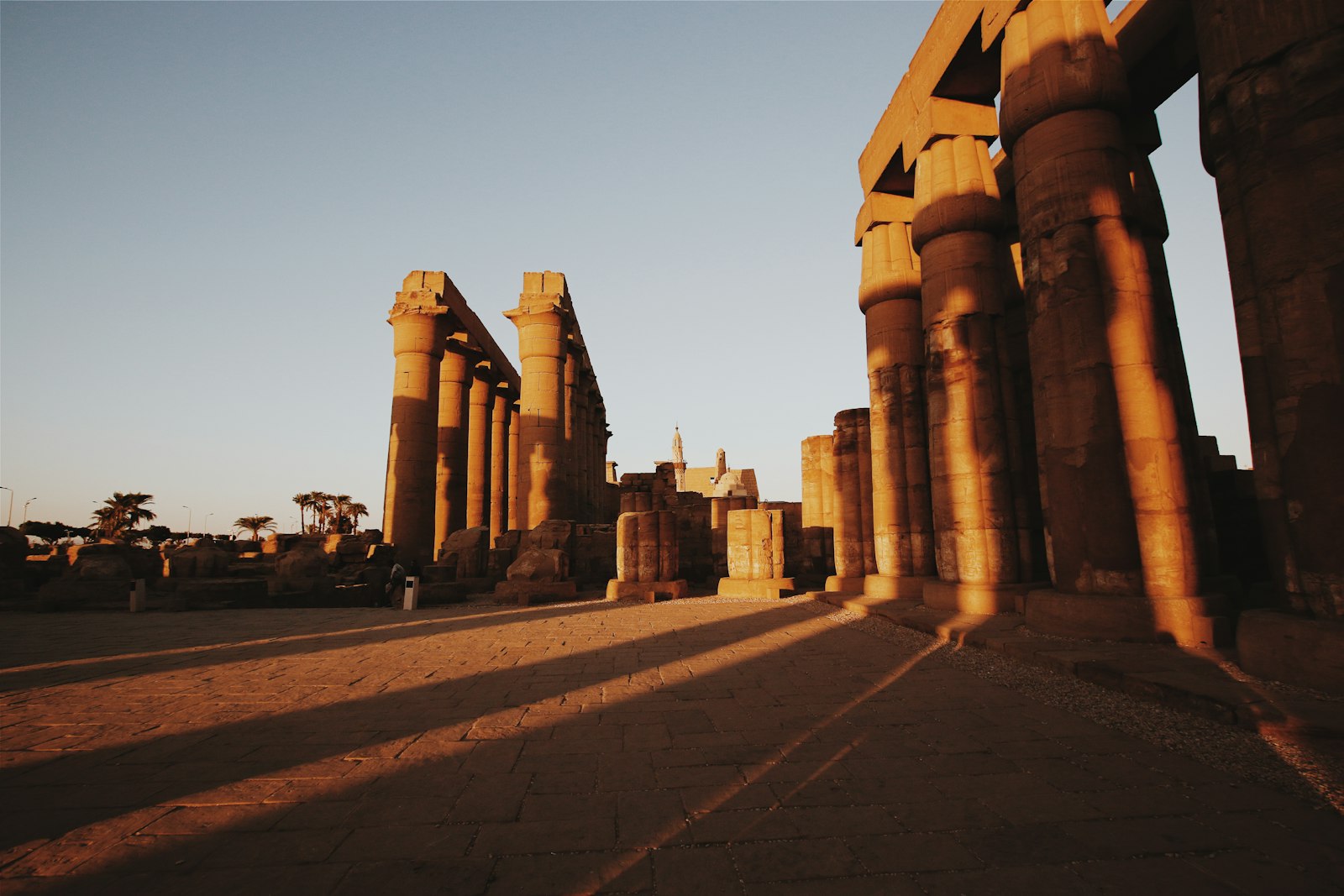
Between the court of Ramesses II and that of Amenhotep III extends the Great Processional Colonnade, one of the most evocative elements of the temple. Fourteen papyrus columns about 16 metres high flank the central corridor, creating a scenographic effect of extraordinary power. The lateral walls of the colonnade are decorated with scenes of the Festival of Opet, illustrating the procession of the sacred barques along the Nile from Karnak to Luxor, the offering rituals, the dances and the celebrations of the people.
These reliefs are of inestimable value for understanding the religious ceremonies of ancient Egypt, since they provide a detailed visual record of one of the most important rituals of the Egyptian liturgical calendar. The scenes show the priests carrying the sacred barques on their shoulders, the musicians playing instruments, the dancers performing and the crowd taking part in the festival with joy and devotion.
The Mosque of Abu el-Haggag
A Millennial Place of Worship
One of the most fascinating aspects of Luxor Temple is the presence, in the upper part of the court of Ramesses II, of the Mosque of Abu el-Haggag, an Islamic place of worship built in the 13th century when the temple was largely buried under the sands and rubble accumulated over the centuries. The mosque, dedicated to Sheikh Yusuf Abu el-Haggag, the venerated patron saint of Luxor, is an extraordinary example of the religious and cultural stratification that characterises many archaeological sites of the Middle East.
When archaeologists began to excavate the temple in the 19th century, the mosque was already an active place of worship deeply rooted in the local community. For this reason, it was preserved and today stands in an apparently incongruous position, with its entrance located several metres above the level of the temple floor, a visual testimony to how many layers of history have accumulated in this place.
The Illuminated Temple: the Night Spectacle
An Unforgettable Experience
Luxor Temple is also open during the evening hours, and the night visit is an absolutely unmissable experience. A sophisticated lighting system highlights the architectural and sculptural details of the temple, creating plays of light and shadow that give the monument a magical and surreal atmosphere. The giant columns, the colossal statues and the reliefs on the walls emerge from the darkness with a drama that daylight cannot equal.
The night-time lighting completely transforms the perception of the temple: the warm colours of the lights enhance the golden tones of the sandstone, while the deep shadows accentuate the depth of the reliefs and the majesty of the proportions. Strolling among the columns of the Great Colonnade at night, with the silence broken only by the distant sound of the city, is an experience that remains imprinted in the memory of every visitor.
Recent Archaeological Discoveries
The Cachette of the Temple
In 1989, during restoration work, a cachette (votive deposit) was accidentally discovered beneath the floor of the court of Amenhotep III, containing twenty-six statues in exceptional condition of preservation. Among these stand out a magnificent diorite statue of the god Amun and a statue of Amenhotep III in red quartzite, today on display at the Luxor Museum. This discovery was one of the most important of the 20th century in the field of Egyptology and has enormously enriched our understanding of the sculptural art of the New Kingdom.
The Roman Remains
During the Roman period, the temple underwent significant alterations. The inner sanctuary was transformed into a chapel dedicated to the imperial cult, and the walls were covered with painted plaster bearing scenes of imperial propaganda. Some of these Roman frescoes are still visible and represent an interesting testimony to the coexistence of Egyptian tradition and Roman rule.
Tips for the Visit
How to Get There
Luxor Temple is in the centre of the city, on the Corniche el-Nil, the main road running along the Nile. It is easily reached on foot from any hotel in the centre, or by horse-drawn carriage, taxi or minibus. The main entrance is on the western façade, facing the square that precedes the temple.
Opening Hours and Tickets
The temple is open every day from 6:00 to 21:00, an extended schedule that allows you to enjoy both the daytime and the night-time visit. The entrance ticket can be purchased at the temple ticket office or online. It is advisable to visit the temple in the late afternoon to enjoy the transition from daylight to the artificial evening lighting.
Practical Suggestions
Wear comfortable shoes and bring plenty of water, especially during the summer months when temperatures can exceed 40°C. A local guide or an audio guide will greatly enrich the experience, helping you to understand the meaning of the scenes carved on the walls. For photography, the best moment is the golden hour before sunset, when the warm light enhances the golden tones of the sandstone.
Combining the Visit
Luxor Temple combines perfectly with a visit to the nearby Luxor Museum and a walk along the Avenue of the Sphinxes towards the Temple of Karnak. For a full day exploring the eastern bank, it is advisable to start from the Temple of Karnak in the morning, walk along the Avenue of the Sphinxes and conclude with Luxor Temple at sunset, then enjoy the spectacle of the night-time illumination.
Did You Know? Facts about Luxor Temple
The temple was used as a place of worship for over 3,000 consecutive years, from its foundation in the 14th century BC to the Islamic era, a record of religious continuity almost unique in the history of humanity. Alexander the Great visited the temple and had the sanctuary of the sacred barque restored, adding his own images beside those of the Egyptian pharaohs. In the following centuries, the temple was used as a Roman military camp, as a Christian church and finally as the seat of the mosque of Abu el-Haggag, in a palimpsest of faiths and cultures that makes this place unique in the world.
To visit Luxor Temple means to immerse oneself in a place where the history of humanity has been layered for millennia, a monument that continues to speak through its stones and its reliefs, telling stories of pharaohs, gods and peoples who shaped civilisation as we know it today.