The Sacred Lake of Karnak: the Primordial Waters in the Heart of the Temple
The Sacred Lake of Karnak represents one of the most fascinating and symbolically significant elements of the entire Karnak temple complex in Luxor. This vast rectangular basin, located between the seventh pylon and the temple of Amun-Ra, was not simply a reserve of water, but a most powerful cosmological symbol that embodied the primordial waters of Nun, the chaotic ocean from which, according to Egyptian mythology, emerged the creation itself of the universe.
With its imposing dimensions of 120 metres in length by 77 metres in width, the Sacred Lake is the largest ritual basin ever built in ancient Egypt. Its waters, which still today partially fill the basin thanks to the water table, served for the daily purifications of the priests who officiated in the temple of Amun-Ra, the supreme god of the Theban pantheon.
History and Construction of the Sacred Lake
The Origins of the Ritual Basin
The construction of the Sacred Lake dates mainly to the period of Thutmose III, the great warrior pharaoh of the 18th dynasty who reigned from about 1479 to 1425 BC. However, it is probable that a smaller sacred basin already existed in an earlier era, perhaps since the Middle Kingdom, when the Karnak complex began its transformation from a modest local sanctuary to a grandiose national religious centre.
Thutmose III had the lake enlarged and monumentalised, lining the banks with accurately squared blocks of limestone and creating the wide staircases that allowed the priests to descend towards the water to perform the ritual ablutions. The stone walls of the basin were designed not only to contain the waters, but also to maintain a constant connection with the underlying water table, ensuring that the lake was always fed.
The Evolution over the Centuries
Over the centuries, several pharaohs contributed to the embellishment and maintenance of the Sacred Lake. Amenhotep III, the great builder of the 18th dynasty, added the famous statue of the giant scarab that still today dominates the north-western corner of the basin. The pharaohs of the 19th and 20th dynasties kept in function the system of underground canals that connected the lake to the Nile, ensuring the continuous renewal of the sacred waters.
During the Ptolemaic and Roman period, the Sacred Lake continued to perform its ritual function, although with modifications to the liturgical practices that reflected the evolution of the Egyptian religion. With the advent of Christianity in Egypt and the definitive closure of the pagan temples in the 4th-5th century AD, the lake fell progressively into disuse and into a state of abandonment, filling partially with sand and debris.
The Cosmological Meaning
Nun: the Primordial Waters
To understand the meaning of the Sacred Lake it is necessary to immerse oneself in Egyptian cosmogony. According to the theology of Thebes, before creation there existed only Nun, an infinite, dark and chaotic ocean that contained in itself all the potentialities of being. From these waters emerged the primordial hill, the Benben, on which the creator god Atum-Ra generated the world.
The Sacred Lake was the earthly representation of Nun within the temple. Every morning, when the priests descended the staircases to immerse themselves in its waters before accessing the sancta sanctorum, they symbolically repeated the act of creation. The purification in the waters of the lake was a return to the origins, a symbolic dissolution of impurity followed by a spiritual rebirth. This ritual was performed four times a day by the priests before every liturgical service.
The Cycle of Rebirth
The lake also embodied the concept of rebirth and regeneration that permeated every aspect of the Egyptian religion. As the sun set every evening in the ocean of Nun to be reborn at dawn renewed, so the priests immersed themselves in the sacred waters to emerge purified and spiritually reborn. This connection between the waters of the lake and the solar cycle explains why the basin was oriented along an east-west axis, following the apparent path of the sun in the sky.
The sacred geese that were raised in a special enclosure along the banks of the lake represented a further cosmological symbol. The goose was associated with the god Amun in his form of the Great Cackler, the being whose cry had broken the primordial silence, giving start to creation. The presence of these sacred animals transformed the Sacred Lake into a living microcosm of the moment of creation.
The Giant Scarab of Amenhotep III
A Symbol of Rebirth
The most famous element of the Sacred Lake is without doubt the great statue of the scarab in pink granite, placed on a high pedestal in the north-western corner of the basin. This monolith, dedicated by Amenhotep III to the god Khepri, the morning form of the sun represented as a scarab, has become one of the most photographed symbols of the entire Karnak complex.
The scarab, in Egyptian symbology, represented rebirth and transformation. As the dung beetle rolls its little ball of dung (which the ancient Egyptians associated with the solar disc that crosses the sky), so the god Khepri pushed the rising sun beyond the horizon every morning. The placement of this statue at the Sacred Lake created a powerful symbolic connection between the primordial waters of Nun and the daily rebirth of the sun.
Modern Traditions and Legends
A modern popular belief, devoid of historical foundation but having become an integral part of the tourist experience, holds that whoever walks three times around the scarab in an anticlockwise direction will see a wish granted, in particular linked to fertility and luck in love. This tradition, probably born in the 20th century, attracts every day hundreds of visitors who perform the circular ritual around the statue, creating a lively and participated atmosphere in this area of the temple. Although it has no basis in the ancient Egyptian religion, this custom testifies to the evocative power that the monuments of ancient Egypt continue to exercise on the collective imagination.
The Enclosure of the Sacred Geese
Along the southern bank of the Sacred Lake was the enclosure of the sacred geese, one of the most curious and least known elements of the Karnak complex. The geese, considered animals sacred to Amun, were raised and cared for by the priests as an integral part of the cult. Their presence at the lake was not casual: they represented the Great Cackler, the creative aspect of Amun whose primordial cry had given origin to the universe.
The remains of the enclosure, although today hardly identifiable by the non-expert visitor, have been located by archaeologists during the excavations of the 20th century. It was a structure in raw bricks with water tanks and covered zones to protect the animals from the sun. The geese were fed with consecrated grain and their care was entrusted to specialised priests who were part of the hierarchy of the temple.
The Sound and Light Show
A Night Stage
The Sacred Lake takes on an entirely particular charm in the evening hours, when it becomes the natural stage of the Sound and Light show of Karnak. The stands for the spectators are positioned along the banks of the lake, offering a spectacular view of the illuminated ruins of the temple that are reflected perfectly in the calm waters of the basin.
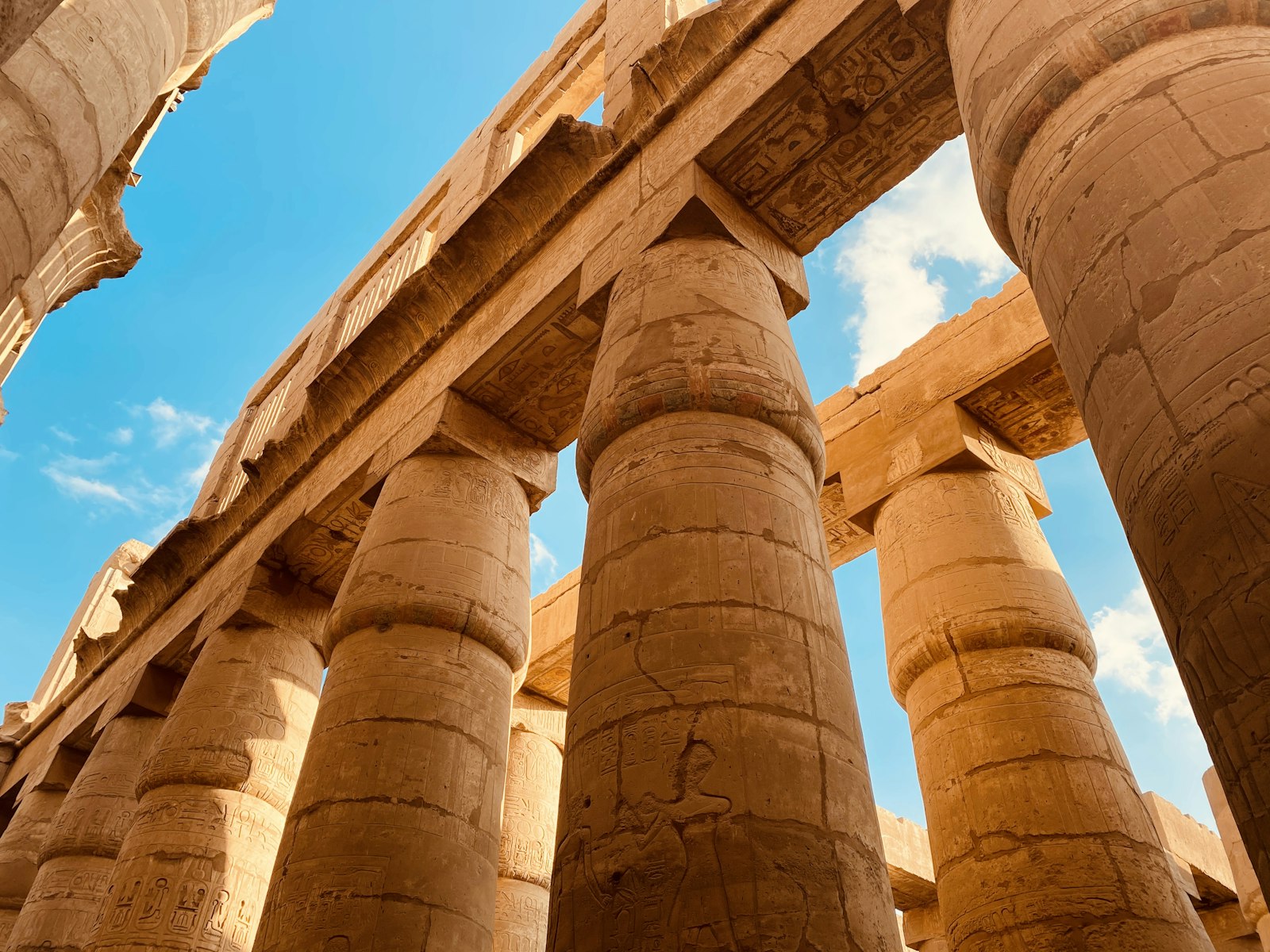
The show, which recounts the millennial history of Thebes and the temple of Amun through lights, projections and narration, exploits the magical atmosphere of the lake to create an immersive and suggestive experience. The reflections of the illuminated pylons and of the columns of the Hypostyle Hall on the calm waters of the lake create a visual effect of extraordinary beauty, which many visitors consider the most exciting moment of the entire show.
The show is available in different languages, including Italian on certain days of the week. It is advisable to verify the times and the linguistic programming at the local tourist office or the official site.
Tips for the Visit
Times and Access
The Sacred Lake is included in the general entrance ticket of the Karnak complex. It is not necessary to purchase a supplementary ticket to visit it. It is reached by following the main axis of the temple beyond the fourth pylon, or through a lateral route that runs alongside the seventh pylon.
Best Moments for the Visit
The ideal moment to visit the Sacred Lake during the day is the late afternoon, when the light of the sunset tinges the waters and the surrounding stones with golden and rosy tones, creating perfect conditions for photography. In the early morning, the lake offers instead an atmosphere of contemplative quiet, with few visitors and a soft and diffuse light.
For the Sound and Light show, it is advisable to arrive in advance to ensure a good seat in the stands. The winter evenings, with pleasant temperatures and clear skies, offer the best conditions to enjoy the show.
Practical Suggestions
Bring with you a bottle of water, especially in the hot months, since the area around the lake offers little shade. Wear comfortable shoes to walk on the irregular terrain. If you visit the lake in the late afternoon, consider stopping also for the evening show, thus combining two experiences in a single visit to Karnak.
The route around the lake is accessible also to visitors with reduced mobility, although some areas of the Karnak complex can present difficulties. Inquire at the entrance about the accessibility options available.
How to Get There
The Karnak complex is located on the eastern bank of the Nile, about 3 kilometres from the centre of Luxor. It is reachable by taxi, carriage, local minibus or through the transfer services organised by the hotels. The route along the Corniche of the Nile up to the entrance of the temple is also a pleasant walk, especially in the less hot hours of the day.
The Sacred Lake of Karnak is much more than a simple basin of water in the desert: it is a living fragment of Egyptian cosmology, a place where history, religion and symbolism intertwine indissolubly. To visit it means to immerse oneself, symbolically as the ancient priests did, in the primordial waters from which one of the most extraordinary civilisations of human history was born.