The Hypostyle Hall of Karnak: the Largest Stone Forest in the World
There exist places in the world that transcend the dimension of the monument to become total sensory experiences, spaces where architecture does not limit itself to containing space but transforms it into pure emotion. The Hypostyle Hall of Karnak is one of these places. With its 134 colossal columns arranged in sixteen rows over a surface of more than 5,000 square metres, this hall is the largest religious structure with columned roofing ever built in the history of humanity, a record that it holds unbeaten for more than three thousand years.
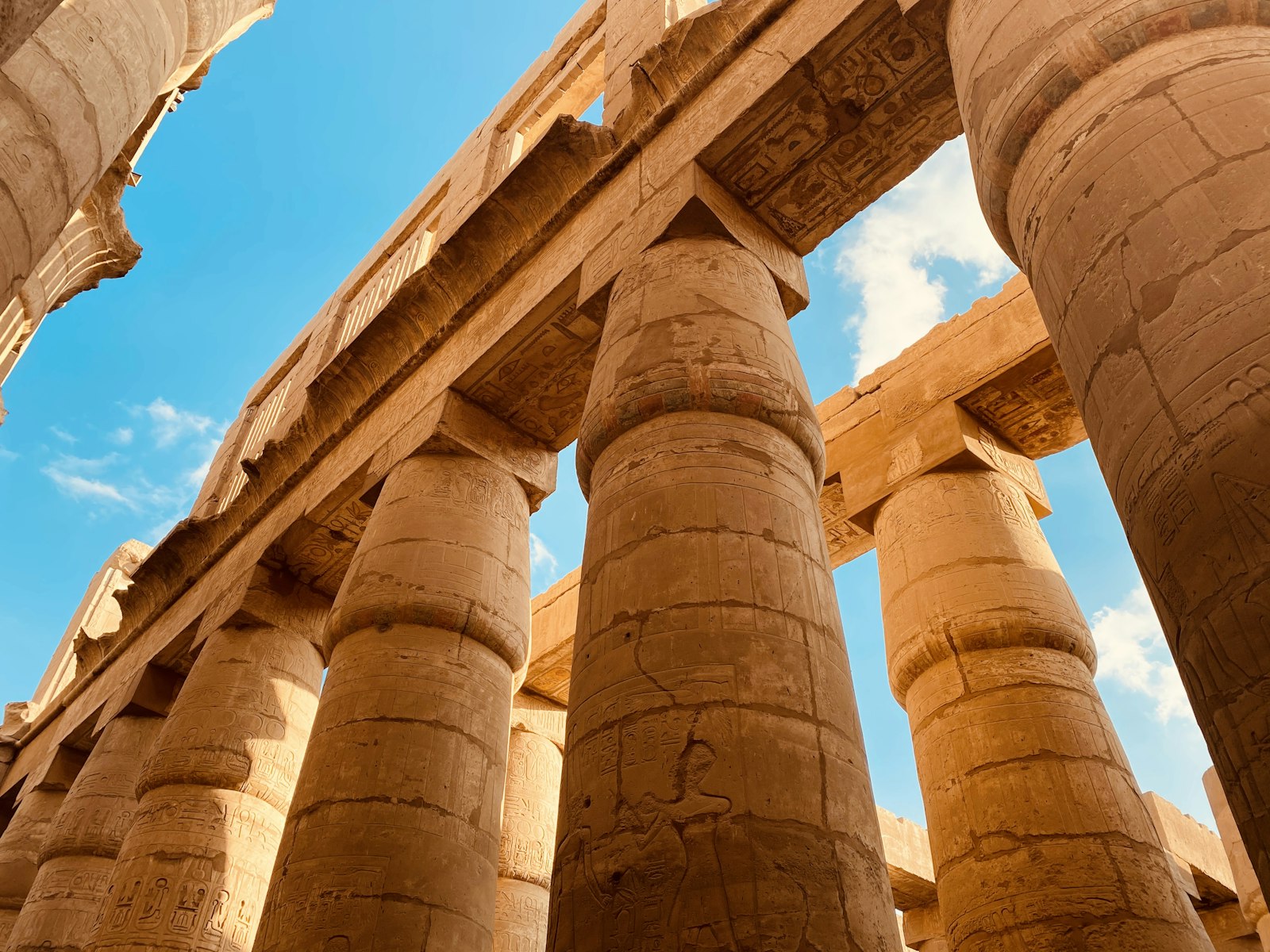
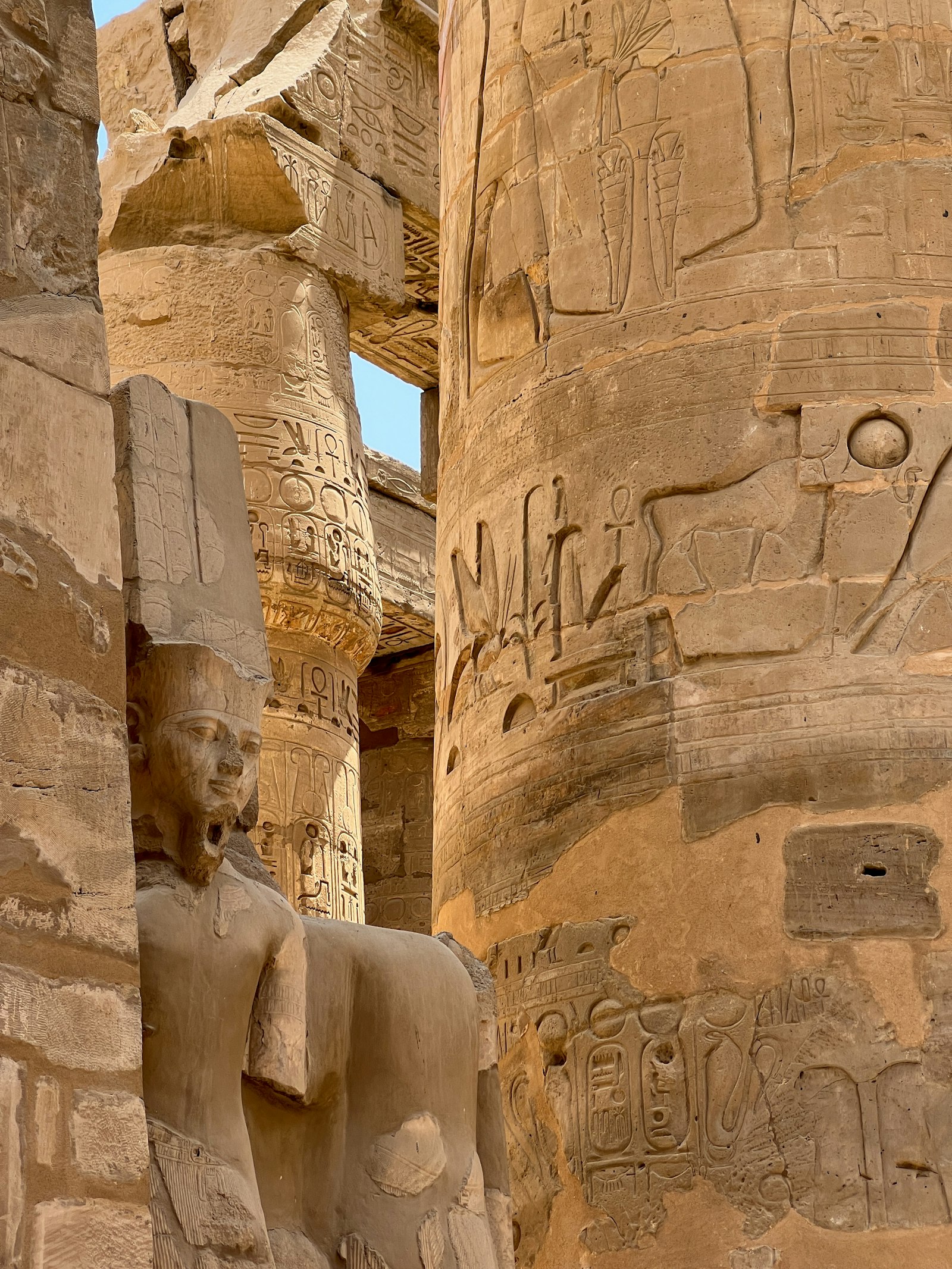
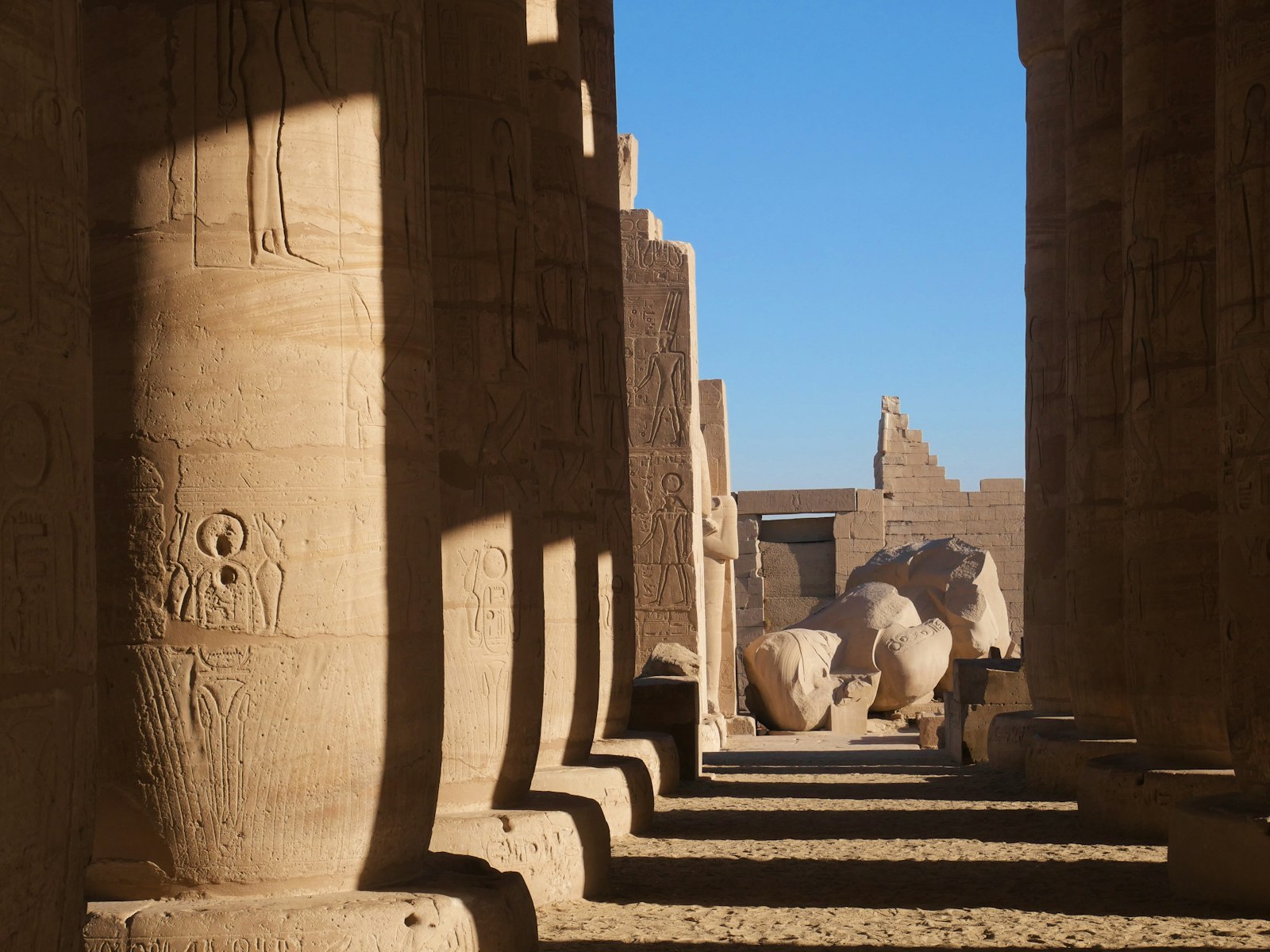
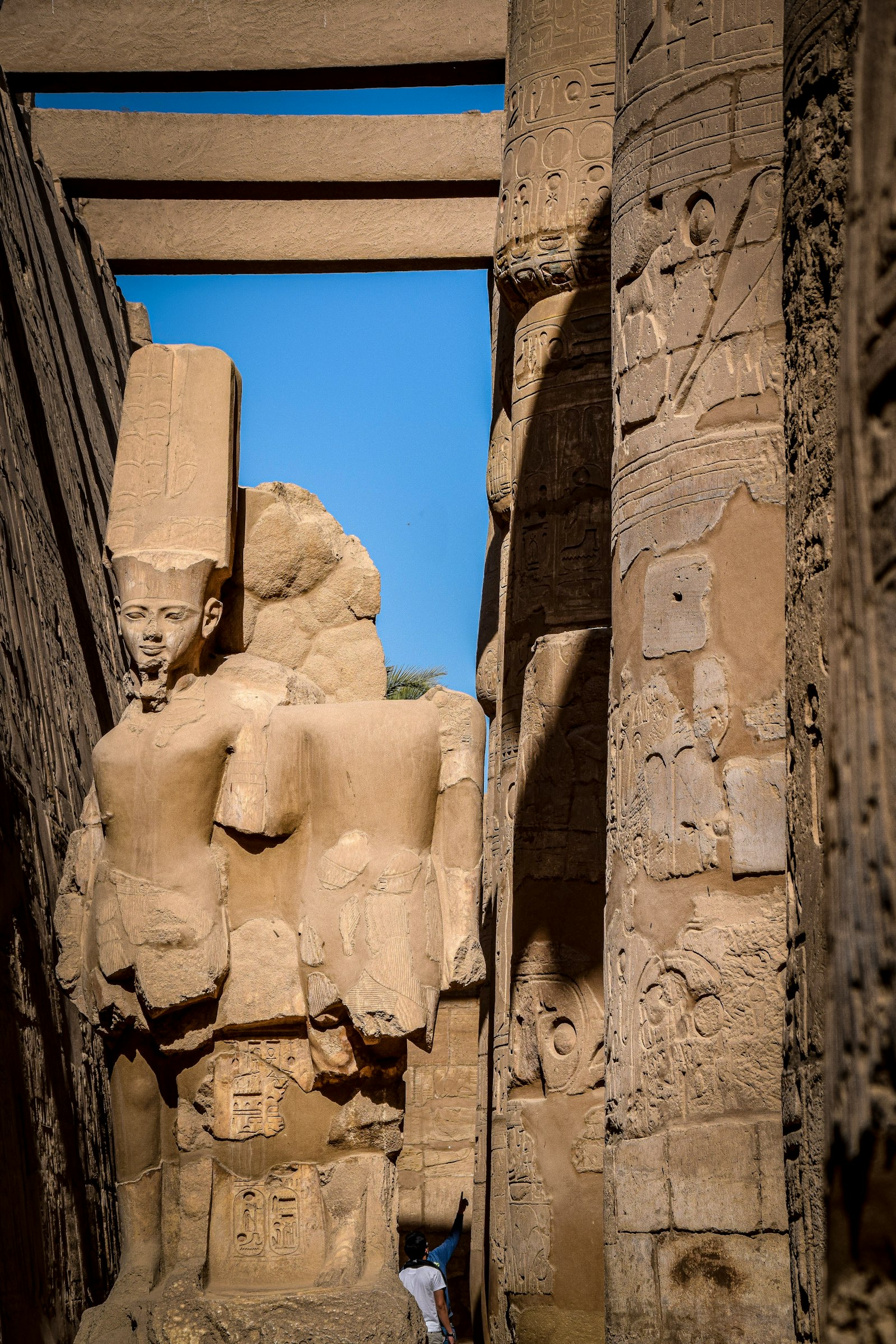
To enter the Hypostyle Hall is like penetrating into a petrified sacred forest. The columns rise all around like gigantic trunks, their surfaces covered with polychrome reliefs that recount myths, wars and divine rituals. The sunlight, filtering through the stone grilles of the clerestory, creates luminous beams that dance over the sculpted surfaces, transforming each hour of the day into a different visual experience. It is a place that has left generations of travellers breathless, from Napoleon to Champollion, from Flaubert to every contemporary visitor who crosses the threshold of the second pylon.
History of the Construction
The Origins of the Project
The construction of the Hypostyle Hall was begun by the pharaoh Seti I (1294-1279 BC) of the 19th dynasty and completed by his celebrated son Ramesses II (1279-1213 BC). However, the initial project might date back to the previous reign of Horemheb, the last pharaoh of the 18th dynasty, who had the second and third pylons built, between which the hall extends.
Seti I, one of the most devout pharaohs in Egyptian history, conceived the hall as a supreme offering to the god Amun-Ra, the lord of Karnak. The project was of an unprecedented ambition: to create a sacred space so vast and magnificent as to reflect on earth the grandeur of the celestial dwelling of the gods. The hall was to be the obligatory passage between the external world and the sacred heart of the temple, a place of transition from the profane to the divine.
The Building Site
The construction of the Hypostyle Hall was one of the greatest building enterprises of the New Kingdom. Thousands of workers, stonecutters, sculptors and painters worked for more than a decade on the realisation of the work. The blocks of sandstone were extracted from the quarries of Gebel el-Silsila, located about 150 kilometres south of Luxor, and transported via the Nile to the site.
Seti I completed most of the structure and of the decorations of the northern half of the hall, characterised by reliefs of very high artistic quality in delicate bas-relief. At his death, his son Ramesses II completed the southern half with a different style: deeper and less refined sunk reliefs but of great visual impact, suited to being read even in the strong light of the Egyptian sun. This stylistic difference between the two halves of the hall is still perfectly appreciable today and offers a living lesson in the history of Egyptian art.
The Architecture: Numbers and Marvels
The 134 Columns
The heart of the Hypostyle Hall is constituted by its 134 columns, arranged in sixteen rows parallel to the principal axis of the temple. The columns divide into two typologies:
The twelve central columns, arranged in two rows of six along the principal nave, are the most imposing. With a height of about 23 metres and a diameter of 3.5 metres, they are the largest stone columns ever realised in antiquity. Their capitals, in the form of an open papyrus (campaniform), have a diameter of almost 15 metres of circumference, sufficient to host fifty people standing on the upper surface of each. These columns supported the highest part of the roof, creating the raised central nave.
The remaining 122 lateral columns, lower (about 13 metres of height), have capitals in the form of a closed papyrus (bud). This difference of height between the central columns and the lateral ones was functional to the lighting system of the clerestory.
The Clerestory System
The difference of height between the central columns and the lateral ones created a vertical band along the sides of the principal nave, where pierced stone grilles were inserted. These elements functioned as windows, allowing the light of day to penetrate inside the hall in controlled beams. This system, known as the clerestory, is the same architectural principle that would be taken up millennia later in the European Gothic cathedrals.
The light that filtered through the clerestory illuminated selectively the central nave, leaving the lateral naves in a suggestive penumbra. This play of light and shadow was not casual but profoundly symbolic: the luminous central nave represented the path of the sun (and of the pharaoh), while the areas in shadow evoked the world of the Afterlife and the mystery of the divine.
The Overall Dimensions
The Hypostyle Hall extends for about 103 metres of width and 52 metres of depth, covering a total area of more than 5,000 square metres. To give a term of comparison, the entire cathedral of Notre-Dame de Paris could be contained inside it. The maximum height of the central nave reached about 24 metres, equivalent to a modern building of eight floors.
The Decorations and the Reliefs
The Reliefs of Seti I
The northern half of the hall, decorated under Seti I, hosts some of the most refined reliefs of all Egypt. The style of Seti I is characterised by a delicate and precise bas-relief, with harmoniously proportioned figures and details of extraordinary finesse. The principal scenes show the pharaoh making offerings to the god Amun-Ra and to the other divinities of the Theban triad, participating in ritual processions and receiving the divine embrace.
Particularly celebrated is the representation of the Feast of Opet, the great annual celebration during which the statue of Amun was transported in procession from the Temple of Karnak to the Temple of Luxor. The reliefs show the sacred barque of the god carried on the shoulders by the priests, accompanied by musicians, dancers, priests who burn incense and crowds in festivity. The vivacity and dynamism of these scenes restore a vivid picture of the religious life of ancient Egypt.
The Reliefs of Ramesses II
The southern half of the hall, completed by Ramesses II, presents a different but equally impressive style. The reliefs are executed in deep sunk relief, a technique that creates more marked shadows and renders the figures legible even under the strong direct light of the sun. The scenes take up similar themes: divine offerings, temple rituals and processions, but with a grandiosity and an emphasis typical of the personality of Ramesses II.
The External Walls: the Battle of Kadesh
The external walls of the Hypostyle Hall host one of the most extensive and detailed representations of battles of all Egypt. The southern wall is dominated by the scenes of the Battle of Kadesh (1274 BC), the celebrated clash between the Egyptian army of Ramesses II and the Hittite forces of Muwatalli II in modern-day Syria.
The reliefs show Ramesses II on his war chariot, with the bow drawn, who charges heroically against the enemy while his rearing horses overwhelm the Hittite soldiers. The scenes are accompanied by a long narrative text, the "Poem of the Battle of Kadesh", which recounts the episode in epic terms, exalting the superhuman courage of the pharaoh. This is the first battle in history of which we possess a detailed account from both sides (Egyptians and Hittites), and the peace accord that followed it is the most ancient known international treaty.
The northern wall, of Seti I, shows the military campaigns of the pharaoh in Palestine, Syria and against the Libyans. The battle scenes are accompanied by representations of the pharaoh who offers the prisoners to the god Amun, integrating the military narrative into the religious context of the temple.
The Traces of the Astronomical Ceiling
Although the roof of the Hypostyle Hall is in great part collapsed, some fragments of the architraves and of the slabs of the ceiling conserve traces of astronomical decorations. The ceiling was painted dark blue with yellow five-pointed stars, representing the night sky. Vultures with spread wings, symbol of the goddess Nekhbet protectress of Upper Egypt, decorated the central beams. These traces of colour, still visible in some protected points, give an idea of the original aspect of the hall, very different from the bare stone that one sees today.
Restoration and Conservation
The Challenges of Restoration
The Hypostyle Hall has been the object of important interventions of restoration over the course of the last two centuries. The partial collapse of some columns, caused by earthquakes and by the erosion of the sandstone, has required complex operations of consolidation and reconstruction. In 1899, eleven columns of the northern section collapsed in a catastrophic domino effect, rendering necessary a massive intervention of restoration that lasted decades.
The Current Programmes
Currently, an international restoration project is in progress for the cleaning, the consolidation and the documentation of the reliefs of the hall. The works have already restored to the light vivid traces of original polychromy hidden under centuries of soot and mineral deposits. The restoration of the external walls has revealed details previously invisible in the battle scenes, enriching our comprehension of these extraordinary historical documents.
Tips for the Visit
The Ideal Moment
The best moment to visit the Hypostyle Hall is in the early hours of the morning, immediately after the opening of Karnak at six. At that hour the sunlight penetrates obliquely from the clerestory, illuminating the columns in a spectacular way, and the hall is relatively free from the crowd. The late afternoon offers an equally suggestive light, with golden beams that create dramatic shadows among the columns.
How to Orient Yourself
Entering the hall from the second pylon (the western entrance), the columns of Seti I are found on your left (north) and those of Ramesses II on your right (south). To appreciate the stylistic difference between the two pharaohs, compare the reliefs of the columns on both sides. Do not forget to exit the hall and walk along the external walls to admire the battle scenes.
Photographic Suggestions
The Hypostyle Hall is a paradise for photographers. The most suggestive photos are obtained with grazing light, when the low sun creates beams of light among the columns. Use the rays of light of the clerestory as a compositional element. To capture the dimensions of the columns, include a human figure as a reference of scale. A wide-angle lens is essential to capture the amplitude of the space.
Time Necessary
Dedicate at least forty-five minutes to the Hypostyle Hall, an hour if you are passionate about photography or history. Many visitors cross the hall in haste, but the true magic reveals itself to those who stop, raise their gaze and let the immensity of the space speak to the heart before to the mind.
Combining with Other Visits
The Hypostyle Hall is the heart of the visiting route of Karnak. From here continue toward the interior to admire the Obelisk of Hatshepsut, reach the Sacred Lake and do not miss the Open-Air Museum with the White Chapel. For a complete day on the eastern bank, add the Temple of Luxor and the Museum of Luxor.
The Hypostyle Hall of Karnak is not a monument to look at: it is a monument in which to lose oneself. To lose oneself among the columns as in a primordial forest, to lose oneself in the gazes of the gods sculpted in the stone, to lose oneself in the time that here seems to have stopped. For three thousand years, this stone forest has welcomed visitors with the same silent majesty, reminding each one that human ingenuity, when it is moved by faith and ambition, can create works that defy eternity.