Mount Sinai: the Sacred Mountain of the Ten Commandments
Mount Sinai, known in Arabic as Jebel Musa (Mountain of Moses), rises majestically to 2,285 metres of altitude in the heart of the Sinai Peninsula, in eastern Egypt. This pink granite mountain is one of the most sacred places in the world for the three great monotheistic religions: Judaism, Christianity and Islam. According to biblical tradition, it was precisely on this summit that God delivered to Moses the Tablets of the Law with the Ten Commandments, the founding event of the covenant between God and the people of Israel that shaped Western civilisation.
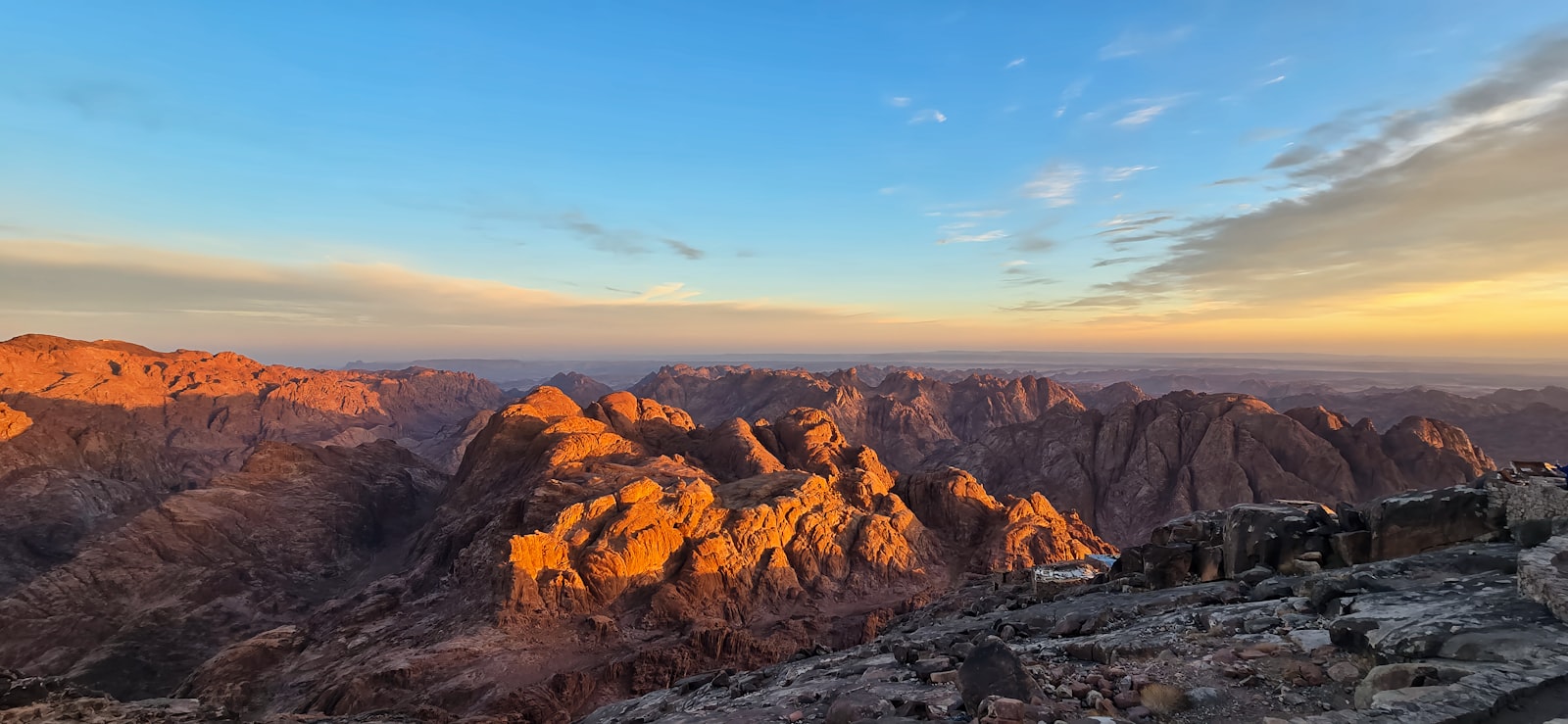
Every year, tens of thousands of pilgrims and travellers undertake the night ascent of Mount Sinai to witness one of the most moving natural spectacles on the planet: the sunrise that progressively illuminates the mountain ranges of the Sinaitic desert, tinting the rocks with shades that go from pink to intense red, from orange to gold. It is an experience that transcends simple tourism and touches deep chords, regardless of the faith or the personal convictions of each one.
History and Religious Significance
The Mountain in the Bible
The Book of Exodus recounts that Moses, after having led the people of Israel out of Egypt, reached the foot of Mount Sinai where God manifested himself amid thunder, lightning and a dense cloud. Moses ascended the mountain and remained there forty days and forty nights, during which he received the Ten Commandments engraved on tablets of stone, together with numerous other laws that would govern the life of the Jewish people.
This event, narrated in Exodus and taken up in Deuteronomy, is considered the founding moment of the pact between God and humanity. The sacredness of the place is recognised also by Islam: the Quran mentions Mount Sinai (Tur Sina) as the place where Moses (Musa) spoke with Allah, and several suras make reference to the sacred mountain.
Historical Identification
The identification of the biblical Mount Sinai with the current Jebel Musa dates back at least to the 3rd-4th century AD, when the first Christian hermits settled in the area. The empress Helena, mother of the emperor Constantine, in 330 AD ordered the construction of a chapel on the summit and of a tower at the foot of the mountain, near the presumed site of the Burning Bush. This secular tradition, reinforced by the foundation of the Monastery of Saint Catherine in the 6th century, has consolidated the identification of the site, although some scholars propose alternative localisations.
Pilgrimage Through the Centuries
The pilgrimage to Mount Sinai has a very ancient history. The pilgrim Egeria, in the 4th century AD, described in detail her ascent of the sacred mountain in a celebrated letter, providing one of the first travel testimonies in Christian history. In the Middle Ages, the pilgrimage to Sinai was considered one of the three great Christian pilgrimages, together with Jerusalem and Rome. The medieval pilgrims faced very dangerous journeys through the desert to reach this sacred place, and many of them left inscriptions on the rocks along the route that are still visible today.
The Ascent Routes
The Camel Path (Sikket el-Bashait)
The most frequented route is the so-called Camel Path, a longer but more gradual way that winds along the northern slope of the mountain. About 7 kilometres long, this trail was created in the 19th century by the Egyptian administrator Abbas Pasha, who also had a palace built (now in ruins) on the summit. The route is sufficiently wide to allow the passage of camels, which the local Bedouins offer for hire to visitors for the first part of the ascent.
The trail rises gradually through a desert landscape of extraordinary beauty, with granite formations of bizarre shapes and deep canyons. Along the route there are several refreshment points managed by the Bedouins, where it is possible to buy hot tea, snacks and blankets for the cold desert nights. At about two thirds of the route one reaches the Basin of Elijah (Farsh Liya), a plateau where, according to tradition, the prophet Elijah took refuge fleeing from queen Jezebel. Here there is a small chapel and a centuries-old cypress. From this point, the trail joins the Steps of Penitence for the last stretch up to the summit.
The Steps of Penitence (Sikket Sayidna Musa)
The most ancient and demanding route is that of the Steps of Penitence, 3,750 irregular steps carved and built into the rock by the monks of the Monastery of Saint Catherine as a form of sacred penitence. This trail starts directly from the back of the monastery and rises steeply along the southern slope of the mountain, offering vertiginous panoramas but requiring a good physical condition.
The route crosses several points of spiritual interest, including the Gate of Confession, where in the past a monk collected the confessions of the pilgrims before they proceeded towards the summit, and the Gate of Saint Stephen, a natural arch in the rock. The ascent is particularly demanding at night, when the majority of visitors undertake the walk, and requires a reliable torch and sturdy shoes. The steps are irregular, at times very steep, and the descent can be more treacherous than the ascent.
The Summit
On the top of Mount Sinai there are several religious structures. The Chapel of the Holy Trinity, a small Greek Orthodox church built in 1934 on the foundations of a 4th-century church, occupies the highest point. Next to it there is a mosque, testimony of the Islamic veneration for this sacred place. The foundations of the ancient palace of Abbas Pasha are still visible, together with the remains of more ancient structures.
The panorama from the summit is simply extraordinary. In every direction extends a sea of mountains and desert valleys, with the peaks of pink and grey granite that create an almost lunar landscape. On clear days it is possible to glimpse the Gulf of Aqaba to the east and the Gulf of Suez to the west, making simultaneously visible the maritime borders of the Sinai Peninsula.
The Sunrise Experience
The Night Climb
The most iconic experience of Mount Sinai is the night ascent to witness the sunrise from the summit. The departure generally takes place between 1:00 and 2:00 at night from the base of the mountain, near the Monastery of Saint Catherine. The walk lasts on average 2.5-3.5 hours depending on the pace and the route chosen.
To walk in the desert under a starry sky of incomparable beauty is in itself an unforgettable experience. Far from the light pollution of the cities, the firmament reveals itself in all its magnificence, with the Milky Way clearly visible to the naked eye. The night air of the desert is cold, often surprisingly freezing between November and March, when the temperatures can drop below zero.
The Spectacle of the Sunrise
Having reached the summit, the visitors gather awaiting the sunrise. Slowly, the darkness gives way to a growing luminosity that progressively reveals the surrounding landscape. The moment in which the sun emerges from the horizon is of an indescribable beauty: the golden light invades the valleys and the mountains, creating a play of lights and shadows that changes from second to second. The granite mountains light up with warm tones, from pink to red, from orange to gold, in a spectacle that many consider among the most beautiful in the world.
For many, the experience involves an emotional dimension that goes beyond the aesthetic. To find oneself at dawn on the same mountain where tradition places one of the founding events of Judaeo-Christian civilisation generates a sense of connection with history and spirituality that is difficult to experience elsewhere.
The Bedouin Guides
The Bedouins of the Jabaliya tribe are the traditional guardians of Mount Sinai for over 1,500 years. Descendants of the Roman soldiers and of the local communities that the emperor Justinian settled in the area to protect the monastery, the Jabaliya converted to Islam in the 7th century but maintained their role as guardians of the sacred place.
Today, the Bedouin guides accompany the visitors in the ascent, offering knowledge of the terrain, assistance and stories about the history and the local traditions. It is highly advisable to make use of a Bedouin guide, both for reasons of safety and to support the local economy. The Bedouin camel drivers also offer the possibility of covering part of the route on camel-back, an option that can be precious for those who have physical difficulties.
Tips for the Visit
Physical Preparation
The ascent of Mount Sinai requires a reasonable physical condition. The elevation gain is about 750 metres and the route, although not technically difficult, is demanding for its length and for the conditions of the terrain. The Camel Path is accessible to anyone with a normal physical condition, while the Steps of Penitence are recommended only to trained people.
Clothing and Equipment
The night temperatures in the desert can be very low, even in spring and autumn: bring layers of warm clothing, gloves and a hat. Sturdy trekking shoes with anti-slip sole are essential. A LED headlamp with spare batteries is indispensable for the night climb. Bring at least 2 litres of water per person and energetic snacks.
Logistics
The base of departure is the town of Saint Catherine, reachable by car from Sharm el-Sheikh in about 3 hours. The majority of organised tours include the transport from Sharm, the Bedouin guide, the night climb and the visit to the Monastery of Saint Catherine the following morning. It is possible to organise the excursion also in an independent way, staying in the accommodations of the town of Saint Catherine.
Recommended Period
The best period for the ascent is from October to April, when the daytime temperatures are pleasant and the nights, though cold, are bearable. The summer months are not advised because of the intense heat during the day. The winter nights of December and January can be very cold, with temperatures below zero at the summit, but the clear air offers spectacular starry skies and unforgettable sunrises.
Mount Sinai is one of those travel experiences that leave a deep mark. Whether you are motivated by faith, by the love of nature or by simple curiosity, the ascent of this sacred mountain in the heart of the Sinai desert will give you emotions and memories that you will carry with you forever.