The Monastery of Saint Catherine: the Oldest Christian Monastery in the World
The Monastery of Saint Catherine, officially known as the Sacred Monastery of the God-Trodden Mount, is a place where history, faith and the desert intertwine inextricably. Located at about 1,500 metres of altitude in the desert valley at the foot of Mount Sinai, in the heart of the Sinai Peninsula, this extraordinary monastic complex holds an absolute record: it is the oldest continuously inhabited Christian monastery in the world. Since the 6th century AD, without interruption, a community of Greek Orthodox monks has lived, prayed and guarded the priceless treasures enclosed within its fortified walls.
Recognised as a UNESCO World Heritage Site since 2002, the Monastery of Saint Catherine is not only a place of worship of extraordinary importance for the three great monotheistic religions, but also a treasure chest of art, culture and knowledge that has crossed fifteen centuries of history while remaining miraculously intact.
History and Foundation
The Origins: from the Burning Bush to Emperor Justinian
Biblical tradition identifies this place with the site where Moses saw the Burning Bush, the bush that burned without being consumed, through which God spoke to him asking him to free the people of Israel from slavery in Egypt. Already in the 3rd and 4th centuries AD, groups of Christian hermits had settled in the area, attracted by the sacredness of the place and by the isolation of the Sinai desert, ideal for the contemplative life.
It was the Byzantine emperor Justinian I who ordered, between 548 and 565 AD, the construction of the monastery in its present form. Justinian had mighty granite walls erected, up to 15 metres high and over 2 metres thick, to protect the monastic community from the incursions of the desert's nomadic tribes. Within the walls the magnificent basilica of the Transfiguration was built, which still today represents the spiritual heart of the complex.
The Name of Saint Catherine
The monastery was originally dedicated to the Virgin Mary, but during the 11th century it took the name of Saint Catherine of Alexandria. According to legend, the relics of the martyr saint, killed in Alexandria of Egypt in 305 AD, were mysteriously transported by angels to the summit of the mountain that today bears her name, adjacent to Mount Sinai. The monks recovered the relics and guarded them in the monastery, where they are still found today, in the basilica.
Surviving the Centuries
One of the most extraordinary aspects of the Monastery of Saint Catherine is its capacity to survive intact through the tumultuous centuries of Middle Eastern history. When the Islamic armies conquered Egypt in the 7th century, the monastery was spared thanks to a document of protection that tradition attributes to the prophet Muhammad himself, known as the Ashtiname. This document, whose copies are preserved in the monastery, guaranteed the monks protection, tax exemption and freedom of worship. A Fatimid mosque was built within the walls in the 12th century as a sign of mutual respect and protection, and still stands today beside the Christian basilica.
During the Crusades, the monastery maintained good relations both with the crusaders and with the Islamic authorities. The Mamluk sultans and then the Ottomans continued to guarantee protection to the complex, recognising its universal spiritual importance.
Artistic and Cultural Treasures
The Basilica of the Transfiguration
The heart of the monastery is the basilica of the Transfiguration, one of the oldest churches still in use in the world. The interior preserves its original 6th-century appearance, with granite columns surmounted by splendidly carved capitals. The floor is composed of original stone slabs and the wooden ceiling dates back to the era of Justinian.
The most precious artistic element of the basilica is the magnificent apse mosaic of the Transfiguration of Christ, made around 565 AD. This masterpiece of Byzantine art depicts Christ transfigured in a mandorla of light, flanked by Moses and Elijah, with the apostles Peter, James and John at his feet. The luminosity of the colours and the mastery of the execution make it one of the best-preserved early Christian mosaics in the world, comparable in importance to the mosaics of Ravenna.
The Collection of Icons
The Monastery of Saint Catherine possesses the most important and ancient collection of icons in the world, with over 2,000 examples covering a time span from the 6th to the 18th century. Among these, the icons of the 6th and 7th centuries are particularly precious because they survived the iconoclastic fury that destroyed thousands of sacred images in the Byzantine Empire between 726 and 843 AD. The isolation of the monastery in the Sinai desert saved it from destruction, preserving works of art that would otherwise have been lost forever.
The icon of Christ Pantocrator, dating to the 6th century, is considered one of the oldest existing representations of Christ. Made with the encaustic technique, it shows a face of surprising realism, with an intentional asymmetry between the two sides of the face that theologians interpret as the dual nature, divine and human, of Christ.
The Library
The library of the Monastery of Saint Catherine is the second largest collection of illuminated manuscripts and ancient codices in the world, surpassed only by the Vatican Apostolic Library. It guards over 3,300 manuscripts in Greek, Arabic, Syriac, Georgian, Ethiopian, Armenian, Coptic, Slavic and Latin, as well as about 5,000 ancient printed books.
Among the most precious treasures figure the Codex Sinaiticus, one of the oldest complete Bibles known (4th century AD), of which some pages are still preserved in the monastery, while the main part is found at the British Museum in London. In 1975 a walled-up room was discovered containing further previously unknown manuscripts and fragments, a finding comparable in importance to the discovery of the Dead Sea Scrolls.
The Burning Bush
Within the walls of the monastery grows a bush venerated as the original Burning Bush, the bramble through which God spoke to Moses according to the account of Exodus. It is a plant of Rubus sanctus, an evergreen bramble that botanists consider effectively native to the Sinai region. The plant is protected and cared for by the monks with great devotion. Numerous attempts to grow cuttings of this bush in other places have failed, fuelling the sense of mystery and sacredness that surrounds the plant.
The chapel of the Burning Bush, located behind the apse of the basilica, is considered the most sacred place of the entire complex. Visitors are required to remove their shoes before entering, in memory of the divine command to Moses: "Take off your sandals from your feet, for the place on which you stand is holy ground."
Architecture and Structure of the Complex
The monastery presents itself as a true fortress in the desert. The granite enclosure walls, still largely original from the 6th century, enclose a complex that includes the basilica, several minor chapels, the Fatimid mosque, the monks' quarters, the library, a refectory, an ossuary and numerous gardens. Outside the walls there are further structures, including a garden of olive and fruit trees irrigated by ancient water conduits, and the ossuary-charnel house where the bones of the deceased monks are kept after decomposition, according to Orthodox tradition.
The original entrance of the monastery took place through an elevated door accessible only via a winch, as a security measure against incursions. Today visitors enter from a more modern ground-level entrance.
Tips for the Visit
How to Get There
The Monastery of Saint Catherine is located in the interior of Sinai, about 350 kilometres from Sharm el-Sheikh and 450 kilometres from Cairo. The most common way to reach it is by car or minibus from Sharm el-Sheikh, a journey of about 3-4 hours through breathtaking desert landscapes. From Sharm airport, organised tours depart that combine the visit to the monastery with the ascent of Mount Sinai.
The small town of Saint Catherine offers basic accommodation, useful above all for those who wish to combine the visit to the monastery with the nocturnal excursion to Mount Sinai to witness the dawn.
Hours and Rules of Visit
The monastery is open to visitors only in the morning hours, generally from 9:00 to 12:00, and is closed on Friday, Sunday and during the numerous Orthodox holidays. It is essential to verify the opening hours before the visit, since they can vary seasonally. Clothing must be respectful: shoulders and knees covered for men and women. Photography is generally forbidden inside the basilica and the library.
What to See Absolutely
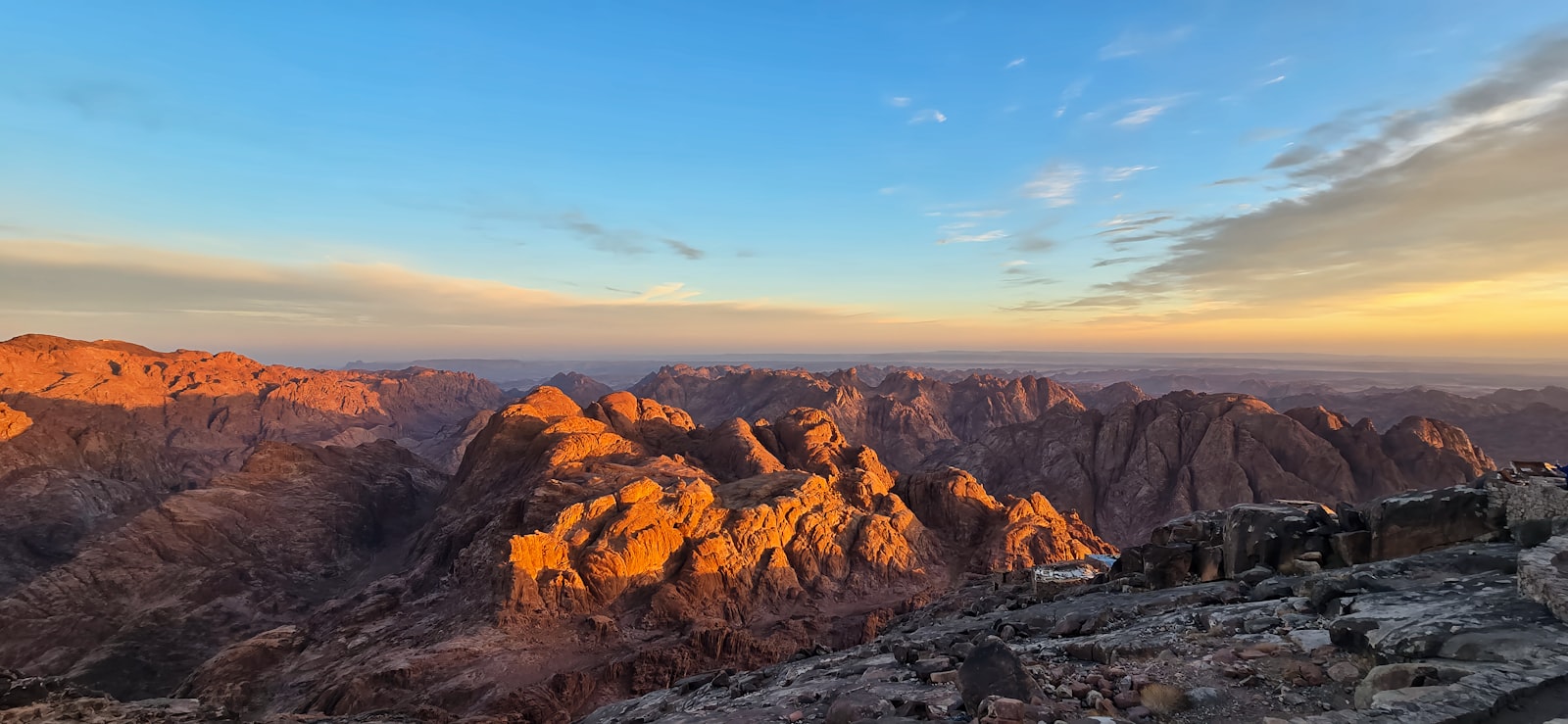
During the visit, dedicate time to the basilica and its mosaic of the Transfiguration, to the Burning Bush, to the Fatimid mosque, to the ossuary and, if accessible, to the gallery of icons. The library is not generally open to the public, but some works are exhibited in a dedicated hall. Do not miss the panoramic view from the internal walkway of the walls, which offers unforgettable glimpses of the surrounding desert and of the pink granite mountains.
Combining with Mount Sinai
Most visitors combine the visit to the monastery with the ascent of Mount Sinai, departing in the night hours to reach the summit at dawn. The monastery is located right at the base of the mountain, making this combination natural and unmissable. It is advisable to dedicate at least two days to the area to enjoy both experiences without haste.
The Monastery of Saint Catherine is much more than a tourist site: it is a place where time seems to have stopped, where the millenary faith of the monks has preserved priceless treasures of humanity in a remote and wild corner of the desert. To visit it means to touch with one's hand fifteen centuries of uninterrupted history and to understand the universal power of spirituality that unites different cultures and religions.