Serabit el-Khadim: the Turquoise Mines and the Birth of the Alphabet
Serabit el-Khadim is one of the most fascinating and least known archaeological sites of Egypt, a place where the history of the ancient Egyptian civilisation intertwines with one of the most revolutionary discoveries in human history: the origin of the alphabet. Located on a desert plateau at about 850 metres of altitude in western Sinai, about 50 kilometres from the coast of the Gulf of Suez, this remote site was for more than a millennium the centre of the Egyptian mining expeditions for the extraction of turquoise, the precious blue stone that the ancient Egyptians called mefkat and considered sacred to the goddess Hathor.
But Serabit el-Khadim is not only an ancient mining site with a temple dedicated to the goddess protectress of the miners. It is also the place where, around 1800 BC, Semitic workers who laboured in the Egyptian mines created a revolutionary writing system that would give origin, through a millennial evolutionary path, to the Phoenician alphabet, from which derive the Greek, Latin, Arabic, Hebrew alphabet and all the modern alphabets. In a few words, the inscriptions on the rocks of this mountain in the desert of Sinai are the roots of the writing that you are reading at this moment.
History of the Turquoise Mines
The Importance of Turquoise in Ancient Egypt
For the ancient Egyptians, turquoise was much more than a simple precious stone: it was a symbol of rebirth, protection and divinity. Its blue-green colour was associated with the sky, with the water of the Nile and with the goddess Hathor, lady of turquoise and protectress of the miners. Turquoise was used to create royal jewels, protective amulets, decorations for sarcophagi and inlays for ritual objects. The famous funerary mask of Tutankhamun is decorated with inserts of turquoise, lapis lazuli and carnelian.
The turquoise mines of Sinai were the principal sources of this coveted stone and their control was a question of royal prestige. The mining expeditions were organised directly by the court of the pharaoh, financed by the royal treasury and led by high officials who documented scrupulously their campaigns with commemorative stelae.
The Expeditions of the Middle Kingdom
The first traces of mining activity at Serabit el-Khadim date back to the Old Kingdom (about 2600 BC), but it was during the Middle Kingdom (about 2055-1650 BC) that the operations reached their maximum intensity. The pharaohs of the 12th dynasty, in particular Amenemhat III, organised numerous expeditions that employed hundreds of workers, including Egyptian miners, escort soldiers, scribes, architects and a considerable workforce recruited among the Semitic populations of Sinai and of the Levant.
The excavations have revealed that the expeditions took place generally during the winter months, when the temperatures of the desert were more bearable. The miners lived in temporary camps on the plateau, where traces of huts, smelting furnaces, stone and ceramic tools, and deposits of mining slag have been found. The working conditions were very hard: extracting turquoise from the sandstone rock required digging in narrow and deep galleries, with the constant risk of collapses.
The Expeditions of the New Kingdom
The mining activities resumed with vigour during the New Kingdom (about 1550-1070 BC), with the pharaohs of the 18th and 19th dynasty who enlarged the temple and continued the expeditions. Hatshepsut, Thutmose III and Ramesses II are among the sovereigns who left traces of their presence at Serabit el-Khadim through stelae, inscriptions and votive offerings. With the decline of the New Kingdom, the mining expeditions became less frequent and finally ceased altogether, leaving the site to oblivion in the desert for almost three thousand years.
The Temple of Hathor
Structure and Architecture
The Temple of Hathor at Serabit el-Khadim is a religious complex unique of its kind, grown organically over the course of almost a millennium through successive additions. Unlike the great temples of the Nile Valley, this sanctuary was built incrementally: each mining expedition added a new room, a portico, a chapel or a stele, creating an irregular but fascinating complex that develops along the rocky plateau.
The heart of the temple is a rock sanctuary excavated in the rock, where the statue of the goddess Hathor was guarded. From this original nucleus, the temple extends toward the west through a series of courts, porticoes and chapels. In total, the complex stretches for about 80 metres, with rooms dedicated to different divinities associated with the mining activity, including Sopdu, god protector of the eastern desert, and Ptah, god of the artisans.
The Votive Stelae
One of the most characteristic elements of the temple is the impressive collection of votive stelae erected by the leaders of the mining expeditions. These slabs of stone, engraved with hieroglyphs and bas-reliefs, document the names of the pharaohs who commissioned the expeditions, the titles of the responsible officials, the dates, the quantities of turquoise extracted and the offerings made to the goddess Hathor. Today, many of these stelae are found in the museums of all the world, but some copies and originals are still visible in situ.
The stelae provide precious information on the mining practices, the social organisation of the expeditions and the religious beliefs of the ancient Egyptians. Some contain prayers to Hathor for the protection of the miners, thanks for successful campaigns and curses against those who would profane the temple.
The Proto-Sinaitic Inscriptions: the Birth of the Alphabet
The Discovery
In 1904-1905, the celebrated British archaeologist Sir William Matthew Flinders Petrie conducted a campaign of excavations at Serabit el-Khadim and, among the ruins of the temple and in the surrounding mines, discovered a series of inscriptions in a writing system until then unknown. These inscriptions, engraved on rocky walls, stelae and small objects, contained symbols that recalled vaguely the Egyptian hieroglyphs but were clearly different and much simpler.
The Decipherment
It was Alan Gardiner, in 1916, who proposed the key of reading that would revolutionise our comprehension of the history of writing. Gardiner identified in the proto-Sinaitic signs a primitive form of alphabetic writing, where each symbol represented a single consonantal sound, inspired in form by the Egyptian hieroglyph corresponding to the first letter of the Semitic word for the object depicted.
For example, the sign that depicted an ox head, in Egyptian "ka", was adopted to represent the sound "aleph" from the Semitic word "alpu" (ox). This sign is the direct ancestor of the Greek letter alpha and of our letter A. In the same way, the sign of a house ("bayt" in Semitic) became the letter beth, then beta, then B. The sign of water ("mayim") became mem, then mu, then M.
The Revolutionary Importance
The invention of the alphabet at Serabit el-Khadim, around 1800 BC, was one of the most significant intellectual revolutions in the history of humanity. The previous writing systems, like the Egyptian hieroglyphs and the Mesopotamian cuneiform, contained hundreds or thousands of signs and required years of study to be mastered, limiting in fact writing to a restricted elite of professional scribes.
The alphabet, with its 20-30 signs, democratised writing, rendering it accessible to anyone who could dedicate a reasonable time to learning. This radical simplification opened the way to the diffusion of literacy, to the birth of literature, to the codification of laws and, in the last analysis, to the development of modern civilisations as we know them.
The Archaeological Expeditions
Flinders Petrie and the Pioneering Excavations
Flinders Petrie, considered the father of scientific Egyptology, conducted his excavations at Serabit el-Khadim in extremely difficult conditions. The plateau was reachable only on the back of a camel through days of march in the desert, and water had to be transported from distant sources. Despite these difficulties, Petrie documented meticulously the temple, the mines and the inscriptions, producing surveys and photographs that remain fundamental for the study of the site.
Subsequent Research
After Petrie, numerous other expeditions have explored Serabit el-Khadim, including those of the Harvard Semitic Museum in the 1930s and the Finnish and Israeli research of the years 1970-1990. Each campaign has added new pieces to the comprehension of the site, discovering new inscriptions, tracing the mining galleries and reconstructing the history of the pharaonic expeditions.
Tips for the Visit
How to Get There
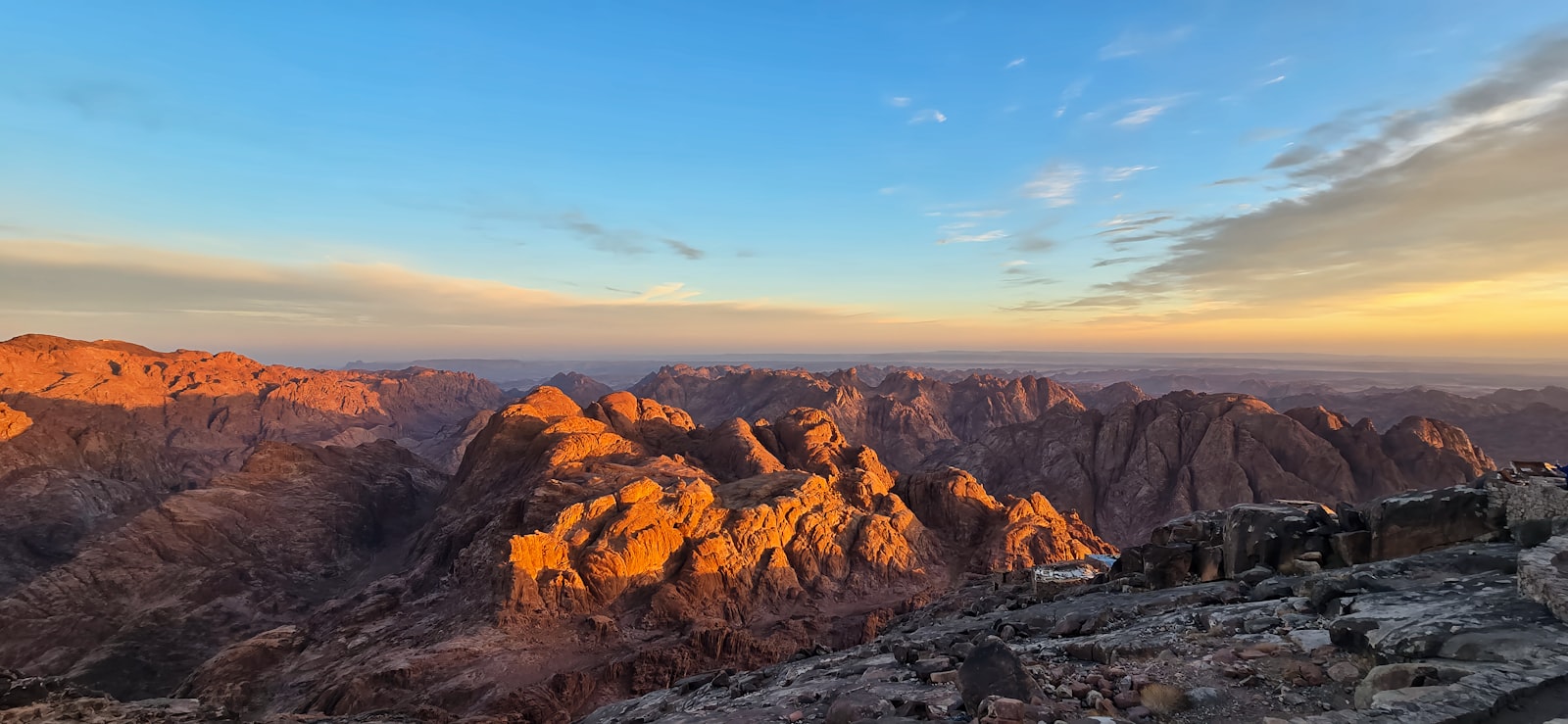
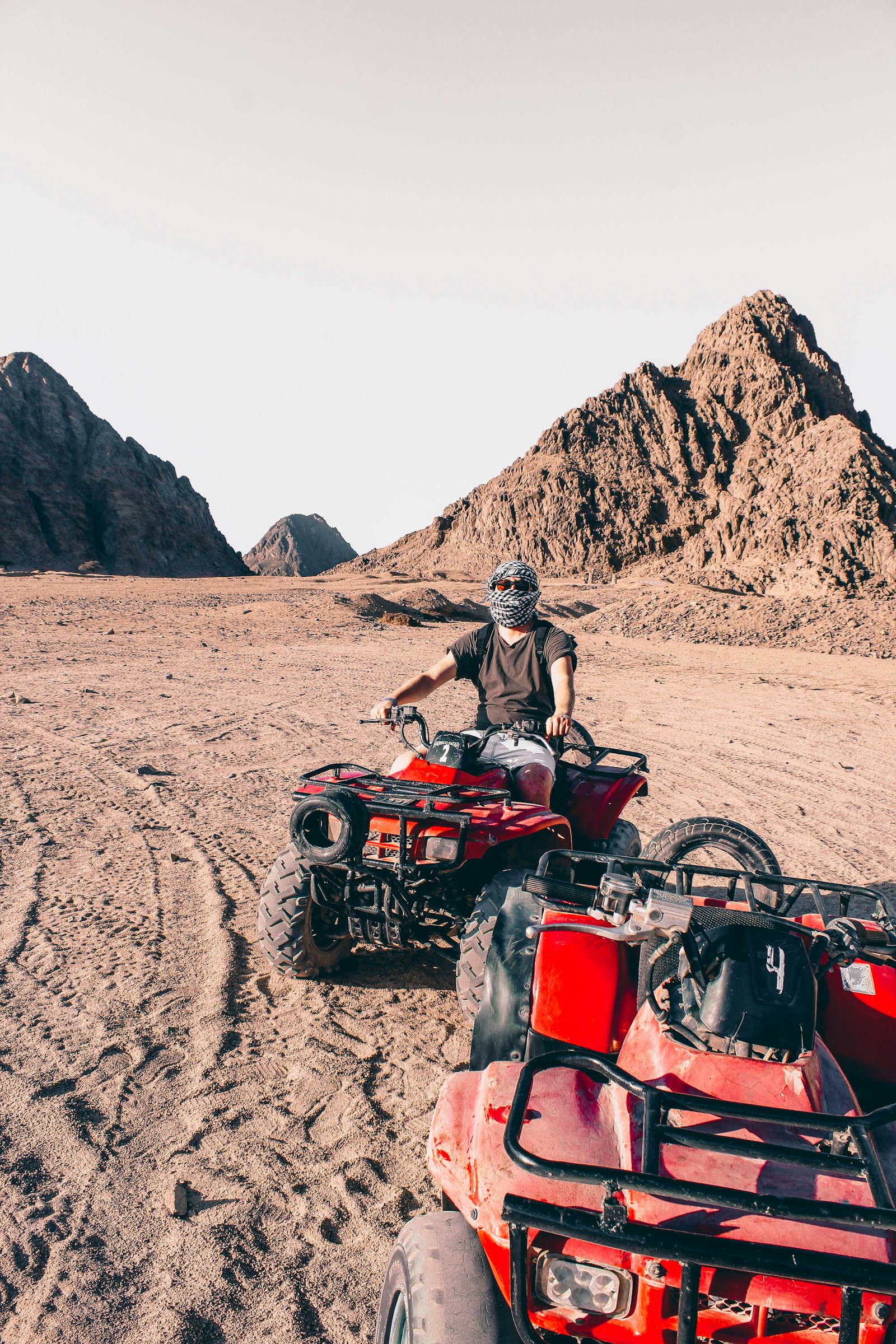
Serabit el-Khadim is located in a remote zone of western Sinai, about 50 kilometres inland from the coastal small town of Abu Zenima, on the Gulf of Suez. The access is possible only with 4x4 vehicles through unpaved desert tracks and requires obligatorily a local Bedouin guide who knows the route. The journey from the coast to the plateau lasts about 2-3 hours and crosses desert landscapes of great beauty.
Most of the visits are organised as a daily excursion from Sharm el-Sheikh (4-5 hours of journey), from Dahab or from Abu Zenima. Some operators offer tours of several days that combine Serabit el-Khadim with other destinations of Sinai.
What to Expect
The site is located on a windy plateau at about 850 metres of altitude. The ruins of the temple are scattered over a vast area and require a walk of 1-2 hours to be explored. There are no service structures, ticket offices nor refreshment points. The site is completely exposed to the sun and to the wind. Bring water in abundance, sun protection, a hat, robust shoes and layered clothing for the wind.
The Charm of the Isolation
Part of the attraction of Serabit el-Khadim resides in its isolation. Unlike the crowded tourist sites of the Nile Valley, here you will find yourself probably completely alone with your guide, surrounded by the silence of the desert and by the remains of a civilisation that left its traces on this remote mountain four thousand years ago. It is an experience that brings archaeology back to its most romantic essence: the discovery of fragments of the past in places forgotten by time.
Best Period
The ideal period for the visit is from October to April. In summer, the temperatures in the desert can be extreme and the journey in 4x4 becomes particularly tiring. The winter mornings offer ideal light for photography and pleasant temperatures for the exploration of the site.
Serabit el-Khadim is a place for curious travellers and lovers of history, a site where the desert guards secrets that have changed the course of human civilisation. To visit it means to tread the same ground where, almost four thousand years ago, human hands engraved in the rock the first signs of what would become the alphabet, the most powerful instrument of communication ever invented by man.