The Mosque of Abu el-Abbas al-Mursi: The Spiritual Heart of Alexandria
The Mosque of Abu el-Abbas al-Mursi is the largest and most venerated mosque of Alexandria in Egypt, a monument of extraordinary architectural beauty that represents the spiritual heart of the city. Dedicated to the Andalusian Sufi saint Shihab al-Din Abu al-Abbas Ahmad ibn Umar al-Mursi, this mosque is not only a place of worship but also a symbol of the religious and cultural identity of Alexandria, a destination of pilgrimage for the Sufi devotees of all the Islamic world.
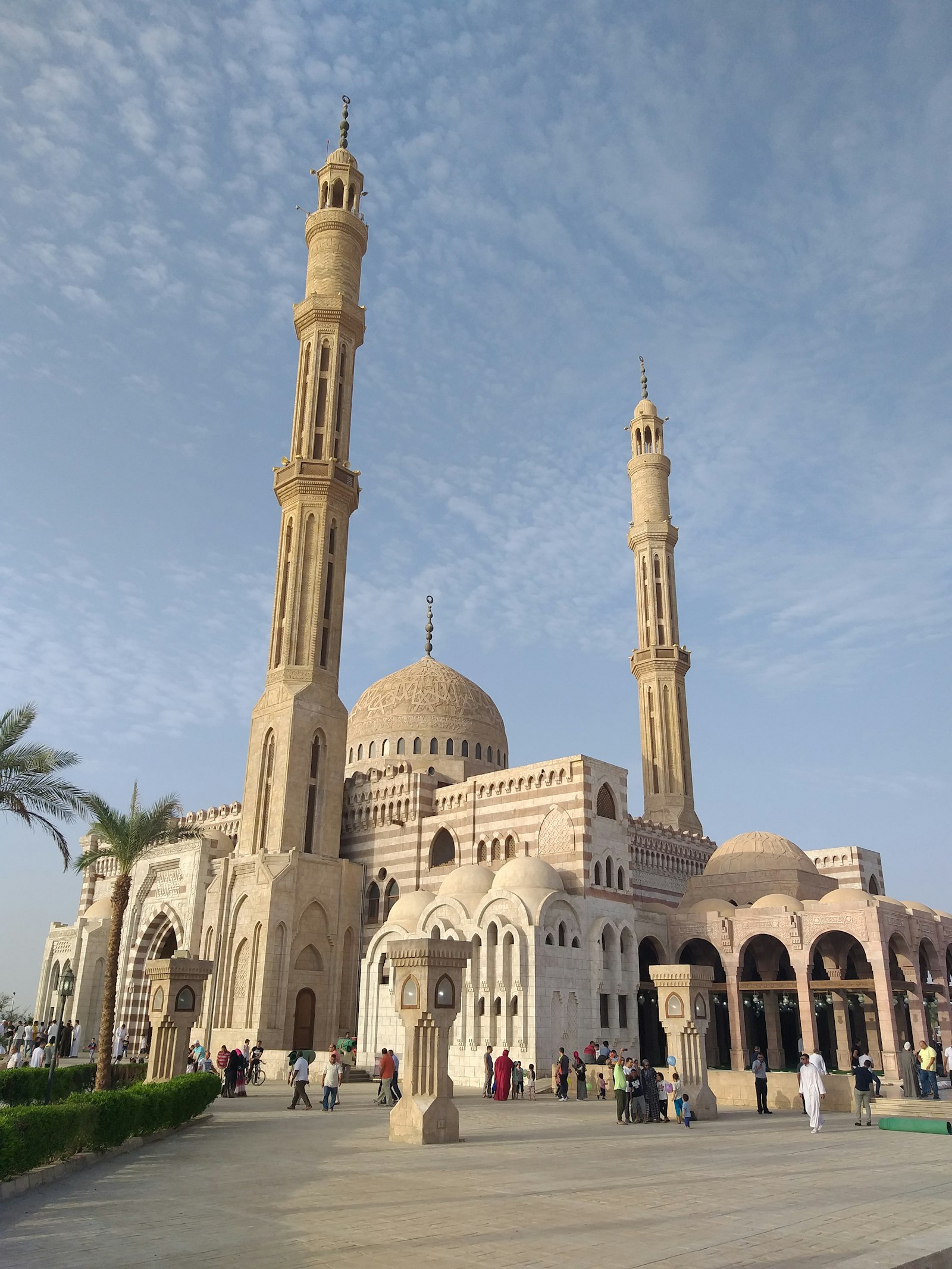
Located on the Corniche, the seafront of Alexandria, in a panoramic position that overlooks the eastern port and the Mediterranean, the mosque imposes itself on the urban panorama with its four majestic domes and its unmistakable octagonal minaret, points of reference visible from every corner of the city.
Abu el-Abbas al-Mursi: The Saint of Alexandria
The Life of the Saint
Abu el-Abbas Ahmad ibn Umar al-Mursi was born in Murcia, in Muslim Spain (al-Andalus), in 1219. Belonging to a family of noble Arab origins, the young Ahmad received a refined religious education in the Andalusian Islamic tradition, known for its intellectual openness and for its contribution to Sufism, the mystical dimension of Islam.
His life changed radically when he met the great Sufi master Abu al-Hasan al-Shadhili, founder of the Shadhiliyya order, one of the most important Sufi brotherhoods of the Islamic world. Al-Mursi became his most devoted disciple and followed him when al-Shadhili moved from North Africa to Egypt, settling finally in Alexandria.
The Sufi Master of Alexandria
After the death of his master al-Shadhili in 1258, Abu el-Abbas al-Mursi became the leader of the Shadhiliyya order and spent the rest of his life in Alexandria, where he taught Sufism and guided a growing community of disciples. His fame of sanctity spread rapidly throughout the Islamic world, and Alexandria became a centre of Sufi pilgrimage.
Al-Mursi was renowned for his profound spirituality, his generosity towards the poor and his ability to reconcile mystical devotion with the observance of Islamic law. His teachings emphasised divine love, the purification of the soul and the service of humanity as ways to draw close to God. He died in Alexandria in 1287 and was buried in the place where today rises the mosque that bears his name.
The Sufi Legacy
The Shadhiliyya brotherhood, through Abu el-Abbas al-Mursi and his successors, spread throughout the Islamic world, from North Africa to the Middle East, from sub-Saharan Africa to Southeast Asia. Still today, the Shadhiliyya is one of the most widespread and influential Sufi brotherhoods, with millions of adepts who follow the spiritual principles transmitted by the Andalusian master.
The mosque of Abu el-Abbas is the most important place of pilgrimage of the Shadhiliyya and, during the annual moulid (festival) of the saint, thousands of devotees converge on Alexandria from all over the world to celebrate the memory of the master with prayers, Sufi chants (dhikr) and ritual ceremonies that transform the surrounding district into a festival of spirituality and devotion.
The Architecture of the Mosque
The Historical Origins
The first mosque built on the tomb of Abu el-Abbas dates back to the 14th century, when the devotees erected a small sanctuary to protect and honour the burial of the saint. Over the centuries, the building was enlarged and renovated several times, but always maintaining the spiritual bond with the original tomb.
The current structure of the mosque dates back to 1943, when it was completely rebuilt on a project by the Italian architect Mario Rossi, who was charged by the Egyptian government to design several mosques in Egypt. Rossi, a profound connoisseur of Islamic architecture, created a building that combines monumental grandeur with the elegance of decorative details, respecting Islamic architectural traditions while introducing modern structural innovations.
The Octagonal Minaret
The most characteristic architectural element of the mosque is its octagonal minaret, an unusual form in Egyptian religious architecture that distinguishes itself immediately in the urban panorama of Alexandria. The octagonal plan of the minaret recalls Islamic numerical symbolism, where the number eight represents paradise and the eight gates of the Jannah (paradise).
The minaret rises for over 70 metres, decorated with Quranic inscriptions, geometric motifs and muqarnas (decorative stalactites) that create a play of lights and shadows particularly suggestive at sunset. The summit of the minaret, with its balcony for the muezzin, offers an extraordinary panoramic view over Alexandria and the Mediterranean, although the access is normally reserved to the personnel of the mosque.
The Four Domes
The mosque is crowned by four imposing domes that confer on the building an unmistakable silhouette. The domes, built in reinforced concrete but clad in light limestone, recall the tradition of the Mamluk mosques of Cairo while reinterpreting it in a contemporary key.
The interior of the domes is decorated with extraordinary geometric and calligraphic motifs. The Quranic inscriptions that run along the pendentives and the drums of the domes are masterpieces of Arabic calligraphy, executed in thuluth style with golden letters on a blue background that create an effect of luminous solemnity.
The Prayer Hall
The interior of the mosque is a vast space of square plan that can accommodate several thousand faithful during the Friday prayers and the religious ceremonies. The columns that support the domes divide the space into naves that converge towards the mihrab, the niche in the wall oriented towards Mecca that indicates the direction of prayer.
The mihrab is a masterpiece of Islamic decoration, with the niche framed by columns in polychrome marble, golden muqarnas and inlays of mother-of-pearl. The minbar (pulpit), in wood carved with arabesque motifs, is used by the imam for the Friday sermon.
The floors are covered with carpets of warm colours, while the walls are adorned with calligraphic panels that report verses of the Quran and invocations to the prophet Muhammad. The lighting, provided by large crystal chandeliers and by openings in the drum of the domes, creates an atmosphere of recollection and spirituality.
The Tomb of the Saint
The spiritual heart of the mosque is the sepulchral chamber where Abu el-Abbas al-Mursi rests. The tomb is enclosed in a maqam (cenotaph) decorated with green fabrics embroidered in gold, the colour of Islam and of paradise. Around the maqam, the devotees gather in prayer and meditation, asking the intercession of the saint.
The chamber of the tomb is an environment of intense spirituality, where time seems suspended and where the aroma of incense mixes with the murmur of prayers. For the Sufis, to visit the tomb of Abu el-Abbas is an experience of profound connection with the mystical tradition and a moment of drawing close to the divine.
The Surrounding District
The Anfoushi Square
The mosque overlooks the Anfoushi square, one of the centres of the social life of the district of the same name. The traditional cafés that surround the square are meeting places where the Alexandrians gather to take tea, play backgammon and converse, keeping alive social traditions that date back to centuries ago.
The district of Anfoushi, with its narrow alleys, its artisan workshops and its houses of pastel colours, preserves an authentic atmosphere that contrasts with the modernisation of the city centre. To stroll through the streets of the district after the visit to the mosque offers an immersion in the daily Alexandrian life.
The Fish Market
A few steps from the mosque is the lively fish market of Alexandria, where every morning the fishermen unload the fresh catch from the Mediterranean. The restaurants of the area offer very fresh fish prepared grilled or fried, accompanied by traditional Egyptian bread and local sauces. A lunch based on fish after the visit to the mosque is an unmissable culinary experience.
Tips for the Visit
How to Arrive
The mosque is located on the Corniche, in the district of Anfoushi, easily reachable by taxi or by tram. The Fortress of Qaitbay is located a few minutes on foot towards the west, and the combination of the two visits is highly advised.
Rules of Conduct
Being an active place of worship, it is fundamental to respect some rules. The shoes must be removed at the entrance. Women must cover hair, shoulders and legs. Men must avoid short trousers. The conduct must be silent and respectful. Photography is generally allowed in the common areas but not during the prayers.
When to Visit
The best moments to visit the mosque are early in the morning, when the sunlight illuminates the domes, or the late afternoon, when the sunset prayer (Maghreb) offers a suggestive spiritual experience. During the period of the moulid of the saint, the mosque and the surrounding district come alive with extraordinary celebrations that deserve to be experienced.
Practical Suggestions
After the visit, stroll along the Corniche towards the Fortress of Qaitbay to enjoy the panorama of the port and the sea. The cafés on the seafront offer an excellent occasion to relax with a mint tea admiring the sunset over the Mediterranean.
The Mosque of Abu el-Abbas al-Mursi is much more than an architectural monument: it is a living bridge between medieval Andalusia and contemporary Egypt, between Sufi mysticism and popular faith, between the legacy of the past and the devotion of the present. To visit it means to touch with one's own hand the spiritual heart of Alexandria and to feel the beat of a mystical tradition that for eight centuries has illuminated the religious life of the city.