The Necropolis of Bagawat: an Ancient Christian Cemetery in the Desert
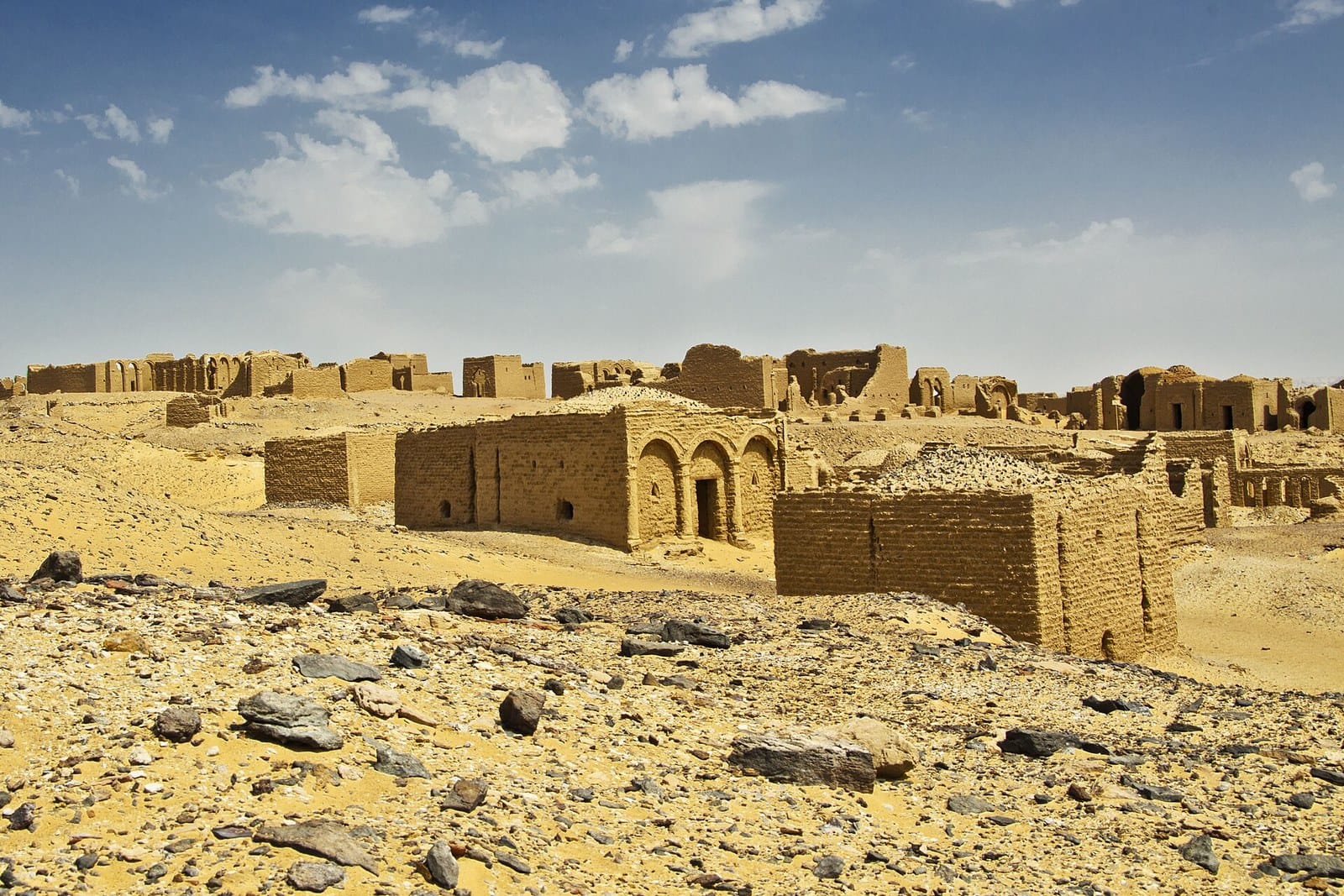
The Necropolis of Bagawat is one of the most extraordinary and moving archaeological sites of all Egypt, as well as one of the most ancient and best-preserved Christian necropolises in the world. Situated on a rocky hill at the northern margins of the Kharga Oasis, a short distance from the Temple of Hibis, this vast funerary area dates to the 3rd-7th century AD and comprises 263 chapels and tombs in mud brick that gather like a small silent village in the heart of the desert.
The name "Bagawat" would derive from the Coptic "paguat", which means "garden" or "verdant place", a reference to the Christian vision of paradise as a celestial garden. The necropolis represents a unique testimony of the early diffusion of Christianity in the remote regions of Egypt and offers, through its frescoes and its architecture, a precious window onto the spiritual and artistic life of the first Coptic Christian communities.
History of the Necropolis
The First Christians in the Oases
The diffusion of Christianity in the oases of the Western Desert occurred relatively early, favoured by the presence of Jewish communities and by the network of commercial routes that connected these regions to the Nile Valley and to the Mediterranean. Already in the 3rd century AD, during the Roman persecutions, the oases became a refuge for fleeing Coptic Christians, who found there welcoming communities and the possibility of freely practising their faith far from imperial control.
The Necropolis of Bagawat probably began to develop around the middle of the 3rd century and continued to be used until the 7th century, covering an arc of time that embraces the transition from the late Roman to the Byzantine era and the first decades of the Arab conquest. This long continuity of use explains the variety of architectural and decorative styles present at the site.
A Spiritual Refuge
The oases of the Western Desert became important centres of Christian monasticism. The isolation of the desert responded perfectly to the ascetic ideal of the desert fathers, who sought in solitude and material privation a way of drawing near to God. The Christian community of Kharga, of which Bagawat is the most eloquent funerary testimony, was probably organised around one or more monastic centres of which few traces remain today.
Architecture of the Chapels
The Domed Structures
The most characteristic architectural element of the Necropolis of Bagawat is the mud brick dome that surmounts the majority of the funerary chapels. These structures, which vary from simple covered rectangular cells to more elaborate chapels with apses and niches, represent one of the most ancient known examples of domed architecture in the area of the eastern Mediterranean.
The chapels are built in sun-dried mud bricks (adobe), an abundant material easily worked in the desert context. The constructive technique of the domes is particularly refined: the bricks are arranged in superimposed concentric rings that narrow progressively towards the top, creating a self-supporting vault without need of centring or temporary frameworks. This technique, known as "Nubian vault" or "wattle vault", has very ancient origins and testifies to a constructive knowledge handed down through generations.
Architectural Typologies
The 263 chapels of the necropolis present a typological variety that reflects the architectural evolution over the course of the four centuries of use of the site. The simplest chapels are small rectangular cells with vault or dome covering, destined for single burials. The more elaborate structures, reserved for the most important families of the community, present more complex plans with entrance vestibules, semicircular apses and niches for votive lamps.
Some chapels are grouped in family nuclei, with common corridors and courtyards that suggest a funerary planning based on kinship ties. In various cases, the chapels have been enlarged over the course of time with the addition of new sepulchral chambers, documenting the family continuity in the necropolis across the generations.
The Pictorial Masterpieces
The Chapel of the Exodus
The Chapel of the Exodus (Chapel n. 30) is the absolute jewel of the Necropolis of Bagawat and one of the most important early Christian pictorial cycles in the world. The walls and the dome of this chapel are covered with frescoes that depict scenes of the Old Testament with a surprising vivacity and chromatic freshness.
The decoration of the dome is organised in concentric registers that illustrate key episodes of biblical history. The central scene depicts the Exodus of the people of Israel from Egypt: Moses guides the Israelites across the Red Sea, while the army of the pharaoh is submerged by the waters. The scene is treated with a pictorial language that combines the Egyptian artistic tradition — in the arrangement of the figures and in the treatment of the background — with Roman and early Christian stylistic elements.
Other scenes include the sacrifice of Abraham, Daniel in the lions' den, Adam and Eve in the garden of Eden, Noah's Ark and the story of Jonah swallowed by the whale. The choice of subjects is not casual: all the themes represented are linked to the concept of salvation and liberation, a message of hope for the deceased and for their family members.
The colours used — red ochre, yellow, white, black and a characteristic green — are natural mineral pigments mixed with an organic binder, a technique that has guaranteed an exceptional conservation in the dry climate of the desert. The quality of the drawing and the assurance of the stroke suggest the hand of artists formed in the Alexandrian pictorial tradition, capable of adapting the classical models to the provincial context of the oases.
The Chapel of Peace
The Chapel of Peace (Chapel n. 25) is another masterpiece of the necropolis, although its state of conservation is less good with respect to the Chapel of the Exodus. The decorative programme of this chapel is centred on the personification of the Christian virtues: Peace (Eirene), Justice (Dikaiosyne), Prayer (Euche) and other allegorical figures are represented as elegantly dressed women, with inscriptions in Greek that indicate their identity.
This pictorial cycle is of great importance for the history of Christian art because it documents the passage from classical allegory to Christian symbology: the pagan virtues are here reinterpreted in a Christian key, in a process of cultural transformation that characterised the first centuries of Christianity. The figures, painted with grace and delicacy, show stylistic influences that range from Punic art to that of the late imperial Roman period.
Other Painted Chapels
Beyond the two main chapels, numerous other structures of the necropolis conserve traces of pictorial decorations, even if in many cases the exposure to atmospheric agents has compromised their legibility. Geometric motifs, crosses, vines laden with bunches of grapes (eucharistic symbol), palms (symbol of victory over death) and peacocks (symbol of immortality) are recurrent in the minor decorations, creating a coherent visual lexicon that expresses the faith and the hopes of the Christian community of Kharga.
Historical and Religious Significance
Testimony of Coptic Christianity
The Necropolis of Bagawat is a document of capital importance for the history of Coptic Christianity in Egypt. The frescoes, the inscriptions and the funerary architecture furnish precious information on the beliefs, the liturgical practices and the social organisation of the first Christian communities in the peripheral regions of the Roman Empire.
The funerary inscriptions, in the Greek and Coptic language, reveal names, professions and family ties of the deceased, permitting to reconstruct the social composition of the community. There are found functionaries, merchants, artisans and priests, in testimony of a diversified and structured community. Some inscriptions contain formulas of blessing and invocations that document the devotional practices of the era.
A Bridge between Antiquity and Middle Ages
The necropolis occupies a crucial chronological position in the history of art and architecture: it is placed at the point of transition between late classical antiquity and the early Middle Ages, documenting the birth of expressive forms that would profoundly influence Byzantine art and, through it, the entire Western artistic tradition. The architectural solutions adopted at Bagawat — in particular the use of the dome on a square plan — anticipate developments that would become canonical in the Christian religious architecture of the following centuries.
The State of Conservation
Challenges and Interventions
The extraordinary state of conservation of the Necropolis of Bagawat is in large part due to the extremely arid climate of the Western Desert, which has protected the mudbrick structures and the frescoes from the principal cause of degradation: humidity. However, the chapels are not immune from threats: wind erosion, thermal excursions, the rising of the water table and the disturbance caused by visitors represent real dangers for the conservation of the site.
Programmes of restoration and monitoring have been started in collaboration with international institutions to guarantee the preservation of this unique heritage. Some particularly fragile chapels have been closed to the public for conservative reasons, while protective panels have been installed to limit the impact of the wind and the sand on the more exposed structures.
Tips for the Visit
How to Get There
The Necropolis of Bagawat is located about 3 kilometres to the north of the centre of El-Kharga, easily reachable by taxi or by car. The site is well signposted and is situated on the same road that leads to the Temple of Hibis, making convenient the joint visit of the two monuments.
Hours and Tickets
The site is open from 08:00 to 17:00 every day. The entrance ticket has a contained cost. It is advisable to arrive in the early morning, both to avoid the heat and to enjoy the best light for the visit of the frescoes in the chapels.
What to Bring
Sun protection, hat and water are indispensable since the site offers very little shade. A torch is essential to illuminate the interiors of the chapels and appreciate the details of the frescoes. Comfortable shoes with robust soles are necessary for the sandy and irregular terrain. It is recommended to bring binoculars to observe the details of the domes and the higher decorations.
Photographic Suggestions
The best light to photograph the ensemble of the necropolis is that of the morning, when the long shadows underline the volumes of the domes and the structures. For the interior frescoes, a torch and long exposure times are necessary: the flash is inadvisable for conservative reasons. The shots from the top of the hill offer suggestive panoramas of the necropolis in the context of the desert landscape.
Respect for the Site
It is strongly recommended not to touch the frescoes and the painted surfaces, since contact with the hands can cause irreversible damage. Do not enter the closed or barred chapels. Do not climb on the domes or on the masonry structures. Respect for these norms is essential to guarantee that future generations may admire this unique heritage of humanity.
A Place of Memory
Strolling among the silent chapels of the Necropolis of Bagawat is an experience of profound suggestion. This place, where the prayers of the first Christians of Egypt are still visible in the paintings of the domes and in the inscriptions on the walls, represents a tangible link with a remote era in which faith and hope in the resurrection found expression in stone and colour. The austere beauty of the surrounding desert amplifies the solemnity of the site, making the visit an unforgettable moment of reflection and contemplation.