The Precinct of Montu: The Domain of the War God at Karnak
The Precinct of Montu is the northernmost enclosure of the vast temple complex of Karnak, located about 300 metres north of the famous Precinct of Amun. Dedicated to the god Montu, the ancient falcon-headed deity associated with war, military valour and the power of the sun, this enclosure represents one of the least visited but historically most significant archaeological sites of the entire Theban region.
Although its dimensions are more contained compared to the majestic Precinct of Amun and the evocative Precinct of Mut, the Precinct of Montu encloses a millennial history that chronologically precedes that of the other two enclosures and which sheds light on the very origins of Theban theology. For enthusiasts of Egyptology and for travellers eager to explore lesser-known aspects of Egyptian civilisation, this site offers a unique and deeply gratifying experience.
The God Montu: The Warrior Falcon
Origins and Cult
Montu was one of the most ancient deities of the Theban region, venerated since the predynastic period as the supreme god of the area. His name is indissolubly linked to the history of Thebes: the ancient name of the city, Waset, was often associated with the four main sanctuaries of Montu located in the region (at Medamud, Tod, Armant and Karnak), and the god was considered the original patron and protector of the entire Theban area.
Montu was depicted as a man with the head of a falcon, surmounted by a solar disc framed by two feathers and a uraeus (the sacred cobra). In his right hand he wielded a spear or a scimitar, symbols of his martial role, while in his left he held the was sceptre (symbol of divine power). His sacred animal was the bull Buchis, a wild bull of prodigious strength venerated in the temple of Armant, whose ferocity embodied the indomitable spirit of the warrior god.
Montu Before Amun
The Precinct of Montu assumes a particular historical significance when one considers that, before the rise of Amun during the Middle Kingdom, Montu was the supreme god of Thebes. The pharaohs of the 11th dynasty, originating from the Theban region, bore theophoric names linked to Montu: Mentuhotep I, II and III (literally "Montu is satisfied") and Montuhotep IV testify to the preeminent role of the god in the theology and politics of the era.
It was only with the advent of the 12th dynasty and the moving of the capital to Itjtawy in the Fayum that Amun began to emerge as the principal deity of Thebes, a process that was completed during the New Kingdom, when Amun-Ra became the supreme god of the entire Egyptian pantheon. Montu was not forgotten, but his role was progressively subordinated to that of Amun, while maintaining a lively cult and a dedicated clergy.
The God of the Warrior Pharaohs
Despite the loss of theological preeminence, Montu remained an extremely popular deity among the pharaohs of the New Kingdom, in particular those with military ambitions. The great conquerors such as Thutmose III and Ramesses II regularly invoked Montu before battles, comparing themselves to the god in their warlike fury. The inscriptions of the Battle of Kadesh describe Ramesses II as "mighty as Montu", and the god is frequently represented on the war chariots of the pharaoh, protecting him with his falcon wings.
The Temple Complex
The Structure of the Enclosure
The Precinct of Montu is bounded by an enclosure wall in raw bricks that encloses an area of about 150 x 200 metres. Inside the enclosure are the remains of several sacred buildings constructed and modified over more than a millennium, from the Middle Kingdom to the Ptolemaic-Roman period.
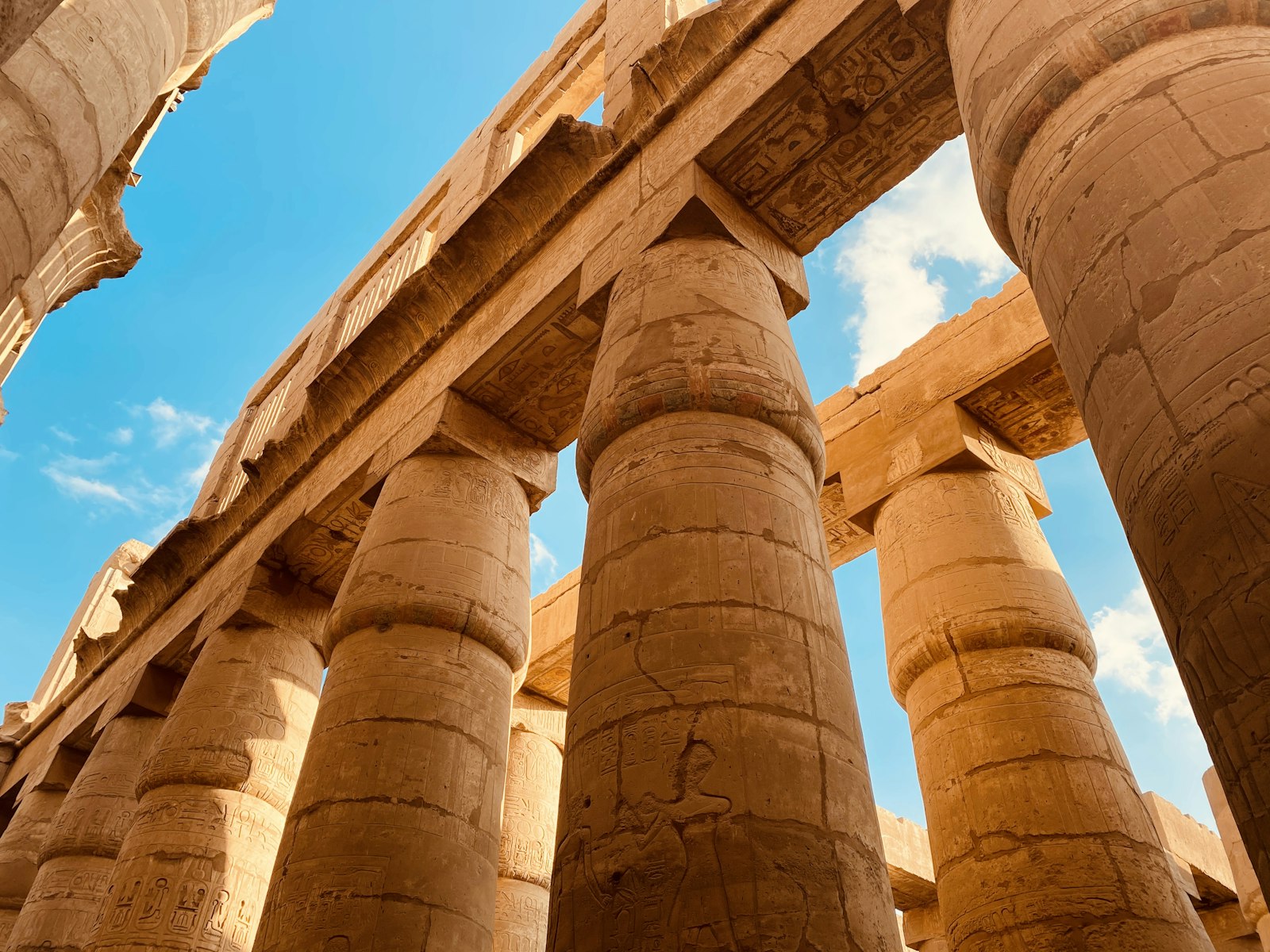
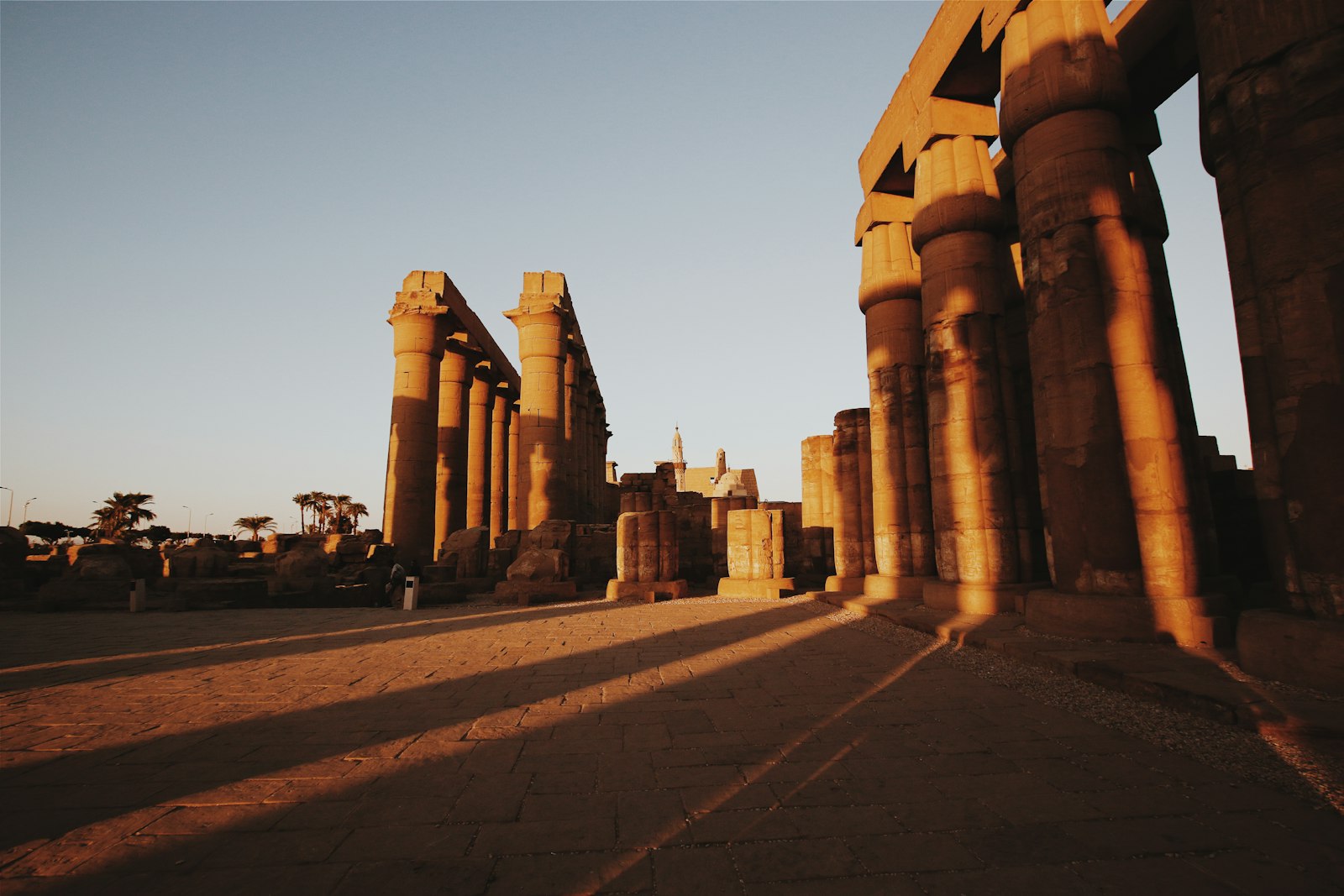
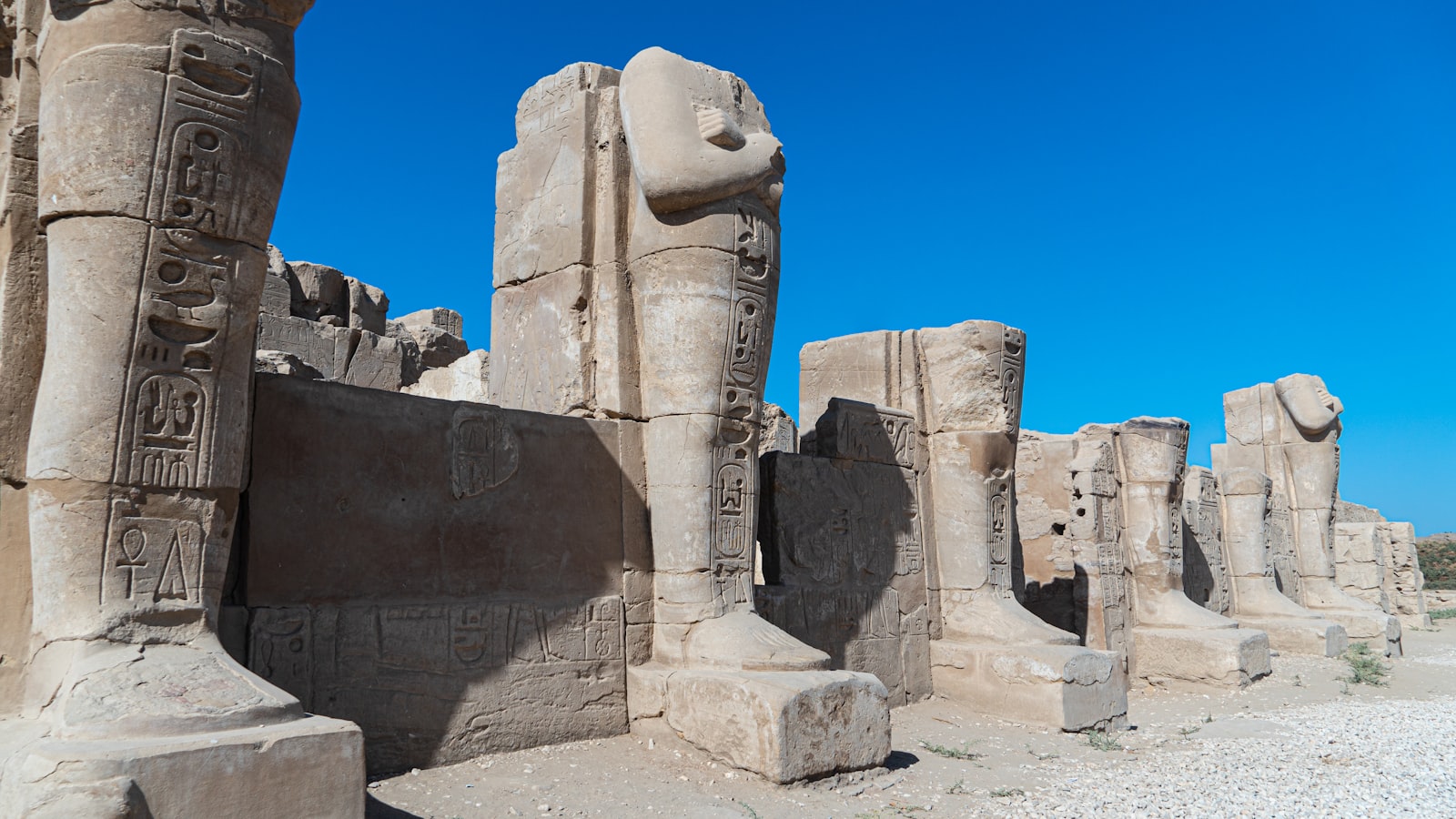
The main temple, dedicated to Montu, occupied the centre of the enclosure and was oriented towards the south, in the direction of the Precinct of Amun. The original structure probably dates back to the 12th dynasty, but it was enlarged and rebuilt several times by successive pharaohs. The visible remains today comprise stone foundations, blocks decorated with reliefs and inscriptions, column bases and fragments of architraves that testify to the original grandeur of the building.
The Portal of Ptolemy III Euergetes
The most imposing and best preserved architectural element of the Precinct of Montu is the great monumental portal erected by Ptolemy III Euergetes (246-222 BC) along the south side of the enclosure. This sandstone portal, several metres tall, presents relief decorations that depict the Ptolemaic sovereign in the act of making offerings to the god Montu and to other deities of the Theban pantheon.
The portal of Ptolemy III is an eloquent example of the religious policy of the Ptolemaic sovereigns, who although being of Greek origin and culturally Hellenistic, adopted the Egyptian religious traditions and invested considerable resources in the construction and restoration of the Egyptian temples. This portal served as a ceremonial entrance for the processions that connected the Precinct of Montu to the Precinct of Amun during the great religious festivals.
The Temple of Harpre
Inside the enclosure are also the remains of a small temple dedicated to Harpre (Horus the Child), a youthful form of the god Horus associated with kingship and rebirth. This temple, built during the 25th-26th dynasty, testifies to the complexity of the theology of the Precinct of Montu, which was not dedicated exclusively to a single deity but hosted an entire interconnected cultic system.
The Temple of Maat
Another significant building inside the enclosure was dedicated to the goddess Maat, the personification of justice, truth and cosmic order. The presence of a temple of Maat in the Precinct of Montu has a precise theological significance: Montu, as a warrior god who fought chaos, was closely associated with the maintenance of cosmic order (Maat), and his temple had to reflect this association.
The Sacred Lake
Like every Egyptian temple enclosure of a certain importance, the Precinct of Montu also possessed its sacred lake, used for the ritual purifications of the priests and for the ceremonies that required the use of sacred water. The remains of the lake are still visible in the north-eastern corner of the enclosure, although today it is completely dried up.
The French Excavations
A Historic Collaboration
The Precinct of Montu has been the object of archaeological excavations conducted by the French mission of the Centre Franco-Égyptien d'Étude des Temples de Karnak (CFEETK), a collaboration between the French Centre National de la Recherche Scientifique (CNRS) and the Egyptian Ministry of Tourism and Antiquities. This mission, active since the 1940s, has conducted systematic work of excavation, documentation and restoration that has transformed our understanding of the site.
The Main Discoveries
The French excavations have brought to light numerous finds of great importance: blocks decorated with ritual scenes, fragments of statues, inscribed stelae, foundation deposits and remains of previously unknown structures. One of the most significant discoveries was the identification of the most ancient construction phases of the temple, which have confirmed the existence of a place of worship already in the Middle Kingdom, long before the construction of the structures visible today.
The geophysical investigations conducted with magnetometers and ground-penetrating radar have revealed the presence of buried structures still to be excavated, suggesting that the Precinct of Montu still hides numerous secrets. The works of excavation and restoration are ongoing and the site evolves constantly, with new discoveries that are announced regularly.
The Restoration of the Blocks
A particularly fascinating aspect of the work of the French mission is the patient restoration of the decorated blocks found in the enclosure. Thousands of fragments are catalogued, photographed, studied and, when possible, reassembled as in a giant three-dimensional puzzle. This meticulous work has allowed the ideal reconstruction of entire walls of the original temple, revealing scenes and inscriptions that shed new light on the theology of Montu and on the history of the site.
Historical Significance
A Witness to the Origins of Thebes
The Precinct of Montu is a site of fundamental historical importance for understanding the origins of Theban grandeur. While the Precinct of Amun recounts the history of Egypt at its apogee — the New Kingdom with its conquering pharaohs and its colossal temples — the Precinct of Montu guards the memory of an earlier era, when Thebes was still a provincial city and its patron god was a warrior falcon rather than the king of the gods.
To study the Precinct of Montu means to understand how the theological revolutions of ancient Egypt were reflected in sacred architecture: the rise of Amun did not cancel the cult of Montu, but incorporated it into a wider system, where the ancient warrior god found a new role as the divine champion of the pharaoh in battle. This religious stratification is visible in the very architecture of the enclosure, where structures of different eras coexist and overlap.
Tips for the Visit
How to Get There
The Precinct of Montu is located at the northern end of the Karnak complex. Access generally takes place through the main enclosure of Amun, continuing towards the north beyond the temple of Ptah. It is advisable to verify the access conditions in advance, as the site could be partially closed for excavation works.
When to Visit
The early hours of the morning are the ideal moment to visit the Precinct of Montu, when the site is deserted and the light is soft. The tranquillity of the place allows one to immerse oneself in the atmosphere of ancient Egypt without the distractions of the tourist crowd.
What to Expect
The Precinct of Montu is an active archaeological site, not a completely restored monument. Visitors will find exposed foundations, scattered blocks, excavation trenches and fenced areas for the ongoing works. This condition requires a certain predisposition to exploration and imagination, but rewards the visitor with a sense of discovery and authenticity that the more touristy sites rarely offer.
Practical Suggestions
Wear sturdy shoes and bring sufficient water, as there are no refreshment points nearby. A specialised guide is strongly recommended, as the site lacks detailed information panels and the understanding of the ruins requires specific knowledge. Bring binoculars if you are interested in the details of the reliefs on the higher blocks.
Combining the Visit
The Precinct of Montu is naturally visited as an extension of the visit to the Precinct of Amun at Karnak. It is advisable to dedicate the morning to the main complex and to continue towards the Precinct of Montu to the north and the Precinct of Mut to the south, for a complete understanding of the entire temple system of Karnak.
Curiosities about the Precinct of Montu
The sacred bull of Montu, the Buchis, was selected according to rigorous criteria: it had to have a white coat with a black head and hairs that grew in the direction opposite to the normal one. When the sacred bull died, it was mummified and buried in the necropolis of the Bucheum at Armant, while a new bull was selected to replace it. This practice continued until the Roman period, with the last burial of a Buchis bull dated to 340 AD, making the cult of Montu one of the last traditional Egyptian cults still practised.
The name Montu still survives today in the topography of the region: Medamud, one of the four main sanctuaries of the god, is located a few kilometres north-east of Karnak, while Armant (the ancient Hermonthis, from "house of Montu") is located on the western bank of the Nile, south of Luxor. These sites, together with the Precinct of Karnak and the temple of Tod, formed a quadripartite sacred system that surrounded and protected the Theban region under the guard of the warrior falcon god.