Memphis: The First Capital of Unified Egypt
Memphis, whose memory survives today in the modest village of Mit Rahina, about 20 kilometres south of Cairo, was for millennia the most important city in all of Egypt and one of the largest and most influential metropolises of the ancient world. Founded around 3100 BC by the legendary pharaoh Menes, the first ruler of unified Egypt, Memphis served as the political, religious and administrative capital for much of pharaonic history. Its original Egyptian name, Ineb-Hedj ("The White Walls"), and the later Men-nefer ("Stable and Beautiful"), from which the Greek name Memphis derives, evoke the image of a majestic and shining city that today, unfortunately, has almost completely vanished beneath the floods of the Nile and modern constructions.
The archaeological site of Memphis, declared a World Heritage Site by UNESCO together with the surrounding necropolises, offers visitors today an open-air museum that, although modest in size, preserves invaluable testimonies of the city's past grandeur.
History of Memphis
The Foundation and the Old Kingdom
According to the tradition handed down by the Egyptian historian Manetho, Memphis was founded by the pharaoh Menes (identified by many scholars with Narmer), who around 3100 BC unified Upper and Lower Egypt under a single crown. Legend tells that Menes diverted the course of the Nile to create the space needed for the construction of his new capital, a grandiose engineering feat which, if confirmed, would testify already at its origins to the extraordinary organisational capacity of Egyptian civilisation.
The location of Memphis was chosen with strategic acumen: situated at the apex of the Nile delta, at the point where the river begins to divide into its branches, the city controlled both the river communication routes towards the Mediterranean and the trade routes towards Upper Egypt. This position made it a natural crossroads for trade, communications and military control of the entire country.
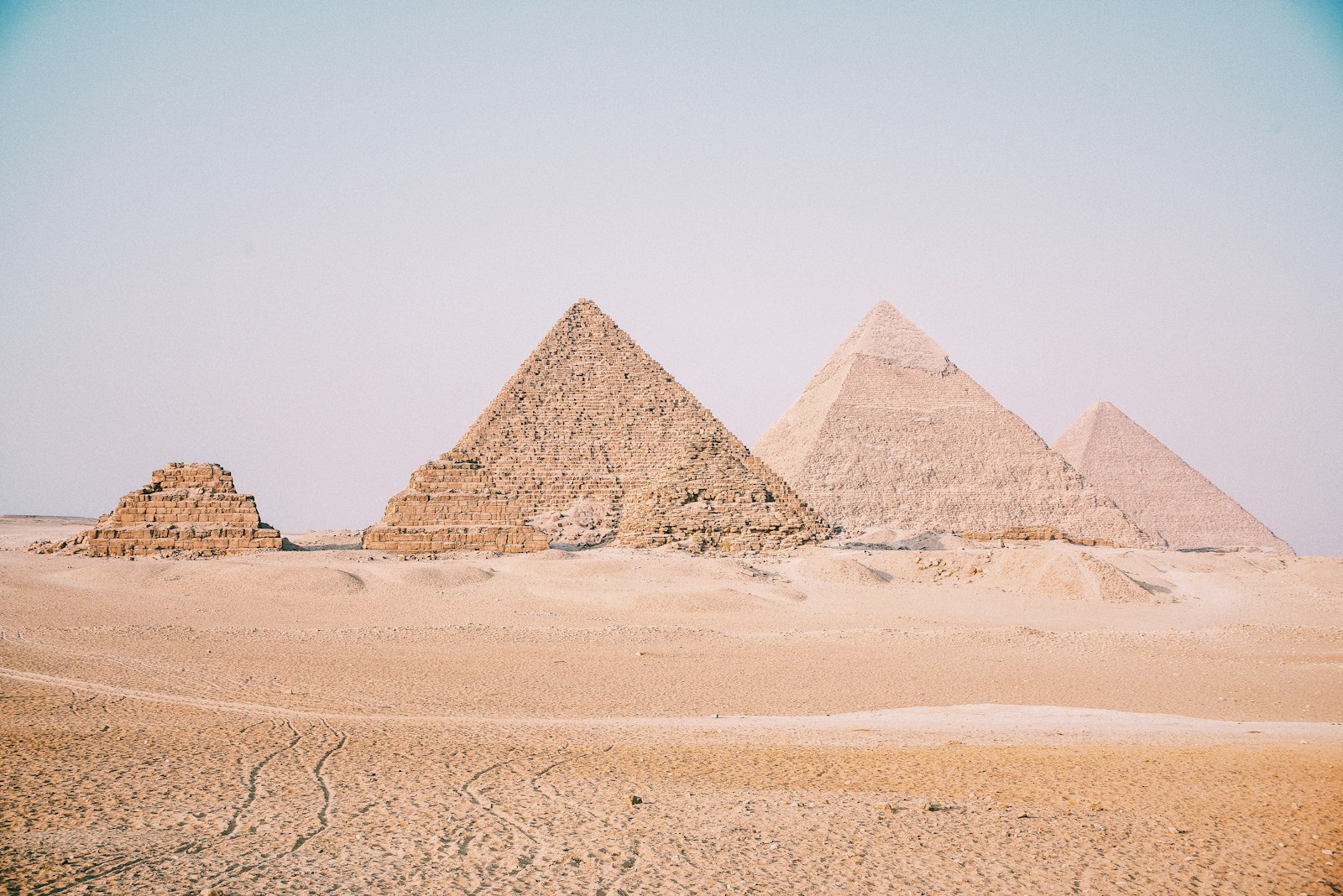
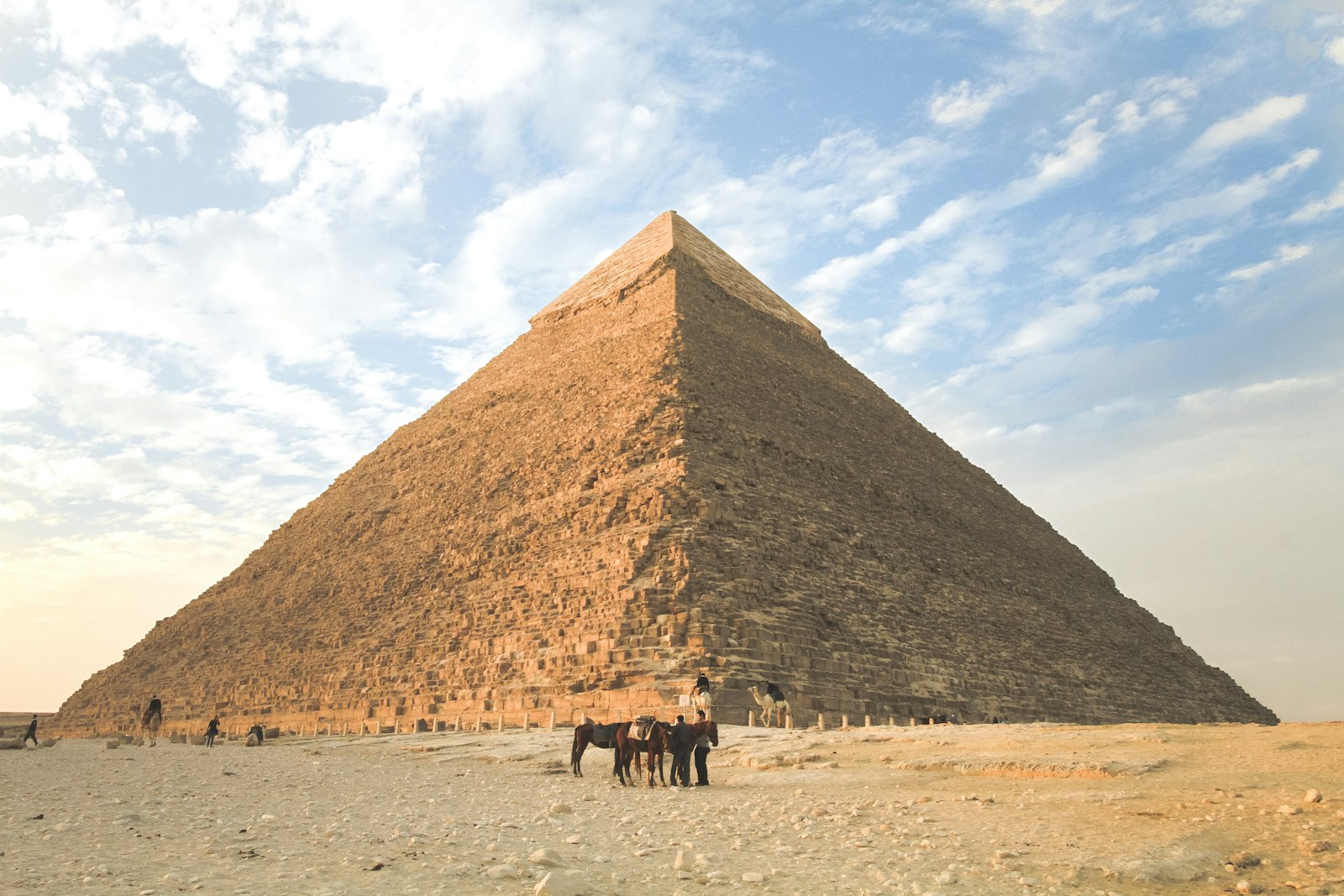
During the Old Kingdom (2686-2181 BC), Memphis reached its first apogee. It was the seat of the pharaonic court during the great dynasties of the pyramid builders, from the Third to the Sixth dynasty. The pyramids of Giza, Saqqara, Dahshur and Abusir were all built as necropolises of the capital, arranged along the western margin of the Nile valley a few kilometres from the city. The extent of these necropolises indirectly testifies to the grandeur and wealth of Memphis during this period.
The Cult of Ptah
Memphis was above all the city of the god Ptah, one of the most important deities of the Egyptian pantheon. Ptah was the creator god according to Memphite theology: through the thought of his heart and the word of his tongue, he had given origin to all beings and all things. His great temple, the Hut-Ka-Ptah ("Dwelling of the Ka of Ptah"), was one of the largest and richest in all of Egypt. It is interesting to note that from the name of this temple the Greek word Aigyptos and, ultimately, the modern name "Egypt" may derive.
The temple of Ptah was constantly enlarged and renovated over the millennia. Ramesses II, in particular, added monumental structures during the Nineteenth dynasty. The priests of Ptah enjoyed enormous influence and their high priest was one of the most powerful figures in the entire state hierarchy. The cult of the Apis bull, the living incarnation of Ptah, had its centre precisely at Memphis, and the sacred bulls were buried in the famous Serapeum of Saqqara.
Apogee and Decline
Memphis maintained its importance through the vicissitudes of Egyptian history. Even when the capital was moved to Thebes during the New Kingdom, Memphis remained a city of primary administrative and religious importance. It was under the Ramessides that the city experienced a second period of great splendour, with the construction of temples, palaces and colossal monuments.
The decline of Memphis began with the foundation of Alexandria by Alexander the Great in 331 BC. The new capital, facing the Mediterranean and open to the Greek world, progressively attracted population, trade and investments that had previously been destined for Memphis. Under the Ptolemies and then under the Romans, Memphis gradually lost its central role, although it continued to host important religious ceremonies.
The final blow came with the Arab conquest in the seventh century AD. The stones of the temples and palaces of Memphis were systematically dismantled and transported to Cairo for the construction of mosques, palaces and fortifications. Over the following centuries, the floods of the Nile progressively covered the remains of the city with layers of fertile silt, and the agricultural village of Mit Rahina developed directly above the ruins. Today, the vast majority of ancient Memphis lies buried beneath cultivated fields and modern dwellings, making extensive excavations impossible.
The Open-Air Museum
The Exhibition Space
The visitable archaeological site of Memphis is organised as an open-air museum occupying a relatively contained area in the village of Mit Rahina. The museum was created in the twentieth century to gather and protect the most significant finds that emerged from occasional excavations in the area. The exhibition area is divided into an open-air garden, where statues, stelae, sarcophagi and architectural elements are arranged, and a covered building that houses the most famous piece of the collection.
The Alabaster Sphinx
Among the finds displayed in the museum garden, the Alabaster Sphinx is certainly the most fascinating. Carved from a single block of calcite alabaster, this sphinx weighs about 80 tonnes and measures about 8 metres in length by 4 in height. Its dating is uncertain: it has been attributed to various pharaohs, from Amenhotep II to Hatshepsut, but the absence of inscriptions makes a definitive identification impossible.
The sphinx of Memphis stands out from other Egyptian sphinxes for the material used: alabaster, a translucent and precious stone, rarely employed for sculptures of these dimensions. The workmanship is refined: the serene and idealised face, the finely detailed nemes headdress and the powerful paws give the statue an exceptional artistic quality. The current position of the sphinx, in the open-air garden of the museum, allows it to be admired up close and its sculptural details to be appreciated.
Other Significant Finds
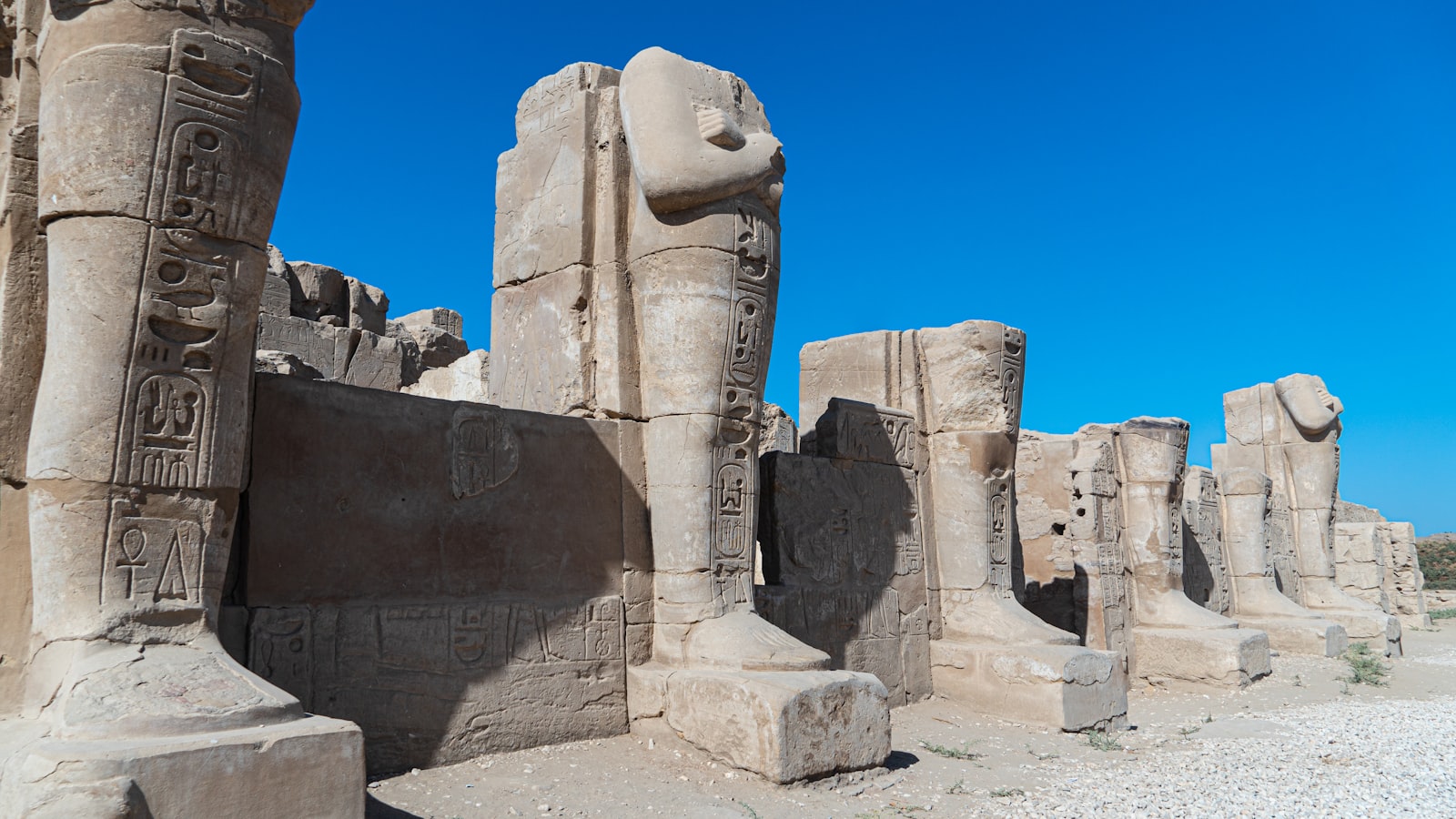
The museum garden houses numerous other finds of great interest. Statues from various eras, from those of the Old Kingdom to the Ptolemaic period, are arranged along the paths shaded by palms. Particularly noteworthy are the fragments of columns from the temple of Ptah, the votive stelae with hieroglyphic inscriptions and the offering tables that attest to the long continuity of religious worship in the city.
A large alabaster embalming table, used for the preparation of the mummies of the Apis bulls, is displayed in a prominent position and offers tangible testimony of the funerary rituals practised at Memphis. Several granite sarcophagi, although less spectacular than those of the Serapeum, complete the collection and document the funerary practices of the Memphite nobility.
The Legacy of Memphis
Influence on Egyptian Civilisation
The importance of Memphis in the history of Egyptian civilisation is difficult to overestimate. For over three millennia, the city was the nerve centre of the political, religious and cultural life of Egypt. From Memphis military expeditions departed, here tributes and goods from all over the country and from abroad converged, and in its temples and schools the administrative and religious elite that governed the nation was formed.
Memphite theology, with Ptah as the creator god, represented one of the most sophisticated religious traditions of ancient Egypt, influencing religious thought not only Egyptian but also of the later Mediterranean cultures. The concept of creation through the divine word, elaborated by the priests of Memphis, presents surprising analogies with later religious traditions and testifies to the intellectual depth reached by Memphite civilisation.
Memphis and the Concept of Heritage
The history of Memphis is also a warning about the fragility of cultural heritage. One of the greatest cities of the ancient world has today almost completely vanished, the victim not so much of natural catastrophes as of the systematic spoliation of its construction materials over the centuries. The stones of the pharaonic temples built with the labour of thousands of workers were reused for buildings that in turn have often disappeared, in a cycle of destruction and reconstruction that has erased almost every visible trace of the ancient capital.
Tips for the Visit
How to Get There
The site of Memphis is located in the village of Mit Rahina, reachable from Cairo in about 30-40 minutes by car. The visit is generally combined with that of the nearby necropolises of Saqqara and Dahshur, creating a day itinerary that covers some of the most important sites of ancient Egypt outside Giza. It is advisable to visit Memphis as the first or last stop of the itinerary, given the relatively short duration of the visit.
What to Expect
The visit to the site of Memphis generally requires one or two hours. The open-air museum is of contained dimensions and can be explored without haste. The covered building that houses the colossal statue of Ramesses II is the ideal starting point, followed by a walk in the garden to admire the Alabaster Sphinx and the other finds. Local guides are available at the entrance and can considerably enrich the experience with historical information and anecdotes.
Practical Recommendations
The site is in the open air and offers little shade, so a hat, sunscreen and abundant water are recommended, especially in the hot months. Comfortable shoes are sufficient to walk the museum's paths. Photography is permitted everywhere, with a supplement for the use of professional video cameras. Toilets are available at the site entrance.
Visiting Memphis today requires a certain effort of imagination: the few visible remains do not do justice to the grandeur of the city that was. Yet precisely this contrast between the modesty of the ruins and the magnificence of the history gives the site a particular charm, inviting the visitor to reflect on the transience of human works and on the unstoppable force of time. Memphis was the cradle of Egyptian civilisation, and even in its most fragmentary remains, that original grandeur continues to shine through for those who know how to look beyond the surface.