The Temple of Athribis: Archaeological Discoveries in the Heart of Middle Egypt
The Temple of Athribis is one of Egypt's most fascinating and least known archaeological sites, a place where discoveries continue to emerge from the sand with a frequency that excites the international scientific community. Located near modern Wannina, about 15 kilometers west of Sohag in Middle Egypt, Athribis (Ancient Egyptian Hut-Repyt, "House of Repyt") was an important religious center dedicated to the lioness goddess Repyt and the fertility god Min-Ra.
The ancient city of Athribis extended over a vast area, of which only a small part has so far been explored. The main temple, dating back to the Ptolemaic period (2nd-1st century BC), is the most monumental structure on the site and represents the focus of the excavations conducted by the joint German-Egyptian mission of the University of Tübingen and the Egyptian Ministry of Tourism and Antiquities.
The Ancient City of Athribis
A Forgotten Religious Center
Athribis was one of the most important cities of the 9th nome of Upper Egypt throughout the Pharaonic, Ptolemaic and Roman periods. Its name, which means "House of Repyt", indicates the centrality of the cult of the lioness goddess Repyt (or Triphis in Greek), a local deity often associated with Sekhmet and Hathor. Alongside Repyt, the city's main cult was dedicated to Min, the god of fertility and protector of the desert ways, worshiped in his syncretic form of Min-Ra.
Despite its importance in antiquity, Athribis fell into oblivion after the Roman period and was progressively buried under layers of sand and debris. For centuries, the site was known only through rare mentions in the writings of travelers and scholars. Only at the end of the 20th century, with the beginning of systematic excavations by the German-Egyptian mission, did the temple begin to reveal its secrets.
The Excavation Campaigns
The excavations at Athribis, directed by Professor Christian Leitz of the University of Tübingen, represent one of the most ambitious archaeological projects currently underway in Egypt. Each excavation season brings to light new structures, reliefs and finds that enrich our understanding of the site and Egyptian culture of the Ptolemaic period.
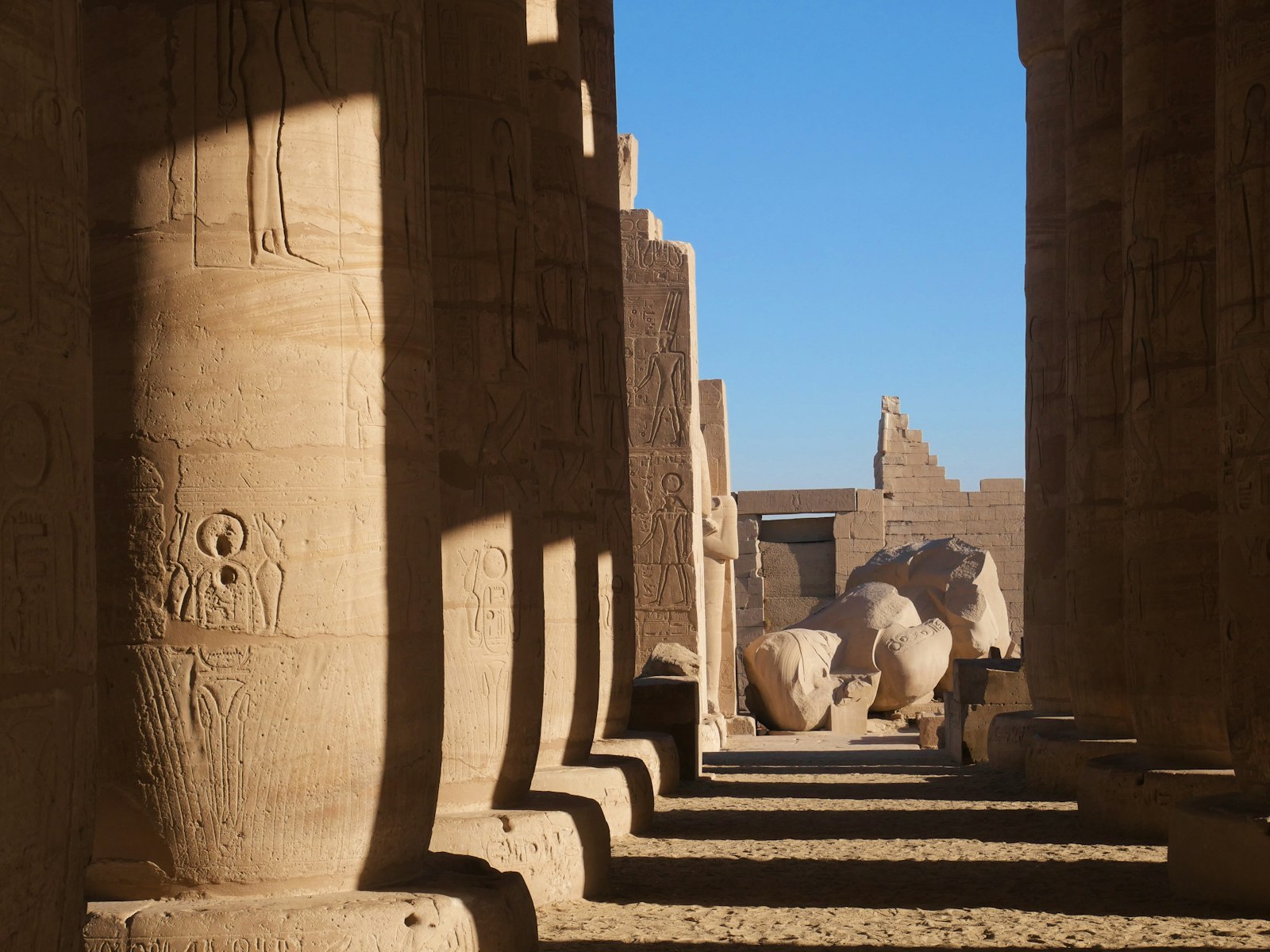
The size of the main temple turned out to be much more impressive than initially expected. Archaeologists have discovered hypostyle halls, colonnaded courtyards, side chapels and ritual rooms decorated with reliefs of an artistic quality comparable to that of the great temples of Dendera and Edfu. The work of documentation, cleaning and consolidation of the reliefs proceeds in parallel with the excavations, creating a digital archive of inestimable value.
The Monumental Reliefs
The Zodiac of Lions
Among the most sensational discoveries is a large zodiac relief that differs profoundly from other known ancient Egyptian zodiacs. Unlike the circular Dendera zodiac, the Athribis zodiac presents the constellations in a novel arrangement, with lion figures dominating the composition. It is a one-of-a-kind astrological representation, which reflects the importance of the leonine cult in Athribis and offers new insights into the understanding of Egyptian astronomy of the Ptolemaic period.
The Athribis zodiac has been dated to the 2nd century BC. and shows a fusion of Egyptian and Greco-Babylonian astronomical traditions. The zodiac figures are accompanied by hieroglyphic and demotic inscriptions that identify their names and characteristics, providing scholars with precious material for studying the evolution of astrology in the ancient world.
Medical Instrument Surveys
Another discovery of extraordinary interest is a series of reliefs depicting medical and surgical instruments with an astonishing level of detail. These reliefs, carved on large limestone blocks, show scalpels, forceps, probes, surgical spoons and other instruments that document the advanced medical knowledge of ancient Egypt.
The presence of these reliefs in a temple suggests the close link between medicine and religion in ancient Egypt. Temples often served as health centers where physician-priests practiced their arts under divine protection. In the case of Athribis, the goddess Repyt was probably invoked as the protector of healers, in continuity with the tradition that associated lioness goddesses with therapeutic powers.
The Ritual and Astronomical Scenes
The temple reliefs also include elaborate ritual scenes showing the Ptolemaic pharaoh making offerings to the deities of Athribis. These scenes follow the iconographic tradition of Egyptian temples, but present stylistic elements typical of the Ptolemaic period, with particular attention to the rendering of anatomical details and ceremonial robes.
The walls of the temple also preserve astronomical representations showing the night sky with its constellations, decans and planets. These celestial scenes are of great importance to historical astronomers, as they document the state of Egyptian astronomical knowledge in a period of intense cultural exchange with the Greek world.
The Ostraca and the Scholastic Exercises
One of Athribis's most unexpected discoveries is the discovery of approximately two thousand ostraca — pottery and limestone fragments used as a support for writing — bearing scholastic exercises dating back to the Ptolemaic period. These ostraca show exercises in hieroglyphic, demotic and Greek writing, with repetitions of signs and phrases that suggest the presence of a scribal school attached to the temple.
The exercises range from learning basic hieroglyphic signs to copying religious and literary texts. Some ostraca show corrected errors, others bear arithmetic calculations and multiplication tables. This teaching material offers a unique window into the educational system of Ptolemaic Egypt and testifies to the vitality of the scribal tradition in an era when Greek was progressively supplanting Egyptian as the language of administration.
Scholars have also found ostraca with lists of deities, holiday calendars and ritual formulas, which contribute to understanding the religious life of the temple. Each fragment was catalogued, photographed and studied by the team at the University of Tübingen, and the results are published regularly in scientific volumes that greatly enrich our knowledge of ancient Egypt.
The Goddess Repyt and the God Min-Ra
The goddess Repyt, the chief deity of Athribis, is a lioness goddess whose worship has been attested since the Old Kingdom. Her name is often translated as "the Noble One" and her leonine appearance links her to the great family of Egyptian feline goddesses, which includes Sekhmet, Bastet, Tefnut and Menhit. In Athribis, Repyt was venerated as wife of Min and mother of the young god Kolanthes, forming a divine triad typical of Egyptian theology.
Min-Ra, the consort of Repyt, is a syncretic form that combines the ithiphallic god Min, protector of fertility and desert travelers, with the solar god Ra. This fusion reflects the theological tendency of the late Pharaonic and Ptolemaic periods to unify local deities with the great cosmic deities, creating increasingly complex and universal divine forms.
Current discoveries and future prospects
The Athribis site is far from fully explored. Every year, new excavation campaigns reveal structures and finds that change our understanding of the site. Recent discoveries include a necropolis with burials of sacred animals, mainly crocodiles and birds, and a series of residential environments that testify to the presence of a stable community around the temple.
The future prospects are exciting: geophysical investigations have revealed the presence of buried structures over a much larger area than that excavated so far, suggesting that Athribis still hides many secrets. The Egyptian government has expressed its intention to make the site accessible to tourism in a more structured way, including the construction of a visitor center and adequate visit routes.
Tips for the Visit
How to Get There
The Athribis site can be reached by taxi from the city of Sohag, with a journey of approximately 20-25 minutes. We recommend combining the visit with that of the nearby White and Red Monasteries, creating a one-day itinerary in Middle Egypt. Taxis can be hired from Sohag Railway Station at affordable rates.
Tickets and Access
Access to the site is generally possible during opening hours with a cheap entrance fee, although accessibility may vary depending on the excavation activities taking place. It is advisable to check the opening status of the site by contacting the Sohag tourist office before your visit.
What to Bring
The site is largely open air and offers little shade. Bring plenty of water, sunscreen, a hat and sturdy shoes suitable for uneven and sandy terrain. There are no food services nearby, so it is advisable to bring some snacks.
Photography Tips
The temple reliefs are the main photographic subject. To capture the details of the sculptures, photograph during the hours when the grazing light of the morning or late afternoon creates shadows that highlight the reliefs. A telephoto lens is useful for details of zodiacs and medical instruments located in high positions on walls.
Athribis is a site for enthusiasts and curious people who wish to experience the emotion of a place where archeology is still in full swing, where every visit can coincide with a new discovery and where the past continues to emerge before our eyes.