The Temple of Dendera: the Splendour of the Goddess Hathor
The Temple of Dendera is one of the most extraordinary archaeological jewels of Upper Egypt, a place where time seems to have stood still for over two thousand years. Located on the western bank of the Nile, about 60 kilometres north of Luxor and not far from the city of Qena, this temple complex is dedicated to the goddess Hathor, deity of music, love, beauty and joy. What makes Dendera unique in the panorama of Egyptian temples is its exceptional state of preservation: the polychrome ceilings, the minutely detailed reliefs and the architectural structures have come down to us in conditions that have few equals in all of Egypt.
The construction of the present temple dates mainly to the Ptolemaic and Roman period, between the 1st century BC and the 1st century AD, although the site was already sacred to Hathor as far back as the Old Kingdom. The Ptolemaic pharaohs, descendants of the Greek generals of Alexander the Great, wished to legitimise their power through the construction of sumptuous temples dedicated to the Egyptian deities, and Dendera represents one of the most successful examples of this religious policy.
The Astronomical Ceiling and the Zodiac of Dendera
The most famous element of the temple is without doubt its extraordinary astronomical ceiling. Entering the hypostyle hall, the visitor is left literally open-mouthed before the ceiling decorated with a complex celestial map representing the constellations, the celestial deities and the astronomical phenomena known to the ancient Egyptians. The original colours — deep blue, ochre yellow, red and green — are still visible and create a visual effect of rare power.
The famous Zodiac of Dendera, a circular bas-relief that decorated the ceiling of a chapel on the roof of the temple, is perhaps the best-known astronomical representation of ancient Egypt. The original was removed in 1821 by French engineers and is today in the Louvre Museum in Paris, replaced in situ by a plaster copy. The zodiac depicts the twelve zodiacal constellations known to the Greco-Egyptian tradition, together with thirty-six decans and representations of the five planets visible to the naked eye. This astronomical document has been the object of heated scientific debate ever since its discovery, since some scholars have tried to use it to date precisely astronomical events of antiquity.
The Façade and the Hypostyle Hall
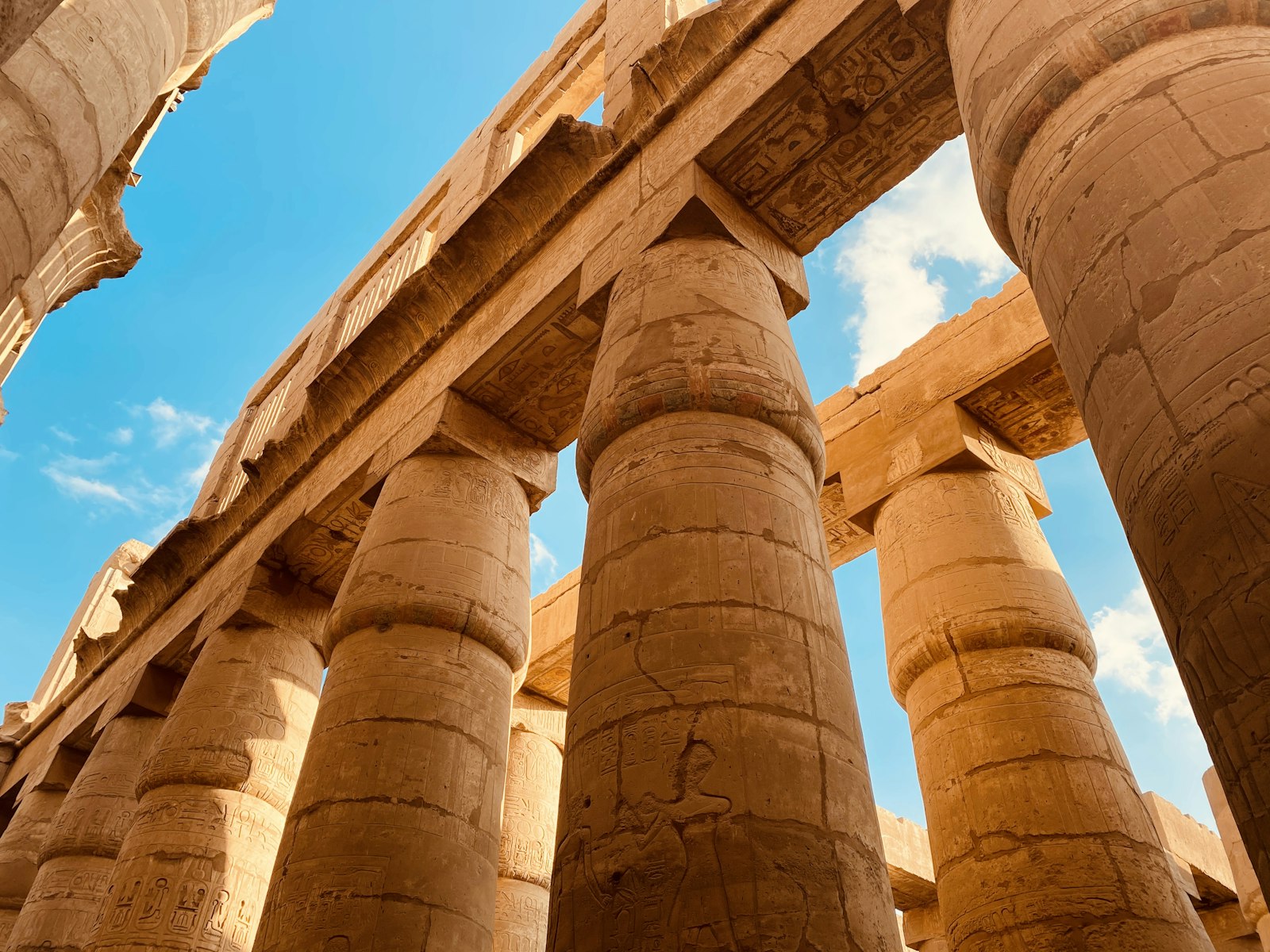
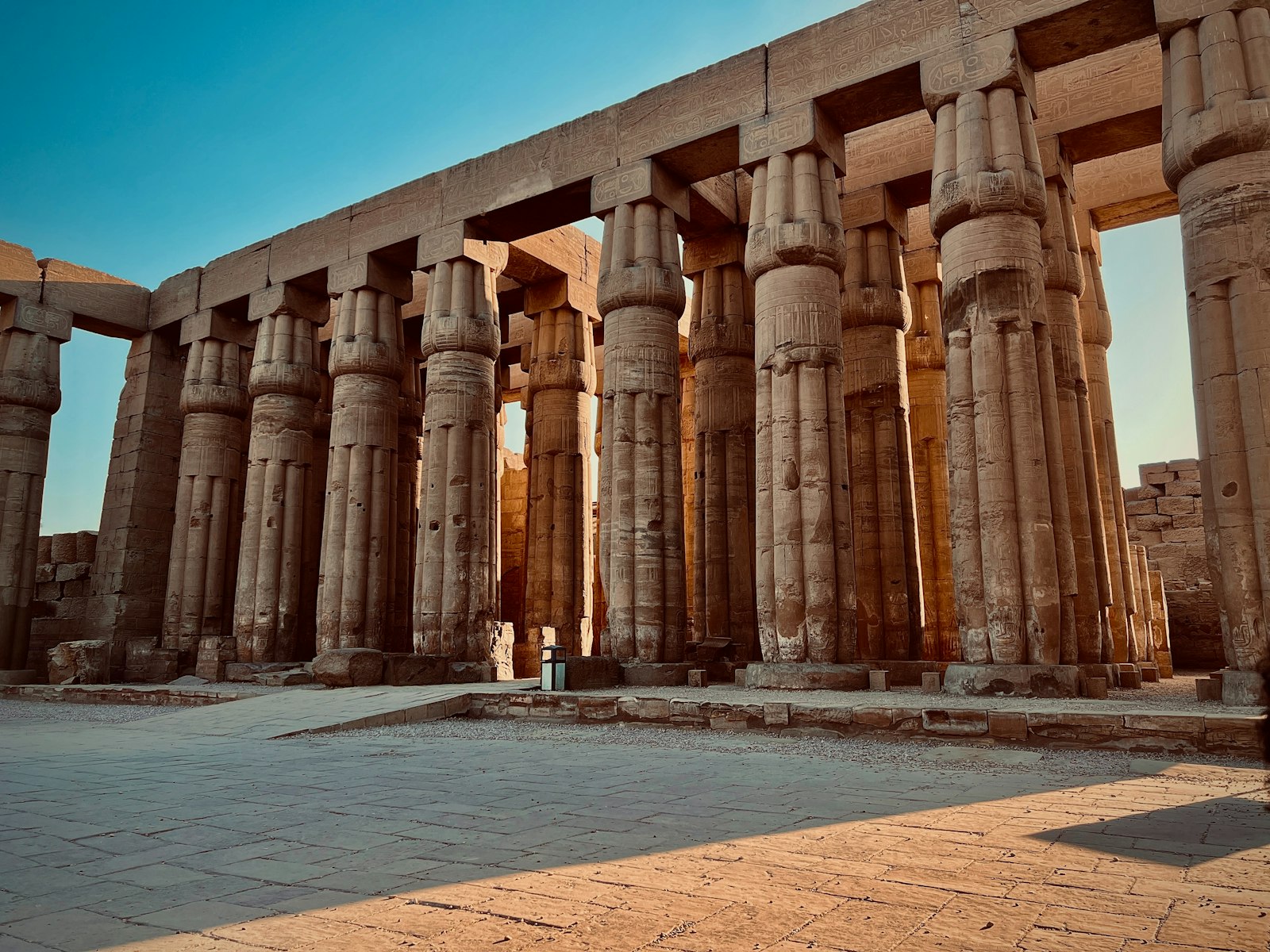
The façade of the temple is one of the most imposing of all Ptolemaic Egypt. Six enormous Hathoric columns — each surmounted by a capital depicting the face of the goddess Hathor on its four sides — support a massive architrave decorated with ritual scenes. These columns, over fifteen metres high, create an effect of monumentality that must have deeply impressed the faithful who approached the sanctuary.
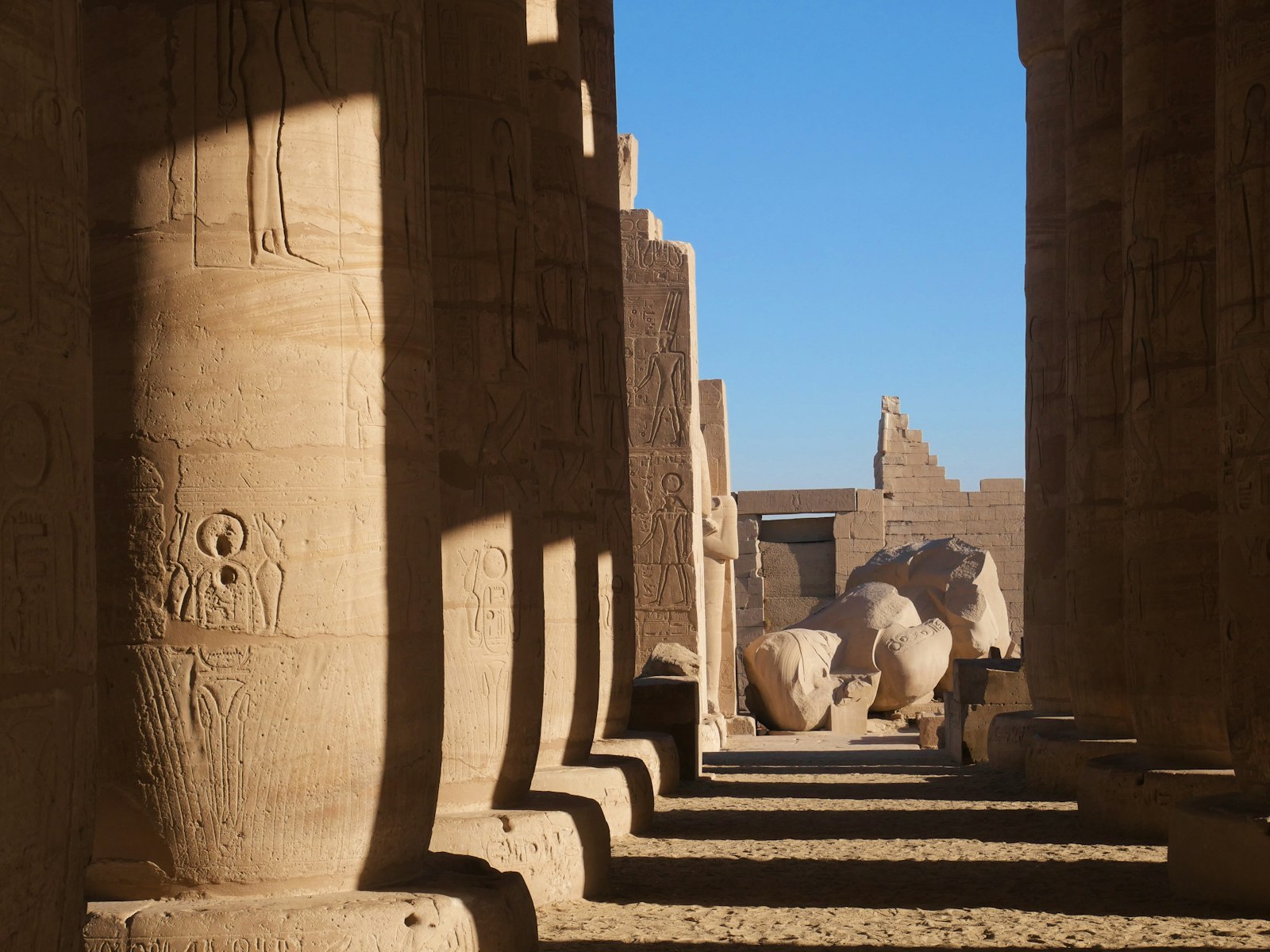
The inner hypostyle hall houses eighteen similar columns, also with Hathoric capitals. Each column is decorated with very fine reliefs representing the pharaoh in the act of performing rituals in honour of the goddess. The artistic quality of these reliefs is exceptional: the anatomical details, the garments, the jewels and the divine attributes are rendered with a precision that bears witness to the skill of the stonecutters of the Ptolemaic era.
Cleopatra VII and Caesarion on the Outer Wall
One of the most fascinating aspects of the temple is the rear outer wall, where there is a large relief depicting Cleopatra VII, the last queen of the Ptolemaic dynasty, together with her son Caesarion, born of her relationship with Julius Caesar. This is one of the very few contemporary representations of Cleopatra in an Egyptian monumental context, and it shows the queen in the act of offering incense to the gods, dressed with the traditional pharaonic royal attributes.
The relief of Cleopatra and Caesarion has become one of the most photographed points of interest of the temple, not only for its historical value but also for the artistic quality of the execution. Cleopatra is depicted with the double crown of Upper and Lower Egypt, while the young Caesarion appears in the robes of a pharaoh to all effects, legitimised by his mother as heir to the throne of Egypt.
The Mammisi and the Underground Crypts
Within the sacred enclosure stands the mammisi, that is the "house of birth", a small temple dedicated to the celebration of the divine birth of the son of Hathor and Horus. The mammisi of Dendera, built in the Roman era under the emperor Augustus and completed by Trajan, is decorated with reliefs illustrating the myths connected with the birth of the god Ihy, divine son of the sacred couple. The scenes are of great delicacy and show the goddess Hathor in the act of suckling the divine newborn, surrounded by protective deities.
The underground crypts of the temple are another element of great interest. These narrow, low corridors, hollowed out in the thickness of the walls, were used to keep sacred objects, statues and ritual furnishings. The walls of the crypts are decorated with reliefs of extraordinary finesse, among which the very famous relief of the so-called "Dendera light bulb", which shows a serpentine figure inside what looks like a large glass ampulla. This image has fuelled numerous pseudoscientific theories about the use of electricity in ancient Egypt, while Egyptologists interpret it as a mythological representation connected with the myth of creation and the lotus flower.
The Vivid Colours of the Temple
One of the most surprising characteristics of Dendera is the preservation of the original colours. In many areas of the temple, the pigments applied over two thousand years ago are still vivid and intense. The deep blues of the ceilings, obtained from lapis lazuli or azurite, the brilliant yellows of the skin of the deities, the greens of the plants and the reds of the clothing create a chromatic effect that allows the visitor to imagine the original splendour of the Egyptian temples, usually perceived as monochrome because of the erosion of time.
This exceptional preservation is due in part to the roofing of the temple, which protected the interior decorations from the atmospheric agents, and in part to the dry climate of Upper Egypt. Some ceilings show traces of soot due to the fires lit by the Coptic Christians who used the temple as a church in the first centuries of the Christian era, but even these traces help to tell the millennial history of the monument.
The Sacred Lake and the Accessory Structures
The complex of Dendera also includes a sacred lake, today dried up, which was used for the ritual ceremonies of purification. The dimensions of the lake bear witness to the importance of the cult of Hathor and to the richness of the celebrations that took place in the temple, in particular the Festival of the Beautiful Reunion, during which the statue of Hathor was carried in procession along the Nile to the temple of Horus at Edfu to celebrate the sacred union between the two deities.
The enclosure of the temple also comprises a sanatorium where the sick went to receive miraculous cures through the intercession of the goddess, as well as several minor chapels, storerooms and a deep well that provided the sacred water for the rituals.
The Roof of the Temple
One of the most evocative experiences for the visitor is the ascent to the roof of the temple by means of an internal staircase decorated with reliefs depicting ritual processions. From the roof one enjoys a spectacular panoramic view over the surrounding countryside, the Nile and the desert on the horizon. The chapels on the roof were dedicated to the rituals of the regeneration of Osiris and hosted ceremonies during which the divine statues were exposed to the rays of the sun to be "recharged" with divine energy.
Tips for the Visit
How to Get There
Dendera is easily reached from Luxor with a half-day excursion. Most local tour operators offer combined Dendera-Abydos visits that depart early in the morning and return in the early afternoon. Alternatively, it is possible to reach the site by private taxi from Qena, the nearest city, in about thirty minutes. The cost of a private taxi from Luxor is reasonable if divided among several people.
Tickets and Opening Hours
The temple is open every day from 7:00 to 17:00. The entrance ticket has a modest cost compared with other principal Egyptian sites. It is advisable to arrive at opening time to enjoy the temple with few other visitors and in the morning light, which is particularly evocative.
What to Bring
Bring with you an electric torch, indispensable for exploring the underground crypts and appreciating the details of the reliefs in the half-light. Artificial light reveals details invisible to the naked eye. Comfortable shoes, abundant water and sun protection are essential. Do not forget a light jacket if you visit the crypts, where the temperature is cooler.
Photographic Suggestions
The polychrome ceilings of the temple are the most coveted photographic subject. To capture the vivid colours, use a wide-angle lens and high ISO settings, since the interior lighting is limited. The relief of Cleopatra on the outer wall is best photographed in the early morning light, when the raking sun enhances the details of the reliefs.
To visit the Temple of Dendera means to immerse oneself in one of the most magical places of ancient Egypt, where art, religion and astronomy blend in a harmony that continues to enchant anyone who crosses its millennial doors.