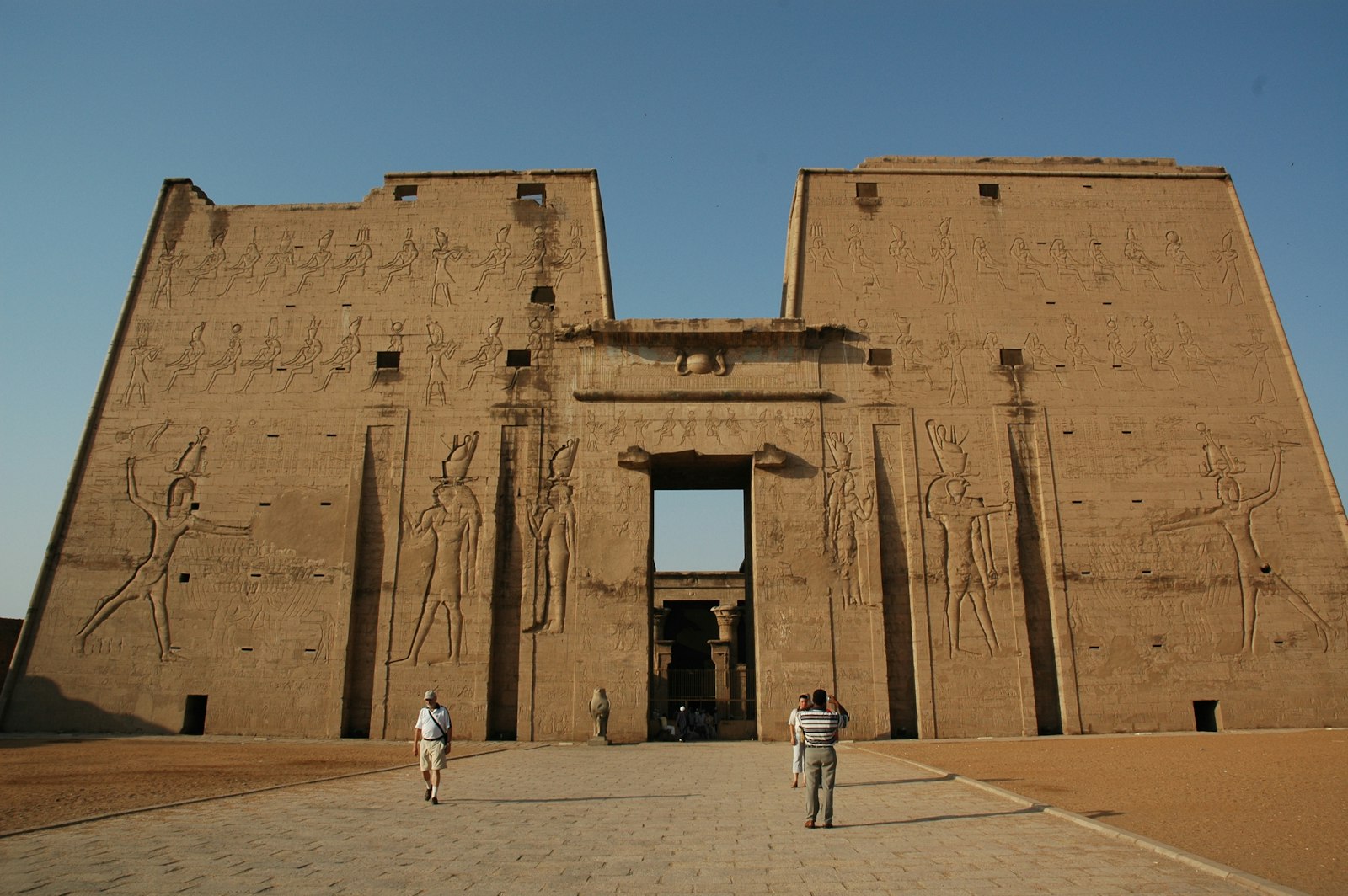
Hermopolis Magna: The Sacred City of the God Thoth
Hermopolis Magna, known today as El Ashmunein, was one of the most important and ancient cities of pharaonic Egypt, a centre of wisdom and religious cult that maintained its prestige for over three thousand years. Situated on the western bank of the Nile, in the region of Middle Egypt, a few kilometres from the modern city of Mallawi, this sacred metropolis was consecrated to the god Thoth — divinity of wisdom, of writing, of magic and of the moon — and kept one of the most fascinating cosmogonic myths of Egyptian religion: that of the Ogdoad.
The Egyptian name of the city was Khmunu, which means "City of the Eight", in reference to the eight primordial divinities of the Ogdoad. The Greeks renamed it Hermopolis, identifying Thoth with their god Hermes, messenger of the gods and patron of knowledge. For centuries, Hermopolis was the principal centre of cult of Thoth in all of Egypt and a place of pilgrimage for scholars, priests and scribes.
The Cosmogonic Myth of the Ogdoad
The Eight Primordial Divinities
The Hermopolitan cosmogony is one of the most ancient and sophisticated mythological traditions of Egypt. According to this myth, before the creation of the world there existed eight primordial divinities — the Ogdoad — that incarnated the forces of primeval chaos. These eight divinities were organised in four male-female couples: Nun and Naunet (the primordial waters), Huh and Hauhet (spatial infinity), Kuk and Kauket (darkness) and Amun and Amaunet (invisibility or air).
According to the myth, these eight primordial forces, interacting among themselves in the primordial waters of Nun, generated the primordial mound — the first earth emerged from chaos — precisely in the place where Hermopolis would arise. On this mound settled a cosmic egg, from which was born the sun, the god Ra, who illuminated the universe and gave start to the creation of all living things. This cosmogonic narration had a remarkable philosophical depth, anticipating concepts that would be developed by the Greek pre-Socratic philosophers millennia later.
The Role of Thoth
Thoth, lord of Hermopolis, occupied a unique position in the Egyptian pantheon. God of wisdom, inventor of hieroglyphic writing, patron of scribes and keeper of the sciences, Thoth was considered the "heart and tongue" of the sun god Ra — he who translated the divine will into word and action. He was also the judge of the gods, the mediator in the conflicts between Horus and Seth, and the guarantor of justice in the weighing of the heart during the judgement of the deceased in the afterlife.
His iconographic representation showed him as a man with the head of an ibis or in the form of a baboon, both sacred animals that were raised and venerated en masse in the city and in the nearby necropolis of Tuna el-Gebel. The Roman writer Claudius Aelianus recounts that the priests of Hermopolis fed thousands of sacred ibises in the enclosures of the temple.
The Monuments of Hermopolis
The Colossi of Baboons of Amenhotep III
The most iconic monuments of Hermopolis are the colossal granite statues of baboons, erected by the pharaoh Amenhotep III (18th dynasty, about 1390-1352 BC) in the enclosure of the temple of Thoth. These imposing sculptures, about 4.5 metres high and weighing several tonnes each, represent baboons seated in the typical pose of the adoration of the rising sun — the front paws raised and the mouths open in a cry that symbolises the salute to the dawn.
The baboons of Amenhotep III are among the largest and best preserved animal sculptures of ancient Egypt. Two of them are still found in situ, partially restored, and their majestic presence dominates the landscape of the ruins. The choice of the baboon as the sacred form of Thoth reflects the observation by the ancient Egyptians of the behaviour of these primates, which at dawn emit sonorous vocalisations turned towards the rising sun, a gesture interpreted as an act of divine adoration.
The Temple of Thoth
The great temple of Thoth, religious heart of the city, was built and enlarged over the course of several dynasties. The most ancient nucleus probably dates to the Middle Kingdom, but the most significant structures were erected during the New Kingdom, in particular under Ramesses II, who built an imposing colonnade using in part blocks of stone coming from the nearby and dismantled Amarna (Akhetaten).
This practice of reuse of the Amarnian materials (the so-called talatat — small standardised blocks introduced by Akhenaten to speed up the construction of the temples of Aten) was systematic: thousands of these blocks decorated with scenes of the Amarnian period were incorporated into the foundations and into the walls of the temple of Thoth. Their finding during the archaeological excavations has provided precious information on the art and the architecture of the period of Amarna.
The Early Christian Basilica
One of the most surprising monuments of Hermopolis is a great early Christian basilica of the 5th century AD, built directly on the ruins of a Roman temple. This church, with a plan of three naves separated by columns of granite and limestone, is one of the most important Christian buildings of Middle Egypt and testifies to the religious transformation of the city from pagan antiquity to Coptic Christianity.
The columns of the basilica, many of which come from the Roman temple beneath, are still standing and create a remarkable scenographic effect. The apse of the church is still partially preserved and some fragments of architectural decoration reveal the artistic quality of the building. The superimposition of layers — pharaonic Egyptian, Roman, Christian — visible in this point is an eloquent document of the historical stratification of the city.
The Roman Agora and the Temple of Nero
During the Roman period, Hermopolis was an important administrative and cultural centre. The remains of an agora (market square) and of Roman public structures are visible in the archaeological area. A temple dedicated to the emperor Nero testifies to the importance of the city also in the imperial epoch, when the cult of Thoth-Hermes still attracted pilgrims and scholars from all over the Mediterranean.
The Archaeological Explorations
The Excavations of the British Museum
The first systematic archaeological explorations of Hermopolis were conducted by the German expedition directed by Günther Roeder in the years 1929-1939, which brought to light important structures of the temple of Thoth and the colossi of baboons. Subsequently, the mission of the British Museum, led by A.J. Spencer and other British archaeologists, conducted excavation campaigns between the eighties and nineties of the twentieth century, revealing the Christian basilica and deepening the knowledge of the urban stratigraphy.
The Talatat of Amarna
One of the most significant discoveries was the finding of thousands of talatat — the small decorated blocks coming from the temples of Akhenaten at Amarna — reused in the foundations of the temples of Hermopolis. The patient work of reconstruction of these fragments, conducted in particular by the mission of the Museum of Fine Arts of Boston, has allowed the recomposition of ample sections of the original decorations of the Amarnian temples, providing information on daily life, religious ceremonies and the art of the ephemeral capital of Akhenaten.
The Ancient University of Hermopolis
Centre of Wisdom
Hermopolis was not only a religious centre but also an important intellectual centre. The "House of Life" (Per Ankh) annexed to the temple of Thoth functioned as a true academic institution, where priest-scholars dedicated themselves to the copying and the conservation of sacred texts, to the composition of literary works, to the teaching of medicine, astronomy and mathematics.
The medical and scientific papyri of ancient Egypt, among the most advanced of the ancient world, owe much to the intellectual tradition of Hermopolis. The city was renowned as a centre of magic — the heka — considered by the Egyptians not a superstition but a sacred science, closely linked to the knowledge of the words of power and of the rituals presided over by Thoth. Even in Greek and Roman epoch, Hermopolis enjoyed international fame as a centre of hermetic wisdom, giving origin to the tradition of Hermeticism that would profoundly influence Western thought.
The Necropolis of Hermopolis
The necropolis of the city was found in the nearby Tuna el-Gebel, where elaborate Greco-Egyptian tombs and very vast catacombs for sacred animals testify to the vitality of the cult of Thoth through the centuries. The relation between Hermopolis and Tuna el-Gebel was very close: the city of the living and the city of the dead formed a single religious and cultural complex.
Tips for the Visit
How to Get There
El Ashmunein (Hermopolis) is located about 8 kilometres north of Mallawi and about 45 kilometres south of Minya. The site is reachable by taxi from both cities. The access road crosses a verdant agricultural landscape that contrasts vividly with the ancient ruins.
Organisation of the Visit
The archaeological site is an open area with monuments dispersed over a relatively ample surface. The points of greatest interest — the colossi of baboons, the remains of the temple of Thoth and the Christian basilica — are reasonably close to each other and can be visited in one or two hours. A local custodian is usually present to open the fenced areas and provide basic indications.
Combination with Tuna el-Gebel
The visit to Hermopolis pairs naturally with that of the nearby necropolis of Tuna el-Gebel, distant about 7 kilometres. Together, the two sites offer a complete picture of the ancient city and of its religious dimension. It is advisable to dedicate half a day to the combined visit of the two sites.
What to Bring
Bring water, sun protection and comfortable shoes. The site is exposed to the sun and does not offer refreshment points. A detailed archaeological guide or an informative app are warmly recommended, since the remains can be of difficult interpretation without an adequate descriptive support.
Hermopolis Magna is a site that speaks to those who know how to listen. Its ruins do not have the immediate grandeur of the temples of Luxor or of the pyramids of Giza, but enclose an extraordinary historical and intellectual depth. Here was born one of the most sophisticated cosmogonic myths of antiquity, here Thoth reigned as lord of wisdom, and here Egyptian wisdom reached summits that would illuminate the thought of Greeks, Romans and of the entire West for millennia to come.