The White Desert: a Lunar Landscape in the Heart of the Sahara
The White Desert, known in Arabic as Sahara el-Beida, is without doubt one of the most extraordinary and surreal natural landscapes of the entire African continent. Located about 45 kilometres north of the Oasis of Farafra in the Egyptian Western Desert, this magical place presents an expanse of white chalk formations, natural sculptures modelled by the wind over the course of millions of years, that rise from the golden sand like sentinels of an alien world. Declared a national park in 2002, the White Desert attracts every year thousands of visitors fascinated by its otherworldly beauty.
To enter the White Desert is like crossing a threshold towards another planet. The contrast between the dazzling white of the chalk formations, the ochre yellow of the sand, the intense blue of the sky and, at sunset, the infinite shades of pink, orange and violet creates a chromatic kaleidoscope that leaves one breathless. It is no coincidence that this place has been compared to the lunar or Martian surface: the sensation of finding oneself in an extraterrestrial environment is concrete and enveloping.
Geology and Formation of the Landscape
The Marine Origins
The White Desert owes its existence to a geological history that begins hundreds of millions of years ago, when the area that today we know as the Egyptian Western Desert was covered by the Tethys Sea, a vast ocean that separated the continents of Laurasia and Gondwana. For millions of years, marine sediments deposited on the bottom of this sea, forming thick layers of white chalk composed principally of the shells of microscopic organisms, foraminifera and seashells.
With the retreat of the waters and the tectonic uplift of the region, these chalk layers emerged at the surface, exposed to the action of the atmospheric agents. The Saharan climate, with its strong thermal excursions between day and night and the persistent winds laden with particles of sand, began a work of erosion lasting millions of years that continues still today.
Wind Erosion as Sculptor
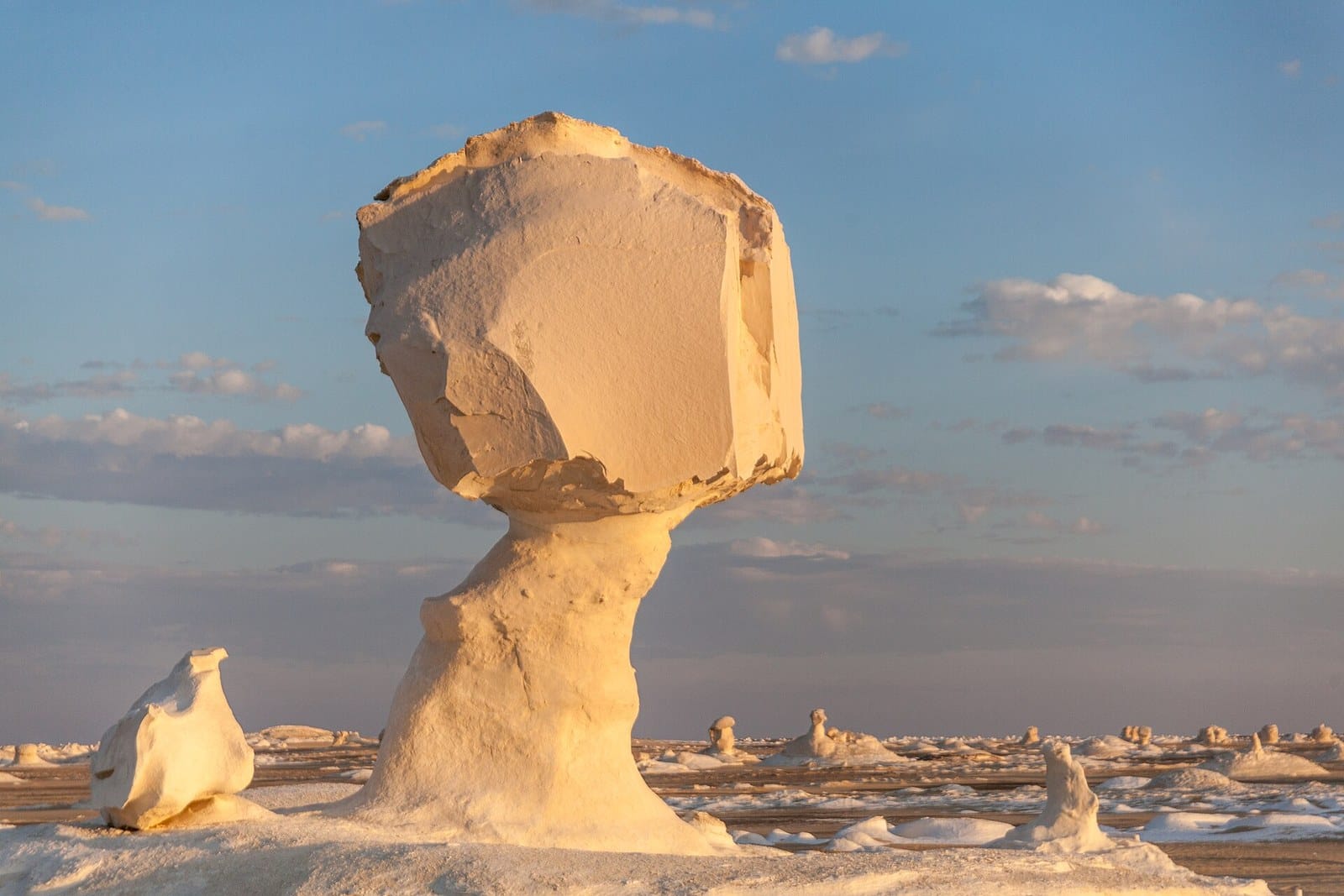
The formations that render the White Desert so unique are the result of differential wind erosion. The wind, transporting grains of sand at variable velocities, erodes the rocks in an unequal way: the softer areas are consumed more rapidly, while the harder portions resist, creating fantastic and improbable forms. This process has produced the celebrated mushroom formations, where a narrow base supports a wider cap, as well as pinnacles, arches, columns and structures that evoke animals, human figures and objects of every type.
The height of the formations varies from a few decimetres to several metres, and their density changes in the different areas of the park. In the central zone of the White Desert, the formations are particularly concentrated, creating a labyrinthine landscape of great evocativeness. In the peripheral areas, the formations are more scattered and isolated, offering photographic compositions of great visual impact against the background of the open desert.
A Geology in Evolution
The White Desert is not a static landscape: the erosion continues incessantly, modifying the existing formations and creating new ones. A mushroom formation that today seems stable could collapse in a few decades or centuries, when the base has been eroded sufficiently. This aspect renders every visit unique and unrepeatable, since the landscape is in constant, albeit very slow, transformation. The geologists estimate that in a few thousand years many of the current formations will have disappeared, replaced by new sculptures created by the wind.
The Marvels of the White Desert
The Mushroom Formations
The mushroom formations are the iconic symbol of the White Desert. These chalk monoliths, with their characteristic cap form supported by a thin stalk, defy the laws of gravity and of imagination. Some reach heights of several metres and present proportions so extreme as to seem the work of a visionary sculptor rather than of nature. The most celebrated have received evocative names from the Bedouins and the local guides: the Chicken, the Rabbit, the Sphinx, the Stone Tree.
The Crystal Mountain
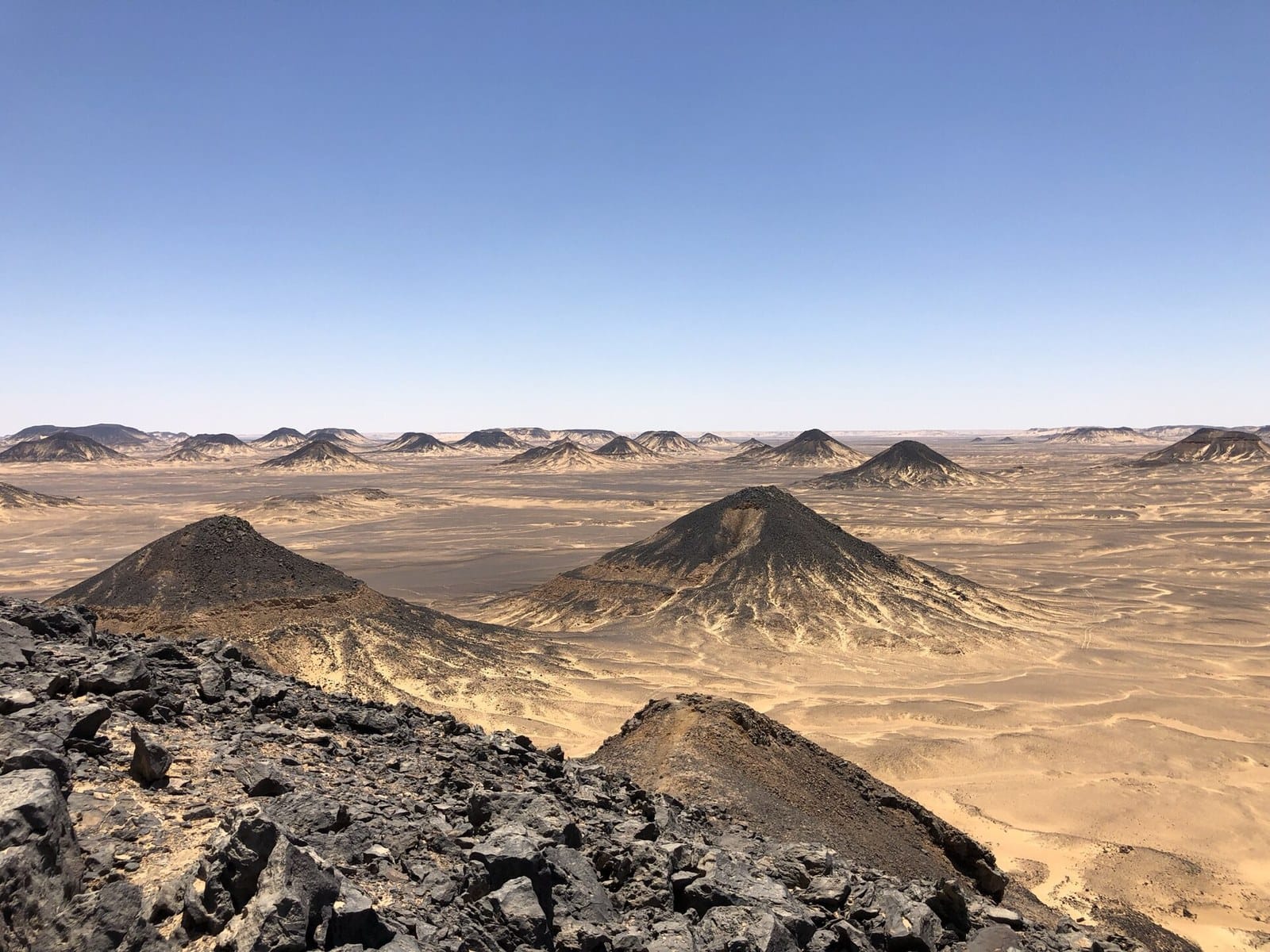
Along the route between the Black Desert and the White Desert is found the Crystal Mountain, a rocky formation entirely covered with crystals of quartz and calcite that shine under the light of the sun like diamonds. This sparkling hill, about ten metres high, is an obligatory stop during every safari in the desert. Inside the rock, natural cavities reveal clusters of transparent and translucent crystals of rare beauty. The Crystal Mountain has become one of the most photographed points of the entire route of the Western Desert.
The Inselbergs and the Pinnacles
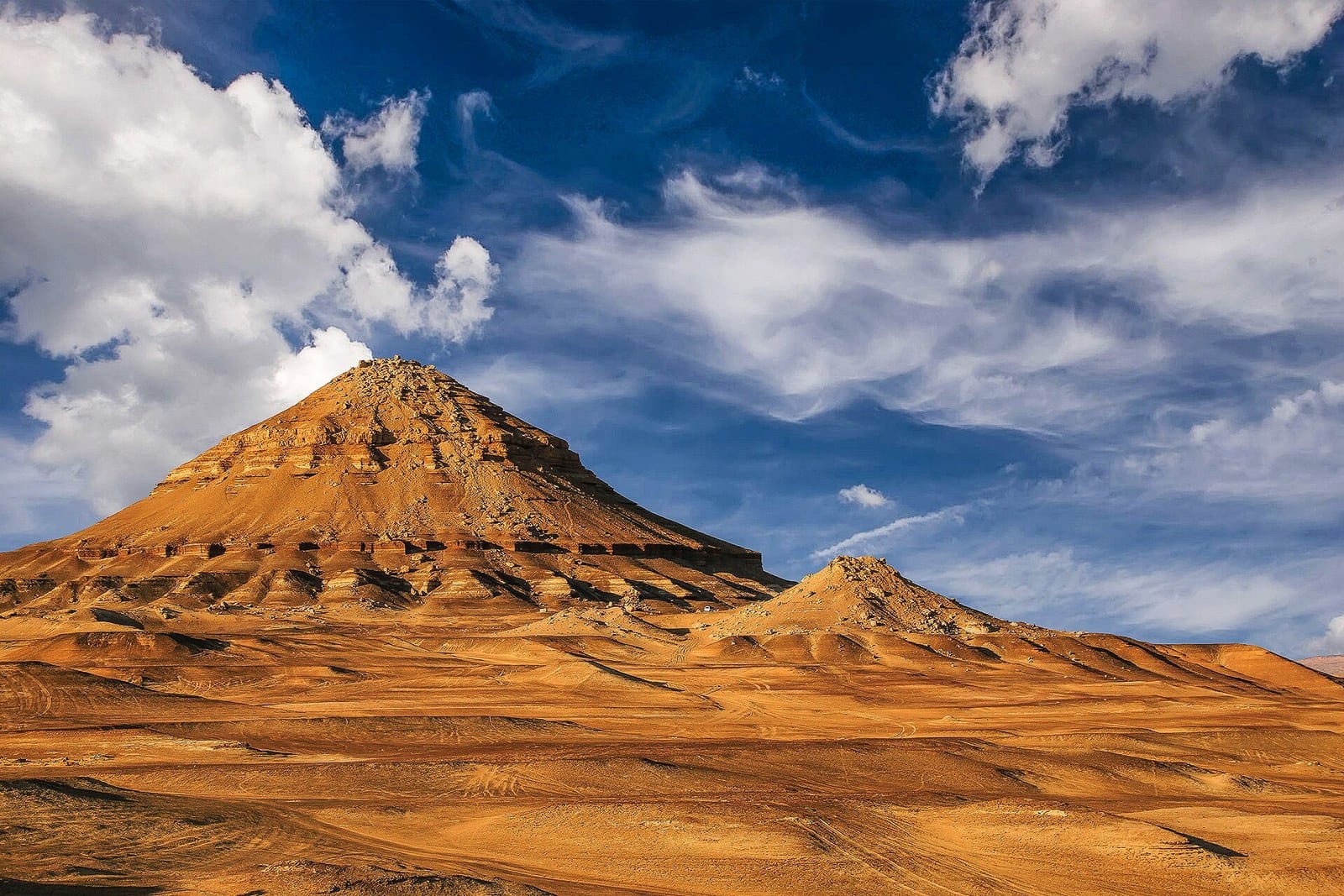
Beyond the mushroom formations, the White Desert hosts numerous inselbergs, isolated hills of chalk that rise abruptly from the surrounding plain, and pinnacles of various forms and dimensions. Some of these formations present coloured striations, where layers of minerals different from the chalk (iron, manganese) create horizontal bands of colour that further enrich the chromatic palette of the landscape.
The Camping Experience
A Night Under the Stars
Night camping in the White Desert is unanimously considered one of the most memorable experiences that Egypt can offer. The local guides set up tented camps in strategic positions among the chalk formations, prepare traditional dinners on campfires and create an intimate and convivial atmosphere that contrasts with the immensity of the surrounding desert.
When night falls, the White Desert transforms completely. The moonlight confers on the white formations an almost phosphorescent luminescence, transforming the landscape into a fairy-tale world of lights and shadows. On moonless nights, the starry sky of the Sahara reveals itself in all its magnificence: the Milky Way crosses the celestial vault like a river of light, and millions of stars, invisible in the polluted skies of the cities, shine with an intensity that moves.
The Nocturnal Fauna
The silence of the nocturnal desert is occasionally interrupted by the calls of the animals that inhabit this apparently inhospitable region. The desert foxes (fennec), with their large ears and agile movements, approach sometimes the camps attracted by the odours of the food. Their footprints on the sand, visible in the morning around the camp, testify to the nocturnal visits. Also desert owls, jerboas (jumping mice) and occasionally gazelles inhabit this area, contributing to an ecosystem richer than one might imagine.
The Sunset and the Dawn
The most magical moments in the White Desert are the sunset and the dawn. At the setting of the sun, the chalk formations are tinged progressively with orange, pink and finally a deep violet, creating a play of colours in continuous change that lasts about an hour. It is the moment in which the photographers take the most spectacular images and the visitors remain in silence, overwhelmed by the beauty of the landscape. At dawn, the process is inverted: the pale pink of the aurora gradually gives way to the dazzling white of the chalk under the full sun, an awakening that repays abundantly the early rising.
The National Park
The Institution of the Park
In 2002, the Egyptian government declared the White Desert a protected area, instituting the National Park of the White Desert. This decision was motivated by the necessity to protect the fragile chalk formations from the growing tourism and from potentially destructive human activities. The formations, although they seem solid, are in reality extremely vulnerable: the chalk is relatively soft and can be easily damaged by impacts, graffiti or removals.
The Rules of the Park
Visitors are required to respect precise rules: it is forbidden to climb on the formations, to take samples of rock, to leave waste and to light fires in the immediate vicinity of the chalk structures. Access to the park requires the payment of an entrance ticket and the presence of an authorised guide. These measures, although sometimes perceived as restrictive, are essential to preserve this unique natural heritage for future generations.
Practical Tips for the Visit
How to Organise the Safari
Access to the White Desert occurs almost exclusively through safaris organised by agencies based in Bahariya or, less frequently, in Farafra. The standard package provides transport in a 4x4 off-road vehicle, lunch, dinner and breakfast, the camping equipment (tents, mats, blankets) and the guide. The safaris can last from one day (without overnight stay) to three or more days, including stops at the Black Desert, the Crystal Mountain and other attractions of the route.
What to Bring
Bring clothing in layers: during the day the temperatures can be elevated, but on winter nights the thermometer can descend to a few degrees above zero. A warm jacket, a hat, sunglasses, high-protection sun cream and abundant water are indispensable. To sleep, a sleeping bag is strongly recommended even if the guides provide blankets. A headlamp is very useful to move around the camp after sunset.
Photography in the Desert
The White Desert is the paradise of photographers, but it also presents specific challenges. The intense light and the reflection of the white chalk can deceive the light meter of the camera: it is advisable to underexpose by 1-2 stops compared to the automatic reading to avoid overexposed images. The fine sand is the enemy of photographic equipment: protect lenses and sensors with covers and UV filters. The golden hours of sunset and dawn offer the best light conditions to capture the chromatic shades of the formations.
Period of Visit
The optimal period goes from October to April, when the daytime temperatures are pleasant and the nights fresh but not freezing. From May to September the daytime temperatures can exceed 45°C, rendering the camping experience extremely difficult and potentially dangerous. During the period of the sandstorms (March-April), the excursions can be cancelled for reasons of safety.
The White Desert is one of those rare places on Earth that defy every description and every photograph. No image can do justice to the emotional impact of finding oneself surrounded by these natural sculptures, under a boundless sky, in the absolute silence of the desert. It is an experience that touches something profound in the human soul, a reminder of the creative power of nature and of our smallness in the face of its grandeur.