Farafra Oasis: the Last Outpost Before the White Desert
Farafra Oasis is the smallest and most isolated among the great oases of the Egyptian Western Desert, a place where time seems to have stopped and where life flows with rhythms dictated by nature and tradition. Located about 310 kilometres from Bahariya Oasis towards the south and almost 600 kilometres from Cairo, Farafra is an enclave of green and silence in the heart of one of the vastest deserts in the world. With a population of barely 5,000 inhabitants, this small community offers an experience of authenticity and tranquillity that Egypt's more touristic destinations cannot equal.
Farafra is known principally as the southern gateway to the White Desert, but it would be reductive to consider it only a transit point. The oasis possesses a charm of its own, made of lush gardens, traditional adobe architecture, regenerating thermal springs and a work of art unique of its kind: the Badr Museum, the visionary creation of a local artist who transformed his house and his garden into an open-air gallery.
History of the Oasis
The Ancient Origins
The history of Farafra is lost in the mists of time. Archaeological finds suggest that the depression was inhabited since the prehistoric era, as testified by rock paintings and stone tools found in the caves and rock shelters of the surroundings. During the Egyptian Old Kingdom, Farafra was known as "Ta-iht", the "Land of Cows", a name that suggests the presence of pastures and an agricultural and pastoral vocation.
Egyptian sources mention Farafra occasionally in contexts linked to the trade routes of the desert and to military expeditions towards the western oases. However, its extremely remote position always kept it at the margins of the main history of Egypt, a state of isolation that, paradoxically, has contributed to preserving intact many of its traditions and its original character.
The Roman and Islamic Era
During the Roman domination of Egypt (30 BC - 395 AD), Farafra experienced a certain development thanks to its position along the caravan routes that connected the oases of the desert with the Nile valley and with the Roman provinces of North Africa. The Romans built fortifications and small settlements to protect the caravans and guarantee the commercial flow.
With the advent of Islam in the 7th century, the oasis was gradually Islamised, and its population adopted the new religion while however maintaining many of the pre-Islamic traditions linked to life in the desert. For centuries, Farafra remained a self-sufficient community, with scarce contacts with the outside world, an isolation that prolonged itself until the construction of the first asphalted roads in the second half of the 20th century.
The Historic Village of Qasr al-Farafra
The ancient heart of the oasis is Qasr al-Farafra, a fortified village in adobe that constitutes the historic nucleus of the settlement. This intricate labyrinth of narrow alleys, houses leaning against one another and internal courtyards is an extraordinarily well-preserved example of vernacular desert architecture. The thick adobe walls, which reach even 60 centimetres, guarantee a natural thermal insulation that keeps the interiors fresh during the sultry summer days and warm during the winter nights.
Many of the houses of Qasr al-Farafra are still inhabited, and strolling among its alleys allows one to observe the daily life of the oasis in an architectural context practically unchanged for centuries. The carved wooden doors, the decorative niches in the walls and the terraces overlooking the palm groves testify to a refined aesthetic tradition that contrasts with the simplicity of the materials used.
The Badr Museum
The Artist and His Vision
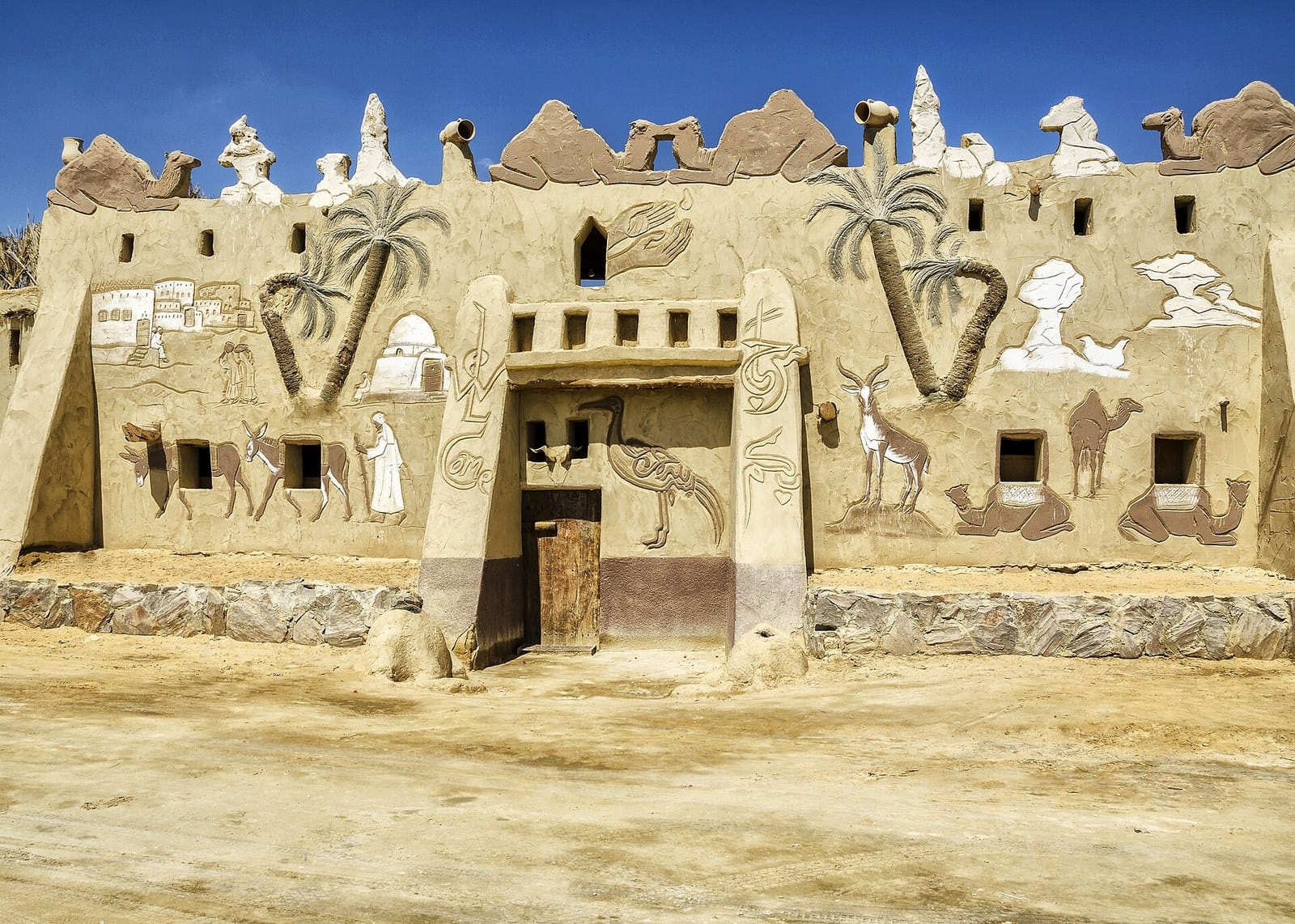
The Badr Museum is one of the most surprising and unexpected attractions of the entire Western Desert. Created by Badr Abdel Moghny, a self-taught artist born and raised in Farafra, this museum-garden is an explosion of creativity that transforms the desert landscape into a world of sculptures, paintings and installations that merge oasis tradition with a deeply personal artistic vision.
Badr, inspired by the beauty of the desert and by attachment to the traditions of his community, began in the 1990s to model sculptures in clay, plaster and local materials that depicted scenes of daily life of the oasis, desert animals, mythological figures and abstract forms inspired by the formations of the White Desert. What began as a hobby transformed itself into a monumental artistic project that today occupies his house, the garden and the surrounding buildings.
The Artistic Work
The museum comprises hundreds of sculptures of various dimensions, from small figures that can be held in the palm of a hand up to installations of several metres in height. The subjects range from hyperrealist representations of Bedouins and peasants of the oasis to oneiric and surreal figures that evoke the fantastic forms of the nearby White Desert. The materials used are predominantly local: desert clay, plaster, stones, sand and palm wood, an approach that confers on the works a deep bond with the territory.
The walls of the house-museum are covered with paintings that tell the life of the oasis through vivid colours and narrative compositions. Desert landscapes, scenes of date harvesting, traditional celebrations and cosmic visions alternate in a continuous visual narrative that transforms each room into a world unto itself. Badr personally welcomes visitors, recounting with passion the story of each work and the meaning that it holds in his artistic vision.
A Unique Experience
The visit to the Badr Museum is an experience that goes well beyond simple artistic contemplation. It is an encounter with an extraordinary person, a man who chose to remain in his native oasis when many of his contemporaries emigrated towards the cities, transforming his love for Farafra and for the desert into a living work of art. The museum is also an important centre of documentation of oasis culture, since many of the sculptures portray activities, tools and traditions that are gradually disappearing.
The Thermal Springs
Bir Sitta
Bir Sitta, literally "Well Number Six", is the most frequented thermal spring in the surroundings of Farafra. Located a few kilometres from the centre of the oasis, this natural circular pool is fed by underground waters that emerge at a temperature of about 24°C, ideal for a refreshing bath after excursions in the desert. Bir Sitta is surrounded by palms and vegetation that create a shaded and pleasant environment, perfect for a moment of relaxation in the middle of a day of exploration.
Other Springs
The oasis counts several other springs, some hot and others cool, distributed in the surrounding gardens and palm groves. Many of these springs are used for agricultural irrigation, but some are accessible for bathing. The local guides know the less frequented springs, where it is possible to enjoy a bath in complete solitude, surrounded only by the green of the palms and the song of the birds.
The Gardens and Agriculture
The Palm Groves of Farafra
Like all the oases of the Western Desert, Farafra owes its existence to the underground water springs that feed a lush vegetation in the middle of the desert. The palm groves of the oasis, although less extensive than those of Siwa or Bahariya, produce dates of excellent quality that are consumed locally and sold in the markets of the Nile valley.
Beyond the date palms, the gardens of Farafra produce olives, citrus fruits, pomegranates, figs and a variety of vegetables that guarantee a practically complete food self-sufficiency to the local community. Agriculture is practised with traditional methods based on canal irrigation, an ancient but effective water system that distributes the water of the springs to the various plots according to a community calendar established by custom.
Traditional Agricultural Life
Strolling among the palm groves of Farafra in the cool hours of the morning or late afternoon is an experience of great peace and beauty. The peasants work in their gardens with simple tools, the women gather the aromatic herbs that grow at the margins of the fields, and the children play among the palms with the same joy as the children of all the world. It is a picture of rural life that survives thanks to the isolation of the oasis and the strong sense of community of its inhabitants.
Gateway of the White Desert
The Natural Connection
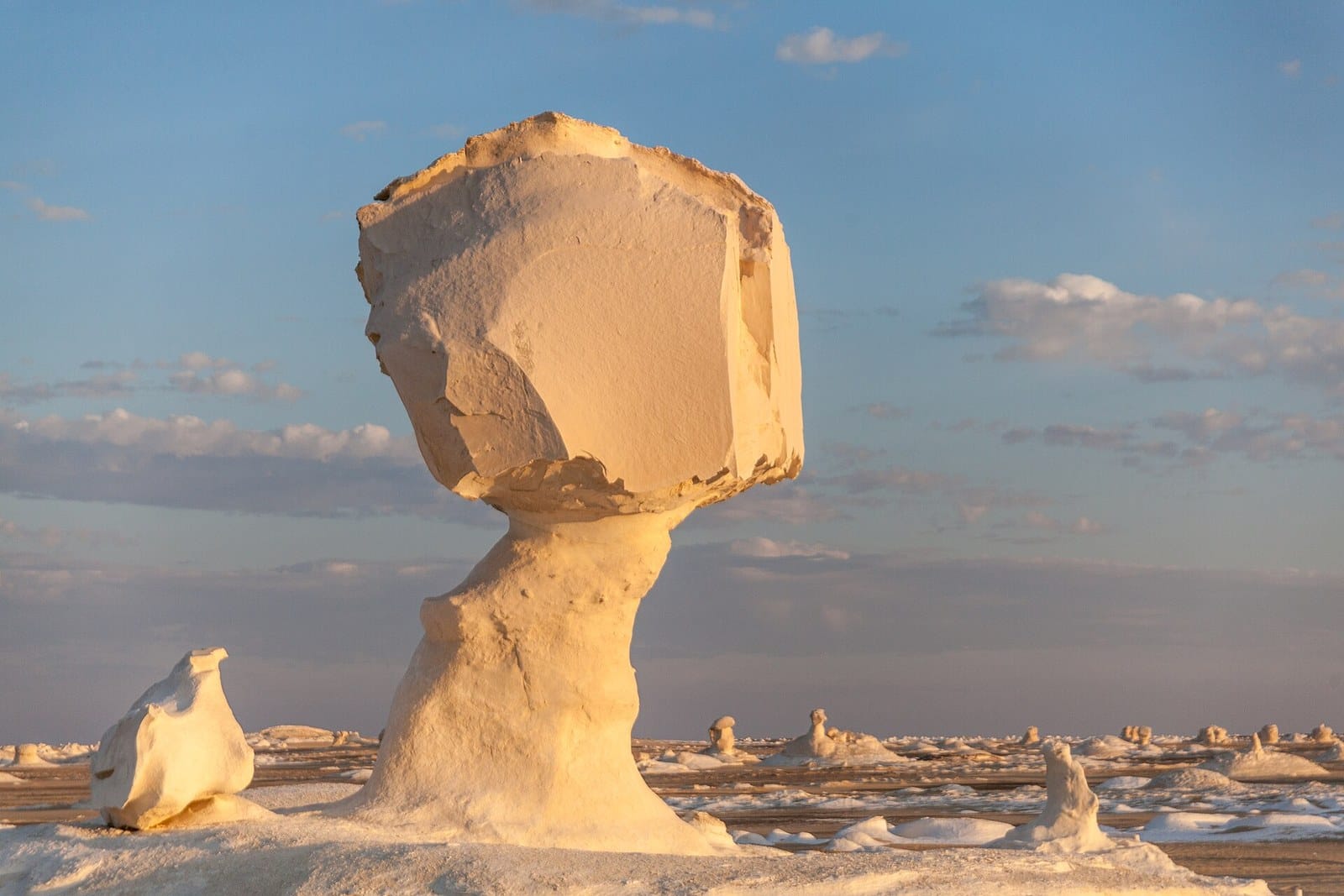
Farafra is the base closest to the White Desert and constitutes the most logical departure (or arrival) point for excursions in this protected area. The proximity to the national park makes Farafra an alternative to Bahariya as an operational base for safaris, although most of the tours depart from the north. Some agencies of Farafra organise excursions dedicated to the White Desert, often combining them with visits to the springs and the sites of the oasis.
Safari and Camping
The local agencies of Farafra offer off-road safaris towards the White Desert with formulas that vary from the half-day trip to the multi-night adventure in the desert. The safaris organised from Farafra have the advantage of departing from a point closer to the White Desert, allowing one to reach the limestone formations in shorter times and to dedicate more time to exploration and camping.
Practical Tips for the Visit
How to Get There
Farafra is reachable from Bahariya (about 310 km to the north) or from Dakhla (about 310 km to the south-east) via asphalted roads that cross the desert. Daily buses connect Farafra with Cairo (about 8-9 hours) via Bahariya. Travel by private car or with a driver is more comfortable and flexible, but requires a vehicle in good condition and sufficient water and fuel supplies, since service stations are very rare along the desert route.
Where to Stay
The accommodation options in Farafra are limited but genuine. A few small hotels and guesthouses offer simple but clean rooms, often managed by local families with a warm hospitality. Camping in the desert in the surroundings of the oasis is another possibility for those who love adventure.
What to See and Do
A day in Farafra should include the visit to the Badr Museum (in the morning, when the artist is more available for guided visits), a walk in the historic village of Qasr al-Farafra, a bath at Bir Sitta and a stroll among the palm groves. Those who have more time can combine the visit of the oasis with an excursion to the White Desert, creating a complete and varied experience.
Respect for Local Traditions
Farafra is a small and traditional community. Visitors are invited to respect the local customs, wearing modest clothing (shoulders and knees covered), always asking permission before photographing people and showing respect for places of worship. In exchange, the inhabitants of Farafra offer a genuine and warm hospitality that makes the visit a deeply human experience.
The Best Period
As for all the oases of the Western Desert, the ideal period to visit Farafra runs from October to April, when temperatures are pleasant and the conditions ideal for excursions in the desert. Summer is inadvisable because of the extreme temperatures that can exceed 50°C.
Farafra Oasis is a place that reminds us what it truly means to slow down, to listen to the silence and to let oneself be enveloped by the simplicity of a life in harmony with nature. In an era of tourist overcrowding, Farafra offers the increasingly rare luxury of authenticity, of solitude and of genuine contact with a community that welcomes visitors as friends found again after a long journey.