The Black Desert: the Volcanic Landscape of the Egyptian Sahara
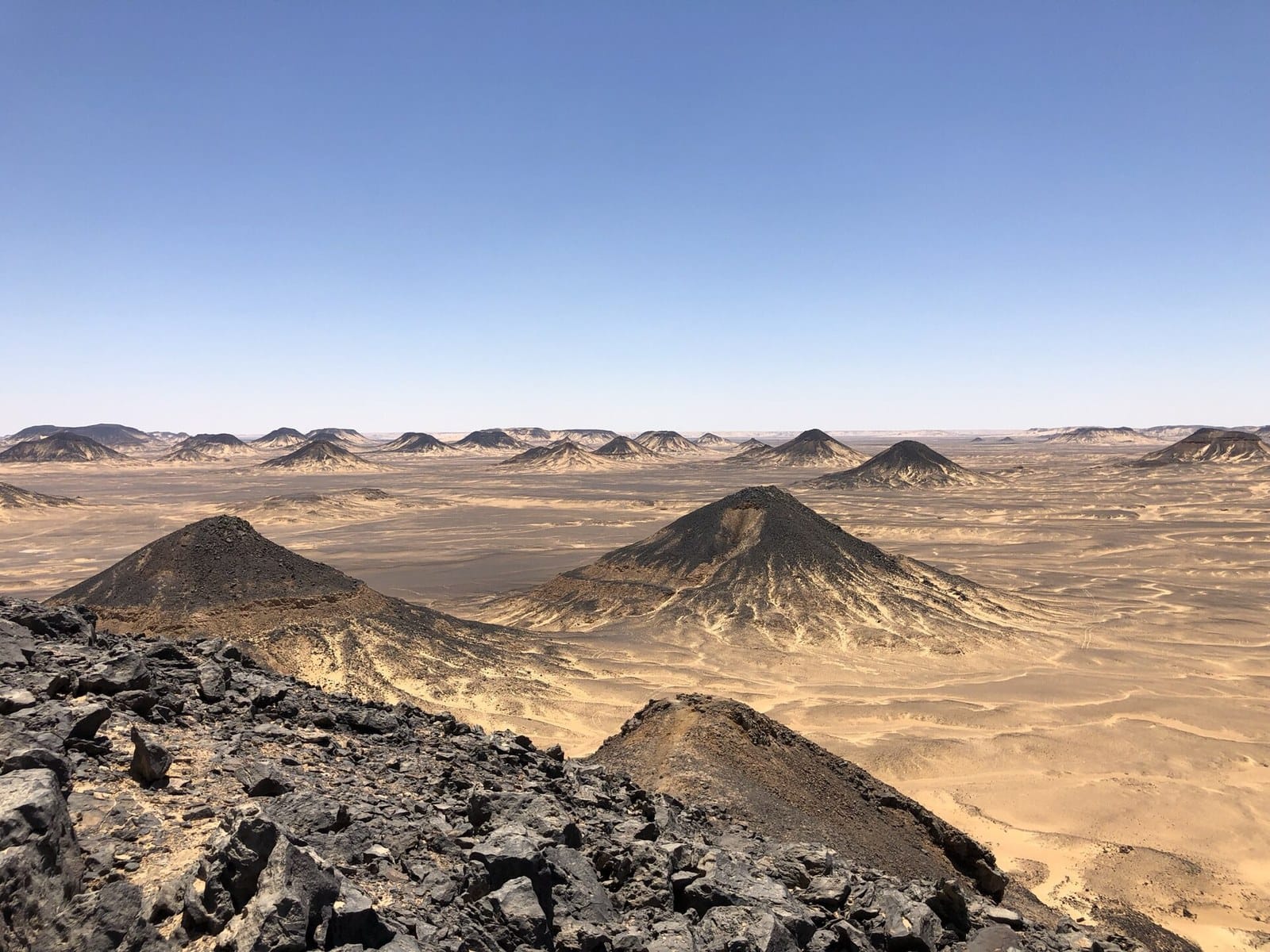
The Black Desert, located about 50 kilometres south of Bahariya Oasis on the road leading towards Farafra, represents one of the most singular and fascinating geological formations of the entire Egyptian Western Desert. This unique landscape, dominated by conical hills covered in black basalt and dolerite pebbles, creates a spectacular chromatic contrast with the golden sand of the surrounding Sahara, offering visitors a scene that seems to belong to another planet.
Unlike the White Desert, which owes its appearance to the erosion of ancient marine seabeds, the Black Desert is the result of intense volcanic activity that took place millions of years ago. The dark hills, the fields of black pebbles and the extinct volcanic cones narrate an extraordinary geological story, transforming this portion of Sahara into an open-air museum of terrestrial geology. The visit to the Black Desert is generally included in the route that connects Bahariya to the White Desert, constituting the first stage of one of the most fascinating safaris in Egypt.
Geology of the Black Desert
The Volcanic Origin
The geological history of the Black Desert begins millions of years ago, during a period of intense tectonic activity that affected the Western Desert. Volcanic eruptions brought large quantities of basaltic magma to the surface which, cooling, formed dark rocks of dolerite and basalt. These volcanic materials were deposited over the pre-existing sedimentary cover, composed of layers of sandstone and limestone of marine origin.
The process that gave the Black Desert its current appearance is twofold. On one hand, progressive erosion has exposed the volcanic cores of the ancient formations, creating the characteristic conical hills that dot the landscape. On the other, the surface disintegration of the volcanic rocks has produced a myriad of black basalt pebbles and fragments that cover the surrounding terrain, conferring on the desert its distinctive dark colouring.
The Composition of the Rocks
The rocks that make up the Black Desert are mainly dolerite, an intrusive igneous rock of basaltic composition, characterised by a fine-grained crystalline structure. Dolerite is rich in ferrous minerals, particularly pyroxenes and olivine, which give it its characteristic dark colour. In some areas there are also flows of more compact basalt, formed by the rapid cooling of lava on the surface.
The pebbles that cover the terrain present various dimensions, from grains of a few millimetres to blocks of several centimetres. Their surface is often shiny and smoothed by the action of wind and sand, creating an almost metallic effect that contributes to the lunar atmosphere of the landscape. In some areas, the concentration of black pebbles is such as to completely obscure the underlying sand, creating uniformly dark expanses that extend to the horizon.
A Landscape of Transition
From the geological point of view, the Black Desert represents a transition zone between the volcanic formations associated with the Bahariya depression and the limestone deposits of the White Desert further south. This gradual change in the composition of the soil is reflected in a fascinating chromatic transformation of the landscape: starting from Bahariya, the dark tones of basalt progressively give way to the lighter tonalities of sandstone and, finally, to the dazzling white of the limestone that characterises the White Desert.
The Main Attractions
The English Mountain
The English Mountain (Gebel el-Ingleez) is the most prominent elevation of the Black Desert and represents the panoramic point par excellence of the entire area. This extinct volcanic cone, which rises about 50 metres above the surrounding plain, owes its anglophone name to the presence, on its summit, of the remains of an observation post built by the British army during the First World War to monitor movements in the desert.
The ascent to the summit of the English Mountain is relatively easy and requires about 15-20 minutes of walking on a path that winds between volcanic rocks and black pebbles. From the summit, the panorama is simply breathtaking: 360 degrees the Black Desert extends with its dozens of conical hills, like an archipelago of dark islands in a sea of golden sand. On clear days, the view extends for dozens of kilometres in every direction, allowing one to appreciate the vastness and solitude of the Saharan landscape.
The English Mountain is particularly spectacular at sunset, when the grazing light accentuates the contrasts between the black surfaces of the hills and the sand illuminated by the warm tones of the last sun. This magical moment is one of the main reasons why many safaris provide a stop at the English Mountain in the late afternoon hours.
The Conical Hills
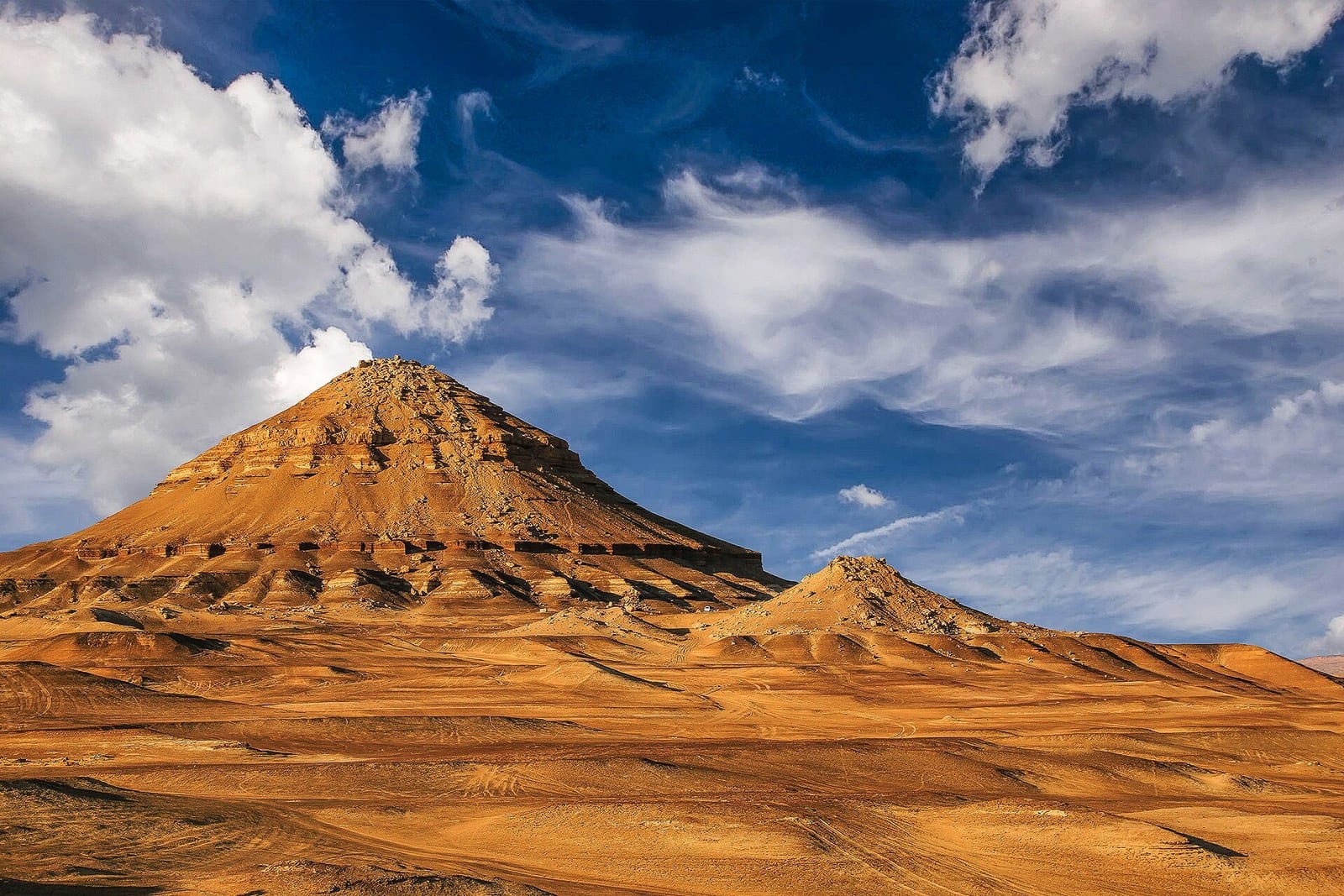
The conical hills of the Black Desert, some of which reach heights of 30-50 metres, are perhaps the most characteristic landscape element of the area. These formations, the result of the differential erosion of ancient volcanic edifices, present regular and symmetrical profiles that recall small perfect volcanoes. Their distribution in the landscape, apparently random but geologically determined, creates scenographic compositions of great visual impact.
Each hill presents a visible stratification, with bands of different colour that testify to the successive phases of volcanic activity. At the base, layers of light sandstone alternating with reddish ferrous deposits; towards the summit, the cap of black dolerite that has protected the hill from complete erosion. This geological structure makes each hill a small manual of Earth's history, legible to the naked eye.
The Fields of Volcanic Pebbles
The flat areas between the hills are covered by vast fields of volcanic pebbles that create a natural paving effect. Walking on these surfaces produces a characteristic sound, an almost metallic tinkling that accompanies every step and contributes to the otherworldly atmosphere of the place. The pebbles, smoothed by wind erosion, present rounded shapes and shiny surfaces that reflect the light of the sun.
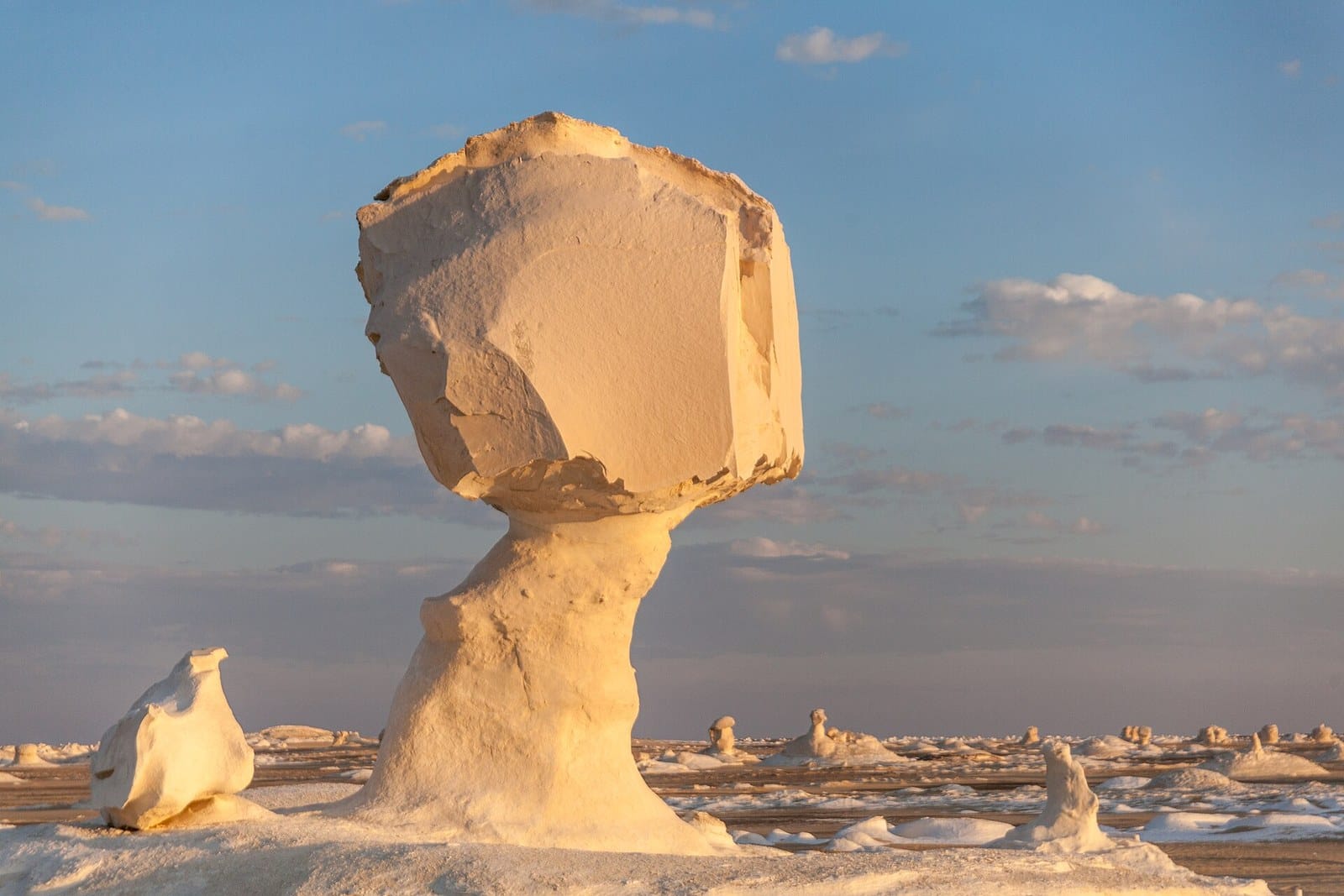
In some areas, phenomena of differential erosion have created curious formations where black pebbles crown small pillars of light sandstone, producing in miniature the same mushroom effect that characterises the formations of the White Desert. These micro-landscapes merit careful observation and offer photographic subjects of great interest for enthusiasts of naturalistic macro-photography.
The Fauna and Flora of the Black Desert
A Surprising Ecosystem
Despite the inhospitable appearance, the Black Desert hosts a surprisingly diversified fauna and flora when one knows where to look. Small drought-resistant shrubs grow in the fissures of the volcanic rocks, nourishing themselves on the residual humidity that condenses during the cold desert nights. These scattered bushes provide food and shelter to a variety of insects, reptiles and small mammals.
The tracks on the sand in the morning reveal an animal world active during the night: the footprints of the Sahara foxes, the jerboas and the beetles intertwine, creating a natural diary of nocturnal activity. Birds of passage, including raptors and desert larks, occasionally fly over the black hills, adding an aerial dimension to a landscape otherwise dominated by earth and rock.
The Safari Experience
The Classic Route
The visit to the Black Desert is almost always integrated into the classic safari that departs from Bahariya towards the White Desert. The route provides for departure from the village of Bawiti in the morning, a first stop at the Black Desert with ascent to the English Mountain, continuation towards Crystal Mountain and finally arrival at the White Desert for the evening camping.
The journey through the Black Desert generally lasts 2-3 hours, with multiple stops to explore the most interesting formations and take photographs. The local guides, who know every corner of the territory, lead the visitors to the most spectacular points and share stories and legends linked to these ancestral lands.
Camping in the Black Desert
Although camping is more commonly practised in the White Desert, some safaris offer the possibility of staying overnight in the Black Desert. The experience is radically different: here the nocturnal landscape is dominated by the darkness of the volcanic hills that stand out as silhouettes against the starry sky, creating a more intimate and gathered atmosphere compared to the White Desert.
The nights in the Black Desert are characterised by an almost absolute silence, broken only by the wind that blows among the volcanic rocks producing deep and evocative sounds. The nocturnal temperature can descend significantly, making the campfire not only a convivial experience but also a practical necessity for warming up.
Practical Tips for the Visit
How to Arrive
The Black Desert is reached exclusively by 4x4 off-road vehicles, departing from Bahariya Oasis. There are no asphalted roads that cross the area and navigation requires expert guides who know the terrain and the local conditions. It is strongly inadvisable to venture autonomously without an authorised guide, since the risk of getting lost in the desert is concrete and the consequences can be serious.
What to Bring
For the visit to the Black Desert, robust trekking shoes are recommended (the volcanic pebbles can be sharp), a hat, sunglasses, sunscreen, abundant water and a light backpack for personal belongings. For photography, a polarising filter is particularly useful to enhance the contrast between the blue sky and the dark rocks. At sunset, a tripod allows one to capture the long exposures that do justice to the chromatic nuances of the landscape.
Respect for the Environment
The Black Desert, like all the Western Desert, is a fragile ecosystem that requires respect and care on the part of visitors. Please do not take rock samples, do not leave waste and follow the paths indicated by the guides to minimise the impact on the terrain. The tracks left by vehicles on the sand remain visible for months and can alter the natural drainage routes: it is important that the guides follow pre-established routes and do not create new tracks without necessity.
Combining the Visit
The visit to the Black Desert combines naturally with the exploration of the White Desert and Bahariya Oasis. A two-day, one-night itinerary allows one to appreciate both deserts with the necessary time, including the nocturnal camping in the White Desert. Those who have more time can extend the safari to three or four days, adding Farafra Oasis and more prolonged stops in both deserts.
The Black Desert is a place that surprises and fascinates for its uniqueness. In a continent rich in deserts, this portion of Sahara distinguishes itself for a landscape that has no equal in the world, where volcanic geology has created a world of forms and colours that defies every expectation. Visiting it means adding an unrepeatable tile to the mosaic of travel memories, an experience that enriches the comprehension of the extraordinary diversity of planet Earth.