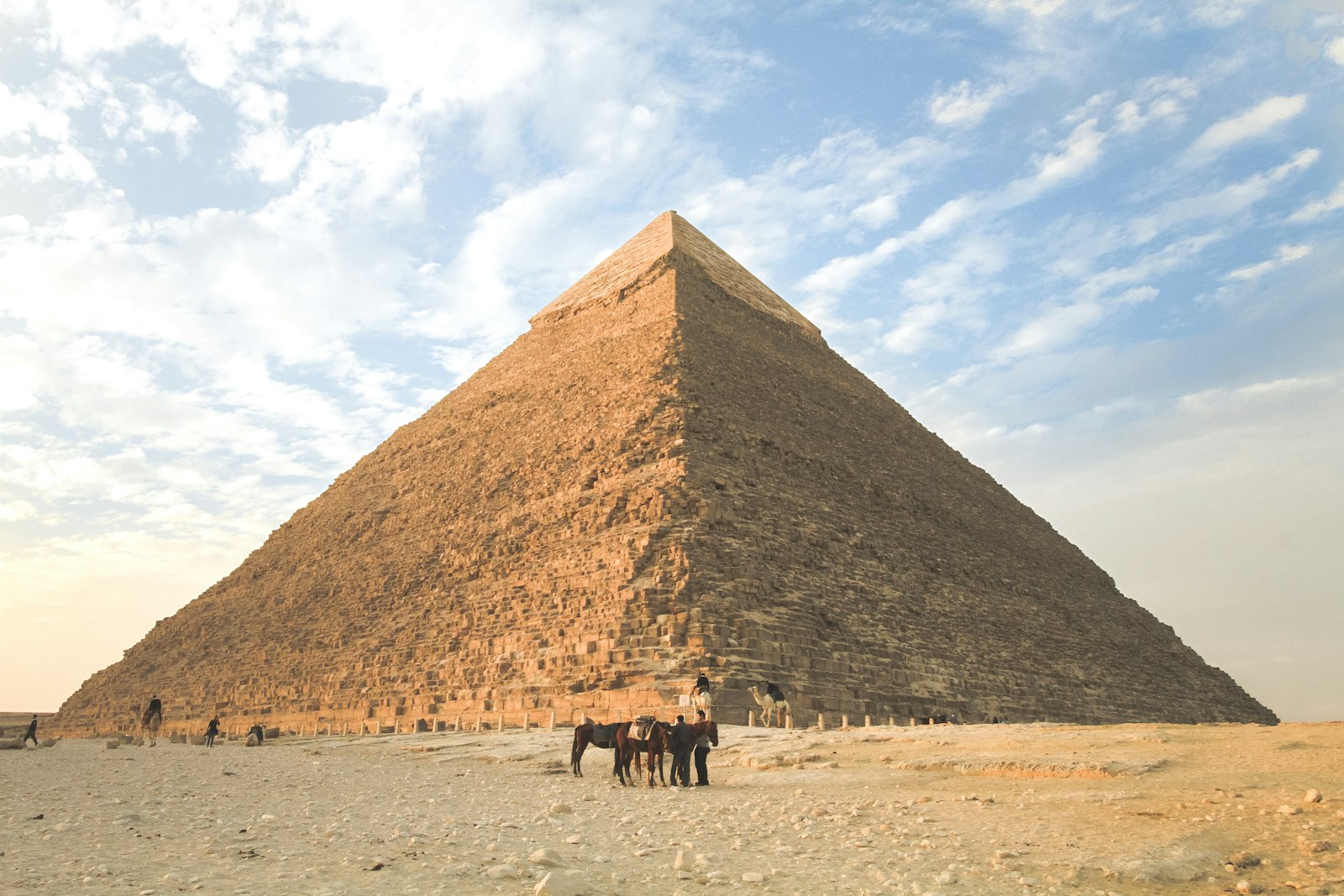
The Great Pyramid of Cheops: the Last Wonder of the Ancient World
The Great Pyramid of Cheops, also known as the Pyramid of Khufu, represents the absolute pinnacle of monumental architecture in ancient Egypt. Located on the Giza Plateau, on the south-western edge of Cairo, this extraordinary structure is the only one of the Seven Wonders of the Ancient World to have survived to the present day. For over 3,800 years it was the tallest structure ever built by humankind, a record that testifies to the incredible engineering skill of the ancient Egyptians.
Built around 2560 BC during the Fourth Dynasty of the Old Kingdom, the pyramid was commissioned by the pharaoh Khufu (known to the Greeks as Cheops) as his eternal dwelling. The architect responsible for the project was Hemiunu, vizier and nephew of the pharaoh himself, who devoted about twenty years to supervising this colossal construction site.
History and Construction
The Origins of the Project
The decision to build the largest pyramid ever conceived was no accident. Pharaoh Khufu wanted to surpass in size and magnificence all previous constructions, including the Step Pyramid of Djoser at Saqqara and the Red Pyramid of Sneferu at Dahshur. The chosen site, a limestone plateau on the Giza plain, offered a solid rocky base and a strategic position near the Nile, essential for transporting materials.
Work probably began around 2580 BC and continued for about twenty years. According to the most recent estimates by archaeologists, the construction site employed a workforce of around 20,000-30,000 workers — not slaves as was once believed, but specialised and seasonal labourers who served as a form of tribute to the pharaoh. Excavations carried out in the adjacent workers' villages have revealed that these labourers were well fed, received medical care and enjoyed a certain social respect.
The Impressive Numbers
The dimensions of the Great Pyramid are staggering. The original height was about 146.6 metres, today reduced to 138.8 metres due to the loss of the pyramidion and the erosion of the outer casing. The base is an almost perfect square with sides of about 230.4 metres, with an alignment error of less than 5 centimetres. The total volume is around 2.6 million cubic metres.
Approximately 2.3 million stone blocks were used for its construction, each weighing an average of 2.5 tonnes, although some blocks in the King's Chamber exceed 80 tonnes. The total weight of the structure is estimated at around 6 million tonnes. The precision with which these blocks were cut and positioned is such that not even a knife blade can be inserted between one block and the next.
Theories on the Construction
The exact method used to build the pyramid remains one of the great mysteries of archaeology. Over the centuries numerous theories have been proposed, each with its strengths and weaknesses.
The straight external ramp theory is one of the most classic: a long inclined ramp would have allowed the blocks to be dragged to the summit. However, to reach the height of the pyramid, such a ramp would have had to be extremely long, creating enormous logistical problems.
The spiral ramp theory, proposed by the French architect Jean-Pierre Houdin, suggests that an internal spiral ramp was integrated into the very structure of the pyramid. This theory has gained credibility thanks to microgravimetry scans that have revealed density anomalies compatible with this hypothesis.
Other theories include the use of levers and counterweights, hydraulic systems based on Nile water, and the use of side ramps combined with primitive machinery. The truth may be a combination of different techniques adapted to the various phases of construction.
Internal Structure
The Entrance and the Corridors
The original entrance to the pyramid is on the north face, about 17 metres high. Today visitors enter through a tunnel dug in the 9th century by the caliph al-Ma'mun, who was searching for treasure inside the structure. The system of internal corridors is surprisingly complex and reveals sophisticated engineering planning.
The Subterranean Chamber
The descending corridor leads to a chamber carved into the limestone rock beneath the pyramid, known as the Subterranean Chamber. This unfinished room, measuring about 14 x 8 metres, may have been the original burial chamber, later abandoned in favour of a higher position within the structure. The ceiling is irregular and the floor features a deep excavation whose purpose remains debated among scholars.
The Queen's Chamber
Located at the level of the pyramid's base, the Queen's Chamber is a modest-sized room (5.75 x 5.23 metres) with a double-pitched ceiling about 6 metres high. Despite its name, this chamber was never intended for the burial of a queen. It may have housed a statue of the pharaoh's Ka or had other ritual functions. Two narrow shafts, originally sealed, start from the north and south walls of the chamber and head towards the exterior of the pyramid, although they do not reach it completely.
The Grand Gallery
The Grand Gallery is perhaps the most spectacular architectural element of the entire pyramid. This ascending corridor, 47 metres long and 8.6 metres high, features corbelled walls with seven successive levels of limestone blocks, creating a false-vault effect that anticipates Roman building techniques by millennia. The precision of the workmanship is extraordinary: each block fits perfectly with the next. The exact function of the Grand Gallery, beyond serving as an access corridor to the King's Chamber, is still the subject of academic discussion.
The King's Chamber
At the end of the Grand Gallery is the King's Chamber, the heart of the pyramid. This rectangular room (10.47 x 5.23 metres, 5.82 metres high) is entirely lined with pink granite from Aswan. Inside it stands a granite sarcophagus, without a lid or decoration, too large to have passed through the access corridors, which proves that it was positioned during the very construction of the pyramid.
Above the King's Chamber are five superimposed relieving chambers, designed to distribute the weight of the blocks above and prevent the ceiling from collapsing. In the highest chamber, the roof is formed by blocks arranged in a double pitch. In these relieving chambers, inscriptions in red ochre left by the work crews have been found, including the name "Khufu", the oldest written record of the pharaoh's name.
Historical and Cultural Significance
Religious Symbolism
The pyramid was not simply a tomb, but a cosmological monument. Its shape recalled the rays of the sun descending from the sky, symbolising the ascent of the pharaoh's soul towards the god Ra. The original casing of white Tura limestone made the pyramid shine in the sunlight, making it visible for kilometres like a divine beacon in the desert.
The orientation of the pyramid is astronomically precise: the four faces are aligned almost perfectly with the four cardinal points, with an error of only 3 minutes and 6 seconds of arc. Some internal corridors were aligned with specific stars important in Egyptian cosmology, such as Thuban (then the pole star) and the stars of Orion's belt, associated with the god Osiris.
Explorations and Discoveries
Over the millennia, the pyramid has attracted explorers, scholars and adventurers. The caliph al-Ma'mun, in 820 AD, was the first to penetrate the interior in modern times. In the 19th century, the British archaeologist Flinders Petrie carried out the first accurate scientific survey of the structure. In 1954, the Egyptian archaeologist Kamal el-Mallakh discovered at the foot of the pyramid the famous solar boat of Cheops, today preserved in the museum dedicated to it.
The most recent research, conducted with advanced technologies such as muography (which uses cosmic rays to see through stone), revealed in 2017 the existence of a large previously unknown void within the structure, named the "ScanPyramids Big Void", at least 30 metres long. The nature and purpose of this cavity remain a fascinating mystery.
Tips for Your Visit
How to Get There
The Giza Plateau is easily reached from the centre of Cairo by taxi, bus or via the metro (Giza station, followed by a short taxi ride). It is advisable to arrive early in the morning to avoid the crowds and the intense heat, especially in the summer months.
Tickets and Access
Access to the Giza Plateau requires the purchase of an entrance ticket. To visit the interior of the Great Pyramid a supplementary ticket is needed, with a limited number of daily entries (about 300 in the morning and 300 in the afternoon). It is strongly recommended to buy tickets as early as possible.
What to Bring
Wear comfortable, sturdy shoes, as the ground is sandy and uneven. Bring plenty of water, sunscreen, a hat and a torch to explore the interior of the pyramid. The internal corridors are narrow, low and can be very hot and humid: the visit is not recommended for those who suffer from claustrophobia.
Photography Tips
The best times to photograph the pyramid are dawn and sunset, when the warm light creates spectacular contrasts. The panoramic viewpoint located to the south-west of the plateau offers an extraordinary view of all three pyramids. For an iconic photo with the Sphinx in the foreground and the pyramid in the background, position yourself in the area of the Valley Temple of Chephren.
Sound and Light Show
Every evening a sound and light show is held that tells the story of the pyramids through projections onto the Sphinx and the pyramids themselves. The show is available in several languages, including Italian on certain days of the week. It is an evocative experience that allows you to admire the monuments in a completely different atmosphere from the daytime visit.
Facts about the Great Pyramid
The Great Pyramid is aligned with surprising precision to geographic north, with a margin of error of only 3/60 of a degree. The temperature inside the King's Chamber remains constant at around 20°C, regardless of the outside temperature. The ratio between the perimeter of the base and the height of the pyramid approaches the value of 2π, although it is debated whether the ancient Egyptians were aware of this mathematical relationship.
The pyramid was originally covered by about 144,000 blocks of polished white limestone, from the quarries of Tura on the eastern bank of the Nile. This casing was progressively removed over the centuries to build mosques and palaces in Cairo. Some blocks of the original casing are still visible at the base of the pyramid, silent witnesses to the monument's ancient splendour.
Visiting the Great Pyramid of Cheops is not simply a tourist excursion: it is a journey through time to discover one of the most extraordinary achievements of human ingenuity, a monument that has defied the millennia and continues to amaze and inspire millions of visitors every year.