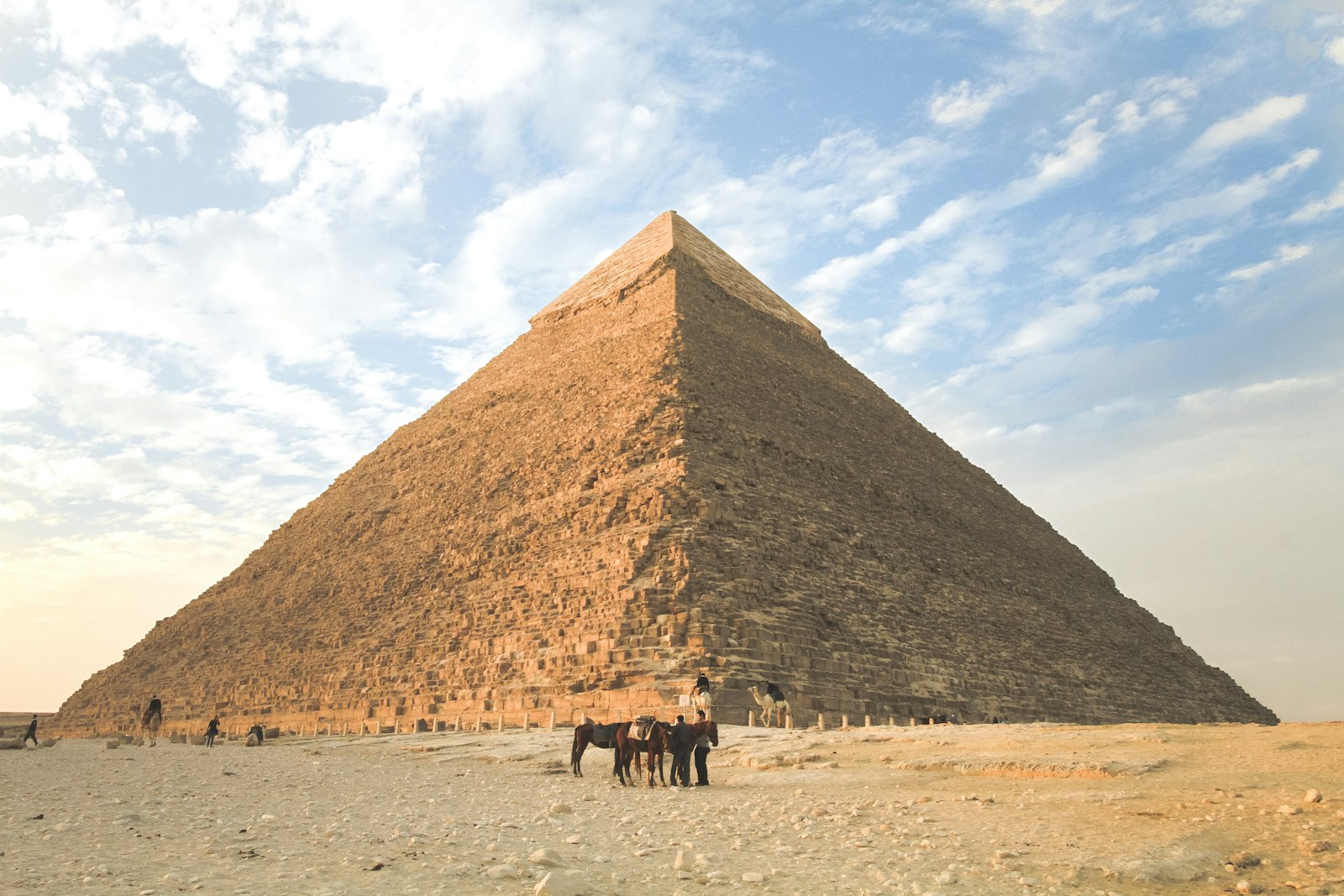
The Pyramid of Menkaure: the Unfinished Jewel of Giza
The Pyramid of Menkaure, also known as the Pyramid of Mycerinus, is the smallest of the three celebrated pyramids of the Giza Plateau, but no less fascinating for that. Indeed, for many Egyptologists it represents the most enigmatic and moving monument of the entire complex, a building that tells a story of ambition, refined art and cruel fate. With its original height of about 65.5 metres and a base of 102.2 metres per side, the pyramid is significantly more modest than its neighbouring sisters, but it compensates for its smaller size with extraordinary build quality and a decorative programme of rare elegance.
The pyramid was built by the pharaoh Menkaure (in Greek, Mycerinus), fifth king of the Fourth Dynasty, who ruled over Egypt approximately between 2532 and 2503 BC. Grandson of the great Khufu and son of Khafre, Menkaure marked a turning point in the history of the pyramids: his was the last great pyramid built on the Giza Plateau and inaugurated a trend toward smaller but more richly decorated funerary structures.
History and Construction
The Pharaoh Menkaure
Ancient sources describe Menkaure as a just and benevolent ruler, in sharp contrast to the tyrannical reputation attributed to his grandfather Khufu. The Greek historian Herodotus, writing in the 5th century BC, reported that Menkaure was loved by his people for his wisdom and clemency, and that during his reign the temples of the gods were reopened after the closures imposed by his predecessors. Although these narratives are probably romanticised, it is significant that tradition associated a positive image with this pharaoh.
The decision to build a pyramid smaller than those of his father and grandfather has been interpreted in various ways by scholars. Some believe it reflects a deliberate choice by Menkaure, perhaps linked to changes in solar theology or a different conception of the relationship between the pharaoh and the gods. Others suggest that the reduction in size was due to economic factors: after two generations of colossal constructions, the resources of the Egyptian state may have been significantly diminished.
The Construction Techniques
Despite its smaller size, the Pyramid of Menkaure presented significant innovations in construction techniques. The boldest choice was the use of blocks of pink Aswan granite for the outer casing of the lower half of the pyramid, in place of the traditional white Tura limestone. Granite, much harder and more difficult to work than limestone, gave the pyramid a unique two-tone appearance: pink in the lower part and white in the upper.
However, the granite blocks of the lower part were never completely polished. Many still display today the rough surface of the initial working, with the marks of the chisels and the protuberances used for transport. This detail suggests that the pyramid was never completed according to the original design, perhaps due to the premature death of the pharaoh. The work was probably finished in haste by his successor Shepseskaf, who completed the missing parts with mudbrick.
The Question of Incompleteness
The incompleteness of the Pyramid of Menkaure is a theme that fascinates scholars. The unpolished granite blocks at the base are the most obvious proof, but not the only one. The mortuary temple on the eastern face also shows signs of a hasty completion: the lower parts, designed in limestone, were replaced with mudbrick in the upper sections. Inscriptions found in the temple confirm that it was Shepseskaf who completed the works, probably simplifying his father's original design.
Interior Structure
The System of Chambers
The interior structure of the Pyramid of Menkaure is surprisingly complex for its size. The entrance is on the north face, at about 4 metres in height, and leads to a descending corridor lined with granite. This opens into an antechamber decorated with panels carved in imitation of palace façades, a decorative motif typical of Egyptian funerary architecture that represented the eternal dwelling of the pharaoh.
From the antechamber, a second corridor descends further until it reaches the main burial chamber, cut into the living rock beneath the pyramid. This room, rectangular and with a barrel-vaulted ceiling made of granite, contained the famous basalt sarcophagus of the pharaoh, one of the masterpieces of Egyptian sculpture of the Old Kingdom.
A peculiarity of the pyramid is the presence of a system of intermediate chambers and corridors that suggest at least two modifications to the original design during construction. The upper chamber, reachable through a horizontal corridor, may have been the burial chamber initially planned, abandoned in favour of the deeper and safer lower chamber.
The Sarcophagus Lost at Sea
The story of Menkaure's sarcophagus is one of the most dramatic in archaeology. Discovered in 1837 by the British explorer Howard Vyse during his aggressive excavation campaigns, the sarcophagus was a masterpiece of Egyptian art: a monolith of black basalt, richly decorated with the palace-façade motif characteristic of the Old Kingdom, with framed niches and recesses that imitated the doors and windows of a royal palace.
Vyse decided to ship the sarcophagus to England to exhibit it at the British Museum. It was loaded aboard the merchant ship "Beatrice" in the port of Alexandria in the autumn of 1838. The ship set sail with its precious cargo but never reached its destination. The "Beatrice" sank during a storm off the coast of Spain, in the stretch of sea between Cartagena and Malta, taking the sarcophagus with it to the bottom of the Mediterranean.
This loss is considered one of the gravest in the history of Egyptology. Menkaure's sarcophagus was one of the very few examples from the Old Kingdom with elaborate decorations still intact, and its loss deprived the world of an artefact of inestimable historical and artistic value. Today we know its appearance only through the drawings and descriptions left by Vyse and his collaborators.
Within the burial chamber a wooden sarcophagus lid was also found bearing the name and titles of Menkaure, together with human remains. Subsequent analyses, however, demonstrated that these finds date to the Late Period of ancient Egypt, probably the result of a reverential reburial carried out centuries after the pharaoh's death.
The Satellite Pyramids
The Three Queens
On the southern side of the Pyramid of Menkaure stand three smaller satellite pyramids, traditionally known as the "queens' pyramids". These structures, designated by archaeologists as G-IIIa, G-IIIb and G-IIIc, present different characteristics that make them particularly interesting for the study of the evolution of pyramidal architecture.
The eastern pyramid (G-IIIa) is the largest of the three, with a base of about 44 metres per side. It is the only one to have a complete pyramidal form and has a small adjoining mortuary temple. Within it a granite sarcophagus was found, suggesting that it housed the burial of a queen, perhaps Khamerernebty II, principal wife of Menkaure.
The central pyramid (G-IIIb) and the western one (G-IIIc) are unfinished and present the typical unfaced stepped structure. Inside the central pyramid a statuette depicting a woman was found, perhaps identifiable with another wife or daughter of the pharaoh.
The satellite pyramids of Menkaure are important for understanding the evolution of the royal funerary complex: they testify to the growing role of the women of the royal family in the architectural and ritual programme associated with the pharaoh's burial.
The Funerary Complex
The Mortuary Temple
The mortuary temple of Menkaure, located on the eastern face of the pyramid, is a building that eloquently tells the story of the incompleteness of the complex. The lower part was built of massive limestone blocks, as foreseen by the original design, but the upper parts were completed in mudbrick and plaster, an economical and rapid solution adopted by his successor Shepseskaf.
Despite the hasty completion, the temple yielded some of the most important treasures of Egyptian art of the Old Kingdom. The famous triads of Menkaure, statuary groups in greywacke depicting the pharaoh flanked by the goddess Hathor and provincial deities, are masterpieces of grace and balance now admired in the Egyptian Museum in Cairo. These statues, among the most beautiful of the entire corpus of Egyptian art, testify to the high artistic level reached during the reign of Menkaure.
The Valley Temple
The Valley Temple of Menkaure, situated at the foot of the plateau and connected to the mortuary temple by a long processional causeway, was also completed in haste with mudbrick. Within it further statues of the pharaoh were found, including the celebrated dyad of Menkaure and Khamerernebty, a sculpture in greywacke that portrays the pharaoh beside his wife with a tenderness unusual in Egyptian royal art.
The Processional Causeway
The processional causeway connecting the two temples wound for about 608 metres across the plateau. Originally it was a covered corridor with decorated walls, but most of the structure has been lost. The surviving fragments suggest that the decorations included scenes of offerings and processions, elements typical of the iconographic programme of the pyramid complexes of the Fourth Dynasty.
Damage and Restorations
The Attempt at Destruction
In the 12th century, the Ayyubid sultan Al-Aziz Uthman, son of Saladin, attempted to demolish the Giza pyramids, beginning precisely with the Pyramid of Menkaure, considered the most vulnerable because of its smaller size. For eight months, teams of workers laboured to dismantle the structure, but managed to remove only a small quantity of blocks from the north face, leaving a vertical scar still clearly visible today.
The undertaking was abandoned when it was realised that the cost of demolition was greater than that of the construction itself: removing the massive granite blocks required an enormous effort for minimal results. Paradoxically, this attempt at destruction provided archaeologists with valuable information about the interior structure of the pyramid, revealing the arrangement of the core blocks and the assembly techniques.
Contemporary Research
In 2023, a team of Japanese and Egyptian archaeologists announced that they had identified, by means of cosmic-ray scanning techniques, a possible previously unknown cavity inside the pyramid. If confirmed, this discovery could reveal new information about the construction history of the monument and, perhaps, accessory spaces still unexplored.
Tips for the Visit
Why Visit the Pyramid of Menkaure
Many tourists concentrate their attention on the Great Pyramid and the Sphinx, neglecting the Pyramid of Menkaure. This is a mistake: the smallest pyramid offers an often more intimate and evocative experience. The lower influx of visitors allows you to appreciate the architectural details at leisure, in particular the unpolished granite blocks at the base that offer a unique window onto the construction process of the pyramids.
Visiting Route
It is advisable to begin the visit from the north side, where the scar left by the medieval demolition attempt is visible. Proceeding clockwise, you reach the south side with the three satellite pyramids, which offer a fascinating context on the function and organisation of the funerary complex. The mortuary temple on the eastern face deserves an attentive pause to observe the contrast between the stone sections and those of mudbrick.
The Best Moment
The late afternoon is the ideal time to visit the Pyramid of Menkaure. At that hour most of the tour groups have already moved on toward the Great Pyramid and the Sphinx, leaving the area relatively quiet. The light of the setting sun illuminating the pinkish granite blocks creates a spectacular chromatic effect, with shades varying from pink to gold.
Facts about the Pyramid of Menkaure
The Pyramid of Menkaure is the only one of the three Giza pyramids to have used pink granite for its outer casing, giving it a unique two-tone appearance. The sarcophagus of Menkaure, lost at sea in 1838, is today one of the most sought-after archaeological finds: proposals are periodically launched to explore the seabed in search of the wreck of the "Beatrice". The triads of Menkaure found in the mortuary temple are considered among the most perfect expressions of Egyptian sculpture of the Old Kingdom and have influenced generations of artists. The pyramid was the first of the three great Giza pyramids to be explored internally in the modern era, when Howard Vyse penetrated it in 1837, using dynamite to open a passage among the granite blocks.