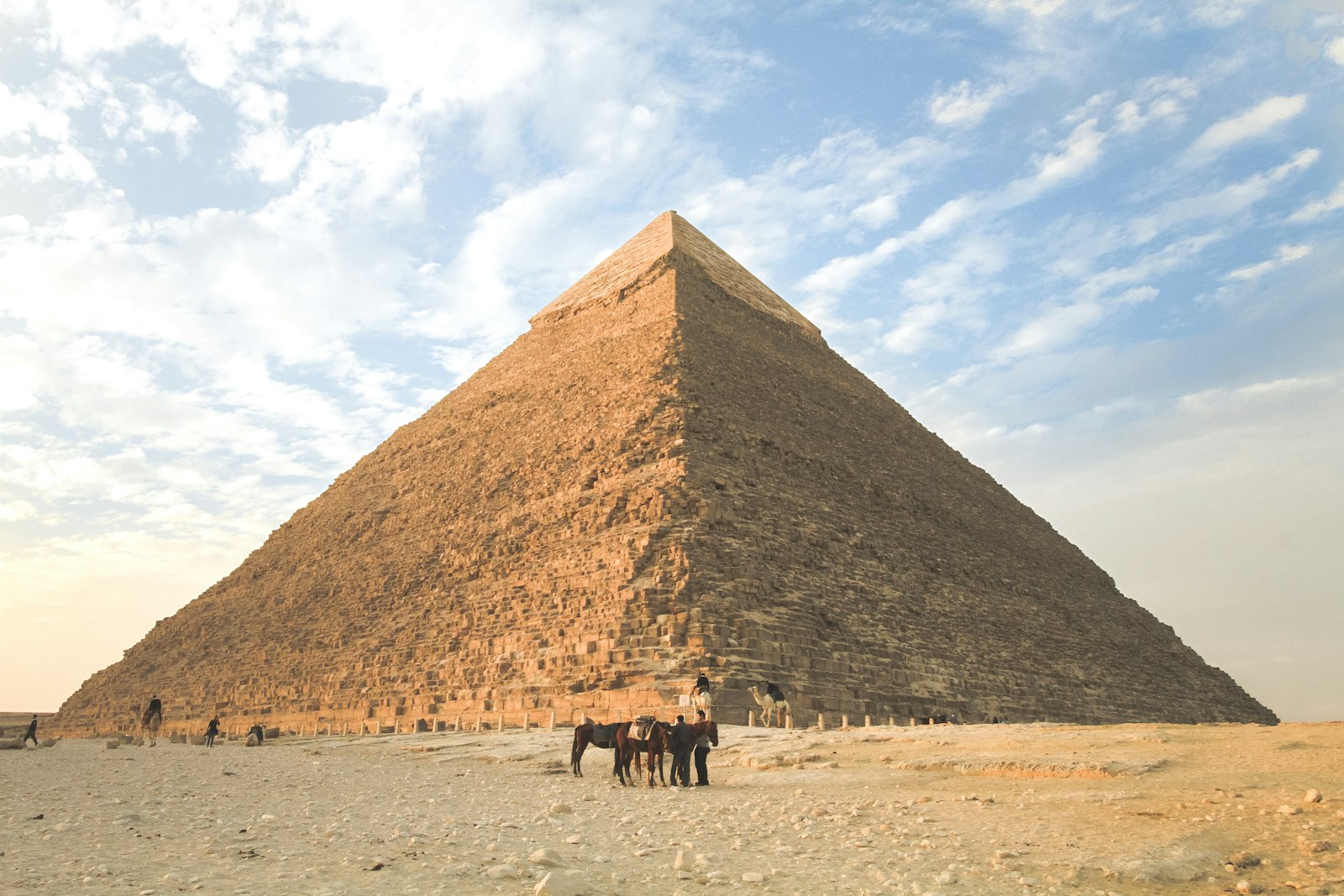
The Pyramid of Khafre: the Majestic Illusion of the Giza Plateau
The Pyramid of Khafre, also known as the Pyramid of Chephren, is the second largest of the Giza Plateau pyramids and represents one of the best-preserved funerary monuments in all of Egypt. Although it is slightly smaller than the nearby Great Pyramid of Khufu, a clever architectural device makes it appear taller: it was built on a natural rise in the terrain of about 10 metres, giving it an imposing appearance that has deceived travellers and scholars for centuries.
What makes the Pyramid of Khafre immediately recognisable is the characteristic cap of white limestone still preserved at its summit, the only significant remnant of the original casing that once covered the entire surface of all the Giza pyramids. This detail gives us a tangible idea of how these extraordinary structures must have looked at the height of their splendour: smooth, gleaming surfaces beneath the Egyptian sun.
History of the Pyramid
The Pharaoh Khafre
The pharaoh Khafre (in Greek, Chephren) ruled over Egypt during the Fourth Dynasty of the Old Kingdom, approximately between 2558 and 2532 BC. Son of the pharaoh Khufu and successor to his brother Djedefre, Khafre chose to return to Giza to build his own funerary complex, abandoning the site of Abu Rawash where Djedefre had erected his pyramid.
The decision to build at Giza, beside his father's pyramid, was not merely a practical matter linked to the availability of the site, but also a political and religious act: Khafre intended to reaffirm the line of succession and consolidate the bond with his most illustrious predecessor. The chosen position, slightly higher and to the south-west of the Great Pyramid, was carefully calculated to create a visual effect of unprecedented grandeur.
The Twenty Years of Construction
As with his father's pyramid, the construction of the Pyramid of Khafre also required about twenty years. The site employed thousands of specialised workers, organised into teams with names such as "The Friends of Khafre" and "The Drunkards of Khafre", as the inscriptions found on the blocks attest. The main materials came from the local quarries of the Giza Plateau for the limestone core, from the quarries of Tura for the outer casing, and from the distant quarries of Aswan for the granite elements.
Architecture and Dimensions
The Proportions of the Pyramid
The Pyramid of Khafre was built with an angle of inclination of 53°10', slightly steeper than the 51°50' of the Great Pyramid of Khufu. This difference, combined with the raised position of the terrain, contributes to the optical illusion that makes it appear taller than the neighbouring Pyramid of Khufu. The actual dimensions are nonetheless impressive: the base measures 215.25 metres per side, with an original height of 143.5 metres, today reduced to about 136.4 metres.
The total volume of the pyramid is estimated at about 2.2 million cubic metres, with a total weight of about 4.8 million tonnes. Although these figures are lower than those of the Great Pyramid, the Pyramid of Khafre remains a formidable engineering achievement, witness to the continuity and refinement of Egyptian construction techniques.
The Limestone Casing
The most distinctive element of the Pyramid of Khafre is without doubt its limestone casing at the summit. While all the other Giza pyramids have completely lost their outer casing over the centuries — the blocks were removed to build mosques, palaces and bridges in Cairo — the Pyramid of Khafre still preserves a significant portion of its original mantle of white Tura limestone in the upper part.
This remnant, covering roughly the upper 25% of the pyramid, allows us to imagine the spectacle these monuments offered when they were completely faced: smooth, gleaming surfaces that reflected the light of the sun, visible for tens of kilometres in the surrounding desert. Tura limestone, quarried from the eastern bank of the Nile, was a prized material, finely polished and of a luminous white.
At the base of the pyramid one can also see a foundation formed of blocks of pink Aswan granite, which added an element of colour and prestige to the structure. This combined use of limestone and granite reflected both aesthetic and practical considerations, since granite offered greater resistance to erosion in the lower part of the structure, more exposed to the weather and the action of the sand.
The Interior Structure
The interior structure of the Pyramid of Khafre is simpler than that of the Great Pyramid of Khufu. It has two entrances on the north face: one at ground level and one higher up, at about 11.5 metres. Both lead to descending corridors that converge into a horizontal passage leading to the burial chamber.
The main burial chamber, cut into the limestone rock and partly into the structure of the pyramid, measures about 14.2 x 5 metres with a double-pitched ceiling made of limestone blocks. Within it stands the pharaoh's black granite sarcophagus, a rectangular monolith with the lid still in place, discovered by the Italian explorer Giovanni Battista Belzoni in 1818. Unfortunately the sarcophagus was found empty, probably plundered in antiquity.
A second chamber, smaller and located on a lower level, was initially considered an unfinished burial chamber, but it may have had ritual functions connected with the funerary cult of the pharaoh.
The Funerary Complex
The Valley Temple
The Pyramid of Khafre is part of an extensive and articulated funerary complex, one of the best preserved of the Old Kingdom. The Valley Temple, situated at the foot of the Giza Plateau, near the ancient bank of the Nile, is a monumental building constructed of enormous limestone blocks faced with pink Aswan granite. Its walls, up to 5 metres thick, enclose a hall in the shape of an inverted T with monolithic granite pillars more than 4 metres high.
Originally the temple housed 23 statues of the pharaoh Khafre, of which the most celebrated — the statue of Khafre in diorite with the falcon Horus protecting the back of his head — is today one of the masterpieces of the Egyptian Museum in Cairo. The temple served as the point of access to the funerary complex and as the place where the rites of embalming and purification of the pharaoh's body were performed.
The Processional Causeway
A long covered corridor, the processional causeway, connected the Valley Temple to the Mortuary Temple located at the eastern base of the pyramid. This ceremonial road, about 494 metres long, was flanked by walls decorated with reliefs that narrated scenes from the pharaoh's life and his journey into the afterlife. Unfortunately most of these reliefs have been lost, but the surviving fragments testify to the high artistic quality of the period.
The Mortuary Temple
The Mortuary Temple, set against the eastern face of the pyramid, was the place where the rites of the funerary cult of the deceased pharaoh were celebrated daily. Built of limestone faced with granite, the temple was arranged around a central open-air court surrounded by pillars. Five niches along the western wall housed as many statues of the pharaoh, and a false door symbolically allowed the soul of the deceased to access the offerings deposited by the priests.
The Connection with the Great Sphinx
The Sphinx as Guardian
One of the most discussed questions in the history of Egyptology concerns the relationship between the Pyramid of Khafre and the Great Sphinx of Giza. The majority of scholars believe that the Sphinx was commissioned by Khafre himself, based on several clues: its position within Khafre's funerary complex, its proximity to the Valley Temple, and the resemblance of the Sphinx's facial features to those of the known statues of Khafre.
The Sphinx, carved directly from the limestone rock of the Giza Plateau, serves as the monumental guardian of the entire funerary complex. Its gaze, turned exactly toward the east, greets the rising sun — symbol of rebirth and eternal life — and watches over the entrance to the processional causeway that leads to the pyramid.
The Temple of the Sphinx
Beside the Great Sphinx stands a temple dedicated to the solar cult, structurally similar to the Valley Temple of Khafre and built with the same massive limestone blocks. The architectural and spatial connection between these two temples reinforces the hypothesis that the Sphinx was an integral part of Khafre's funerary project.
Explorations and Discoveries
Giovanni Battista Belzoni
The first modern European to penetrate the interior of the Pyramid of Khafre was the Italian adventurer and engineer Giovanni Battista Belzoni, on 2 March 1818. After weeks of excavation and research, Belzoni located the upper entrance on the north face and made his way to the burial chamber, where he found the empty granite sarcophagus. His feat was documented in the celebrated journal "Narrative of the Operations and Recent Discoveries within the Pyramids, Temples, Tombs and Excavations in Egypt and Nubia", published in 1820.
Modern Research
Modern archaeological investigations have made it possible to better understand the construction history of the pyramid and its complex. During the 20th and 21st centuries, systematic excavation campaigns have brought to light the remains of the workers' village, the construction ramps and numerous artefacts documenting the daily life of the builders of the pyramids. Technologies such as LIDAR and digital photogrammetry have made it possible to create detailed three-dimensional models of the pyramid and to identify structural anomalies that may reveal still-unexplored chambers.
Tips for the Visit
Organising the Day
The Pyramid of Khafre can be visited with a ticket that includes access to the Giza Plateau. To enter the interior of the pyramid a separate supplementary ticket is required. The number of visitors admitted inside is limited, so it is advisable to arrive early in the morning. The interior visit lasts about 30–40 minutes and requires good physical fitness, as the corridors are narrow and low.
Recommended Route
An ideal itinerary involves starting from the Pyramid of Khafre early in the morning, when the light is optimal for photographs and temperatures are still bearable. After visiting the pyramid, you can continue toward the Valley Temple and the Sphinx, ideally following the same route that the funerary processions once took in antiquity.
Panoramic Viewpoint
The best panoramic spot to photograph all three Giza pyramids is to the south of the Pyramid of Khafre, on the artificial hill created by construction debris. From here you can enjoy a spectacular view over the entire plateau, with the three pyramids perfectly aligned and the desert stretching to the horizon. The best time for photographs is the late afternoon, when the low sun creates long, dramatic shadows on the faces of the pyramids.
What to Know Before You Go
The climate in Giza can be extremely hot, especially between May and September. Always carry plenty of water, high-protection sunscreen and a hat. Inside the pyramid the temperature is cooler but the humidity can be high. Wear closed, comfortable shoes with non-slip soles. Be wary of street vendors and camel drivers who can be very insistent: agree on a price before accepting any service.
Facts about the Pyramid of Khafre
The Pyramid of Khafre is the only Giza pyramid that still preserves a significant portion of its original casing, allowing us to imagine how these structures looked in antiquity. The sarcophagus of Khafre, discovered by Belzoni, is oriented east-west, a symbolic choice that linked the deceased pharaoh to the solar cycle of death and rebirth. For centuries the pyramid was erroneously identified as the largest, a misconception due to its raised position that persists even today among many visitors.