Mount Catherine: the Highest Peak in Egypt
Mount Catherine, known in Arabic as Jebel Katarina, is the highest mountain in all of Egypt, with its 2,629 metres above sea level. Located in the heart of the Sinai Peninsula, a few kilometres from the more celebrated Mount Sinai (Jebel Musa), this majestic peak offers a more demanding and rewarding hiking experience than its neighbour, with panoramas that embrace the entire mountain range of southern Sinai and, on the clearest days, extend as far as the Gulf of Aqaba and the Gulf of Suez.
Mount Catherine is part of the protected area of Saint Catherine, declared a UNESCO World Heritage Site in 2002, which also includes the celebrated Monastery of Saint Catherine and Mount Sinai. This area represents a place of extraordinary naturalistic, historical and spiritual value, where millenary traditions coexist with a unique mountain desert ecosystem.
The Legend of Saint Catherine
The Finding of the Body
The mountain owes its name to Saint Catherine of Alexandria, a noble Christian martyred in the 4th century under the emperor Maximinus. According to tradition, after the martyrdom that took place in Alexandria of Egypt, the body of the saint was transported by angels to the summit of the highest mountain of Sinai, where it remained hidden for several centuries.
It was the monks of the nearby Monastery of Saint Catherine who found the relics on the summit of the mountain, guided, according to legend, by a divine vision. The finding took place probably around the 8th or 9th century and contributed to consolidate the fame of the monastery as a place of pilgrimage. The relics of the saint were transferred to the monastery, where they are guarded still today in the main church, destination of Christian pilgrims from all over the world.
Spiritual Significance
For Orthodox Christians, Mount Catherine is a deeply sacred place. The small chapel built on the summit marks the exact point where, according to tradition, the body of the saint was found. The chapel, maintained by the monks of the monastery, is a simple building in local stone that encloses an altar and some sacred icons. To reach this chapel after hours of walking along steep paths is, for many pilgrims, a profound spiritual experience that evokes the toils and the rewards of the path of faith.
The Hike to the Summit
The Main Trail
The hike to Mount Catherine is significantly more demanding than the more popular ascent of Mount Sinai. The main trail starts from the area of the Monastery of Saint Catherine and winds for about 7-8 kilometres through a mountain landscape of extraordinary beauty. The total elevation gain is about 1,100 metres and the average time to reach the summit is 4-5 hours of walking uphill.
Unlike Mount Sinai, which offers a comfortable stepped path and a flatter alternative route, the trail of Mount Catherine is wilder and less marked. The route crosses stony wadis, rocky ridges and stretches of easy climbing on boulders of red granite. There are no refreshment facilities along the way, making an adequate preparation and autonomy necessary.
The Obligation of the Bedouin Guide
The ascent of Mount Catherine obligatorily requires the accompaniment of a local Bedouin guide. This rule, in addition to guaranteeing the safety of the hikers on terrain that can be treacherous, also represents an important source of income for the Bedouin communities of the area, in particular the Jabaliya tribe that has inhabited the area of Saint Catherine for centuries.
The Bedouin guides know the territory in a capillary way: they know where to find water, how to avoid the most dangerous stretches and can indicate points of naturalistic and historical interest along the route. Many guides share with visitors the ancient Bedouin legends linked to the mountains, enriching the experience with a cultural heritage handed down orally for generations. The cost of the guide is generally modest and is to be agreed before departure.
The Panoramas from the Summit
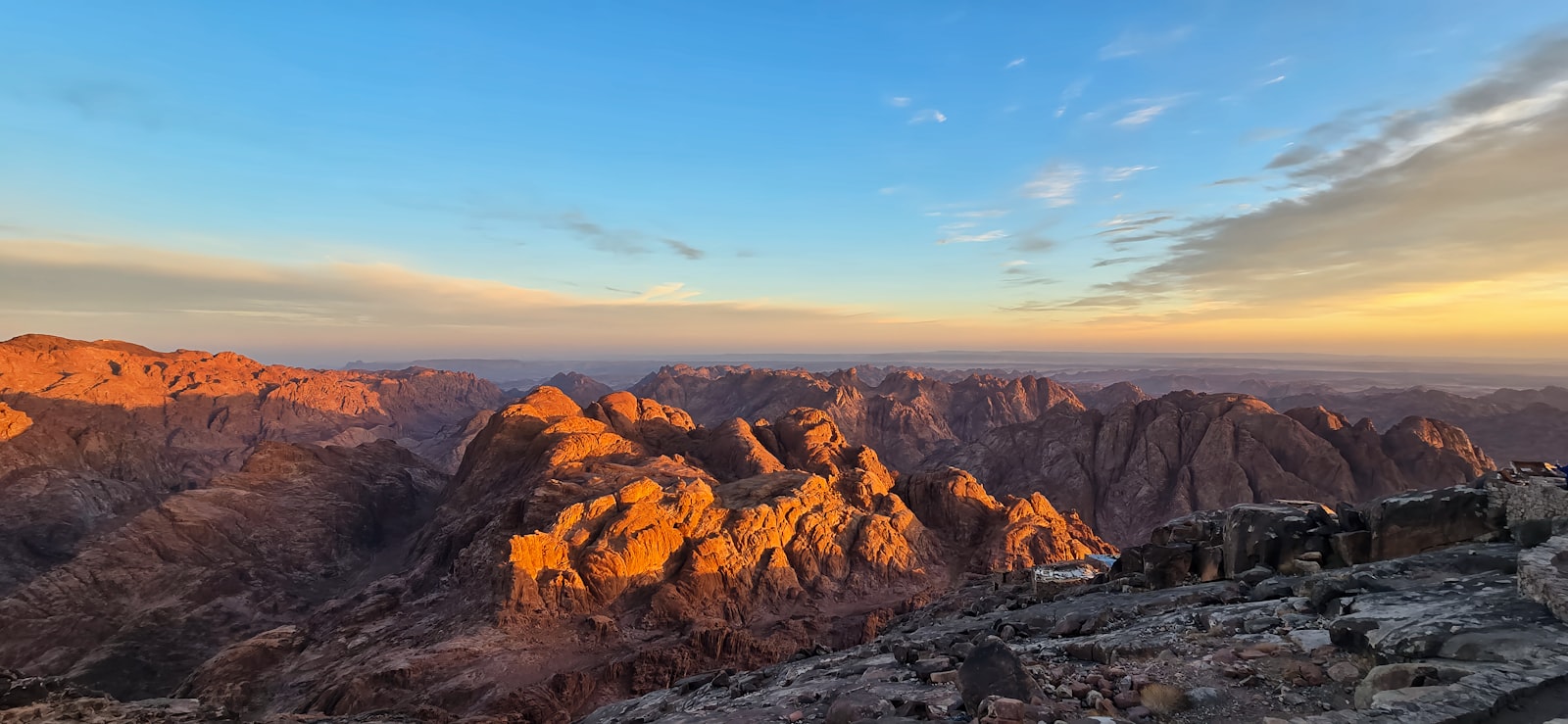
The reward for the toil of the ascent is a panorama that takes the breath away. From the summit of Mount Catherine the gaze sweeps in every direction over a sea of granite mountains, with tones that vary from red to grey to violet depending on the hour of the day and the light. On the clearest days, towards the east one can glimpse the glitter of the Gulf of Aqaba and towards the west the dark line of the Gulf of Suez.
Mount Sinai, although being more famous, appears clearly lower observed from the top of Mount Catherine. This privileged perspective offers a visual understanding of the entire topography of southern Sinai impossible to obtain from any other point. In winter, the summit can be covered by a thin layer of snow, a rare phenomenon in Egypt that adds a further charm to the hike.
Flora and Fauna
The High-Mountain Vegetation
Mount Catherine hosts a botanical ecosystem unique in Egypt. At altitudes higher than 2,000 metres, there are alpine plant species that do not exist in any other part of the country. Among these stand out endemic shrubs, aromatic herbs used by traditional Bedouin medicine, and small plants that flower briefly after the rare rains, transforming the desert landscape into a carpet of unexpected colours.
The flora of Mount Catherine includes dozens of endemic species of the Sinai Peninsula, some of which extremely rare and protected. Botanists have catalogued over 470 plant species in the protected area of Saint Catherine, a surprising number for such an arid environment. Many of these plants are used by the Jabaliya Bedouins in their traditional medicine and in the preparation of herbal teas and infusions.
The Wildlife
Despite the apparent aridity, the mountains of southern Sinai host a surprisingly diversified fauna. The faunal symbol of the area is the Nubian ibex (Capra nubiana), an elegant wild goat with long curved horns that moves with apparently impossible agility on the vertical rocky walls. To spot an ibex during the hike is a relatively common experience, above all in the morning hours.
The rock hyrax (Procavia capensis), known locally as "wabr", is another easily observable mammal. This small furry animal, which resembles a marmot but is in reality the closest living relative of the elephant, lives in the fissures of the rocks and warms itself in the sun on the warm stones in the morning. Among the birds of prey, the steppe eagle and the bearded vulture are sightable above all during the seasonal migrations.
Even desert foxes, wolves and Sinai leopards (extremely rare) frequent the area, although the sightings of these species are sporadic. The Sinai leopard, in particular, is considered functionally extinct, with very few specimens remaining in nature.
The Geological Context
The mountains of southern Sinai are among the most ancient geological formations on Earth. The red and grey granite that composes Mount Catherine dates back to the Precambrian, with an estimated age of about 600-800 million years. These crystalline rocks formed during an intense magmatic activity linked to the closure of an ancient ocean and to the collision of continental masses.
The hike to Mount Catherine is also a journey into the history of the Earth: along the trail it is possible to observe formations of granite, gneiss, basalt and various types of minerals. The veins of white quartz that cross the pink granite create natural designs of great beauty, and it is not rare to find crystals of feldspar and mica that glitter under the desert sun.
Tips for the Visit
Physical Preparation
The hike to Mount Catherine requires a reasonably good physical form. The route includes steep stretches, passages over rocks and a prolonged exposure to the sun and wind. It is not a technical trek, but the altitude and the irregular terrain require attention. The hike is not advised for people with cardiac or respiratory problems without consulting a doctor.
Best Period
The ideal months for the hike are from October to April, when the temperatures are milder. In summer the heat can be unbearable during the central hours of the day, even at high altitude. In winter, especially between December and February, the temperatures at the summit can drop below zero, making necessary adequate layered clothing.
What to Bring
Bring at least 3 litres of water per person, energetic food (dried fruit, bars), sun protection, sunglasses, a hat, trekking shoes with good grip, a windproof jacket and, in winter, thermal layers and gloves. A headlamp is useful if you depart before dawn. Trekking poles are recommended for the steepest stretches.
Practical Organisation
The Bedouin guides can be booked directly at the Monastery of Saint Catherine, in the hotels of the area or through the tour operators of Sharm el-Sheikh and Dahab. It is advisable to depart very early in the morning, ideally before dawn, to avoid the heat and enjoy the best light at the summit. The complete hike requires from six to eight hours, including the stops.
Mount Catherine is an experience for those who seek the authentic Sinai, far from the resorts and the beaches, a place where the grandeur of nature and the depth of history merge in a hike that marks deeply anyone who has the privilege of accomplishing it.