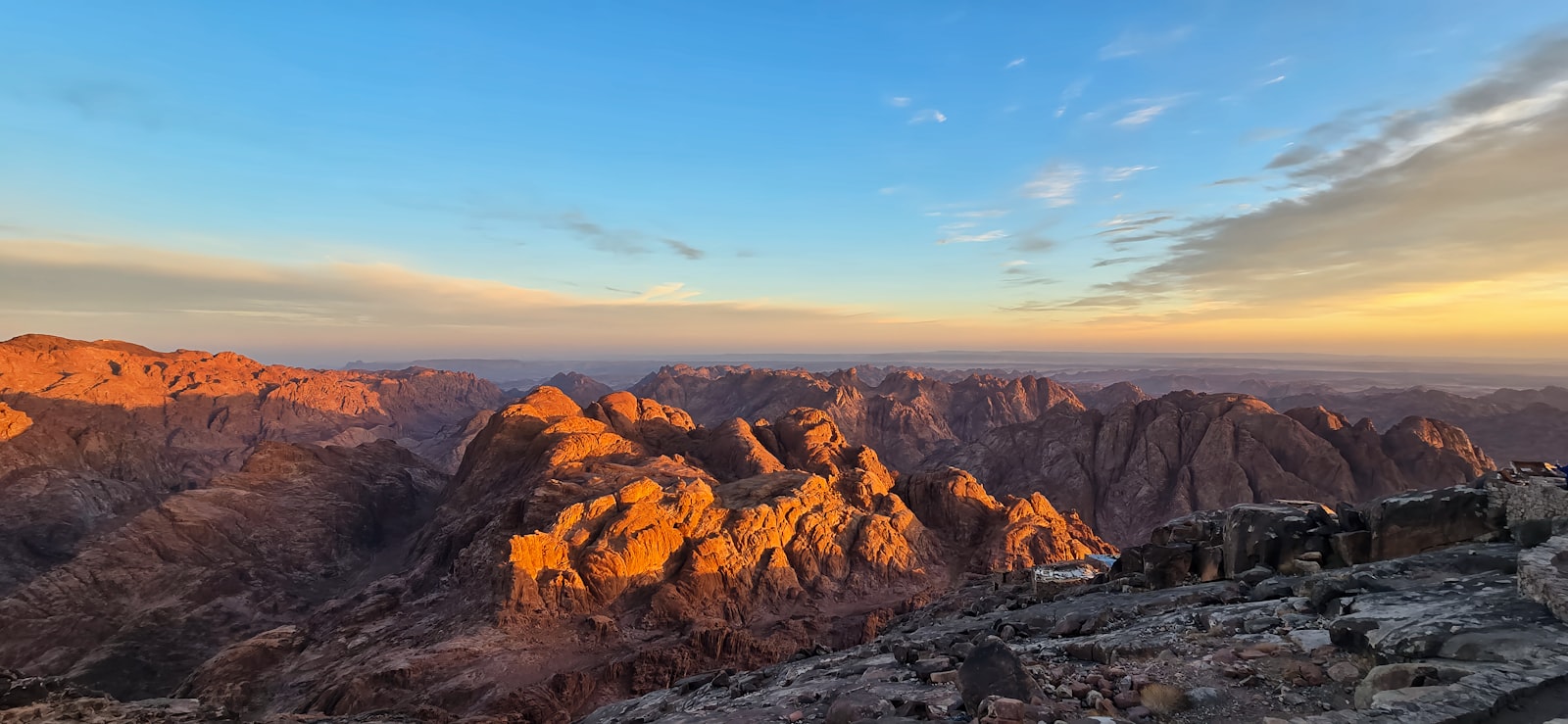
Wadi Feiran: the Great Oasis of the Sinai
Wadi Feiran is the largest and most fertile oasis of the entire Sinai peninsula, a ribbon of luxuriant green that stretches for about 5 kilometres through a narrow valley framed by imposing granite mountains. Located along the historical road that connects the Gulf of Suez to the Monastery of Saint Catherine, this oasis has been for millennia a fundamental crossroads of civilisations, religions and cultures, a place where biblical history, primitive Christian monasticism, the Nabataean commercial routes and Bedouin culture intersect in a fascinating mosaic.
The name "Feiran" — sometimes transliterated as Pharan or Faran — derives from the ancient Semitic name of the oasis, which appears in the Egyptian, biblical and Greco-Roman sources. For the Fathers of the Church, Feiran was identified with the biblical Rephidim, the place where Moses struck the rock to make water gush forth and where the Israelites fought the famous battle against the Amalekites, while Moses held his arms raised towards the sky from the top of a nearby hill.
The Biblical History
The Battle with the Amalekites
According to the account of Exodus (chapter 17), the Israelites during their journey in the desert of the Sinai reached a place called Rephidim, where they found no water to drink. The people murmured against Moses, who by divine order struck the rock of Horeb making the water gush forth. Immediately after, the Amalekites attacked the Israelites, and Moses sent Joshua to fight while he climbed a hill to pray with his arms raised. As long as the arms of Moses remained raised, Israel prevailed; when he lowered them, the Amalekites prevailed. Aaron and Hur helped him to keep his arms raised until sunset, guaranteeing the victory.
On the summit of the hill of Jebel Tahuna, which dominates the oasis, the tradition identifies the exact place where Moses prayed during the battle. Traces of a Byzantine chapel built on the top bear witness to the antiquity of this identification. For the Christian pilgrims of the first centuries, Wadi Feiran was therefore a sacred place of primary importance, an obligatory stop in the pilgrimage towards Mount Sinai.
The Spring of Moses
Still today the Bedouins and the local guides indicate a spring within the oasis as the "Spring of Moses", the point where according to the tradition the prophet made the water gush forth from the rock. The water flows effectively from the base of a rock formation and feeds the traditional irrigation system that sustains the palm grove of the oasis. Whether or not it is the biblical place, the presence of this perennial spring in a desert environment has certainly contributed to making Wadi Feiran a place charged with sacred meaning for the local populations since antiquity.
The Ancient Christian Diocese
The Episcopal See
The Christian history of Wadi Feiran is among the most fascinating of the ancient world. In the fifth century AD, the oasis became the seat of one of the most important Christian dioceses of the Sinai. The Bishop of Pharan was a figure of importance in the Eastern ecclesiastical hierarchy and participated in the ecumenical councils. The diocese comprised not only the oasis but also the monastic communities scattered in the southern Sinai.
The Christian settlement of Pharan reached its apex between the fourth and seventh century, with the construction of a cathedral, an episcopal palace, a library and numerous churches and chapels. The population of the oasis in this period may have reached several thousands of inhabitants, a considerable number for a desert area. Monks, pilgrims and merchants crossed in the streets of the little town, creating a cosmopolitan community in the heart of the Sinai.
The Ruins of the Settlement
The remains of the ancient Christian settlement are still visible in the oasis and on the slopes of the surrounding mountains. The foundations of the cathedral, dating back to the fifth century, show a building with three naves of considerable dimensions, with floors in mosaic and columns in local granite. Near the cathedral have been identified the remains of other ecclesiastical buildings, dwellings, an irrigation system and a wall enclosure that protected the inhabited centre.
On the hills around the oasis are found numerous eremitic cells and small chapels dug into the rock or built in dry stone, testimony of the flourishing monastic life that developed in the area. Some of these hermitages preserve traces of frescoes and inscriptions in Greek, Armenian and Syriac.
The Convent
Today at Wadi Feiran there exists a small Greek Orthodox convent, dependent on the Monastery of Saint Catherine, which keeps alive the Christian tradition in this millennial oasis. The convent guards a collection of manuscripts and liturgical objects of great historical value. The nuns who inhabit it welcome the visitors with discretion and can illustrate the history of the place to those who request it.
The Nabataean Inscriptions
An Archive of Stone
One of the most fascinating and least known aspects of Wadi Feiran are the numerous Nabataean inscriptions carved on the rocks of the valley and of the surrounding heights. The Nabataeans, the people of merchants that built the famous Petra in Jordan, used the Sinai as a commercial corridor between Arabia and the Mediterranean for several centuries, from the third century BC to the fourth century AD.
The inscriptions of Wadi Feiran, together with those of other wadis of the southern Sinai, constitute one of the largest Nabataean epigraphic archives outside of Jordan. They are for the most part graffiti left by travellers and caravans that transited through the oasis, with formulas of greeting and divine invocation such as "May the name of [person] be remembered for good before Dushara" (the principal Nabataean deity).
The Greek and Christian Inscriptions
Alongside the Nabataean inscriptions are found also numerous Greek inscriptions dating back to the Byzantine period, left by Christian pilgrims travelling towards Mount Sinai. These inscriptions, often accompanied by the symbol of the cross, bear witness to the continuous flow of faithful that crossed Wadi Feiran to reach the sacred places of the Sinai. Some inscriptions include prayers, thanksgivings for a healing and invocations to the divine protection for the journey.
The Palm Grove and the Bedouin Agriculture
The Green Oasis
The palm grove of Wadi Feiran is a natural spectacle that strikes for the violent contrast with the surrounding desert landscape. About 12,000 date palms grow in the valley, fed by underground springs and by the rare events of rain that the morphology of the wadi channels into the oasis. The palms produce dates of various varieties, some of which are considered among the best of the entire Egypt.
Under the palms grow irrigated gardens where the local Bedouins cultivate almond trees, fig trees, olive trees, pomegranates and various varieties of vegetables. This traditional agricultural system, based on an ingenious network of irrigation canals built and maintained for generations, represents a notable example of human adaptation to the desert environment.
The Bedouin Life
The oasis is inhabited by a Bedouin community that practises agriculture and pastoralism, integrating them with tourist hospitality. The Bedouins of Wadi Feiran belong mainly to the tribe of the Sawalha and have kept alive many of the ancestral traditions linked to life in the oasis. The care of the palms, the management of the water and the techniques of cultivation are knowledge transmitted from father to son since time immemorial.
Visitors can experience the Bedouin hospitality by stopping for a tea in the tent of a shepherd or by participating in the harvest of the dates in the season of the harvest (September-October). These interactions offer an authentic glimpse of a way of living that, although threatened by modernisation, still preserves an extraordinary depth and cultural richness.
The Way towards Mount Sinai
The Historical Route
Wadi Feiran is located along the historical road that connects the western coast of the Sinai to Mount Sinai and to the Monastery of Saint Catherine. For centuries, this has been the principal itinerary followed by the Christian pilgrims who from Suez or from Cairo reached the sacred places of the Sinai. The oasis represented the last important stop before the ascent to the mountains, a place where to replenish water, rest and gather the strength for the last stages of the journey.
Today the asphalted road that crosses Wadi Feiran is part of the modern road network that connects the coastal cities of the Sinai with the area of Saint Catherine. The oasis is a natural stop for the travellers headed to the Monastery, and many tour operators include a stop at Wadi Feiran in their itineraries.
Excursions in the Valley
Beyond the visit of the oasis itself, Wadi Feiran offers various excursion possibilities. The climb to the hill of Jebel Tahuna, with the remains of the Byzantine chapel and a panoramic view over the entire oasis, is a brief but very gratifying excursion. For the more ambitious hikers, the lateral wadis offer routes of various lengths through spectacular mountain landscapes, with the possibility of observing rock carvings, flora and fauna of the desert.
Tips for the Visit
How to Get There
Wadi Feiran is located along the principal road that connects Abu Rudeis (on the coast of the Gulf of Suez) to Saint Catherine, about 60 kilometres from the Monastery of Saint Catherine. It is reachable by car or minibus from Sharm el-Sheikh (about 3 hours), from Cairo (about 5 hours through the Suez tunnel) or from Dahab and Nuweiba through the internal road of the Sinai.
Best Period
The months from October to April offer the ideal climatic conditions for the visit, with pleasant daytime temperatures and cool nights. In summer the heat can be intense, above all in the central hours of the day, but the shade of the palm grove makes the visit possible nonetheless. The season of the dates (September-October) is a particularly interesting period to observe the traditional agricultural activities.
What to Bring
Bring sufficient water, sun protection, a hat and comfortable shoes. If you intend to explore the surrounding heights to see the inscriptions or the remains of the monastery, trekking shoes are advisable. Binoculars are useful to observe the inscriptions on the more distant rocks. A local guide can enormously enrich the visit with explanations on the inscriptions, the ruins and the history of the oasis.
Respect of the Local Community
Wadi Feiran is an inhabited place with a living and active community. Respect the privacy of the residents, ask permission before photographing the people and be discreet in the vicinity of the convent and of the sacred spaces. If you are offered tea or food, to accept is a sign of respect and an occasion for an authentic cultural exchange.
Wadi Feiran is a place where biblical history, primitive Christian monasticism, the Nabataean caravans and contemporary Bedouin culture overlap in a millennial palimpsest, an oasis of green and of memory in the stone heart of the Sinai.