The Pyramid of Hawara and the Legendary Labyrinth
The Pyramid of Hawara represents one of the most enigmatic and fascinating monuments of ancient Egypt, a funerary complex that once hosted one of the most extraordinary structures ever built by man: the Labyrinth. Located in the eastern part of the Fayoum depression, about twelve kilometres south-east of the city of Fayoum, this pyramid was built by the pharaoh Amenemhat III of the 12th dynasty, around 1850 BC, as his eternal dwelling and centre of funerary cult.
Although today the pyramid appears as an eroded mass of mud bricks, its history and its significance make it one of the most important sites of Egyptian archaeology. The Labyrinth that flanked it, described by ancient historians as a construction more impressive than the pyramids of Giza, has been one of the greatest losses of the architectural heritage of humanity.
Amenemhat III and the Middle Kingdom
The Great Builder
Amenemhat III was the last great pharaoh of the 12th dynasty, reigning for about forty-five years (approximately 1860-1814 BC) during what Egyptologists consider the golden age of the Middle Kingdom. He was an energetic and ambitious sovereign, known for his grandiose public works and his hydraulic projects that transformed the Fayoum from a seasonal swamp into one of the most productive regions of Egypt.
The pharaoh had a special bond with the Fayoum. Under his reign, the Bahr Youssef canal was expanded and regulated, vast marshy areas were reclaimed and new lands were put to cultivation. The construction of the dams that controlled the inflow of the waters of the Nile into Lake Moeris represented a work of hydraulic engineering without precedent that guaranteed the agricultural prosperity of the region.
Two Pyramids, One Pharaoh
Amenemhat III is one of the few pharaohs to have built two pyramids. The first, at Dahshur, presented serious structural problems that compromised its stability. The pharaoh therefore decided to build a second pyramid at Hawara, which became his actual place of burial. This decision was decisive for the history of Egyptian architecture, since the complex of Hawara became the largest and most articulated funerary temple of the Middle Kingdom.
The Pyramid
Structure and Construction
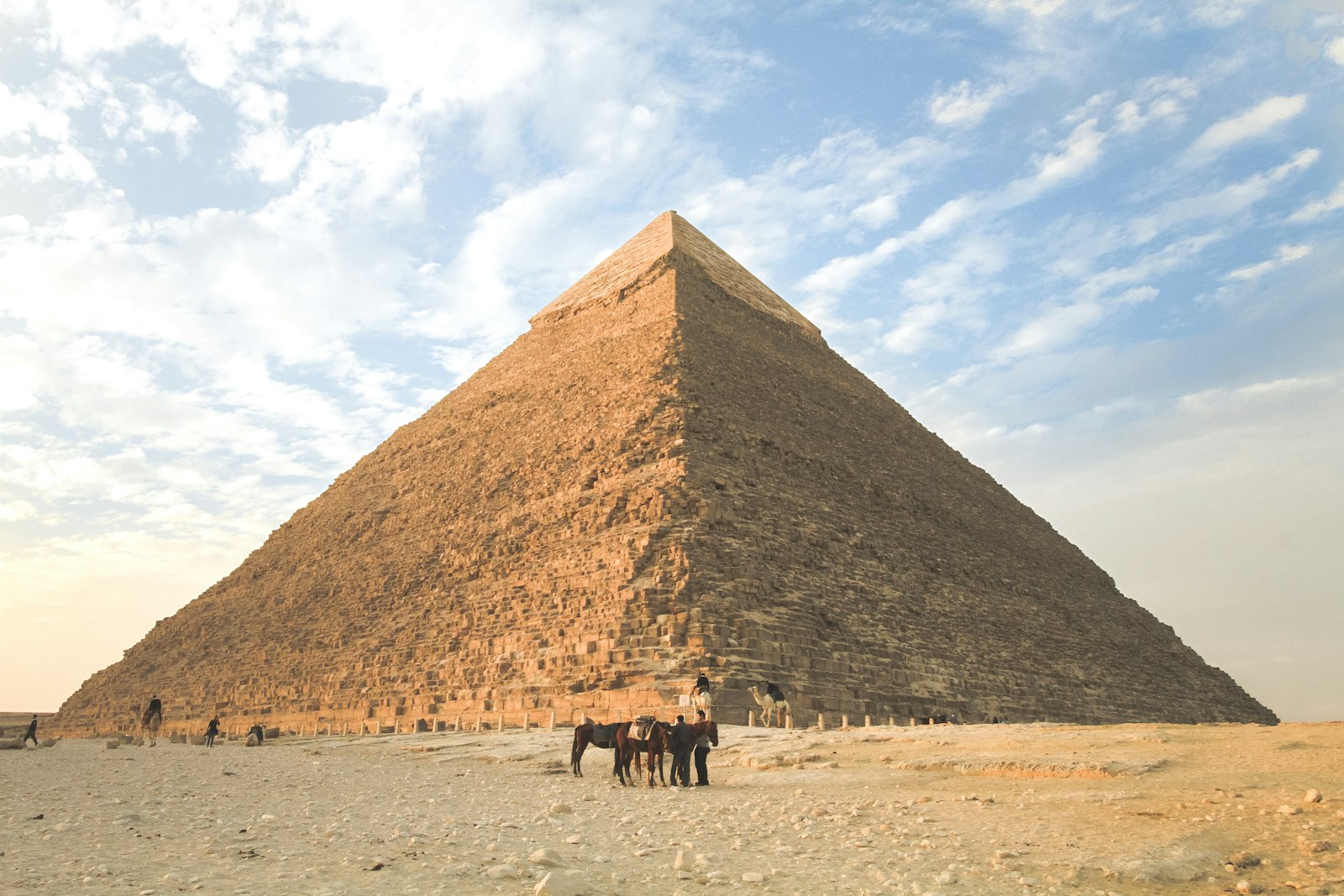
The Pyramid of Hawara was built with a core of mud bricks (adobe), a technique typical of the Middle Kingdom that differed significantly from the pyramids of the Old Kingdom, made of limestone. Originally faced with white Tura limestone, the pyramid had a height of about 58 metres and a base of 105 metres per side, considerable dimensions even if inferior to the great pyramids of Giza.
The interior of the pyramid reveals a very sophisticated security system, designed to protect the burial of the pharaoh from looters. Blind corridors, passages blocked by enormous slabs of stone, trap chambers and false doors composed an intricate puzzle that should have discouraged any attempt at violation. Despite these precautions, the tomb was nonetheless looted in antiquity.
The funerary chamber, carved in a single block of quartzite with an estimated weight of over a hundred tonnes, represents a masterpiece of engineering. The enormous monolith was lowered into a pit and then covered with three slabs of quartzite that formed the ceiling, for an overall weight estimated at about 180 tonnes. Within the chamber, Flinders Petrie discovered the remains of two sarcophagi, one belonging to Amenemhat III and the other probably to his daughter Neferuptah.
The Legendary Labyrinth
The Testimonies of the Ancients
The Labyrinth of Hawara is without doubt the most fascinating and mysterious aspect of the complex. Various ancient authors visited it and left astonished descriptions of it. Herodotus, who saw it in the 5th century BC, wrote:
"I have seen things that surpass all description. If one were to gather all the works and constructions of the Greeks, they would prove inferior in effort and expense to this labyrinth. And yet the labyrinth surpasses even the pyramids."
Strabo, Diodorus Siculus and Pliny the Elder confirmed the impressions of Herodotus. According to their descriptions, the Labyrinth was an immense complex of three thousand rooms, half of which underground, with tortuous corridors, colonnades, courtyards and decorated halls, all covered by a single roof. The structure served both as a funerary temple for Amenemhat III and as an administrative and religious centre for the cults of the various nomes (provinces) of Egypt.
The Archaeological Reality
Unfortunately, of the Labyrinth almost nothing remains. Over the millennia, the structure was systematically dismantled and its materials recycled for other constructions. When Flinders Petrie conducted his excavations between 1888 and 1911, he found only the foundations of a vast complex, sufficient however to confirm the extraordinary dimensions of the building.
The geophysical investigations conducted in 2008 by a Belgian-Egyptian mission have revealed traces of a colossal underground structure beneath the visible foundations, suggesting that part of the Labyrinth might still exist beneath the surface. These discoveries have rekindled the scientific interest in the site, although further excavations are still necessary to confirm the extent of the buried structures.
The Fayoum Portraits
A Revolutionary Discovery
The necropolis adjacent to the pyramid is the place where Flinders Petrie discovered many of the celebrated Fayoum Portraits, one of the most important collections of ancient art ever found. These painted panels, dating back to the Roman period (1st-3rd century AD), were placed on the face of the mummies and represent realistic portraits of the deceased.
The portraits discovered at Hawara are particularly notable for their artistic quality. Made with the encaustic technique, that is pigments mixed with melted beeswax and applied with brushes and spatulas on panels of lime or sycamore wood, these portraits strike for their extraordinary realism. The faces portrayed express a vivacity and an individuality that make them surprisingly modern, almost like photographs of real people who lived two thousand years ago.
The Artistic Importance
The Fayoum Portraits represent the only significant corpus of portraiture of antiquity surviving to our days. They constitute a bridge between Egyptian art and Greco-Roman art, showing how the pharaonic funerary tradition had blended with the Hellenistic aesthetic. These masterpieces are today dispersed in the museums of all the world, from the Egyptian Museum of Cairo to the British Museum, from the Louvre to the Metropolitan Museum of New York.
The Excavations of Petrie
The Pioneer of Modern Archaeology
Sir William Matthew Flinders Petrie, often considered the father of scientific archaeology in Egypt, conducted intensive excavation campaigns at Hawara between 1888 and 1911. Petrie was the first to apply systematic methods of recording and cataloguing of the finds, revolutionising the approach to archaeological research in Egypt.
His excavations at Hawara brought to light not only the Fayoum Portraits, but also important information on the internal structure of the pyramid, on the layout of the Labyrinth and on the surrounding necropolis. Petrie's detailed excavation reports remain a fundamental source for the understanding of the complex of Hawara.
The Hydraulic Engineering
The complex of Hawara was intimately linked to the water management system of the Fayoum. The pyramid rose in proximity to the canals that regulated the inflow of the waters of the Nile into Lake Moeris, and the Labyrinth itself might have had functions linked to the administration of this complex hydraulic system. The ability of Amenemhat III to control the waters of the Nile was seen as an expression of the divine power of the pharaoh, and the Labyrinth celebrated this technological and religious supremacy.
Practical Tips for the Visit
How to Get There
The Pyramid of Hawara is located about twelve kilometres south-east of the city of Fayoum, reachable through a secondary road that crosses the countryside of the oasis. From Cairo, the site is about 100 kilometres away, which can be covered in about an hour and a half by car. There are no direct public transport to the site, so it is necessary to rely on a taxi or an organised tour.
The Visit
The archaeological site is relatively small and can be visited in one or two hours. The area is open and little shaded, so it is essential to bring sun protection, a hat and water. The terrain is sandy and uneven, so robust shoes are recommended. There are no service structures in the vicinity, so it is appropriate to bring everything necessary.
Combining with Other Sites
The visit to the Pyramid of Hawara can be combined with that of the nearby pyramid of Lahun (Senusret II) and with a tour of the oasis of Fayoum for a day rich in discoveries. It is advisable to visit also the small museum of Kom Aushim at the entrance of the oasis, where finds coming from the archaeological sites of the region are exhibited, including some of the Fayoum Portraits.
The Pyramid of Hawara and its lost Labyrinth represent one of the most fascinating chapters of the history of ancient architecture, a warning about the fragility of the human heritage and an invitation to imagine the wonders that once adorned this extraordinary land. Visiting this site means walking in the footsteps of Herodotus and Petrie, among the ghosts of a glorious past that still awaits to be fully revealed.