The Temple of Amada: The Oldest Jewel of Nubia
On the silent shores of Lake Nasser, in the heart of Egyptian Nubia, lies a temple modest in size but immense in historical and artistic value: the Temple of Amada, the oldest Egyptian temple in the entire Nubian region. Built during the 18th dynasty by some of the greatest pharaohs in Egyptian history - Thutmose III, Amenhotep II and Thutmose IV - this small sanctuary houses within it the most refined and best preserved decorative reliefs in all of Nubia, an artistic treasure that has spanned almost thirty-five centuries reaching us in extraordinary condition.
But the history of the Temple of Amada is not only that of its remote pharaonic past. It is also the story of an unprecedented modern engineering feat: to save it from the waters of Lake Nasser, in the 1960s, a team of French engineers transported the entire temple on rails for 2.5 kilometers without dismantling it, thus preserving the fragility of its polychrome reliefs. This daring rescue intervention remains one of the most exciting and ingenious episodes of UNESCO's campaign to save Nubian monuments.
History of the Temple
The Foundation under Thutmose III
The Amada Temple was founded around 1450 BC. by Pharaoh Thutmose III, the great conqueror of the 18th Dynasty who extended Egypt's borders from northern Syria to the Fourth Cataract of the Nile. Thutmose III, often called the "Napoleon of Egypt" for his military campaigns, dedicated the temple jointly to two important deities: Amun-Ra, king of the gods and lord of Karnak, and Ra-Horakhty, the sun god in his falcon manifestation on the horizon.
The choice to dedicate the temple to these two joint deities was not accidental. Amun-Ra was the national god of Egypt, the patron of the ruling dynasty and the guarantor of pharaonic legitimacy. Ra-Horakhty was the god of the rising sun, a symbol of rebirth and cosmic power. Their association in the Temple of Amada served to project the image of the pharaoh's divine power onto Nubia and to sacralize Egyptian rule over this frontier region.
The Additions of Amenhotep II and Thutmose IV
Thutmose III's son and successor, Pharaoh Amenhotep II, continued work on the temple, adding significant decorations and a hypostyle hall. Amenhotep II, known for his extraordinary physical strength and athletic prowess — inscriptions describe him as a formidable archer and tireless rower — left two inscriptions of enormous historical importance in the temple that are the monument's main claim to fame among scholars.
Thutmose IV, son of Amenhotep II, completed the work by adding a vestibule with hathori protomes and enlarging the external courtyard of the temple. Under his reign, the Temple of Amada reached its final configuration, which has remained largely intact to this day.
The Historical Inscriptions
The Amada Temple houses two inscriptions of exceptional historical value which are among the main reasons why Egyptologists consider this temple so important.
The first, dating back to the reign of Amenhotep II, narrates the pharaoh's military campaign in Syria and his victory over the rebel princes of Retenu (Palestine). The inscription describes in stark detail how Amenhotep II, after the battle, hung the bodies of the seven defeated princes in the bow of his royal ship during the voyage back to Egypt, then displayed them on the walls of several cities as a warning. Six were hung on the walls of Thebes, while the seventh was sent to Napata in Nubia to serve as a warning to the Nubians against possible insurrections.
The second inscription, even more historically significant, dates back to the reign of Pharaoh Merenptah of the 19th Dynasty (circa 1213-1203 BC) and documents Egypt's victory against a Libyan invasion. This "Stele of Amada" is a fundamental document for the chronology of the New Kingdom and completes the information contained in the most famous Stele of Merenptah preserved in the Egyptian Museum in Cairo, the one which contains the first historical mention of Israel in Egyptian documentation.
Architecture and Decoration
The Structure of the Temple
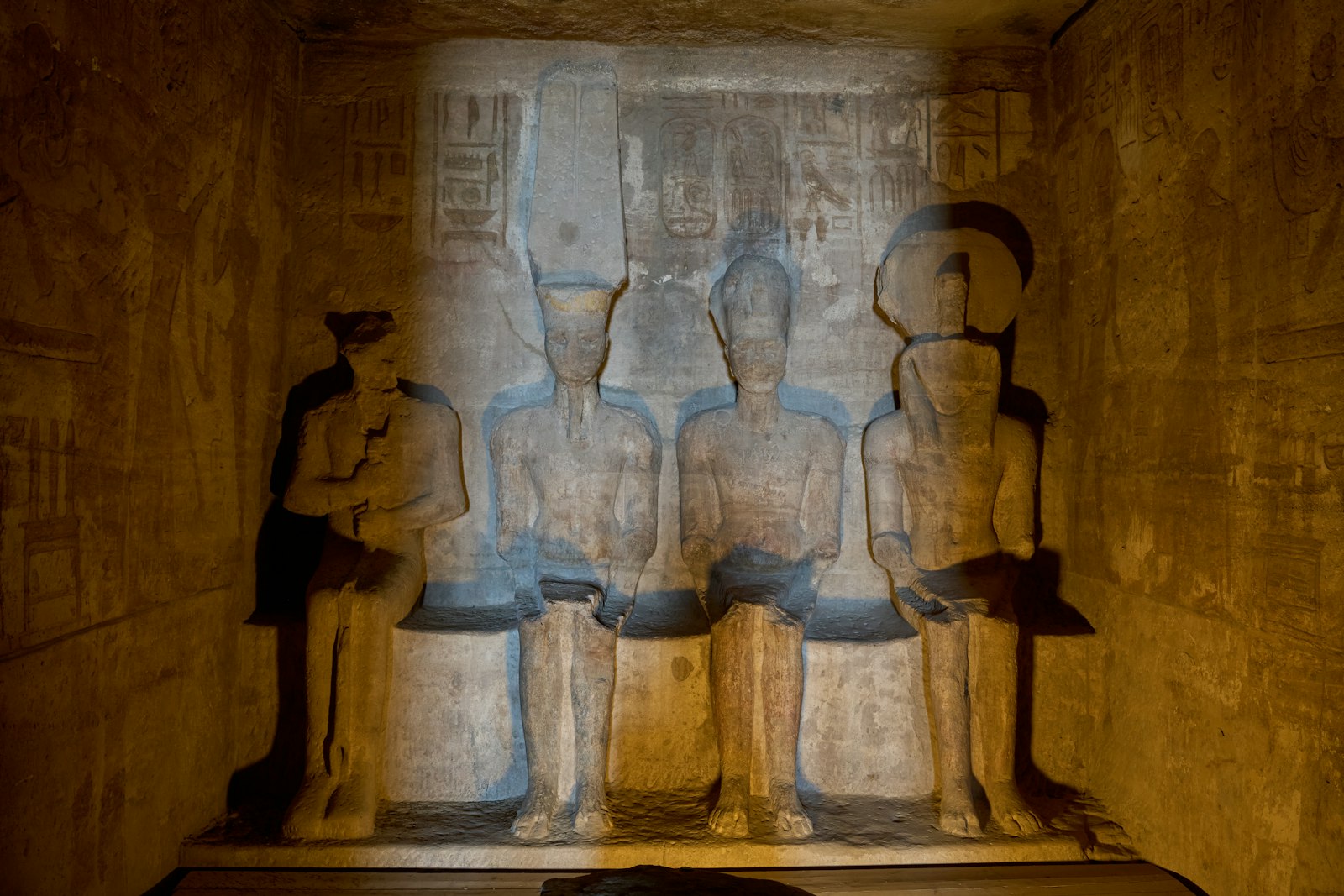
The Temple of Amada is relatively small compared to the great Egyptian sanctuaries, but its floor plan is a model of balance and harmony. The building consists of an entrance pylon, a vestibule with hathori pillars, a hypostyle hall with twelve pillars and finally three sanctuary chapels dedicated respectively to Amun-Ra, Ra-Horakhty and the deified pharaoh.
The hypostyle hall, built by Amenhotep II, is the artistic heart of the temple. The twelve pillars that support the ceiling are decorated with surprisingly delicate reliefs, which show the pharaoh in the presence of the divinities in scenes of offering and worship. The attention to detail is extraordinary: every fiber of the wigs, every fold of the clothes, every hieroglyph is executed with a precision that reveals the hand of artists of the highest caliber.
The Polychrome Reliefs
What makes the Temple of Amada unique in the Nubian panorama is the exceptional conservation of its polychrome reliefs. While in most Egyptian temples the original colors have faded centuries ago, at Amada the paintings that complemented the bas-reliefs have retained much of their original vibrancy. The intense reds, brilliant blues, emerald greens and golden yellows that color the scenes on the temple walls transport the visitor to a distant era, allowing him to see these images almost as the faithful saw them three thousand years ago.
The preservation of these colors is due in part to the climatic conditions of Nubia — the extreme aridity slowed down the deterioration of the pigments — but above all to the closure of the temple in the Christian era, when the building was converted into a church and many of the pagan reliefs were covered with a layer of stucco and Christian paintings. Paradoxically, this act of iconoclasm protected the underlying reliefs from erosion and sunlight for over a millennium, preserving the colors in astonishing conditions.
The Artistic Style
The reliefs of the Temple of Amada belong to the great artistic season of the 18th dynasty, considered by art historians as the pinnacle of Egyptian bas-relief sculpture. The style is characterized by a fluid and confident line, by harmonious proportions of the figures and by a naturalistic rendering of anatomical details that anticipates the artistic sensitivity of the Amarnian period by centuries. The figures of the gods, with their elaborate crowns and their symbolic attributes, are executed with a mastery that testifies to the exceptional level reached by Egyptian artistic workshops in this historical period.
Rescue on Rails
The Company of French Engineers
When the construction of the Aswan High Dam threatened to submerge Nubian monuments, the Amada Temple posed a particular challenge to conservatives. Its polychrome reliefs were too fragile to resist the dismantling and reconstruction that were adopted for the other temples in the region: the risk of losing the colors during the cutting and transporting of the blocks was too high.
The solution adopted by the French engineers was as bold as it was ingenious: instead of dismantling the temple, they decided to move it in one piece. The entire building, weighing over 800 tons, was lifted on hydraulic jacks, placed on a rail-mounted platform and slowly transported 2.5 kilometers to its new location, at an altitude approximately 65 meters higher than its original location. The operation, which lasted several months, required laying tracks in the desert and using diesel locomotives to haul the enormous load at a speed of just a few meters per hour.
A Unique Precedent
The transfer of the Amada Temple to rails remains an almost unique case in the history of archeology and engineering. The only comparable precedent is the move of the Temple of Abu Simbel, which however was carried out with the traditional technique of dismantling and reconstruction. The technique employed at Amada was later applied to the nearby Temple of Derr, which was also too fragile to dismantle.
Tips for the Visit
How to Get There
The Amada Temple is located on the western shore of Lake Nasser, about 180 kilometers south of Aswan. The most common way to reach it is via a cruise on Lake Nasser, where Amada represents one of the main stops on the itinerary. The visit is generally combined with the nearby Temple of Derr and the Tomb of Pennut, both located in the immediate vicinity.
The Visit of the Temple
It is advisable to dedicate at least an hour and a half to visiting the temple, taking all the time necessary to admire the polychrome reliefs which represent the main attraction of the site. Internal lighting is limited: a torch is essential to appreciate the details and colors of the reliefs in the darkest areas of the temple. Photographs are generally permitted without flash.
What to Bring
As with all Lake Nasser sites, it is essential to bring plenty of water, sunscreen, a hat and comfortable shoes. An electric torch is particularly important when visiting this temple, given the poor lighting conditions of the internal rooms where the most precious reliefs are located.
Combine with Other Visits
The area surrounding the Temple of Amada is home to two other monuments of notable interest: the Temple of Derr, a cave temple of Ramesses II also relocated from its original location, and the Tomb of Pennut, a small decorated tomb dating back to the 20th Dynasty. The visit to the three sites takes approximately three hours in total and offers a complete panorama of Nubian art and architecture from the 18th to the 20th dynasty.
Curiosities about the Temple of Amada
The Temple of Amada is the only Nubian temple in which reliefs attributable with certainty to the era of Thutmose III are preserved, which makes it an irreplaceable artistic document for the study of the art of the first half of the 18th dynasty. Analysis of the pigments used in the reliefs revealed the use of minerals from different regions of Egypt and Nubia, including lapis lazuli from Afghanistan for the deep blue and malachite from Sinai for the green.
Pharaoh Akhenaten, during his religious revolution, systematically erased the names of Amun from all the temples of Egypt, including Amada. After the restoration of traditional worship under Tutankhamun and Horemheb, the names were restored, and traces of this double change are still visible in several places of the temple, offering tangible testimony to one of the most dramatic episodes in Egyptian religious history.
Visiting the Temple of Amada is a rare and precious experience: a journey to discover the most ancient Egyptian sanctuary in Nubia, a monument that preserves within it an artistic heritage of unparalleled beauty and a history that intertwines the grandeur of the pharaohs with the ingenuity of modern monument saviors.