Bab Zuweila: the Last Gate of Fatimid Cairo
Bab Zuweila is the last southern gate still standing of the ancient walls of Fatimid Cairo, a monumental fortified entrance that for over nine centuries has watched over the access to the historic city. Built in 1092 during the reign of the Fatimid caliph al-Mustansir Billah, this imposing stone structure represents one of the most important monuments of medieval Islamic military architecture and an unmistakable landmark in the panorama of Islamic Cairo.
With its two massive circular towers, surmounted by the minarets of the Mosque of al-Mu'ayyad Sheikh added in the 15th century, Bab Zuweila offers a unique and immediately recognisable silhouette in the skyline of historic Cairo. The gate is not only an architectural monument, but a place steeped in history, legends and popular traditions that have crossed the centuries.
History and Historical Context
The Foundation of Fatimid Cairo
To understand the importance of Bab Zuweila it is necessary to know the history of the foundation of Cairo. In 969 AD, the Fatimid general Jawhar al-Siqilli conquered Egypt and founded a new city, al-Qahira (Cairo), as the capital of the Fatimid caliphate. The new city was conceived as a royal citadel, protected by mudbrick walls that separated it from the old capital Fustat.
The original walls of Fatimid Cairo were built in haste and with modest materials. A century later, the powerful vizier Badr al-Jamali decided to replace them with new stone fortifications, much more robust and imposing. The works, executed between 1087 and 1092 by Armenian architects brought from northern Syria, produced the three monumental gates that still survive today: Bab al-Futuh and Bab al-Nasr to the north, and Bab Zuweila to the south.
The Origin of the Name
The name "Zuweila" (or "Zuwayla") derives from the Berber tribe of the Zuwayla, originally from the Fezzan region in present-day Libya. Members of this tribe were part of the Fatimid army and had their encampments near the southern gate of the city, which thus took their name. This denomination testifies to the multi-ethnic composition of the Fatimid army and society, which comprised North African Berbers, Turks, Sudanese and Armenians.
Theatre of Public Executions
Bab Zuweila was for centuries the place of public executions in Cairo, a macabre function that confers on the gate a sinister aura in the collective memory. The heads of the condemned were displayed on the gate's leaves as a warning to the population. The most famous execution was that of the last Mamluk sultan, Tumanbay II, who in 1517 was hanged at the gate by order of the Ottoman conqueror Selim I. According to legend, the rope broke three times before the execution succeeded, an event interpreted by the population as a divine sign.
Architecture and Characteristics
The Defensive Structure
Bab Zuweila is a masterpiece of Islamic military architecture. The gate is flanked by two massive semicircular towers, each about 15 metres in diameter, which project from the plane of the walls creating a zone of crossfire that made any assault attempt extremely difficult. The towers are built of carefully squared limestone blocks, with walls of enormous thickness that guaranteed resistance to catapult projectiles.
Entry to the city took place through a bent-axis vaulted passage, a tactical expedient typical of Islamic military architecture that prevented assailants from charging the gate directly with a battering ram. The passage, about 25 metres long, was defended by machicolations in the ceiling from which the defenders could pour boiling oil or stones on the attackers.
The iron-reinforced wooden doors that originally closed the access are still partially preserved and show the signs of wear of nearly a thousand years of use. The original hinges, of enormous dimensions, testify to the weight and solidity of the leaves.
The Minarets of the Mosque of al-Mu'ayyad
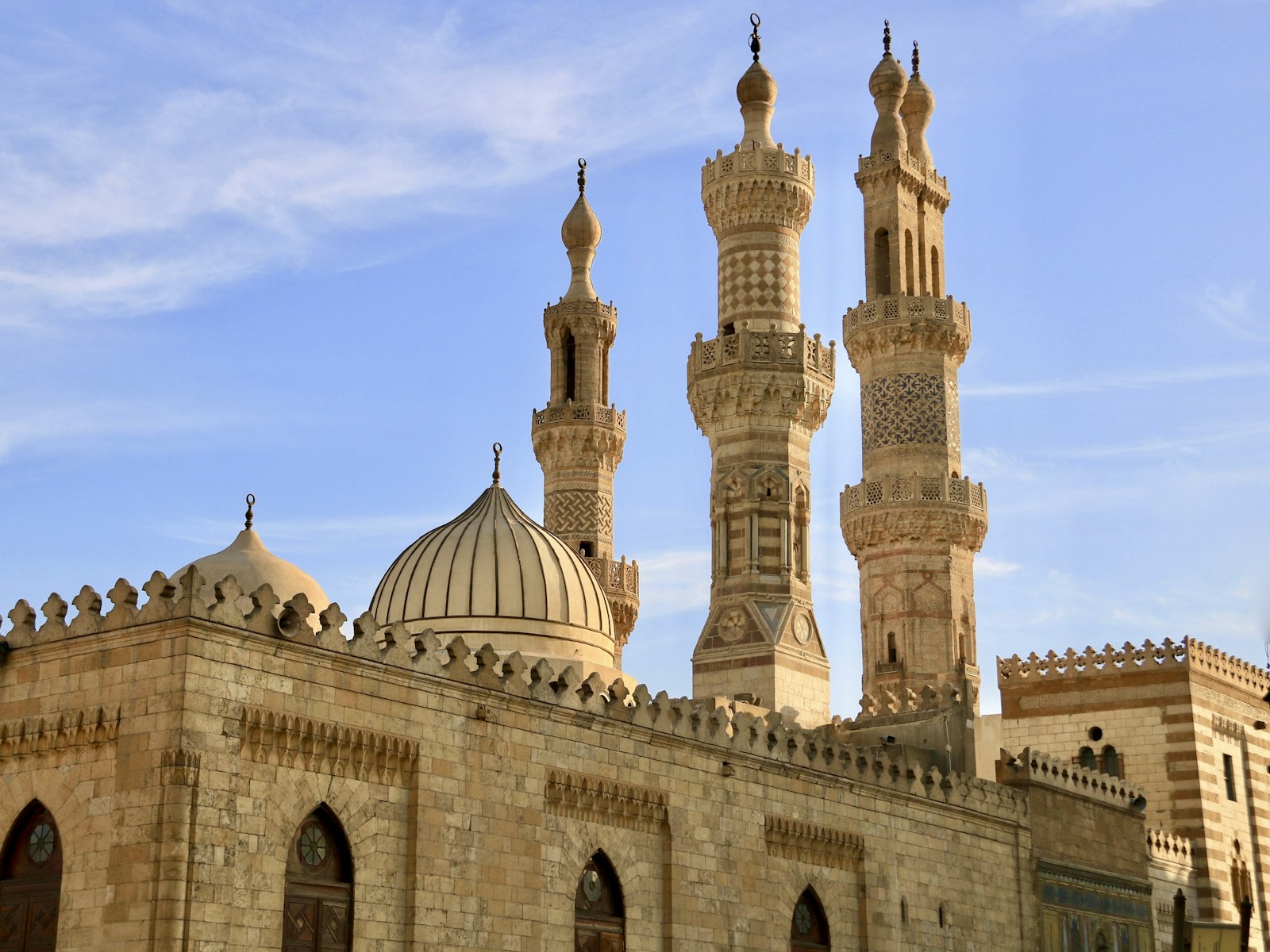
The most visible element of Bab Zuweila are the two minarets that rise above the towers. These minarets were not part of the original structure of the gate, but were added in 1420 when the Mamluk sultan al-Mu'ayyad Sheikh built his mosque immediately adjacent to the gate, using the towers as a base for the minarets.
This architectural solution, as audacious as it is unusual, created one of the most iconic silhouettes of Cairo, with the two elegant Mamluk minarets rising from the massive Fatimid structure, fusing in a single monument two centuries of Islamic architecture. The minarets present the typical Mamluk structure with three sections of decreasing diameter, projecting balconies with stalactite brackets and bulbous crowning.
The Decorations
Despite the primarily military function, Bab Zuweila presents decorative elements of remarkable quality. The entrance arch is surrounded by a moulded frame with geometric motifs, while the towers present decorative niches and horizontal bands that lighten the masonry mass. The inscriptions in Kufic and Naskhi characters, distributed on the facade, report Koranic verses and information about the construction.
Inside the passage, the vaults are decorated with bricks arranged in geometric motifs, while the walls preserve traces of painted plaster that suggest an original decoration much richer than is visible today.
The Mosque of al-Mu'ayyad Sheikh
An Integrated Complex
Immediately behind Bab Zuweila is the Mosque of al-Mu'ayyad Sheikh, an important Mamluk religious complex built in 1415-1420. The mosque was built on the site of a prison where sultan al-Mu'ayyad Sheikh had been detained before ascending the throne, and its construction was an act of gratitude for the liberation and the rise to power.
The mosque presents an internal courtyard with porticoes and an elegant mihrab decorated with polychrome marbles. The internal decorations include panels of inlaid marble, carved stuccoes and a magnificent bronze portal that originally belonged to the Mosque of Sultan Hassan. The visit to the mosque is often combined with that of Bab Zuweila, since access to the minarets takes place through the mosque itself.
The Surrounding District
Al-Muizz Street
Bab Zuweila is located at the southern end of al-Muizz li-Din Allah Street, the historic main artery of Fatimid Cairo that crosses the old city from south to north, connecting Bab Zuweila to Bab al-Futuh. This street, one of the oldest and best preserved of the Islamic world, is flanked by mosques, madrasas, caravanserais, public fountains and palaces that cover a time span of nearly a thousand years.
Strolling along al-Muizz Street from Bab Zuweila towards the north is like crossing an open-air museum of Islamic architecture, with monuments of every epoch that succeed one another in a kaleidoscope of styles and historical periods.
The Tentmakers' District
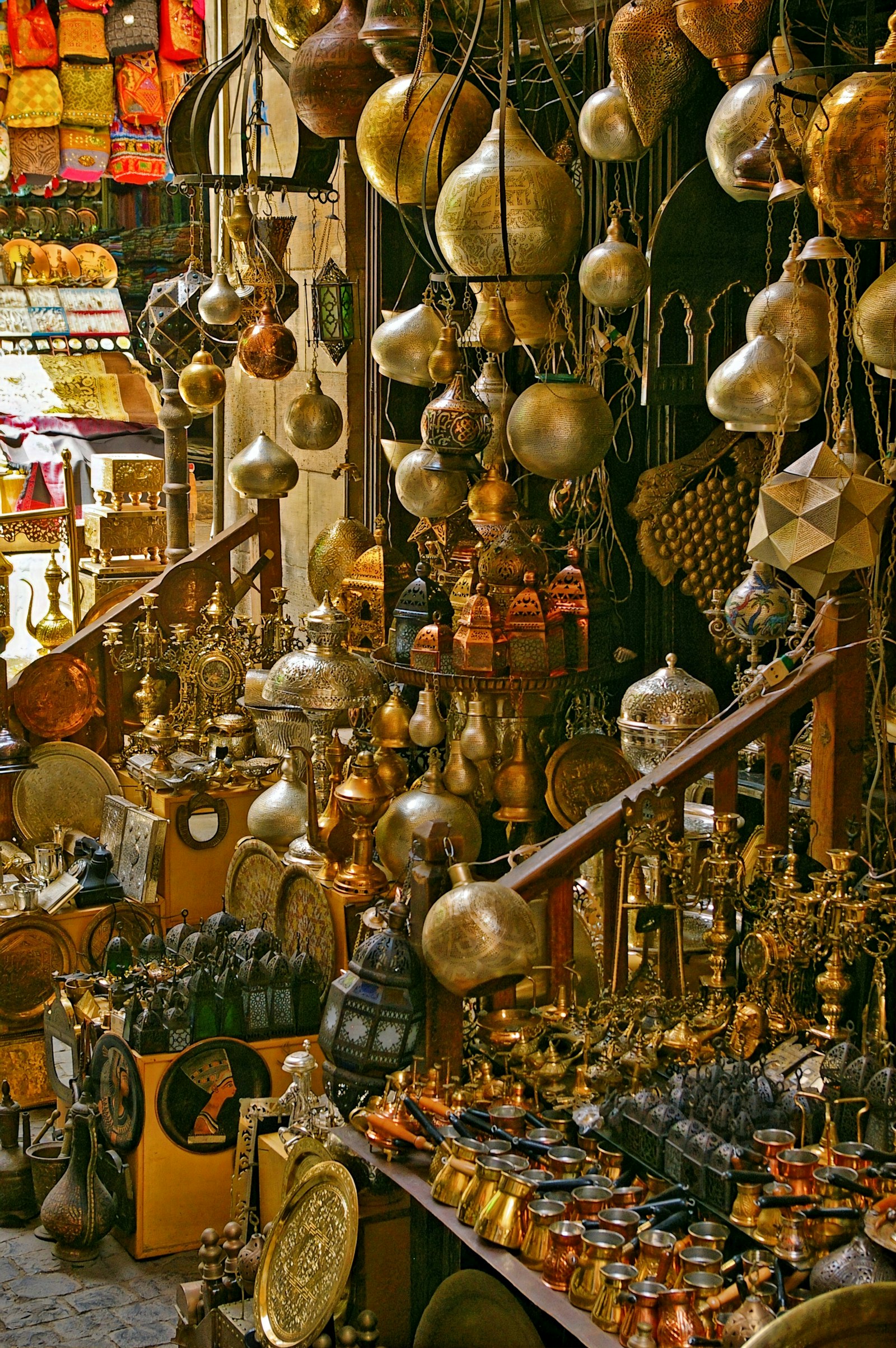
Immediately outside Bab Zuweila is the Suq al-Khayamiyya, the "Tentmakers' Alley", the last medieval covered market of Cairo still in operation. Here artisans who pass down a centuries-old art produce and sell the traditional Egyptian appliqué textiles, used to decorate ceremonial tents, cushions and tapestries. These very colourful textiles, with floral, geometric and calligraphic motifs, are among the most authentic and appreciated souvenirs of Cairo.
The Museum of Islamic Art
A short distance from Bab Zuweila is the Museum of Islamic Art of Cairo, one of the most important museums of Islamic art in the world. The collection comprises over 100,000 objects including ceramics, glass, metals, textiles, carved woods, manuscripts and jewellery from all over the Islamic world. The museum, recently restored after the damage suffered during the 2011 revolution, is an unmissable stop for those who wish to deepen their knowledge of Islamic art and culture.
Legends and Popular Traditions
The Miraculous Power of the Gate
Bab Zuweila is at the centre of numerous legends and popular beliefs. The best known concerns the alleged thaumaturgic powers of the gate: for centuries, the Cairenes have fixed nails to the leaves of the gate while reciting prayers to obtain healing from illnesses or the solution of personal problems. Still today it is possible to see the nails and the shreds of fabric left by the devout on the surface of the ancient wood.
This tradition is linked to the cult of Mitwalli al-Qutb, a Sufi saint whose spirit, according to popular belief, inhabits the gate. The Cairenes often refer to Bab Zuweila as "Bab al-Mitwalli", from the name of the saint, and the gate is considered a place of baraka (divine blessing).
Panoramic View from the Summit
A Belvedere over Historic Cairo
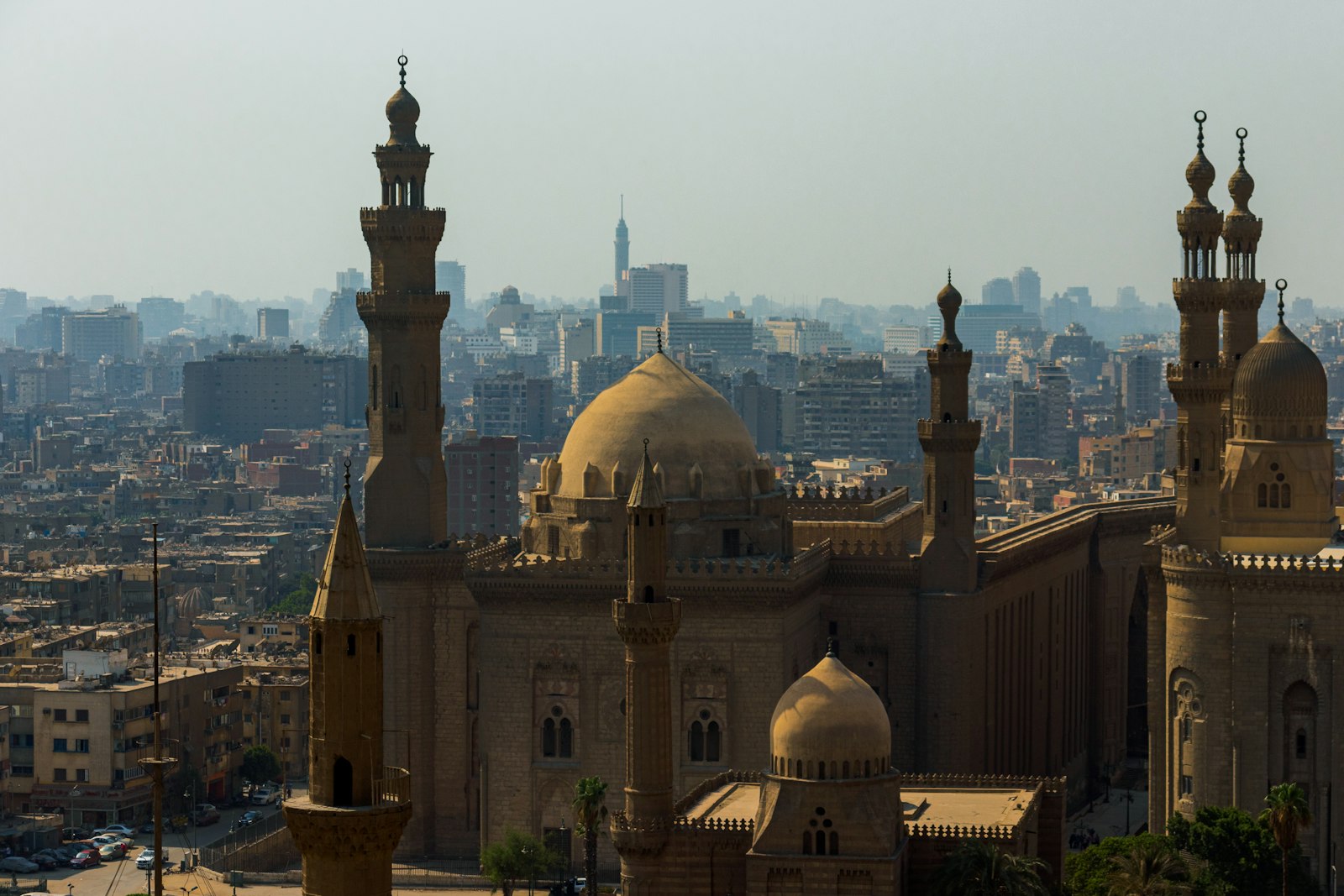
One of the major attractions of Bab Zuweila is the possibility of climbing to the summit of the towers and minarets to enjoy a 360-degree panoramic view over historic Cairo. From the top one ranges over the minarets and domes of the hundreds of mosques of Islamic Cairo, over the Citadel of Saladin with the Mosque of Muhammad Ali, over the modern city with its skyscrapers and, on clear days, up to the pyramids of Giza on the horizon.
The ascent takes place through narrow spiral staircases inside the towers and minarets, an adventurous experience that requires a certain physical form but that is amply repaid by the spectacle that opens from the summit.
Tips for the Visit
How to Get There
Bab Zuweila is located in the heart of Islamic Cairo, reachable by taxi or with the ride-sharing service. The nearest metro station is Mohamed Naguib on line 1 or 2, from which one can reach the gate on foot in about 15-20 minutes crossing the historic district. Alternatively, it is possible to begin the visit from Khan el-Khalili and walk along al-Muizz Street towards the south until reaching the gate.
Opening Hours and Tickets
Bab Zuweila is generally open from 9:00 to 17:00, every day. The entrance ticket is economical and includes access to the towers and minarets. It is advisable to visit in the early hours of the morning, both to avoid the heat and to enjoy the best light for the photographs from the summit.
What to Bring
Wear comfortable shoes with a non-slip sole to face the steep internal stairs. Bring water, sun protection and a hat if you plan to spend time on the panoramic terrace. A torch can be useful in the darker passages inside the towers.
Photographic Suggestions
The best moment to photograph the gate from outside is the late afternoon, when the golden light illuminates the facade creating a dramatic contrast with the sky. From the summit of the minarets, the best panoramic photographs are obtained early in the morning, when the air is clearer and the haze of Cairo has not yet obscured the horizon. Do not forget to photograph the evocative Suq al-Khayamiyya at the foot of the gate.
Combining the Visit
Bab Zuweila is the ideal starting point for an itinerary along al-Muizz Street towards the north, passing through numerous mosques and historic monuments until reaching Khan el-Khalili and the Mosque of al-Azhar. Alternatively, it is possible to head towards the south-east to visit the Mosque of Ibn Tulun, or towards the east to reach the Citadel of Saladin. Allow at least half a day to explore the district adequately.
Bab Zuweila is much more than a simple gate: it is a monument that encloses within itself the thousand-year history of Cairo, from the Fatimid origins to the Mamluk epoch, from popular legends to spiritual traditions. Climbing its minarets and contemplating the panorama of the city is an experience that allows one to grasp the historical stratification and cultural vitality of one of the most fascinating metropolises of the world.