Al-Azhar Mosque: A Thousand Years of Knowledge and Spirituality
Al-Azhar Mosque is one of the most venerable and significant monuments of the entire Islamic world. Founded in 970 AD by the Fatimid general Jawhar al-Siqilli at the behest of caliph al-Mu'izz li-Din Allah, this thousand-year-old mosque is not only one of the oldest Muslim places of worship in Cairo, but also the seat of what is universally recognised as the oldest university in the world still in operation: the University of Al-Azhar, founded in 975 AD.
The name "Al-Azhar", which means "the resplendent" or "the luminous", probably derives from the epithet of Fatima al-Zahra, daughter of the Prophet Muhammad and ancestor of the Fatimid dynasty that founded Cairo and the mosque itself. Over the centuries this name has acquired a resonance that transcends mere toponymic designation, becoming synonymous with theological authority, academic excellence and spiritual leadership in the Sunni world.
A Millennial History
The Fatimid Foundation (970-1171)
The construction of Al-Azhar Mosque was one of the first works undertaken by the Fatimid dynasty after the founding of Cairo in 969 AD. The Fatimids, Ismaili Shiite caliphs from present-day Tunisia, had conquered Egypt with the aim of creating an empire rival to the Abbasid caliphate of Baghdad. The new mosque was to serve as the congregational mosque of the new capital and as a centre of religious propaganda for the Ismaili doctrine.
Construction work lasted just two years, from 970 to 972, under the direction of Jawhar al-Siqilli himself. The original structure was relatively modest: a hypostyle prayer hall with five aisles, a central porticoed courtyard and a single minaret. However, from the outset the mosque was conceived not only as a place of worship but also as a centre of teaching, thus anticipating its future university vocation.
In 975 AD, a few years after the founding, caliph al-Aziz billah formally instituted the first study circles (halqa) in the mosque, giving rise to what is considered the oldest university in the world still in operation. The initial teachings focused on Ismaili Islamic jurisprudence, theology, philosophy and the sciences. Students and scholars flocked from all over the Islamic world, attracted by the generosity of the caliphs who provided scholarships, lodging and stipends.
The Ayyubid Era and the Shift to Sunnism (1171-1250)
The fall of the Fatimid dynasty at the hands of Saladin in 1171 marked a radical turning point in the history of Al-Azhar. Saladin, a devout Sunni, stripped the mosque of its role as a centre of Shiite propaganda and temporarily excluded it from its congregational functions, transferring Friday prayer to the new al-Hakim Mosque. For nearly a century, Al-Azhar went through a period of relative decline, although teaching never completely ceased.
The Mamluk Renaissance (1250-1517)
It was under the Mamluk sultans that Al-Azhar was reborn and reached its maximum splendour as an academic and religious centre. Sultan Baybars restored Friday prayer in the mosque in 1266 and began a programme of expansion and embellishment that lasted for over two centuries. The Mamluks, fervent Sunnis, made Al-Azhar the undisputed centre of teaching for the four Sunni juridical schools (Hanafi, Maliki, Shafi'i and Hanbali), conferring upon it the religious authority it still retains today.
During this period, the mosque was expanded several times. New porticoes, madrasas (theological schools), riwaq (dormitories for foreign students) and minarets were added, transforming the modest Fatimid structure into a vast architectural complex. The introduction of scholarships financed by pious endowments (waqf) made it possible to maintain hundreds of students from all over the Islamic world, from Indonesia to Morocco, from Turkey to sub-Saharan Africa.
The Ottoman and Modern Era (1517-present)
The Ottoman conquest of 1517 did not interrupt the prestige of Al-Azhar, which continued to be the religious and intellectual centre of Egypt and of the entire Sunni world. During the Napoleonic invasion of 1798, the mosque was the scene of a popular revolt against the French that transformed it into a symbol of national resistance. Napoleon briefly suppressed the activities of the mosque, but its importance was such that it was quickly reopened.
In the 19th and 20th centuries, Al-Azhar went through a process of modernisation that transformed it from a purely religious institution into a modern university with faculties of medicine, engineering, sciences and letters, while maintaining its core of Islamic studies. Today the University of Al-Azhar has hundreds of thousands of students in dozens of campuses scattered throughout Egypt and remains the highest Sunni religious authority, whose Grand Imam is considered the most authoritative voice of moderate Islam.
Architecture and Spaces
The Five Minarets
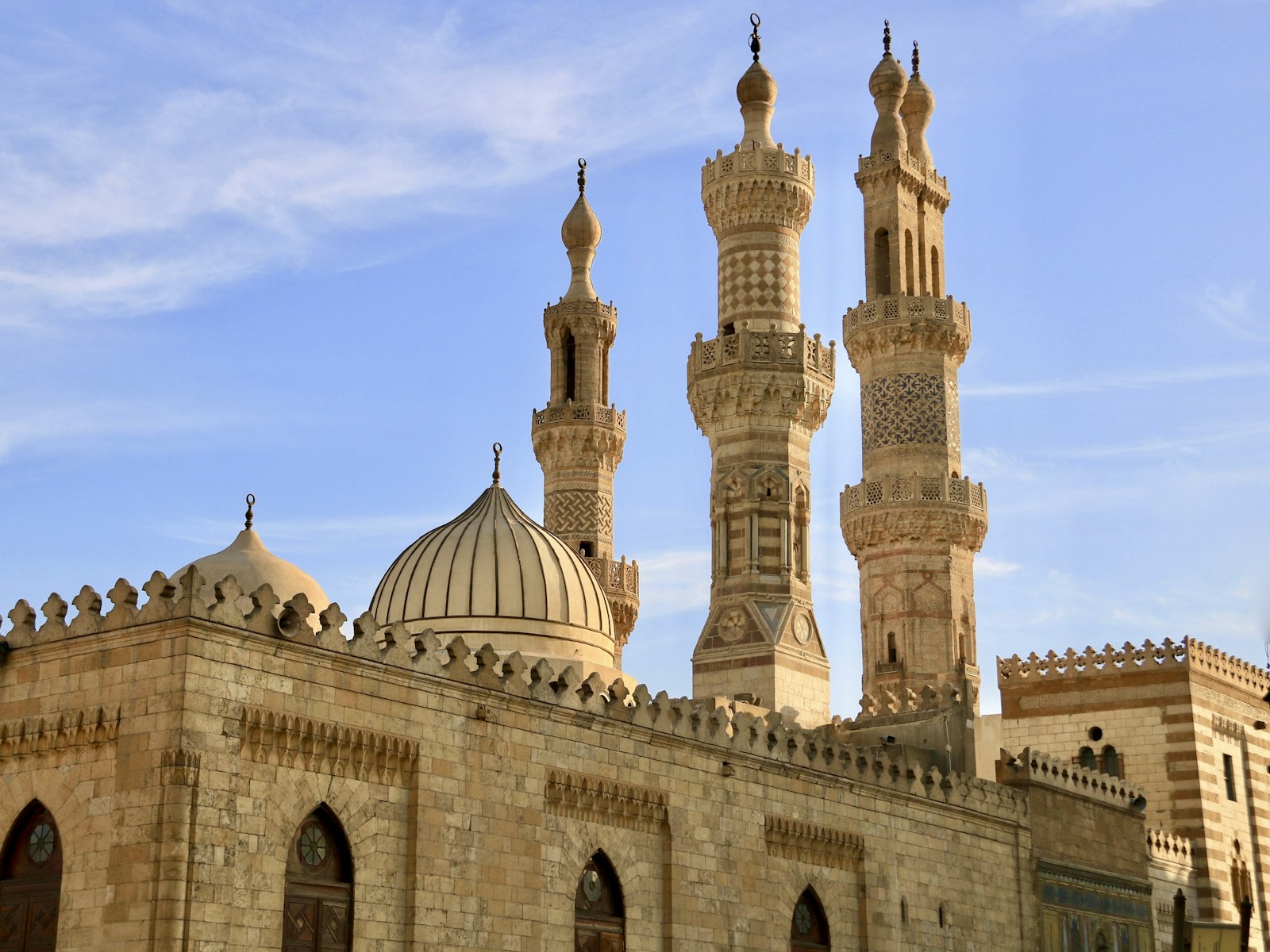
One of the most distinctive features of Al-Azhar Mosque is the presence of five minarets, each built in a different era and a different style, which together recount the evolution of Islamic architecture in Egypt through the centuries. The oldest minaret, of the Fatimid era, has a simple cylindrical structure. The Mamluk minarets, with their elaborate carved-stone decorations and superimposed galleries, contrast with the Ottoman minaret with its slender, tapered profile typical of the mosques of Istanbul.
This plurality of architectural styles is not accidental: it is the tangible result of a thousand years of history during which each dynasty left its own mark on the structure, enriching the complex without ever erasing the testimonies of previous eras.
The Central Courtyard
The central courtyard (sahn), surrounded by porticoes with arcades supported by columns, is the spatial and spiritual heart of the mosque. Rectangular in plan, the courtyard is paved in stone and offers a space for meditation and rest between study and prayer sessions. The arcades of the porticoes feature stucco decorations from different eras, with geometric, vegetal and calligraphic motifs that testify to the evolution of Islamic ornamental taste.
The western portico, the oldest, still preserves elements of the original 10th-century Fatimid construction. The lateral porticoes were added in the Mamluk era and feature more elaborate decorations. The fountain for ablutions at the centre of the courtyard, restored several times over the centuries, is a functional and symbolic element that recalls the inseparable bond between physical and spiritual purification in Islam.
The Prayer Hall
The main prayer hall (haram) is a vast hypostyle space supported by rows of columns that create parallel aisles oriented towards the qibla (the direction of Mecca). The columns, coming from buildings of different eras, create the effect of a forest of stone reminiscent of the great mosques of early Islam. The main mihrab, the niche indicating the direction of prayer, is decorated with finely worked mosaics and stuccoes.
The floor is covered with carpets on which students and the faithful sit for lessons and prayer, exactly as happened a thousand years ago. The walls are decorated with Quranic inscriptions in various calligraphies, from Kufic to thuluth, which are not only ornament but constitute an iconographic programme of religious teaching.
The Madrasas and the Riwaq
Around the main mosque are articulated several madrasas (schools) and riwaq (dormitories) built over the centuries to accommodate students of different geographical origins. The Riwaq of the Turkish students, the Riwaq of the Maghrebi students, the Riwaq of the Southeast Asian students: each of these spaces recounts the international and multicultural dimension that Al-Azhar has always had as a centre of Islamic learning.
The Role of Al-Azhar in the Contemporary Islamic World
Religious Authority
The Grand Imam of Al-Azhar (Shaykh al-Azhar) is considered the highest religious authority of the Sunni world, a role comparable in importance to that of the Pope for Catholics. The pronouncements (fatwa) of the Committee of the Grand Ulema of Al-Azhar on theological, juridical and ethical questions are followed by millions of Muslims throughout the world. Al-Azhar actively promotes interreligious dialogue and the fight against extremism, positioning itself as the voice of moderate and enlightened Islam.
The University Today
The University of Al-Azhar is today one of the largest academic institutions in Egypt and the Arab world, with campuses throughout the country and faculties ranging from theology to medicine, from engineering to social sciences. Alongside the modern disciplines, traditional Islamic studies continue to be imparted according to methods that blend classical teaching with contemporary pedagogical approaches.
Tips for the Visit
How to Get There
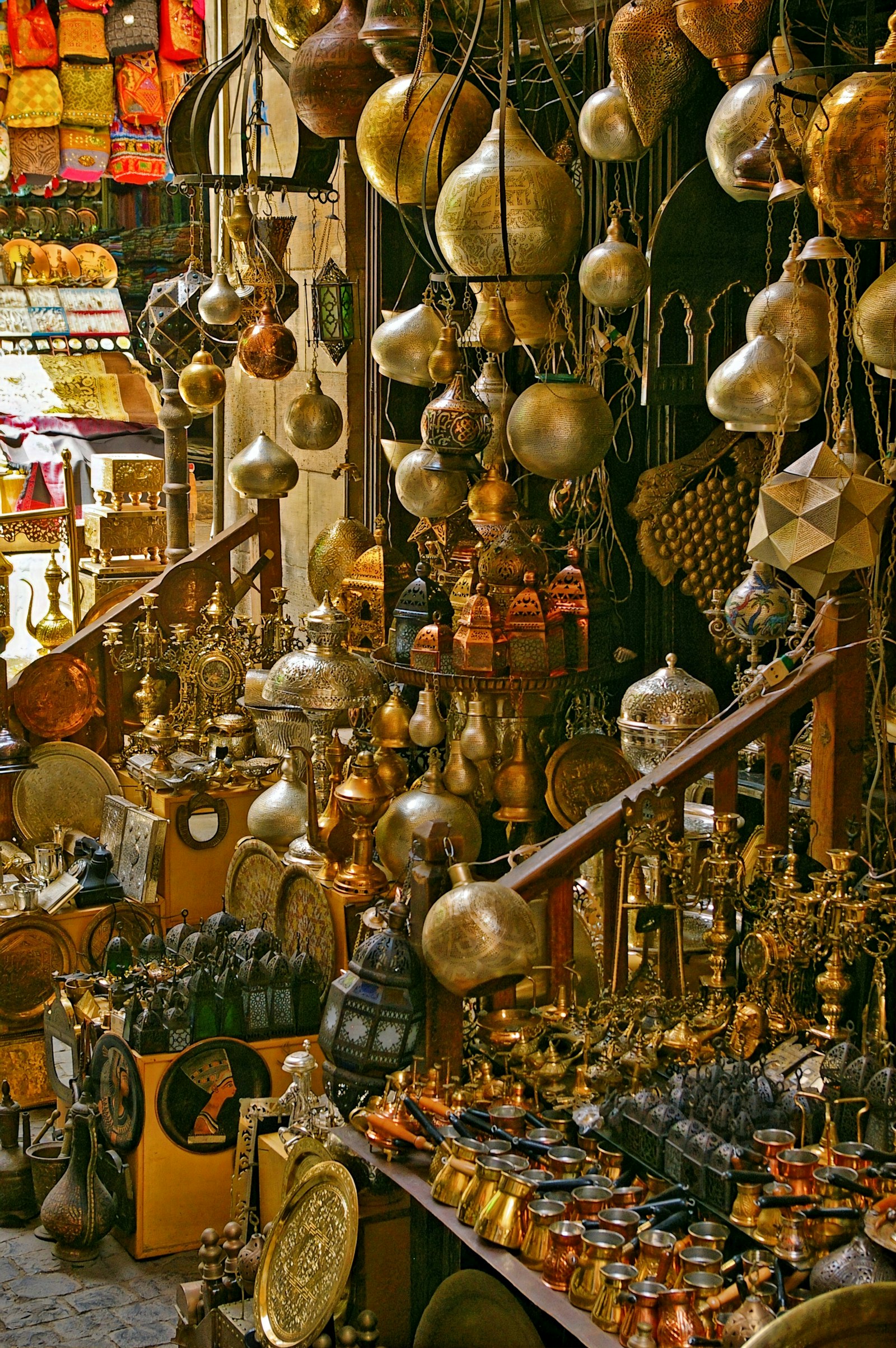
Al-Azhar Mosque is located in the heart of Islamic Cairo, adjacent to the Khan el-Khalili bazaar. The main entrance faces Sharia al-Azhar, one of the main arteries of the historic centre. It is reachable by taxi, with ride-sharing services or from the Ataba metro station, from which you can proceed on foot or by taxi.
Rules for Visitors
The mosque is an active place of worship and requires respectful behaviour. It is necessary to take off your shoes at the entrance. Clothing must cover shoulders and knees for both sexes; women must cover their hair with a headscarf (available on loan at the entrance for those without one). Photography is generally permitted in the courtyard and public areas, but it is good practice to ask permission before photographing people at prayer.
The Ideal Moment
Early morning is the best time to visit the mosque, when the light filters through the windows illuminating the courtyard and the prayer hall with warm and evocative tones. Avoid the hours of Friday prayer (midday), when the mosque is dedicated to the faithful and access for tourists is limited.
Combining the Visit
The strategic position of the mosque makes it the ideal starting point for exploring the Islamic quarter of Cairo. A few steps away is the entrance to Khan el-Khalili, while continuing along Sharia al-Muizz you encounter the al-Hakim Mosque, the complex of sultan al-Ghuri, the complex of sultan Qalawun and dozens of other mosques and madrasas that make Islamic Cairo the largest museum of medieval Islamic architecture in the world. A walk along the al-Muizz street, declared by UNESCO the largest open-air museum of Islamic architecture, is a perfect complement to the visit of Al-Azhar.
Al-Azhar Mosque is much more than a historic building: it is a living institution that embodies a thousand years of Islamic knowledge, spirituality and culture. To visit it means to come into contact with an intellectual and religious tradition that has shaped the history of the world and that continues to influence the thought and faith of hundreds of millions of people. It is a place where past and present merge in a rare harmony, offering the visitor an experience of profound beauty and meaning.