Khan el-Khalili: the Beating Heart of Islamic Cairo
Khan el-Khalili is the oldest and most famous bazaar in all of Egypt, a fascinating labyrinth of narrow alleys, glittering shops and hidden courtyards in the heart of the Islamic quarter of Cairo. Founded in 1382 during the period of the Mamluk sultanate, this extraordinary market has kept alive for over six centuries an uninterrupted commercial tradition that sinks its roots into the ancient caravan routes that connected Africa, Asia and Europe through Egypt.
An integral part of historic Cairo, inscribed in the UNESCO World Heritage, Khan el-Khalili is not simply a place to buy souvenirs: it is a total sensory experience where sight, hearing, smell and taste are stimulated simultaneously in a whirl of colours, sounds, scents and flavours that transports the visitor into a world where time seems to have stopped.
History of the Bazaar
The Mamluk Origins
The history of Khan el-Khalili begins in 1382, when the emir Jarkas al-Khalili, master of the stables of the Mamluk sultan Barquq, built a great caravanserai (khan) on the site of the ancient Fatimid cemetery of the caliphs. The caravanserai was conceived as a luxury commercial centre where foreign merchants could lodge, store goods and conduct their business in a protected and regulated environment.
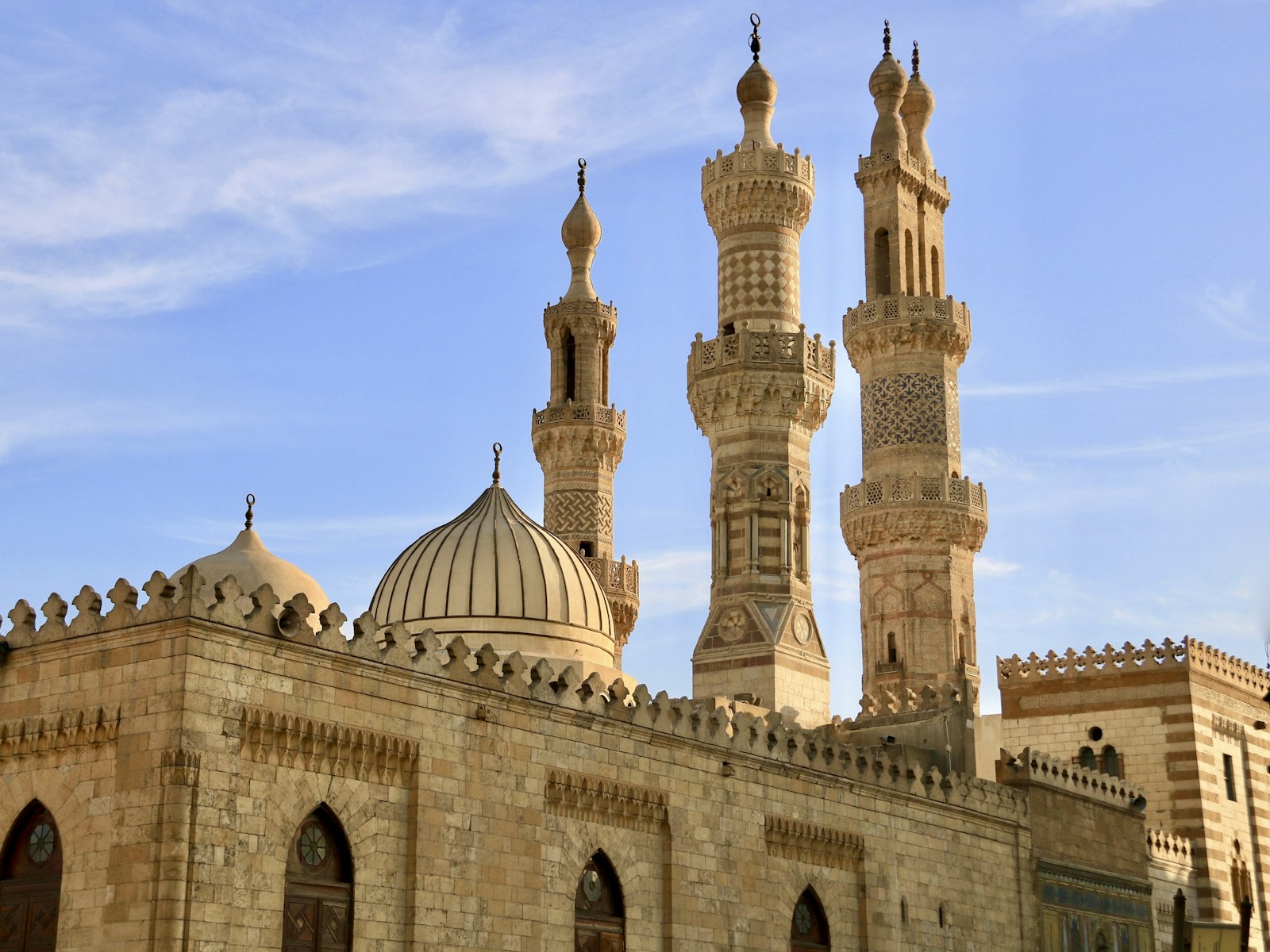
The strategic position, adjacent to the Mosque of al-Azhar and the nerve centre of the Fatimid city, guaranteed the khan immediate success. In a short time, around the original structure developed an increasingly dense commercial fabric of shops, warehouses and craft workshops that expanded into the surrounding streets.
The Expansion in the Mamluk Period
Under the sultan al-Ghuri (1501-1516), the last great Mamluk sultan, the bazaar reached its maximum splendour. Al-Ghuri had built the magnificent complex that bears his name, comprising a mosque, a madrasa, a mausoleum and a caravanserai, which still today represents one of the most refined examples of late Mamluk architecture. The market became the principal commercial centre of the Middle East, a fundamental hub for the spice trade between the Orient and Europe.
The arrival of the Portuguese in the Indian Ocean at the end of the 15th century and the discovery of the Cape of Good Hope route gradually reduced Egypt's role as an intermediary in the spice trade, but Khan el-Khalili continued to prosper as a local and regional market, adapting to economic changes with its proverbial resilience.
The Bazaar through the Centuries
The Ottoman conquest of 1517 brought new architectural and commercial influences, with the introduction of Turkish products and craft techniques that fused with the local tradition. In the 18th and 19th centuries, the bazaar attracted European travellers and writers whose descriptions contributed to creating the orientalist myth of the Middle Eastern souk. Gustave Flaubert, Gérard de Nerval and many other European intellectuals strolled through these alleys, leaving literary testimonies that still today feed the charm of the place.
In the 20th century, Khan el-Khalili went through alternating periods of decline and rebirth. The world wars, the revolution of 1952 and the urban transformations of modern Cairo threatened the integrity of the bazaar several times, but the tenacity of the merchants and the growing importance of tourism guaranteed its survival and renewal.
What to Find in the Bazaar
The Gold and Silver Souk
One of the most spectacular sections of the bazaar is the gold souk (souk al-sagha), a set of alleys where hundreds of display windows laden with jewels in 18 and 21 carat gold shine. Here are found both modern creations and jewels inspired by pharaonic art, with scarabs, ankhs, eyes of Horus and pharaonic cartouches reproduced in gold and precious stones. Silver is equally present, with elaborate filigree and semi-precious stones such as Sinai turquoise, lapis lazuli and carnelian.
The purchase of gold at the souk is generally safe thanks to the strict government controls on the purity of the metal, but it is always advisable to buy in shops with guarantee marks and to request certification of the weight and carat.
The Spice Souk
The spice market is an explosion of colours and scents. Cumin, coriander, cardamom, cinnamon, saffron, hibiscus (karkadeh) and dozens of other spices are displayed in colourful pyramids that catch the eye and tickle the smell. Here one can also buy teas, medicinal herbs, incense and traditional Egyptian perfumes. The merchants are often willing to explain the properties and uses of the various spices, transforming the purchase into an educational experience.
Handicrafts and Souvenirs
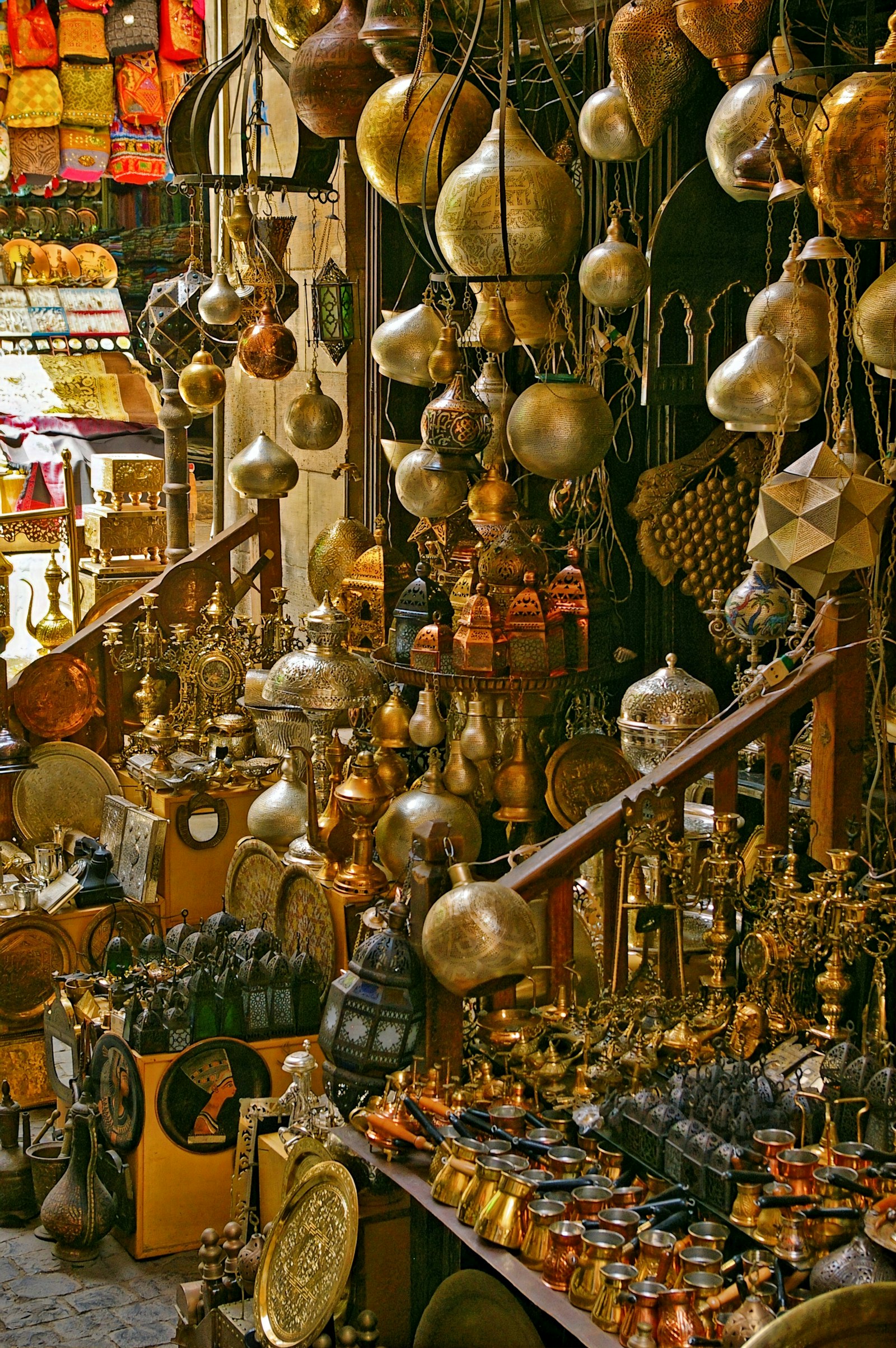
The craft shops of Khan el-Khalili offer an extraordinary variety of products, including lanterns in copper and coloured glass (the famous Ramadan fanous), objects in sculpted alabaster, papyri hand-painted with scenes of ancient Egypt, embroidered fabrics, decorated ceramics, traditional musical instruments, hookahs, mother-of-pearl objects and inlaid wood mosaics (mashrabiyya).
Particularly sought after are the products in hand-beaten copper: trays, coffee pots, braziers and decorative plates whose working requires hours of patient manual labour. The sound of the coppersmiths' hammers beating the copper is one of the characteristic soundtracks of the bazaar.
Perfumes and Essences
The perfume shops are another unmissable attraction of the bazaar. Egypt has a millennial tradition in the production of essences and perfumes, dating back to the pharaonic era. The shops display hundreds of bottles of concentrated essences, derived from flowers such as jasmine, lotus, rose and orange blossom. The perfumers mix the essences on request, creating personalised fragrances that can be purchased in elegant bottles of blown glass.
The Legendary el-Fishawi Café
A Café Open for Over 200 Years
In the heart of the bazaar hides one of the most famous cafés in the Arab world: the el-Fishawi Café, open uninterruptedly since 1797 (according to tradition, although the exact date is debated). This small place with its antique mirrors, wooden benches and atmosphere dense with hookah smoke has hosted writers, intellectuals, politicians and artists for generations.
The Nobel Prize for Literature Naguib Mahfouz (1911-2006), the greatest Egyptian writer, was a habitué of the Fishawi and set many of his works in the surrounding quarter. Sitting at one of the little tables of the Fishawi, sipping a mint tea or a Turkish coffee while observing the incessant flow of passers-by, is an almost obligatory rite for anyone visiting Cairo.
What to Order
Turkish coffee (qahwa) is ordered specifying the level of sugar: sada (without sugar), arriha (little sugar), mazbuta (medium), or ziyada (a lot of sugar). Fresh mint tea (shai bil na'na) and karkadeh (hibiscus infusion, served hot or cold) are refreshing alternatives. The hookah with tobacco flavoured with apple, strawberry or mixed fruits traditionally accompanies the pause at the café.
The Art of Bargaining
Unwritten Rules of the Bazaar
Bargaining is an integral part of the Khan el-Khalili experience and refusing it would mean giving up a fundamental cultural element. It is not simply about obtaining a lower price, but a codified social ritual that both parties expect and appreciate.
The first rule is not to show excessive enthusiasm for an object: the merchant will interpret your interest as willingness to pay more. The second is to initially propose a price equal to about a third or half of that requested, leaving margin for a gradual negotiation towards a meeting point. The third is to be ready to walk away if the price does not satisfy you: often the seller will call you back with a better offer.
During the bargaining, it is common for the merchant to offer tea or a drink as a gesture of hospitality. Accepting does not oblige you to buy, but refusing brusquely would be discourteous. Bargaining must remain a pleasant experience: the smile and good humour are the best weapons.
The Architecture of the Bazaar
An Open-Air Museum
Beyond the commercial aspect, Khan el-Khalili is a precious open-air museum of Islamic architecture. Among the alleys hide sculpted Mamluk portals, mashrabiyya (lattice balconies in carved wood) of the Ottoman era, public fountains (sabil) decorated with majolica and caravanserais with porticoed courtyards that recount centuries of architectural history.
The Bab al-Ghuri, the monumental portal of the complex of the sultan al-Ghuri, is one of the most notable architectural elements. The Wikala al-Ghuri, a restored caravanserai of the 16th century, today hosts performances of Sufi music and dervish dance, offering an unforgettable cultural evening in the heart of the historic quarter.
Tips for the Visit
When to Go
The bazaar is particularly lively in the evening hours, when the lanterns light up and the atmosphere becomes magical. On Friday some shops close in the morning for congregational prayer, but reopen in the afternoon with great vitality. During Ramadan, the bazaar stays open until late at night and takes on a particularly festive atmosphere after the iftar (the evening meal breaking the fast).
Safety and Precautions
Khan el-Khalili is generally safe, but as in any crowded market it is advisable to pay attention to one's personal effects. Keep your wallet in an inner pocket and your bag in front of your body. Avoid showing flashy jewels or large quantities of money. The majority of merchants are honest and hospitable, but it is well to be aware of common scams such as the substitution of goods after the agreement on the price.
How to Get There and Find Your Way
Khan el-Khalili is located in the area of al-Husayn, reachable by taxi or from the metro stop Ataba (lines 2 and 3). The main entrance of the bazaar is on Sharia al-Muski. The labyrinthine structure of the market can disorient: if you get lost, ask directions for the Mosque of al-Husayn or for Sharia al-Muski, the two main points of reference.
Combining the Visit
Khan el-Khalili is the ideal starting point to explore Islamic Cairo. The nearby Mosque of al-Azhar, the street of al-Muizz li-Din Allah with its Mamluk mosques and madrasas, the complex of al-Ghuri and the Mosque of al-Husayn are all reachable on foot. An evening stroll along the al-Muizz street, illuminated by the street lamps and animated by the daily life of the quarter, is one of the most suggestive routes of the entire Cairo.
Khan el-Khalili is much more than a market: it is the beating heart of historic Cairo, a place where history mixes with daily life, where the medieval past coexists with the present in a fascinating and fragile balance. Getting lost among its alleys is a sensory and cultural adventure that no visitor to Cairo should miss.