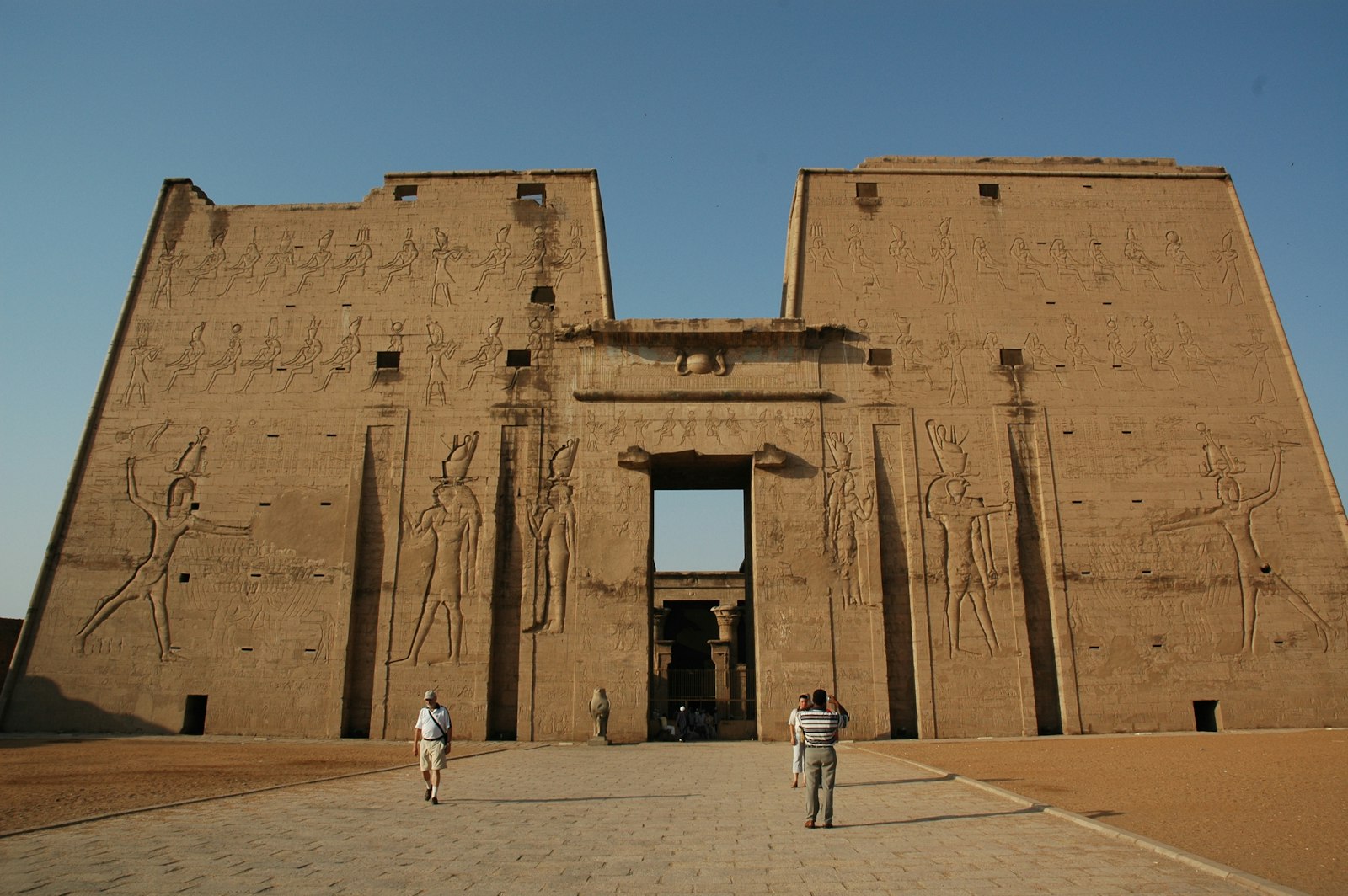
Tuna el-Gebel: The City of the Dead of Hermopolis
Tuna el-Gebel is one of the most fascinating and least known archaeological sites in Middle Egypt, a vast necropolis that for centuries served as the sacred burial place of nearby Hermopolis Magna (El Ashmunein), the city of the god Thoth. Located in the western desert, about 7 kilometres from the ancient city, Tuna el-Gebel houses an archaeological heritage of extraordinary variety: from the magnificent tomb-temple of Petosiris, a masterpiece of Greco-Egyptian art, to the immense catacombs containing millions of mummified animals sacred to Thoth, to one of the great boundary steles of the Amarna era.
The site extends for several kilometres into the desert and embraces a vast span of time, from the 14th century BC (New Kingdom) to the Roman period, documenting the profound religious, artistic and cultural transformations that Egypt underwent over more than a millennium of history.
The Tomb of Petosiris
A Masterpiece of Greco-Egyptian Art
The tomb-temple of Petosiris is without doubt the most important monument of Tuna el-Gebel and one of the most significant of the entire late period of ancient Egypt. Petosiris was high priest of the god Thoth at Hermopolis during the end of the 4th century BC, a crucial transitional period in which Egypt was passing from Persian rule to the Macedonian rule of Alexander the Great.
The structure of the tomb reproduces that of a small Egyptian temple, with a columned vestibule (pronaos) and an interior chapel (naos). The pronaos features four columns with composite capitals of Greco-Egyptian influence, creating a unique architectural atmosphere that blends elements of the two traditions.
Artistic Hybridism
What makes the tomb of Petosiris absolutely exceptional is its decoration, which represents the most extraordinary example of fusion between traditional Egyptian art and Greek Hellenistic art. In the outer vestibule, the scenes of daily life — agriculture, viticulture, animal husbandry, craftsmanship — are represented in a style that mixes the typically Egyptian composition by registers with the naturalism, anatomical proportions and drapery of garments characteristic of Greek art.
The figures wear Greek clothing but perform typically Egyptian gestures and activities; the faces have individualised features of Hellenistic tradition but are inserted into compositions that follow Egyptian conventions. This hybridism is neither accidental nor naïve: it reflects the reality of a society in which different cultures were beginning to merge, anticipating the great cultural synthesis of Ptolemaic Egypt.
In the interior chapel, on the other hand, the style is purely traditional Egyptian, with religious and funerary scenes executed according to the millennial canons of pharaonic art. This distinction between public spaces (Greco-Egyptian) and sacred spaces (purely Egyptian) reveals the complexity of the cultural identity of the Egyptian elite in the transitional period.
The Inscriptions of Petosiris
The autobiographical inscriptions of Petosiris, carved on the walls of the tomb, are texts of great historical and literary interest. Petosiris recounts his devotion to the god Thoth, his restoration of the temples of Hermopolis devastated during the Persian occupation, and his administration of the clergy. The tone is that of a deeply religious and patriotic man, proud of having preserved Egyptian traditions in a period of foreign domination.
The Catacombs of the Sacred Animals
A Cult on an Industrial Scale
The catacombs of the ibises and baboons of Tuna el-Gebel constitute one of the most impressive cult phenomena of ancient Egypt. This vast system of underground galleries, which extends for kilometres beneath the desert, contained millions — literally millions — of mummies of ibises and baboons, the animals sacred to the god Thoth.
The cult of the sacred animals reached its peak during the Late Period and the Ptolemaic era (7th–1st century BC), when pilgrims from all over Egypt bought animal mummies near the sanctuaries to offer them to the deity as ex-votos. At Tuna el-Gebel, the breeding of ibises and baboons and their mummification became a veritable sacred industry, managed by a specialised caste of priests.
The Structure of the Catacombs
The catacombs are organised into main and secondary galleries dug into the limestone rock, with lateral niches in which the sarcophagi and the vessels containing the mummies were deposited. The ibises were mummified individually, wrapped in linen bandages and often placed in terracotta vessels or in wooden and stone sarcophagi. Some specimens of particular value were laid in finely worked bronze sarcophagi.
The baboons, rarer and more expensive, received an even more elaborate treatment. Some baboon mummies have been found in a seated position, wrapped in layers of bandages with amulets and ornaments, placed in painted wooden sarcophagi. Modern scientific analyses have revealed that many of these animals were bred in captivity specifically for mummification and suffered from pathologies linked to imprisonment.
The Scale of the Phenomenon
Estimates of the total number of animals mummified at Tuna el-Gebel vary, but the most conservative figures speak of several million ibises and tens of thousands of baboons. This phenomenon poses fascinating questions about the logistics of ancient Egypt: how were these enormous breeding operations fed and maintained? What ecological impact did they have? How was the production chain organised, from the capture of the animal to the deposition of the mummy in the catacombs?
Recent research has shown that the supply of ibises and baboons required an extensive commercial network: while ibises could be captured locally in the marshes of the Nile, baboons had to be imported from sub-Saharan Africa, a trade that testifies to the reach of the commercial networks of late pharaonic Egypt.
The Boundary Stele A of Akhenaten
A Monument of the Amarna Era
At the northern end of the site stands Boundary Stele A, one of the sixteen great steles that the pharaoh Akhenaten had carved into the cliffs surrounding his new capital Akhetaten (Tell el-Amarna) to delimit its sacred territory. The Tuna el-Gebel stele is one of the best preserved and shows the pharaoh, Queen Nefertiti and their daughters in adoration beneath the rays of the solar disc Aten.
The hieroglyphic inscription reports the foundation decree of the city of Akhetaten, in which Akhenaten swears not to cross the established boundaries and dedicates the territory to the god Aten. This monument directly connects Tuna el-Gebel to the Amarna religious revolution, recalling that this corner of desert witnessed one of the most dramatic moments in Egyptian history.
The Tomb of Isadora of Hermopolis
A Roman Love Story
Among the most moving monuments of Tuna el-Gebel is the tomb of Isadora, a young woman who, according to local tradition, drowned in the Nile around the 2nd century AD while trying to reach her lover on the opposite bank of the river. Her tomb, built in the form of a small Roman temple with a triangular pediment, is decorated with paintings that mix Egyptian and Roman themes.
Inside the tomb was found the mummy of Isadora, extraordinarily well preserved, with her hair still intact and long, testifying to the young age of the deceased. The romantic story associated with this burial has made it one of the most visited and beloved monuments of the site, a reminder that even in Roman Egypt the pharaonic funerary traditions continued to live.
The Roman Waterwheel (Saqia)
A Work of Hydraulic Engineering
In the western part of the site are the remains of a saqia, a waterwheel of the Roman era used to raise water from the well to ground level. This structure, well preserved, testifies to the ingenuity of ancient hydraulic engineering and the importance of water supply in a desert site.
The saqia of Tuna el-Gebel worked thanks to animal traction: an ox or a donkey, connected to a wooden gear mechanism, made a vertical wheel equipped with terracotta vessels turn, which drew water from the deep well and poured it into a distribution channel. This type of technology, introduced into Egypt during the Ptolemaic period, is still used in some rural areas of the country.
The Tombs of the City of the Dead
A Living Necropolis
In addition to the tomb of Petosiris and the burial of Isadora, Tuna el-Gebel houses an entire "city of the dead" of the Greco-Roman era, with house-tombs arranged along regular streets that replicate the structure of an urban settlement. These tombs, many of them with several storeys and decorated façades, were used for commemorative ceremonies by the relatives of the deceased who came there periodically to celebrate the funerary rites.
The decorations of these tombs freely mix Egyptian, Greek and Roman elements, creating a syncretic artistic language typical of late antique Egypt. Some tombs preserve wall paintings of remarkable quality with mythological scenes, Egyptian deities represented in Greek style and portraits of the deceased that anticipate the famous Fayum portraits.
Tips for the Visit
How to Get There
Tuna el-Gebel is located about 7 kilometres west of El Ashmunein (Hermopolis) and about 10 kilometres from Mallawi. The site is reachable by taxi from Mallawi or from Minya. The access road crosses a landscape of cultivated fields before venturing into the desert.
Organising the Visit
The main points of interest — the tomb of Petosiris, the catacombs of the sacred animals, the boundary stele and the tomb of Isadora — can be visited in two or three hours. A local custodian normally accompanies visitors and provides access to the closed structures. The catacombs are partially accessible, but the corridors are narrow and low, making the visit challenging for those who suffer from claustrophobia.
What to Bring
The site is in the desert, completely exposed to the sun. Bring plenty of water, sun protection, a hat and sturdy shoes. An electric torch is indispensable for exploring the catacombs. There are no refreshment points at the site. Photography is generally permitted but a supplement may be required.
Combining with Hermopolis
The visit to Tuna el-Gebel is inseparable from that of Hermopolis (El Ashmunein), on which the necropolis depended. The two sites, about 7 kilometres apart, can be visited in the same half-day, offering a complete picture of the city of the living and the city of the dead. It is advisable to start from Hermopolis in the morning and continue to Tuna el-Gebel in the early afternoon.
Tuna el-Gebel is a place that defies the expectations of the visitor. It is neither the solemn pharaonic temple nor the monumental pyramid: it is rather an open window onto the most intimate and everyday aspects of Egyptian religiosity — popular devotion, the cult of the sacred animals, the fusion of cultures — which reveal an Egypt far more complex and multifaceted than the conventional images allow us to imagine.