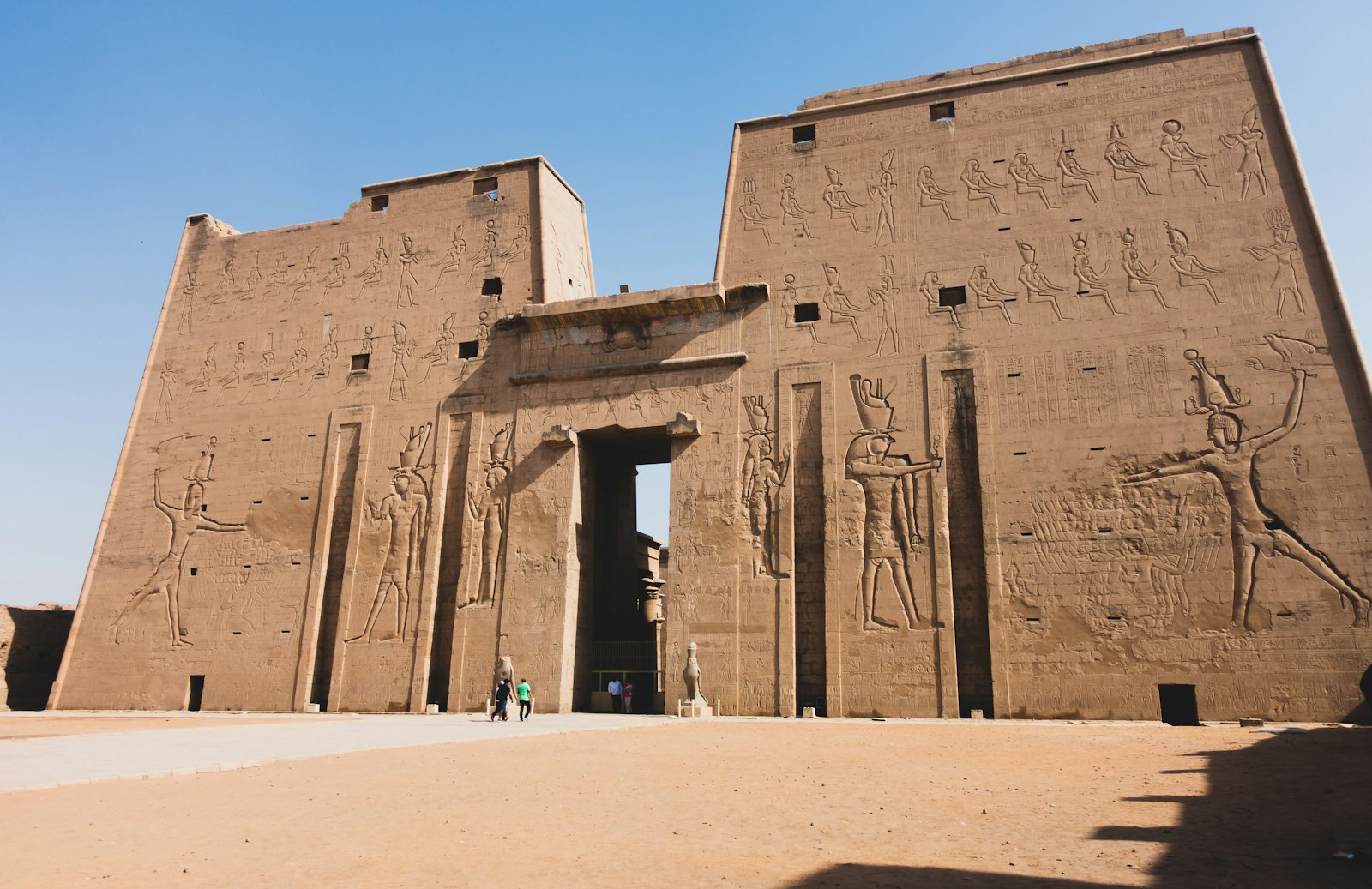
Hierakonpolis: the Cradle of Pharaonic Civilisation
Hierakonpolis, the ancient Nekhen, today also known as Kom el-Ahmar ("the red mound"), is the site where the civilisation of ancient Egypt was born. Located on the western bank of the Nile, a few kilometres north of Edfu, this predynastic city was the first capital of Upper Egypt and the place where some of the most celebrated and significant finds of Egyptian archaeology came to light, including the legendary Narmer Palette, considered the most ancient document of the unification of Egypt under a single sovereign.
For the visitor passionate about ancient history, Hierakonpolis offers a unique experience: to walk among the remains of a city that flourished more than five thousand years ago, where the foundations were laid of the pharaonic culture that would dominate the Nile valley for three millennia. Although the site does not present monumental structures comparable to the great temples of the historical era, its historical importance and the discoveries still in progress make it a place of extraordinary intellectual fascination.
The Origins of Egyptian Civilisation
Nekhen: the City of the Falcon
The Greek name Hierakonpolis means "City of the Falcon", in reference to the cult of the god Horus who had here his most ancient seat. In ancient Egyptian, the city was called Nekhen, and it was the religious and political centre of Upper Egypt in the predynastic period (about 4000-3100 BC). The Egyptian religious tradition considered Nekhen the place where Horus had appeared for the first time in the form of a falcon, effectively legitimising the claim of the local sovereigns to govern in the name of the god.
The strategic position of Nekhen, on the western bank of the Nile at a point where the desert draws near the river, guaranteed it the control of both the river routes and the caravan ways towards the gold mines of the eastern desert. This privileged position favoured the accumulation of wealth that allowed the chiefs of Nekhen to progressively expand their power, until unifying under their dominion the entire Upper Egypt and, finally, conquering also Lower Egypt.
The Unification of Egypt
It is at Nekhen that Egyptian historical tradition places the events that led to the unification of Egypt around 3100 BC. King Narmer, last predynastic sovereign of Upper Egypt, probably departed from Nekhen for his campaign of conquest of the Delta, thus founding the unified state that would become one of the greatest civilisations of human history. The Narmer Palette, found at Hierakonpolis in 1898 and today preserved at the Egyptian Museum of Cairo, commemorates this founding event with powerful images that show the king in the act of striking an enemy of Lower Egypt.
The Great Discoveries
The Narmer Palette
The Narmer Palette is perhaps the single most important find ever discovered for the understanding of the origins of Egyptian civilisation. This ceremonial tablet in green schist, about 63 centimetres high, was found by the British archaeologists James Quibell and Frederick Green in 1898 in the so-called "Main Deposit" of the temple of Horus at Hierakonpolis.
On one side, King Narmer is depicted with the white crown of Upper Egypt in the act of striking a prisoner, while the falcon god Horus holds the enemies in subjection. On the other side, Narmer wears the red crown of Lower Egypt and inspects rows of decapitated enemies. The iconography of the palette establishes the canons of royal representation that will remain unchanged for three thousand years: the pharaoh as victorious warrior, protected by the gods, guarantor of cosmic order against the forces of chaos.
Tomb 100: the Most Ancient Painting of Egypt
Another fundamental discovery made at Hierakonpolis is the so-called Tomb 100, or "Decorated Tomb", discovered in 1899. This predynastic burial (about 3400-3300 BC) contained the most ancient mural paintings ever found in Egypt: scenes depicting boats on the Nile, combats, hunts and human figures in movement, painted in red, white and black on mud plaster.
These paintings, unfortunately today largely deteriorated (fragments are preserved at the Egyptian Museum of Cairo), represent the first known attempt of Egyptian narrative art and establish iconographic themes that will be developed for millennia by pharaonic painting: the boat as symbol of otherworldly journey, the combat as demonstration of power, the hunt as metaphor of dominion over nature.
The Predynastic Zoo
Among the most surprising discoveries of Hierakonpolis figures a true predynastic zoo, dated around 3500 BC. The excavations of the American mission have revealed the burials of an extraordinary variety of exotic animals: elephants, baboons, hippopotami, crocodiles, a leopard, wild cats and wild cattle. These animals were probably kept in captivity as symbols of power and of the capacity for control over nature on the part of the predynastic sovereigns of Nekhen.
The presence of exotic African animals also testifies to the commercial and diplomatic networks that connected Nekhen to the southern regions of Africa, prefiguring the contacts with Nubia and Punt that would characterise Egyptian foreign policy in the subsequent millennia.
The Archaeological Site
The Temple of Horus
The ceremonial centre of Nekhen was dominated by the temple of Horus, one of the most ancient places of worship of Egypt. Of the original temple very few traces remain, but the excavations have revealed a sequence of structures that range from a simple predynastic enclosure to a stone temple of the Old Kingdom. In the celebrated "Main Deposit" of the temple were found, in addition to the Narmer Palette, other objects of extraordinary value, including the Battlefield Palette, the gold Falcon Head and the copper Statue of Pepi I, the most ancient life-size metal statue of the ancient world.
The Desert Fort
About two kilometres from the centre of the city, in the desert, are the remains of a great mud-brick structure known as "the Fort". This rectangular building, whose walls reached a considerable height, has been variously interpreted as a fortress, a palace or a ceremonial enclosure. Its exact function remains debated, but its isolated position in the desert and its monumental dimensions testify to the power and ambitions of the predynastic sovereigns of Nekhen.
The Predynastic Necropolis
The necropolis of Hierakonpolis extends over a vast desert area and comprises hundreds of burials dated from the Naqada I period to the protodynastic period. The most ancient tombs are simple oval pits with the deceased in fetal position, accompanied by ceramic vases, flint weapons and personal ornaments. The most recent tombs and those of higher rank show a growing complexity, with multiple chambers, rich furnishings and, in the case of Tomb 100, parietal pictorial decoration.
The Predynastic Brewery
The excavations have also revealed the remains of a great brewery dated around 3700 BC, one of the most ancient beer production plants known in the world. The structures, constituted by rows of ceramic vats inserted in temperature-controlled furnaces, could produce hundreds of litres of beer at a time, well beyond the necessities of a single family. This avant la lettre industrial brewery was probably linked to the religious rituals of the temple and to the distribution of beer during the festivities, a custom that would remain central in Egyptian religious life for millennia.
The Archaeological Missions
The American Mission
Since 1967, Hierakonpolis is the object of systematic excavations conducted by the American mission directed first by Michael Hoffman and then by Renée Friedman, supported by the Hierakonpolis Expedition. These researches, among the most long-lasting and productive of modern Egyptology, have radically transformed the understanding of the predynastic period and of the origins of the Egyptian state.
The avant-garde techniques used by the mission, including geophysical prospections, analysis of ancient DNA and archaeobotanical studies, have allowed the reconstruction not only of political history but also of daily life, alimentation, funerary practices and the natural environment of the Nile valley in the 4th millennium BC. The website of the Hierakonpolis Expedition is an exceptional disseminative resource, accessible free of charge, that documents in real time the discoveries season after season.
Tips for the Visit
How to Get There
Hierakonpolis is located on the western bank of the Nile, about 15 kilometres north of Edfu and 95 kilometres south of Luxor. The site is reachable by private taxi from Edfu (20 minutes) or from Luxor (about 1 hour and 30 minutes). There are no direct public transports. The visit can be combined with that of El Kab, located on the opposite bank of the Nile, for a complete day excursion.
Opening Hours and Tickets
The site is open from 6:00 to 17:00 every day. The entrance ticket is affordable. The visit requires at least two hours to explore the main areas. Keep in mind that the site is vast and largely not delimited by fences: respect the active excavation areas and follow the indications of the custodians.
What to Expect
Hierakonpolis is a site for enthusiasts of archaeology and ancient history, not a conventional tourist monument. The visible structures are mainly foundations, floors and low mud-brick walls, which require imagination and basic knowledge to be appreciated fully. The most spectacular finds (Narmer Palette, gold falcon head, statue of Pepi I) are exhibited at the Egyptian Museum of Cairo and at the Grand Egyptian Museum of Giza.
Practical Suggestions
Bring abundant water, hat, sunscreen and resistant shoes: the terrain is sandy and uneven. There are no service structures at the site. An expert guide is practically indispensable to understand the disposition and significance of the archaeological structures. Consult the website of the Hierakonpolis Expedition before the visit to contextualise the most recent discoveries.
Hierakonpolis is the place where everything began: here was born the very idea of an Egypt unified under a single divine sovereign, here were shaped the symbols and traditions that would define one of the greatest civilisations of human history. To visit this site means to touch the deepest roots of pharaonic culture, in a place where the dust of the desert still guards millennial secrets awaiting to be revealed.