The Temple of Edfu: the Best Preserved Sanctuary of Horus in Egypt
The Temple of Edfu, consecrated to the falcon god Horus, is unanimously recognized as the best preserved temple of all of ancient Egypt. Situated on the western bank of the Nile, halfway between Luxor and Aswan, this monumental Ptolemaic building captures the gaze of visitors with its imposing pylon 36 metres high, its iconic statue of the falcon in black granite and its perfectly legible reliefs that narrate myths, rituals and the history of its own construction. For anyone who wishes to understand how an Egyptian temple appeared in the fullness of its splendour, Edfu is the indispensable destination.
The construction of the temple began on 23 August 237 BC, under the reign of Ptolemy III Euergetes, and was completed almost two centuries later, in 57 BC, under Ptolemy XII Neos Dionysos, father of the famous Cleopatra VII. Despite the long period of construction, the temple presents a remarkable stylistic coherence, fruit of a meticulous planning and of the scrupulous respect of the ancient Egyptian architectural traditions on the part of the Ptolemaic sovereigns of Greek origin.
History and Construction
The Origins of the Sacred Site
The site of Edfu was sacred to Horus since very remote epochs. The foundations of the Ptolemaic temple rest on the remains of more ancient structures dating to the New Kingdom and perhaps also to earlier periods. According to Egyptian mythology, Edfu was the place where Horus fought and defeated his rival Seth in the legendary battle for the throne of Egypt, making the site one of the most important religious centres of the country.
The texts engraved on the walls of the temple itself provide detailed information on the history of the construction, a unique case in Egyptian sacred architecture. These "foundation texts" describe the consecration ceremonies, the measurements of the building, the materials used and even the names of the priests involved in the project. Thanks to these inscriptions, we know with precision the dates of beginning and completion of each construction phase.
The Rediscovery by Auguste Mariette
For centuries, the temple remained buried under metres of sand and debris, with dwellings built by the local farmers directly on the roof of the building. It was the French Egyptologist Auguste Mariette who began, in 1860, the systematic work of excavation that brought the temple back to light in its almost entirety. The sand that had covered the building for almost two thousand years had paradoxically contributed to its exceptional conservation, protecting it from the atmospheric agents and from the reuse of the stones on the part of the local inhabitants.
Architecture of the Temple
The Great Pylon
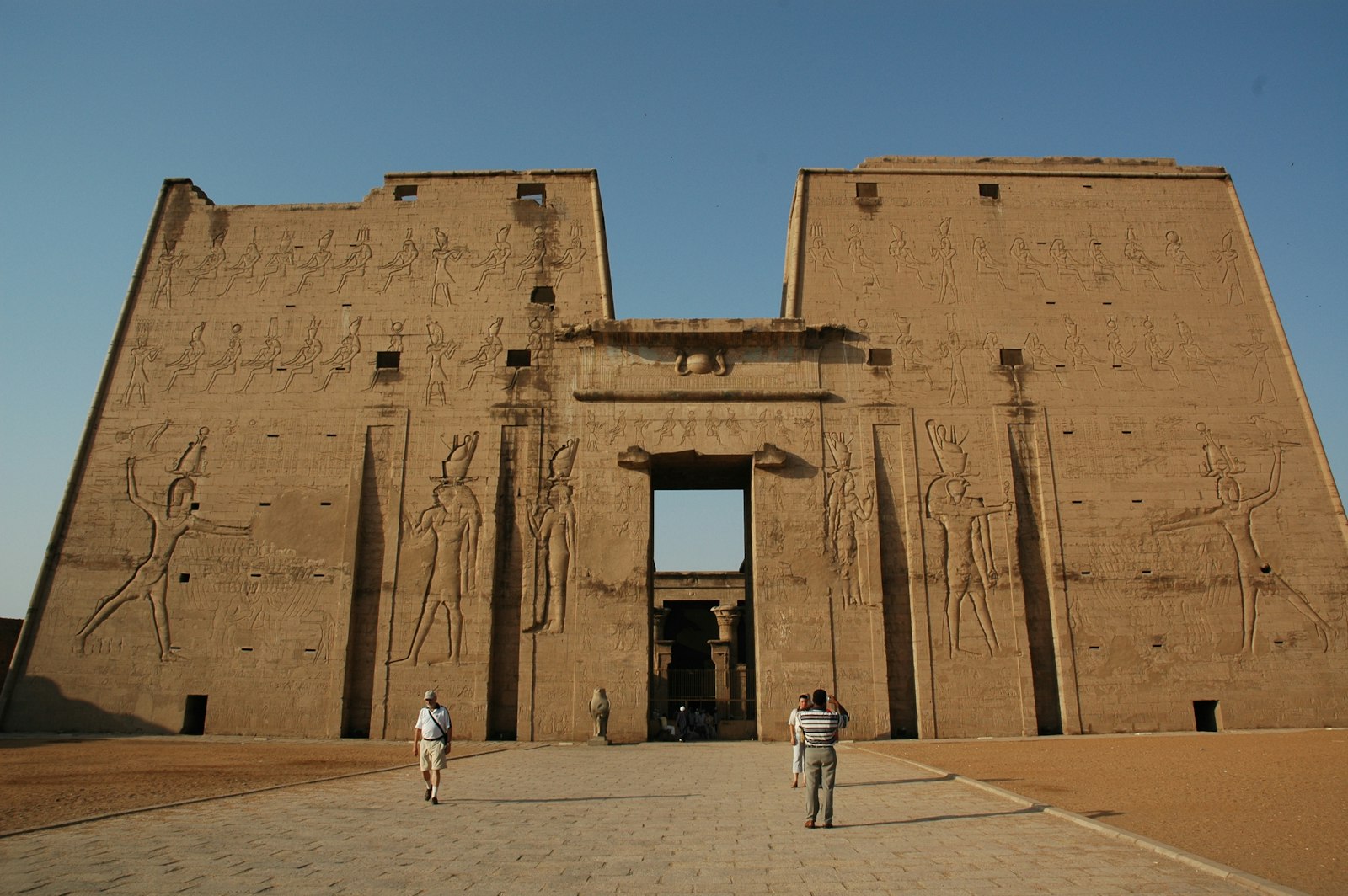
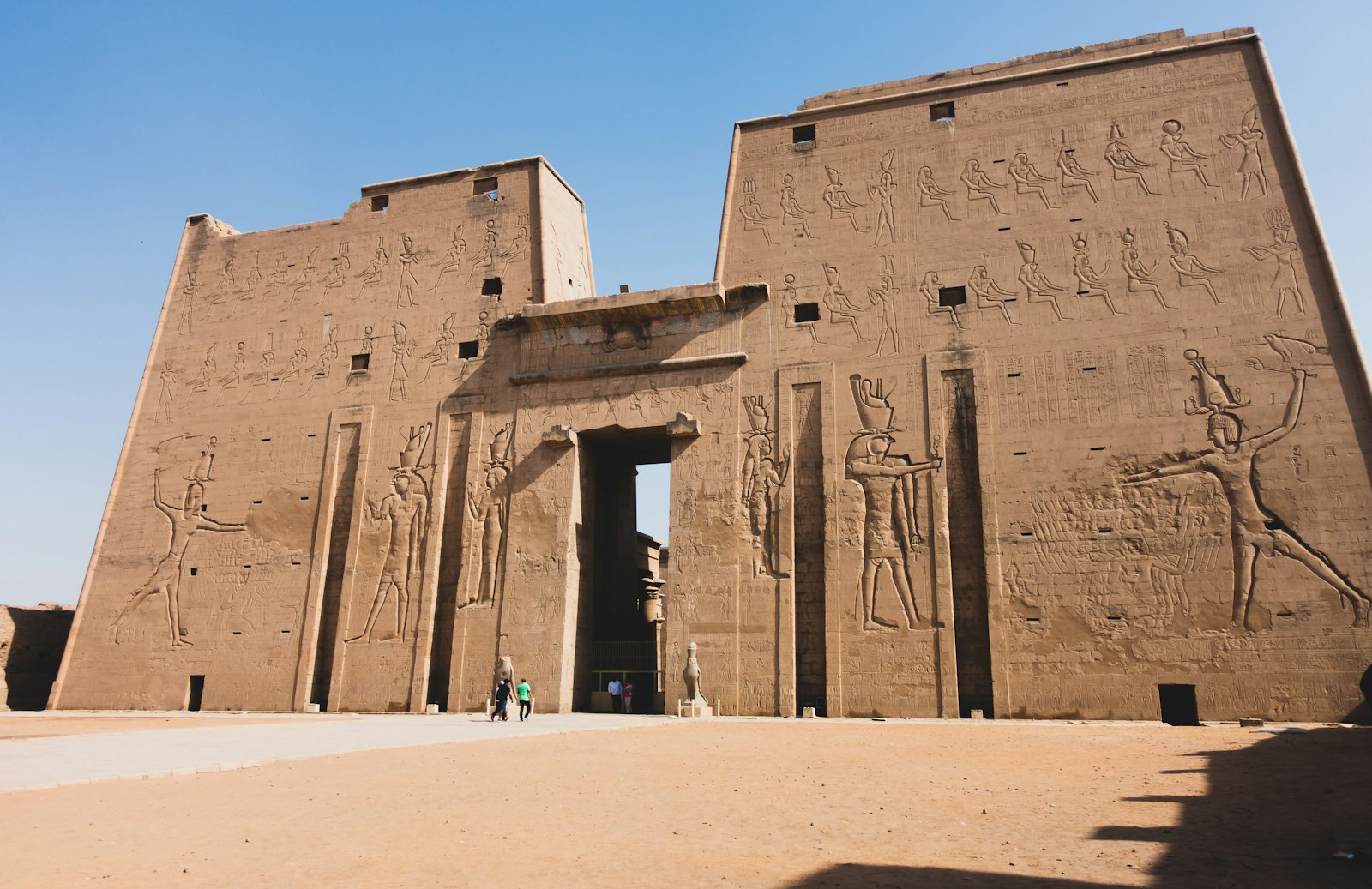
The entrance of the temple is dominated by the first pylon, a monumental structure 36 metres high and 79 metres wide, which remains one of the best preserved pylons of ancient Egypt. The facade is decorated with enormous reliefs that depict Ptolemy XII in the act of striking the enemies of Egypt before the god Horus, a ritual scene whose iconography dates back to the origins of the pharaonic civilization.
At the feet of the pylon, two magnificent statues in black granite depict Horus in his form of falcon with the double crown of Upper and Lower Egypt. These statues, above all the one positioned to the left of the entrance, are among the most iconic and photographed images of all of Egypt. Their sculptural perfection and the lustre of the black granite bear witness to the mastery of the craftsmen of the Ptolemaic era.
The Peristyle Courtyard
Having passed the pylon, one accesses a wide courtyard surrounded on three sides by a portico with thirty-two columns. The walls of the courtyard are decorated with scenes of the Festival of the Beautiful Meeting, one of the most important religious celebrations of ancient Egypt. During this annual festival, the statue of Hathor was transported by sacred barque from the temple of Dendera to Edfu to meet her spouse Horus, in a fluvial procession that lasted fourteen days and involved the communities of every village along the route.
The Hypostyle Halls
The temple contains two successive hypostyle halls. The first, wider, presents twelve columns with composite capitals of extraordinary variety and beauty. The second hall, more intimate, leads towards the sacred heart of the temple. The walls of both halls are covered with reliefs that illustrate daily rituals, festive processions and scenes of offering to the god Horus. The quality of the carving is exceptional: each hieroglyph, each figure is sculpted with a precision that bears witness to centuries of technical perfection.
The Sancta Sanctorum
The naos, that is the sancta sanctorum, is the most sacred heart of the temple. In this small dark room, reachable only by the priests of highest rank, the cult statue of the god Horus was guarded. The naos in grey granite that hosted the statue is still in its place, perfectly preserved: it is a monolith of granite almost four metres high, dating to the reign of Nectanebo II (last native pharaoh of Egypt), more ancient therefore than the temple itself that hosts it.
Around the sancta sanctorum develops an ambulatory with numerous lateral chapels dedicated to various divinities. Each chapel preserves reliefs that illustrate the specific rituals celebrated within it, offering a complete picture of the complex daily liturgy of an Egyptian temple.
The Mammisi
On the eastern side of the main temple is found the mammisi, or "house of birth", a small temple dedicated to the divine birth of Horus. The mammisi were common structures in the Ptolemaic and Roman temple complexes, where the mystery of the birth of the divine son was celebrated. The reliefs of the mammisi of Edfu narrate the birth of Harsomtus, son of Horus and Hathor, with scenes of great artistic delicacy that unite elements of the Egyptian tradition with influences of Hellenistic art.
The Texts of the Temple
The Library of the Walls
One of the most precious characteristics of the Temple of Edfu is the extraordinary quantity of hieroglyphic texts that cover almost every surface of its walls. These texts constitute a true encyclopaedia of the religion, of the mythology and of the rituals of ancient Egypt in the Ptolemaic era. Among the most important figure the myth of the struggle between Horus and Seth, the texts on the foundation of the temple, the calendars of the festivities, the hymns to the god Horus and the detailed descriptions of the daily rituals.
The "Library" of the temple, a small room whose walls list the titles of the rolls of papyrus once preserved within it, offers a unique look at the knowledge guarded by the priests. The titles range from theology to medicine, from astronomy to sacred geography, bearing witness to the breadth of the knowledge preserved in the Egyptian temples.
The Construction Texts
The construction texts engraved on the external walls of the temple provide a detailed account of the entire building process: from the foundation ceremonies to the laying of the first stone, from the construction of the foundations to the positioning of the pyramidion. These texts represent a source of invaluable information for the archaeologists and the historians of architecture, since they describe with technical precision the materials, measurements and construction methods of the Ptolemaic era.
The Festival of the Beautiful Meeting
The Sacred Marriage
The Festival of the Beautiful Meeting (Shemu, month of Epiphi) was the most important celebration of the religious calendar of Edfu. Every year, during the third month of the summer, the statue of the goddess Hathor left her temple at Dendera and ascended the Nile on a richly decorated sacred barque, escorted by processions of priests, musicians and faithful. After about two weeks of travel and ritual stops, Hathor reached Edfu where she was welcomed with grandiose festivities.
The sacred union between Horus and Hathor, celebrated in the sancta sanctorum of the temple, symbolized the cosmic regeneration and the fertility of the land of Egypt. The festivities lasted fourteen days and included public banquets, distributions of food and drink, nocturnal processions illuminated by torches and theatrical representations of the myth of Horus. The reliefs of the peristyle courtyard document in detail the various phases of this extraordinary celebration.
Tips for the Visit
How to Arrive
Edfu is located about 110 kilometres south of Luxor and 105 kilometres north of Aswan. The city is a standard stop of the Nile cruises. For those who travel independently, Edfu is reachable by train (station of Edfu on the Cairo-Aswan line), by bus or by private taxi from Luxor or Aswan. From the pier to the temple, which is about a kilometre distant, it is possible to take a horse-drawn carriage, a picturesque experience although the conditions of the animals deserve attention from sensitive visitors.
Hours and Tickets
The temple is open from 6:00 to 18:00 in winter and until 19:00 in summer. Arriving at the opening allows to avoid both the crowd of the organized groups and the intense heat of the central hours. The entrance ticket is accessible and includes access to all the areas of the temple complex, including the mammisi.
What Not to Miss
Look for the statue of the falcon Horus in black granite at the entrance: it is the most photographed image of the temple. Inside, do not miss the "Library" with the list of sacred texts, the naos in granite in the sancta sanctorum and the reliefs of the Festival of the Beautiful Meeting in the courtyard. On the western external wall, find the scenes of the myth of Horus and Seth, narrated in an almost cinematographic sequence. Climb to the first floor of the pylon for a panoramic view of the courtyard and of the surrounding city.
Practical Suggestions
Bring water, hat and sun cream. A good tourist guide or an audioguide are particularly useful at Edfu, where the quantity of texts and reliefs is such as to require a key of reading to be appreciated fully. Photographers will find the best light conditions in the early hours of the morning, when the rays of the sun penetrate obliquely into the corridors of the temple creating dramatic effects of light and shadow.
To visit the Temple of Edfu means to make a journey in time up to the era in which the Egyptian temples were living places of cult, where priests celebrated millenary rituals and the perfume of incense mixed with the chant of the sacred hymns. The perfection of its conservation offers a unique and unrepeatable experience in the world archaeological panorama.