Elephantine Island: the Gateway to Ancient Egypt
Elephantine Island, in Arabic Geziret Aswan, is the largest of the islands that dot the Nile in the stretch of Aswan, and one of the most history-laden places in all of Egypt. Inhabited continuously for at least five thousand years, this island about 1,200 metres long and 400 wide was for millennia the southernmost frontier city of pharaonic Egypt, the point of entry and control for all trade with sub-Saharan Africa. Its ancient Egyptian name, Abu, meant both "elephant" and "ivory", recalling the trade of this precious material that transited from Africa through this strategic outpost.
Today Elephantine Island offers visitors a unique experience that combines millennial archaeology, living Nubian culture and river landscapes of extraordinary beauty. To walk on the island means to cross overlapping layers of history, from the foundations of the pharaonic temples to the colourful houses of the Nubian villages, in a kaleidoscope of eras and civilisations.
History of the Island
The Ancient City of Abu
Human settlement on Elephantine Island dates back to the predynastic period, at least to the 4th millennium BC. The strategic position of the island, located right at the First Cataract of the Nile, made it a natural border point. The cataract, a series of rapids and rocks that made the Nile unnavigable, divided Egypt from Nubia and acted as a natural barrier. Abu thus became the gateway of Egypt, the place where goods from Africa — ivory, ebony, gold, incense, exotic skins — were unloaded and transshipped onto new vessels for the journey northward.
The city was also an important military centre. During the Old Kingdom, the governors of Elephantine commanded the expeditions towards Nubia and inner Africa. The autobiographies inscribed in the tombs of the princes of Elephantine, carved into the hills of the western bank of the Nile (the so-called Qubbet el-Hawa), recount adventurous commercial and military expeditions into distant lands that anticipate by millennia the tales of the great European explorers.
The Religious Centre
Elephantine Island was the main centre of worship of the god Khnum, the ram-headed god who, according to Egyptian mythology, had created humanity on his potter's wheel using the clay of the Nile. Khnum was also considered the guardian of the sources of the Nile and the controller of the annual floods. Together with Khnum, the goddesses Satis and Anuket were venerated on the island, forming the divine triad of Elephantine.
The position of the island at the First Cataract, where the Nile became tumultuous and mysterious, fuelled the belief that the sources of the sacred river were located right beneath the rocks of Elephantine. For this reason, the island became a religious centre of primary importance, where the priests carefully monitored the floods of the Nile through an ingenious instrument: the Nilometer.
The Papyri of Elephantine
One of the most sensational discoveries in the history of archaeology was the finding of the Elephantine Papyri, an archive of documents in Aramaic dating back to the 5th century BC. These papyri, discovered between the end of the 1800s and the beginning of the 1900s, revealed the existence of a Jewish military community stationed on the island during the Persian period, which had built its own temple dedicated to Yahweh. The papyri contain letters, contracts, legal documents and even a correspondence with the authorities of Jerusalem, providing a unique testimony of daily life in a multiethnic community of ancient Egypt.
The Monuments of the Island
The Nilometer
The Nilometer of Elephantine is one of the oldest and best preserved instruments for measuring the level of the Nile. Dating back to the pharaonic period and restored in Roman times, it consists of a series of steps carved into the rock that descend to the level of the river, with a graduated scale that allowed the height of the water to be measured precisely. The measurements of the Nilometer were of vital importance for the economy of the entire Egypt: the prospects of the harvest and, consequently, the determination of taxes depended on the prediction of the extent of the annual flood. A flood too scarce meant famine; one too abundant, destruction.
The Nilometer of Elephantine was used until the 19th century and its records have provided modern scientists with precious data on the historical hydrology of the Nile. Access to the Nilometer occurs through a covered staircase that descends to the river, a suggestive route that recalls the ancient ritual of measurement.
The Ruins of the Temple of Khnum
At the southern end of the island lie the ruins of the Temple of Khnum, the main sanctuary of the island. The current temple dates mainly to the Ptolemaic period, with a pylon built by Nectanebo II (360-343 BC), but the foundations reveal constructive layers dating up to the Old Kingdom. The excavations, conducted by the German Archaeological Institute and the Swiss Institute, have brought to light remains of superimposed temples that cover a time span of over two thousand years.
The Temple of Satis
Adjacent to the Temple of Khnum lie the remains of the Temple of Satis, dedicated to the goddess of the cataract and divine companion of Khnum. This small temple, partially reconstructed by the German Archaeological Institute, reveals an exceptional stratigraphy with constructive levels ranging from the predynastic period to the Ptolemaic era. The partial reconstruction of the temple allows visitors to visualise the different phases of its architectural evolution.
The Museum of Aswan
In the northern part of the island lies the small but refined Museum of Aswan, housed in an elegant colonial building that was the residence of the chief engineer of the Old Dam. The museum exhibits finds discovered on the island and in the surrounding region, including the mummy of the sacred ram of Khnum, weapons, instruments and ceramics that document daily life on the island through the millennia.
The Nubian Villages
A Unique Cultural Experience
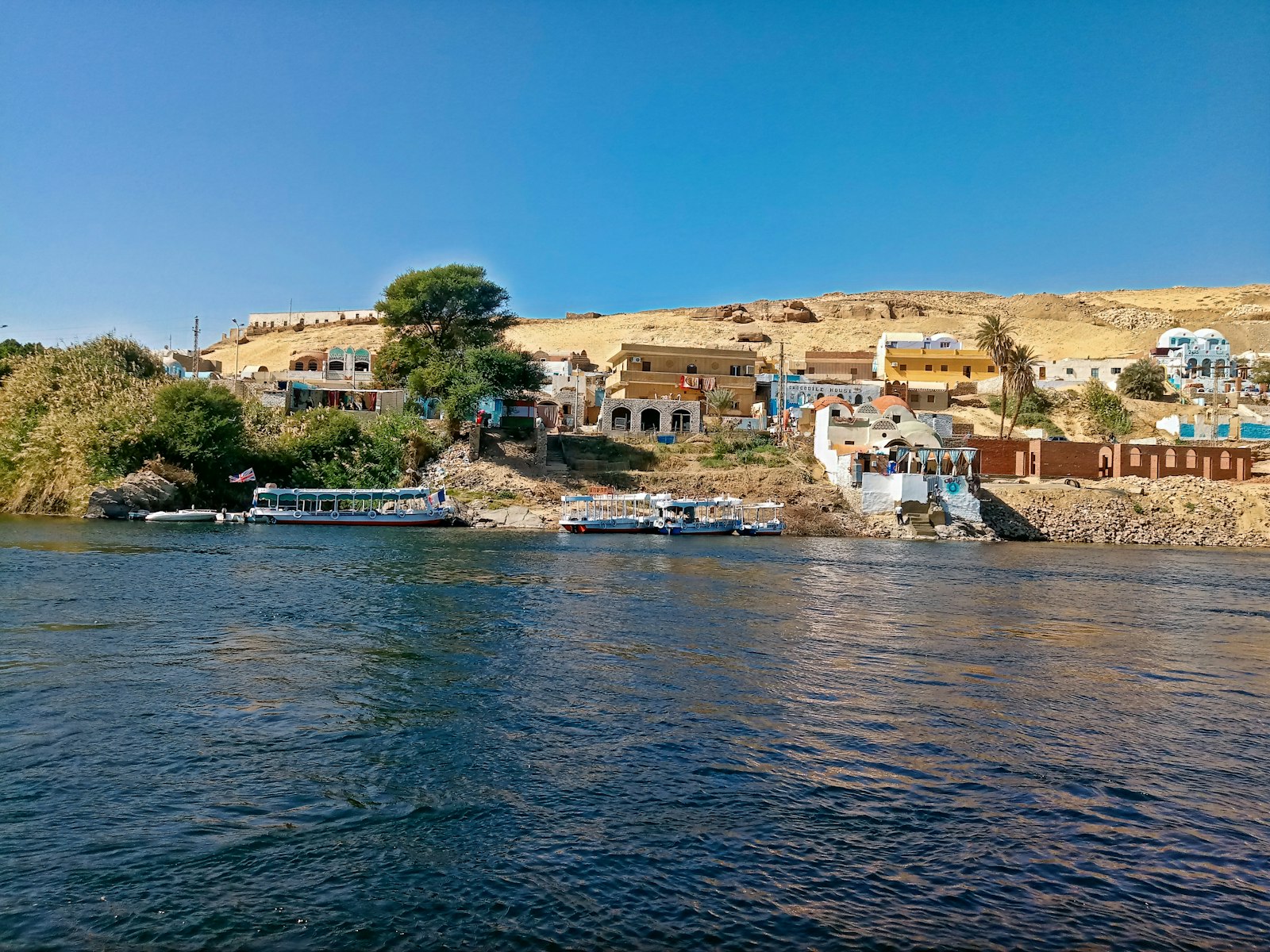
The northern and central part of Elephantine Island is occupied by two picturesque Nubian villages, Siou and Koti, which offer visitors an immersion in contemporary Nubian culture. The houses, often painted with vivid colours — blue, ochre yellow, green — and decorated with geometric motifs and representations of pilgrimages to Mecca, create an environment of great visual charm.
Walking through the narrow alleys of the villages is a complete sensory experience: the scents of spices mix with the karkade (hibiscus) that the women prepare on the threshold of the houses, children play among the dirt streets, goats wander lazily among the houses. Nubian hospitality is proverbial, and it is not uncommon to be invited to drink a tea or a karkade in the house of a local family.
Nubian Culture
The Nubians of Elephantine Island keep their ancestral traditions alive, including the Nubian language (today spoken by about 500,000 people), traditional music with the tar (frame drum) and ritual dances. Some inhabitants of the island open their houses to visitors, offering traditional Nubian meals that include dishes such as ful (broad beans), bamia (okra), Nubian bread baked in the earth oven and delicious sweets based on dates.
Tips for the Visit
How to Get There
Elephantine Island is reachable by felucca (traditional sailing boat) or by motorboat from the Corniche of Aswan. The journey by felucca, lasting about 15-20 minutes, is particularly pleasant and romantic, especially at sunset. Some hotels on the eastern bank offer a free shuttle service. It is also possible to use the public ferry, very economical, which regularly connects the eastern bank with the island.
Organising the Visit
The archaeological site at the southern end of the island requires an entrance ticket. It is advisable to dedicate at least a couple of hours to the archaeological area and the museum, and further time to explore the Nubian villages. A complete visit of the island, including a stop for a tea in a Nubian village, can occupy half a day. The combination with a felucca cruise around the island and the nearby Kitchener Island (Botanical Garden) is recommended.
What to Bring
Comfortable shoes are essential for walking on the dirt roads of the villages and on the archaeological terrain. Bring water, sun protection and a hat. A small amount of cash is useful if you wish to buy Nubian handicraft souvenirs or enjoy a meal in a village. Respect local traditions by dressing appropriately, especially when visiting residential areas.
Photographic Suggestions
Elephantine Island offers countless photographic opportunities. The colourful houses of the Nubian villages are particularly photogenic with the morning light. The Nilometer and the temple ruins are at their best in the late afternoon. For panoramic photos of the entire island, the best point is the terrace of the Old Cataract Hotel on the eastern bank of the Nile, where even Agatha Christie found inspiration for her novels.
Curiosities about Elephantine Island
The name "Elephantine" has several interpretations: it could derive from the shape of the island, which seen from above vaguely recalls an elephant, from the ivory trade that transited here, or from the large rounded granite rocks on the southern tip that seem elephants in the water. The Greek scientist Eratosthenes used in the 3rd century BC the observations conducted at Elephantine to calculate the circumference of the Earth with a surprisingly small error, less than 2%. The Jewish community of Elephantine is one of the oldest documented diaspora in history.
Elephantine Island is a microcosm of the entire Egyptian history, a place where five millennia of civilisation overlap in a compact but extremely dense space of meanings, an unmissable experience for anyone who visits Aswan.