The Mosque of Muhammad Ali: Cairo's Alabaster Jewel
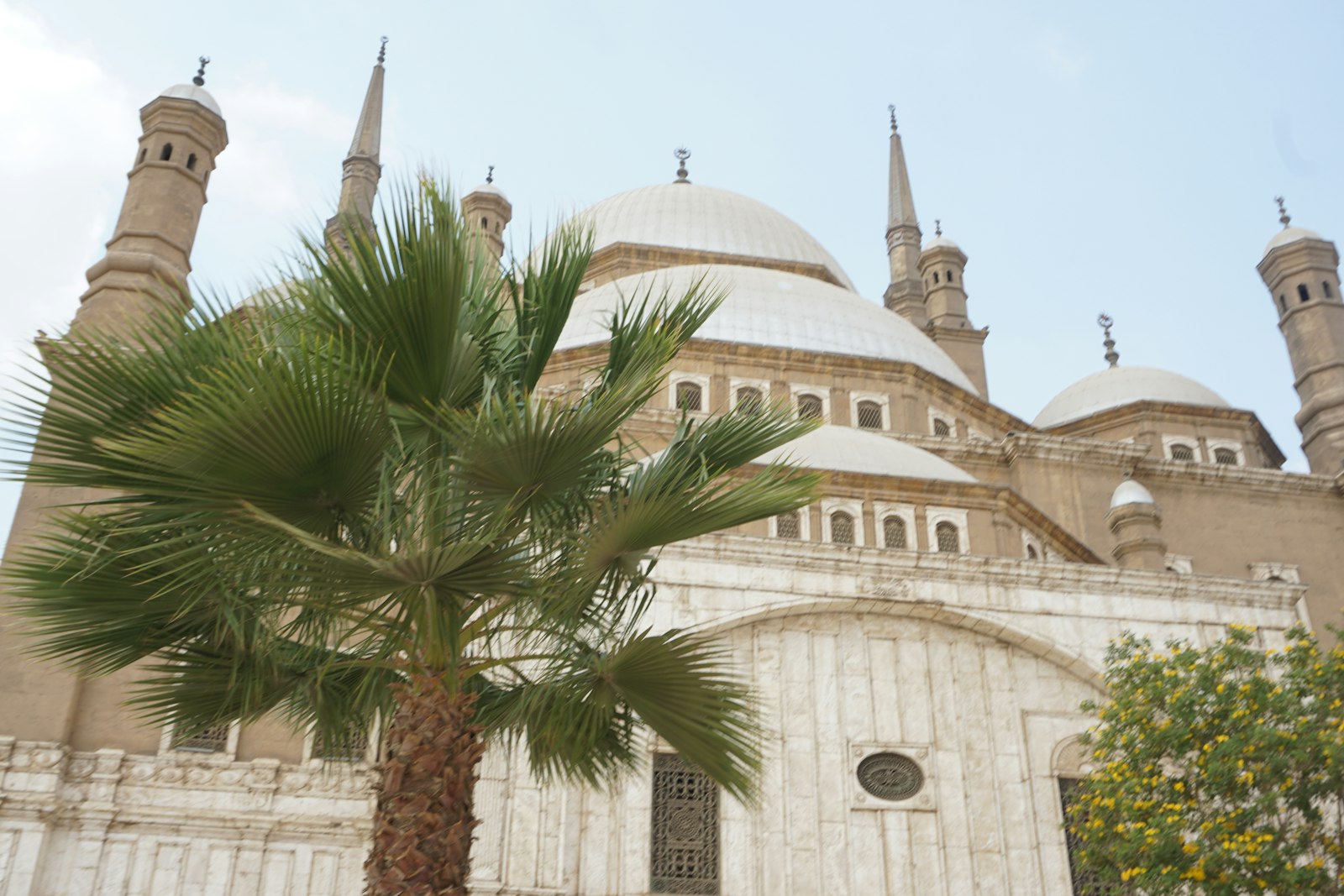
The Mosque of Muhammad Ali, universally known as the Alabaster Mosque, is the most iconic and recognizable monument of the Citadel of Cairo and of the entire skyline of the Egyptian capital. Built between 1830 and 1848 at the behest of Muhammad Ali Pasha, the founder of modern Egypt, this majestic mosque in the Ottoman style dominates the Mokattam hill with its great lead-clad central domes and the two extremely elegant minarets that soar towards the sky to a height of 82 metres.
The nickname of "Alabaster Mosque" derives from the external and internal cladding of the walls with slabs of precious Egyptian alabaster, a stone with a luminous and translucent appearance that gives the building a unique luminosity, especially in the hours of sunset when the warm light of the sun enhances its golden and amber tones.
History of the Construction
Muhammad Ali and his Ambitious Project
Muhammad Ali Pasha (1769-1849), of Albanian origin, became governor of Egypt on behalf of the Ottoman Empire in 1805 and transformed the country with radical reforms in the army, agriculture, industry and education. The construction of a great mosque within the citadel was part of his project of modernization and self-celebration: the monument was meant to rival the great imperial mosques of Istanbul and to affirm the prestige of Egypt under his dynasty.
The works began in 1830 to a design by the Greek architect Yusuf Bushnak, who explicitly took inspiration from the Mosque of Sultan Ahmed (the famous Blue Mosque) of Istanbul, adapting its proportions and style to the Cairene context. The construction required eighteen years and Muhammad Ali never saw the completed mosque: he died in 1849, a year after the end of the main works. His tomb in white Carrara marble, placed in the inner courtyard to the right of the entrance, became the burial place of the founder of modern Egypt.
Restorations and Conservation
Over the course of the 20th century, the mosque underwent several restoration interventions. The most significant was the one conducted between 1931 and 1939 under the direction of the Committee for the Conservation of Arab Monuments, which replaced some of the original domes and reinforced the load-bearing structures. A further restoration in the 2000s consolidated the foundations and restored part of the alabaster cladding deteriorated by the atmospheric pollution of Cairo.
Architecture and Design
The Majestic Exterior
The architecture of the mosque follows the model of the great Ottoman imperial mosques with a square prayer hall plan covered by a central dome flanked by semi-domes. The main dome, with a diameter of 21 metres, rises to 52 metres from the ground and is supported by four massive piers connected by pointed arches. Around the central dome are arranged four semi-domes that give the building its characteristic profile, visible from kilometres away.
The two cylindrical minarets, 82 metres high, rise at the western corners of the mosque and are equipped with two balconies each, decorated with geometric motifs. Their slenderness and elegance contrast with the compact mass of the domes, creating a visual balance typical of classical Ottoman architecture. The minarets are among the tallest in Cairo and serve as a visual reference point in the entire urban panorama.
The Courtyard
The large rectangular courtyard in front of the prayer hall is surrounded by a portico with columns and pointed arches. At the centre of the courtyard is a fountain for ritual ablutions (wudu), surmounted by an elegant domed pavilion with floral and geometric decorations. The fountain, in carved alabaster, is a refined example of Egyptian craftsmanship of the era.
The French Clock Tower
In the western corner of the courtyard rises a clock tower that encapsulates a piece of diplomatic history: the clock was donated in 1845 by the King of France Louis Philippe I to Muhammad Ali as a gesture of thanks for the gift of the Luxor obelisk, today installed in the Place de la Concorde in Paris. The clock, however, arrived in Cairo already damaged and has never worked, remaining an ironic symbol of Franco-Egyptian relations of the 19th century. Despite this, the tower remains one of the most photographed elements of the courtyard.
The Dazzling Interior
The interior of the mosque is one of the most spectacular sacred spaces in the Islamic world. The walls are entirely clad in alabaster up to a height of about 11 metres, creating a luminous and warm surface that reflects the light coming from the hundreds of lamps and chandeliers. Above the alabaster cladding, the domes and semi-domes are decorated with floral motifs and Quranic calligraphy in gold on a blue and green background.
The artificial lighting is provided by a cascade of circular chandeliers of crystal and gilded bronze, suspended at various heights, which in the evening hours create an atmosphere of extraordinary mystical suggestion. The stained-glass windows filter the natural light, projecting polychrome reflections on the alabaster walls, transforming every moment of the day into a different visual experience.
The mihrab (the niche that indicates the direction of Mecca) is clad in precious marble with gilded inlays, while the minbar (the pulpit for the Friday sermon) is a masterpiece of wood carving with gilding and geometric carvings of Mamluk inspiration. The dikka, a raised platform for the Quranic cantor, is supported by marble columns with carved capitals.
The Tomb of Muhammad Ali
To the right of the entrance of the prayer hall is the tomb of Muhammad Ali Pasha, enclosed by an elegant enclosure in gilded bronze. The cenotaph in white Carrara marble is carved with inscriptions in Arabic and floral motifs of extraordinary delicacy. The light filtered by the stained-glass windows that illuminates the tomb creates an atmosphere of contemplation and solemnity appropriate for the resting place of the founder of modern Egypt.
The Panoramic Terrace
An Unrivalled View over Cairo
The terrace that surrounds the mosque offers one of the most spectacular panoramic views in the world. From this elevated position, the gaze embraces the entire urban landscape of Cairo, one of the largest metropolises on the planet. Towards the north stretches the modern centre with its skyscrapers and night lights. Towards the east one sees the hills of Mokattam and the City of the Dead. Towards the west, the blue ribbon of the Nile is lost among the residential quarters and, on particularly clear days, the silhouettes of the pyramids of Giza appear on the horizon like mirages in the desert.
The most evocative moment to admire the view is sunset, when the city is tinged with orange and pink tones and the minarets of the hundreds of mosques of Cairo light up one after another, while the call to the Maghrib prayer resounds simultaneously from every direction, creating an absolutely unique acoustic and visual experience.
Cultural and Religious Significance
A Symbol of Modern Egypt
The Mosque of Muhammad Ali is not only a place of worship, but a powerful symbol of Egyptian national identity. Muhammad Ali Pasha is considered the father of modern Egypt for his reforms that transformed the country from a peripheral province of the Ottoman Empire into a semi-independent state with regional ambitions. The mosque, with its grandeur and its dominant position, reflects these ambitions and continues to represent the aspirations of contemporary Egypt.
The Mosque as a Place of Worship
The Mosque of Muhammad Ali is still an active place of worship and hosts the five daily prayers and the Friday prayer. During Ramadan, the mosque fills with the faithful for the Tarawih prayer and takes on an atmosphere of particular devotion and community. Non-Muslim visitors are welcome outside of prayer times, but respectful conduct and appropriate clothing are required.
Tips for the Visit
How to Get There
The mosque is located within the Citadel of Saladin, accessible from the Bab al-Mudarraj (main entrance). The entrance ticket to the citadel includes access to the mosque. It is advisable to dedicate the visit to the mosque within the framework of a wider exploration of the citadel, allowing at least one hour to appreciate the interior and the panoramic view.
Rules for Visitors
At the entrance of the mosque it is necessary to remove one's shoes, which can be carried in a plastic bag or left at the entrance. Clothing that covers shoulders and knees is required. Women should bring a headscarf to cover their hair, although this requirement is not always strictly applied to tourists. Photography is generally permitted inside the mosque, without flash and without tripod.
Photographic Tips
The best moments to photograph the exterior of the mosque are the early morning, when the sunlight illuminates the eastern facade, and the late afternoon for the sunset from the terrace. For the interior, the natural light that filters through the stained-glass windows creates better effects in the central hours of the day. The courtyard with the fountain and the clock tower offers particularly evocative photographic compositions.
Combining the Visit
After the mosque, it is advisable to visit the nearby Mosque of al-Nasir Muhammad for a comparison between Mamluk and Ottoman architecture, the Military Museum and the Well of Joseph. At the base of the citadel, the Islamic quarter of Darb al-Ahmar offers a fascinating route among medieval alleys, historic mosques and craft workshops that lead all the way to Khan el-Khalili.
The Mosque of Muhammad Ali is much more than a religious building: it is a monument to the vision of a man who transformed Egypt, an architectural masterpiece that fuses Ottoman tradition and Egyptian identity, and an incomparable belvedere over one of the most fascinating and complex cities in the world. To visit it means to understand a crucial chapter of Egyptian history and to carry away with you an unforgettable visual and spiritual memory.