The Mosque of Ibn Tulun: the Jewel of Abbasid Architecture in Cairo
The Mosque of Ibn Tulun is the oldest intact mosque in Cairo and one of the most extraordinary monuments of the entire Islamic world. Built between 876 and 879 AD at the behest of Ahmad ibn Tulun, governor of Egypt of Turkish origin who founded the first dynasty independent of the Abbasid caliphate, this mosque represents a fundamental chapter in the history of Islamic architecture. Its vast courtyard, the stucco decorations of refined beauty and the famous spiral minaret make it an unmissable stop for anyone visiting historic Cairo.
Located in the al-Sayyida Zaynab district, in the heart of Islamic Cairo, the mosque extends over an area of more than 26,000 square metres, making it one of the largest mosques in Egypt and the entire African continent. Its uniqueness lies not only in its monumental dimensions, but also in the architectural style that distinguishes it clearly from the other Cairene mosques, reflecting Mesopotamian influences rarely found in Egyptian lands.
History and Historical Context
Ahmad ibn Tulun and the Founding of the Tulunid Dynasty
Ahmad ibn Tulun was born in 835 AD in Samarra, the then capital of the Abbasid caliphate in Iraq. Of Turkish origin, he grew up in the cultured and refined environment of the caliphal court, where he received a first-rate military and administrative education. In 868 he was sent to Egypt as representative of the nominal governor, but thanks to his political and military skill he managed to become progressively independent of the central power of Baghdad, founding the Tulunid dynasty that would govern Egypt and Syria until 905 AD.
Ibn Tulun founded a new administrative city, al-Qata'i, to the northeast of Fustat (the ancient Islamic capital of Egypt), and decided to build there a great congregational mosque that reflected the greatness and ambition of his reign. The new mosque was to be the religious and social heart of the city, a place where the entire community could gather for Friday prayer.
The Construction of the Mosque
The construction work began in 876 AD and was completed in just three years, a surprisingly short time considering the dimensions of the building. According to tradition, the architect responsible for the project was a Coptic Christian, which testifies to the climate of relative religious tolerance that characterised the government of Ibn Tulun, who employed officials and craftsmen of different faiths.
The mosque was built entirely in fired bricks coated with stucco, a constructive technique typical of Mesopotamia but unusual in Egypt, where stone was the privileged building material. A legend tells that Ibn Tulun had initially planned the use of columns taken from Christian churches, but that the architect convinced him to adopt brick pillars, thus avoiding a sacrilegious act and at the same time creating a more robust and unitary structure.
Architecture and Characteristics
The Central Courtyard
The heart of the mosque is its immense square-plan courtyard, which measures about 92 x 92 metres. At the centre is a fountain for ritual ablutions, housed in a domed pavilion added in the 13th century by the Mamluk sultan Lajin, who had found refuge in the mosque during a period of exile and had sworn to restore it if he became sultan.
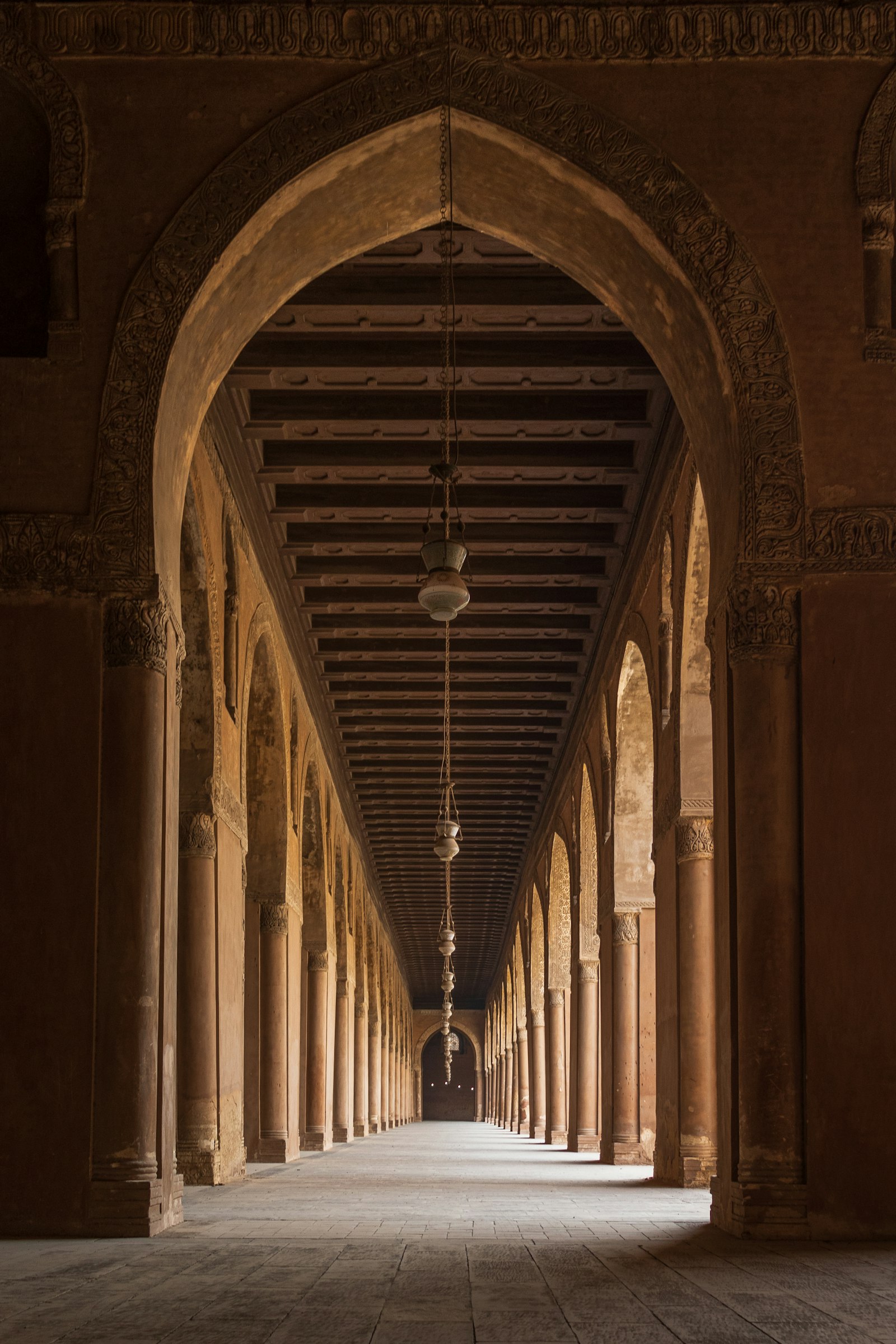
The courtyard is surrounded on three sides by double-arcade porticoes, while the qibla side (oriented towards Mecca) features five parallel aisles. The arches, slightly ogival, rest on robust rectangular brick pillars with angular columns, a structural system that gives the interior an architectural rhythm of great harmony and elegance.
The Stucco Decorations
One of the most fascinating elements of the mosque is the very rich stucco decoration that adorns the arches, the spandrels and the bands under the ceiling. These carvings, executed with extraordinary craftsmanship, feature stylised vegetal motifs, geometric arabesques and Quranic inscriptions in Kufic characters. The stucco, worked both by carving and by mould, creates plays of light and shadow that vary over the course of the day, animating the architectural surfaces with an effect of great evocativeness.
The decorations are particularly remarkable for their variety: it is estimated that none of the approximately 128 arches present in the mosque exactly repeats the same decorative motif, a tour de force of artisanal creativity that has no equal in the Islamic architecture of the period.
The Spiral Minaret
The most iconic element of the Mosque of Ibn Tulun is without doubt its spiral minaret (malwiyya), a unique structure in the Egyptian architectural panorama. Inspired by the famous minaret of the Great Mosque of Samarra in Iraq, where Ibn Tulun had grown up, this minaret features an external spiral ramp that winds around a cylindrical core, allowing the ascent to the summit.
The minaret, about 40 metres high, is located outside the enclosure of the mosque, to which it is connected by a covered bridge. Its helical form, reminiscent of a miniature tower of Babel, is a clear homage to the Mesopotamian origins of the founder and represents an architectural element without precedent and without later imitators in Egyptian architecture. The ascent to the minaret is possible and offers an extraordinary panoramic view over historic Cairo.
The Battlements and the External Enclosure
The mosque is surrounded on three sides by an external enclosure (ziyada) that separates it from the surrounding urban fabric, creating a buffer zone that contributes to the sense of isolation and sacredness of the space. The battlements that crown the perimeter walls feature a profile in the shape of stylised human figures, a unique decorative motif of uncertain interpretation that has fuelled numerous theories and legends.
The Gayer-Anderson Museum
A Journey into Domestic Islamic Art
Adjacent to the Mosque of Ibn Tulun is the Gayer-Anderson Museum, housed in two Ottoman houses of the 17th century connected by a bridge on the first floor. The museum takes its name from Major Robert Gayer-Anderson Pasha, British officer and art collector who lived in these houses from 1935 to 1942 and furnished them with his vast collection of Islamic, Pharaonic and Oriental artefacts.
The museum offers a fascinating insight into the domestic life of the wealthy classes of Ottoman Cairo, with richly decorated rooms, carved wooden mashrabiyya, ceramic tiles, internal fountains and a private hammam. The collection includes objects from all over the Islamic world, as well as pieces of ancient Egypt and the Far East. The museum is also known for having been a location of the James Bond film "The Spy Who Loved Me" (1977).
Cultural and Religious Significance
The Mosque of Ibn Tulun is not only an architectural monument, but a still-active place of worship that continues to carry out its religious function after more than eleven centuries since its foundation. This makes it one of the longest-lived religious buildings in the Islamic world.
The mosque also represents an important historical document, tangible testimony of the brief but brilliant Tulunid period in the history of Egypt. The choice of a Mesopotamian architectural style rather than Egyptian or North African reflects Ibn Tulun's desire to assert his own cultural and political identity, creating at the same time a precedent that would influence the Islamic architecture of subsequent centuries.
The inclusion of the Mosque of Ibn Tulun in the UNESCO site of Historic Cairo, together with other monuments of Islamic Cairo, recognises its universal value as a masterpiece of Islamic architecture and an irreplaceable testimony of medieval Egyptian civilisation.
Restorations and Conservation
Over the centuries, the mosque has undergone numerous restoration works. The most important was that of the Mamluk sultan Lajin in 1296, who restored the central fountain and added the domed pavilion that protects it. In the Ottoman period the mosque experienced a period of relative abandonment, during which parts of the structure were used as warehouses and dwellings.
The first modern restorations were begun at the end of the 19th century by the Committee for the Conservation of the Monuments of Arab Art, founded in 1881. Further restoration campaigns have been conducted in the 20th and 21st centuries, with particular attention to structural consolidation, the restoration of the stucco decorations and the removal of the improper additions accumulated over the centuries.
Tips for the Visit
How to Get There
The mosque is located in the al-Sayyida Zaynab district, easily reachable by taxi or with the ride-sharing service from the centre of Cairo. The nearest metro station is Sayyida Zeinab on line 1. From there it is possible to reach the mosque on foot in about 15 minutes, crossing a neighbourhood rich in atmosphere and daily life.
What to Wear
Being an active place of worship, it is necessary to dress respectfully. Women must cover their shoulders and wear a veil on the head; men must avoid short shorts. It is obligatory to take off your shoes before entering the prayer hall, so it is advisable to bring comfortable socks.
Hours and Tickets
The mosque is generally open from 8:00 to 18:00, but the hours may vary during Ramadan and Islamic holidays. Entry to the mosque is free, although a small offering is welcome. The adjacent Gayer-Anderson Museum requires a separate ticket.
Photographic Suggestions
The best moment to photograph the courtyard is in the early hours of the morning, when the soft light creates long and evocative shadows between the arches of the porticoes. The spiral minaret is particularly photogenic against the blue sky of the afternoon. Climbing to the top of the minaret you enjoy an exceptional panoramic view over the rooftops of historic Cairo, ideal for panoramic shots.
Combining the Visit
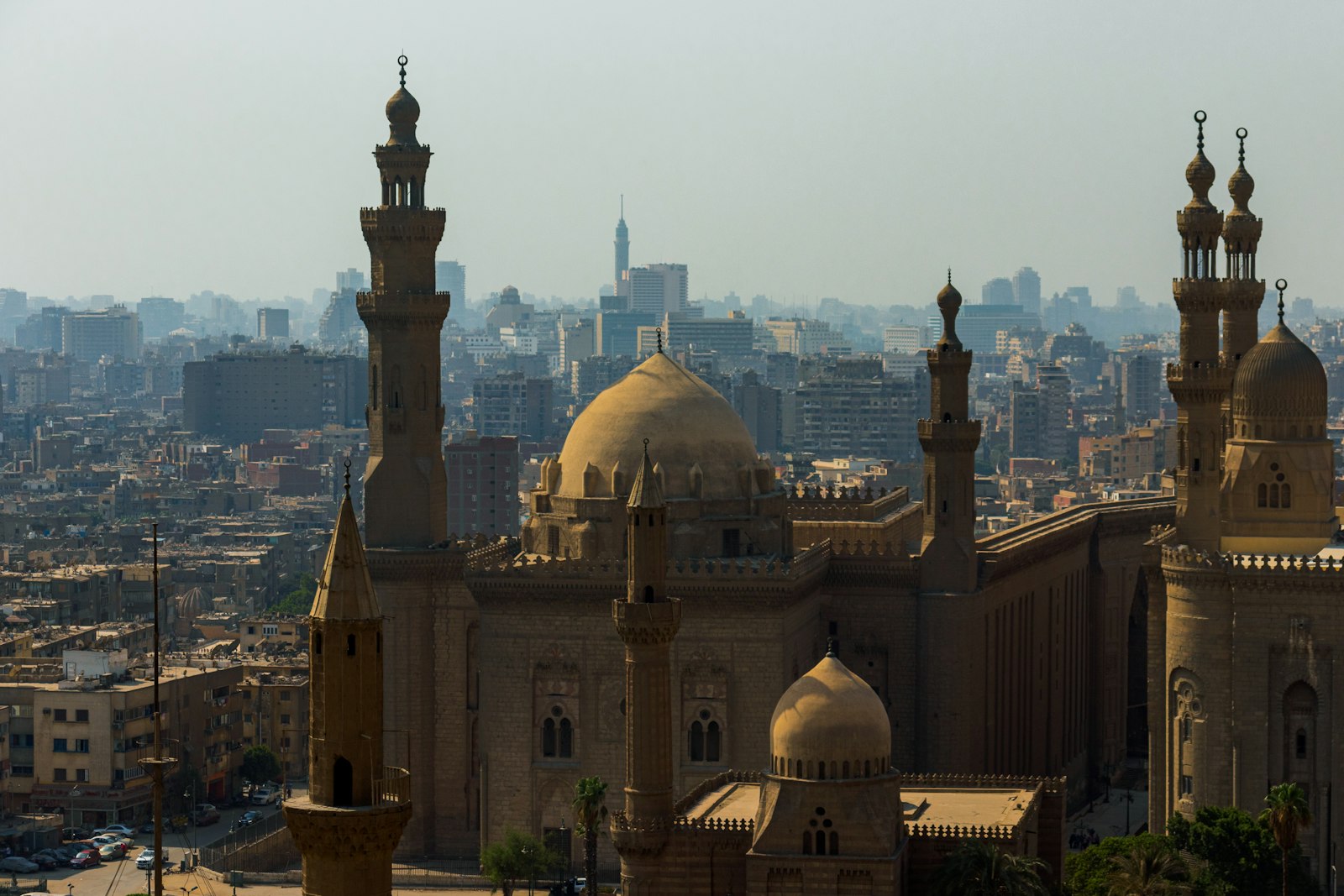
The Mosque of Ibn Tulun lends itself perfectly to being inserted in an itinerary of Islamic Cairo. After the visit, it is possible to head towards the Citadel of Saladin, about a kilometre away, passing by the Mosque of Sultan Hassan and the Al-Rifa'i Mosque. Alternatively, it is possible to explore the surrounding neighbourhood, rich in artisan workshops, traditional cafés and minor monuments of great charm.
The Mosque of Ibn Tulun remains one of the lesser-known treasures of Cairo, a place where the majesty of Islamic architecture merges with a profound spirituality, offering the visitor an unforgettable experience far from the tourist frenzy of the most famous sites.