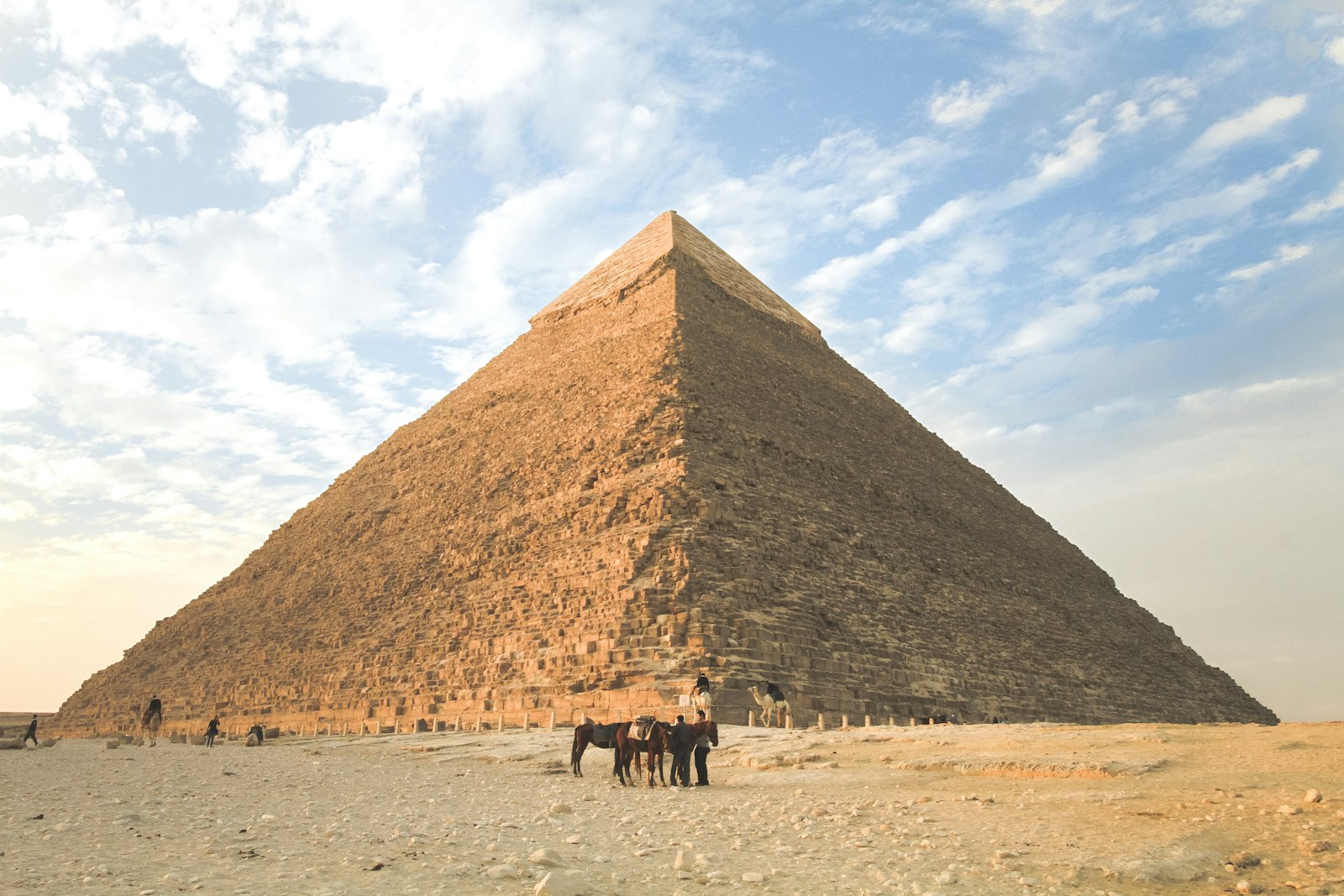
The Pyramids of the Queens: the Little Sentinels of the Giza Plateau
On the eastern side of the Great Pyramid of Khufu, three smaller pyramids rise in an orderly row like silent sentinels. They are the so-called Pyramids of the Queens, dedicated to the most important women in the life of the pharaoh Khufu: his mother Hetepheres I and his wives Meritites I and Henutsen. Although often overlooked by visitors who concentrate their attention on the three larger pyramids, these satellite structures represent a fascinating chapter in the history of Egyptian funerary architecture and offer precious information on the role of royal women in ancient Egypt.
The three pyramids, conventionally named G1-a, G1-b and G1-c by the archaeologists, were built during the 4th dynasty, around 2560 BC, simultaneously with or shortly after the Great Pyramid. Each of them, although considerably smaller than the pyramid of the pharaoh, represented a complete funerary monument, equipped with a chapel for the cult, a burial chamber and, originally, a cladding in white limestone that made them luminous under the desert sun.
The Pyramid of Hetepheres I (G1-a)
The Mother of the Pharaoh
The northernmost pyramid of the group, G1-a, is generally attributed to the queen Hetepheres I, mother of the pharaoh Khufu and wife of the pharaoh Sneferu. Hetepheres I occupied a position of extraordinary prestige in the social hierarchy of the Old Kingdom: as mother of the reigning pharaoh, she bore the title of "Mother of the King of Upper and Lower Egypt" and enjoyed considerable influence in the royal court.
The pyramid measures about 46.5 metres per side at the base and reached an original height of about 30 metres, dimensions that, although modest compared to the Great Pyramid, were nonetheless impressive for a non-royal burial. The internal structure comprises a descending corridor that leads to a small burial chamber carved into the rock.
The Discovery of the Treasure of Hetepheres
The story of the queen Hetepheres I is linked to one of the most sensational archaeological discoveries of the 20th century. In 1925, the photographer of the expedition of Harvard University, while positioning the tripod near the pyramid G1-a, noticed an anomaly in the ground. The excavation that followed, conducted by the archaeologist George Andrew Reisner, brought to light a shaft 27 metres deep at whose base was a sealed chamber containing the funerary equipment of the queen.
The treasure comprised furniture decorated in gold, a canopy for the bed, a litter, vessels in gold and silver, jewels and numerous objects of daily use. However, the alabaster sarcophagus, sealed and apparently intact, proved empty upon opening, generating a mystery that still today fascinates Egyptologists. The most credited hypothesis suggests that the original burial of Hetepheres, probably at Dahshur near the pyramid of her husband Sneferu, had been violated by tomb robbers and that her son Khufu had ordered the transfer of the equipment to a new secret burial at Giza, perhaps without knowing that the body of his mother had already been stolen.
The Pyramid of Meritites I (G1-b)
The Principal Wife
The central pyramid, G1-b, is attributed to the queen Meritites I, considered the principal wife of the pharaoh Khufu. The information on the life of Meritites is relatively scarce, but her role of "Great Royal Wife" placed her at the summit of the female hierarchy of the court. The very fact that a pyramid had been built for her next to that of the pharaoh testifies to the importance of her status.
The pyramid of Meritites presents slightly inferior dimensions compared to that of Hetepheres, with a side at the base of about 45 metres. The internal structure follows the classic scheme of the satellite pyramids, with a descending corridor oriented towards the north that leads to the burial chamber. Unfortunately, as happens for most of the Egyptian tombs, the chamber was looted in antiquity and has not returned the original funerary equipment.
The Role of the Great Royal Wife
In ancient Egypt, the Great Royal Wife was not simply the wife of the pharaoh, but held a religious and ceremonial role of the first order. She participated in the temple rituals, could act as regent in the absence of the sovereign and, through her descent, legitimised the succession to the throne. The fact that Meritites was able to enjoy a pyramid of her own on the Giza plateau confirms that her role went well beyond that of a simple consort.
The inscriptions found around the pyramid and in the surrounding mastabas provide some of her titles: "She who sees Horus and Seth", "Great of favours", and "Companion of Horus". These titles, typical of the queens of the Old Kingdom, underline the sacred dimension of Egyptian female royalty.
The Pyramid of Henutsen (G1-c)
The Queen of the Temple
The southernmost pyramid of the group, G1-c, is attributed to the queen Henutsen, another wife of Khufu. This pyramid has a particularly interesting history because it was profoundly transformed over the course of the centuries. During the 21st dynasty (about 1070-945 BC), over one thousand five hundred years after its original construction, the pyramid and the adjacent chapel were converted into a temple dedicated to the goddess Isis, lady of the pyramids.
This transformation testifies to how the ancient monuments were continuously reinterpreted and reused by the subsequent generations. The Temple of Isis that arose next to the pyramid of Henutsen became an important centre of cult and pilgrimage, and continued to be frequented until the Roman era. A stele found in the temple, known as the "Inventory Stele", contains a text that erroneously attributes the construction of the Sphinx to the pharaoh Khufu, generating a debate that continues still today.
The Architecture of the Pyramid
The pyramid of Henutsen measures about 45 metres per side and presented an original height of about 29 metres. Like its companions, it was equipped with a descending corridor and an underground burial chamber. The eastern funerary chapel, before its transformation into an Isiac temple, followed the standard model of the satellite pyramids, with a false-door stele through which the spirit of the deceased could receive the offerings of the living.
During the excavations conducted in the area, fragments of reliefs and inscriptions were found that have allowed the partial reconstruction of the original decoration of the chapel. These fragments show scenes typical of the funerary art of the Old Kingdom, with processions of offering bearers and representations of the queen who receives gifts from her servants in the otherworldly world.
The Architecture of the Satellite Pyramids
Construction Technique
The Pyramids of the Queens, although of reduced dimensions compared to the royal pyramids, were built with the same care and the same techniques. The core is composed of blocks of local limestone, extracted from the quarries of the Giza plateau, while the external cladding was in fine Tura limestone, the same material used for the Great Pyramid. The slope of the faces is about 52 degrees, an angle similar to that of the pyramid of Khufu.
Each pyramid was accompanied by a small funerary chapel on the eastern side, where the priests celebrated the daily rituals for the sustenance of the soul of the deceased. Traces of these chapels are still visible, although in a fragmentary state. To the south of each pyramid there was moreover a pit for a ritual boat, destined to transport the soul of the queen to the afterlife, a privilege that underlines the importance of the royal women in Egyptian funerary cosmology.
Comparison with the Pyramids of the Queens of Menkaure
On the southern side of the Pyramid of Menkaure there are another three satellite pyramids, also traditionally attributed to queens. A comparison between the two groups reveals interesting evolutions in the royal funerary practice. The satellite pyramids of Menkaure are slightly smaller and less refined than those of Khufu, reflecting perhaps a reduction of the available resources towards the end of the 4th dynasty. However, one of them, the G3-a, still preserves part of the cladding in granite at the base, a prized material that testifies to the importance of the recipient.
The Role of Royal Women in Ancient Egypt
The Pyramids of the Queens of Giza offer an important window on the role and the status of women at the summit of Egyptian society. In ancient Egypt, women enjoyed considerably greater rights compared to many other ancient civilisations: they could own property, manage business, divorce and even, in exceptional cases, govern as pharaohs.
The queens of the Old Kingdom carried out essential religious functions, in particular in the cult of the goddess Hathor. They were considered intermediaries between the human world and the divine one, and their presence in the rituals was deemed indispensable to guarantee the cosmic order. The fact that pyramids of their own were dedicated to them, built with great expenditure of resources next to those of the pharaohs, demonstrates that their role was not secondary or merely symbolic.
Tips for the Visit
Access and Tickets
The Pyramids of the Queens are included in the area of the Giza plateau and are accessible with the general entrance ticket. Access to the interior of some pyramids might require a supplementary ticket, depending on the period. It is advisable to check at the ticket office the options available at the moment of the visit.
Visit Route
The pyramids are located on the eastern side of the Great Pyramid of Khufu and are easily reachable on foot from the main entrance area. It is advisable to visit them after having explored the Great Pyramid, proceeding from north to south to follow the traditional chronological order. The visit combines perfectly with the exploration of the nearby Tombs of the Nobles.
Photography
The Pyramids of the Queens offer interesting photographic cues, especially in the hours of the late afternoon when the golden light creates an evocative contrast with the Great Pyramid in the background. The best point for an overall photograph is located slightly to the south-east of the group, from where it is possible to frame the three satellite pyramids with the majestic pyramid of Khufu that stands out behind them.
Visiting the Pyramids of the Queens means discovering an often overlooked aspect of Egyptian civilisation, where female power and family devotion expressed themselves through monuments destined to challenge eternity. These small pyramids, in their elegant simplicity, tell stories of queens whose memory, after four and a half millennia, continues to live in the stone of the desert.