The Temple of Beit el-Wali: The Battle Gallery of Ramesses II
A few steps from the majestic Temple of Kalabsha, near the High Dam of Aswan, lies a small rock temple which is an authentic treasure chest of Egyptian military art: the Temple of Beit el-Wali, whose Arabic name means "House of the Saint" in reference to a Christian hermit who found refuge there in medieval times. This modest sanctuary, dug into the rock by the will of the great pharaoh Ramesses II, is the oldest of the temples that this prolific builder erected in Nubia, chronologically preceding even the famous colossi of Abu Simbel.
What makes Beit el-Wali unique in the panorama of Nubian temples is the extraordinary liveliness of its wall decorations. The battle scenes that adorn the walls of the vestibule are among the most dynamic and detailed in all of Egypt, a military gallery carved into the rock that recounts Ramesses II's campaigns against the Nubians, Libyans and Syrians with dramatic intensity. The preservation of the original colors, unusually good for a three-thousand-year-old temple, adds to these scenes a vitality that leaves the visitor breathless.
History of the Temple
The Construction under Ramesses II
The Temple of Beit el-Wali was built at the beginning of the long reign of Ramesses II, probably around 1270 BC, in the years immediately following the pharaoh's accession to the throne. It was the first of a series of seven temples that Ramesses II would erect in the Nubian region, an unprecedented building program that culminated in the construction of the two colossal temples of Abu Simbel. The choice to start this ambitious program from Lower Nubia, the region closest to Egypt, reflected the gradual strategy of cultural and religious penetration in the region.
The temple was carved into the rock face of a valley in Lower Nubia, in the ancient Egyptian location known as Aniba. The person responsible for the construction was the viceroy of Nubia, whose job included supervising all construction, military and administrative activities in the region. The temple's inscriptions celebrate the power of Ramesses II and his rule over Nubia, functioning simultaneously as a religious sanctuary and as an instrument of imperial propaganda.
The Christian Period
Like many other temples in Nubia, Beit el-Wali was also converted into a place of Christian worship during the Coptic era. The very name of the temple recalls the tradition of a holy hermit who lived in the rooms of the sanctuary, transforming the home of the deified pharaoh into a monastic cell. During this period, some of the pagan decorations were covered with stucco and plaster, while others were left intact, perhaps because the Coptic monks did not consider them a threat to their faith.
Saving and Transfer
The Beit el-Wali Temple was among the Nubian monuments saved during the great UNESCO campaign of the 1960s. Unlike other larger temples that were dismantled block by block, Beit el-Wali was cut from the rock face into which it was excavated, divided into sections and transported to its current location, next to the Kalabsha Temple, in the immediate vicinity of the Aswan High Dam.
The rescue work was carried out by a team of Polish archaeologists and engineers from the Center for Mediterranean Archeology of the University of Warsaw, under the direction of Professor Kazimierz Michałowski. The Polish expedition stood out for the meticulous care with which it documented and cataloged every element of the temple before and during the transfer, producing a detailed scientific publication that still remains the fundamental reference text for the study of the monument.
Temple Architecture
The Rock Structure
The Temple of Beit el-Wali is a rock temple of relatively modest dimensions, composed of three main rooms dug in succession into the rock: an open-air vestibule (now partially rebuilt), a transverse hall and a sanctuary. The progression from the bright, open spaces of the vestibule to the concentrated darkness of the sanctuary reflects the Egyptian theological principle of the gradual transition from the earthly world to the divine realm, a path that the priest took daily during offering rituals to the god.
Despite its small size - the entire temple is approximately 25 meters deep - Beit el-Wali manages to communicate a sense of solemnity and power thanks to the exceptional quality of its decorations. Every square centimeter of the walls is covered with expertly carved reliefs colored with bright pigments, creating an effect of decorative richness that more than compensates for the modesty of the architectural dimensions.
The Vestibule and the Battle Scenes
The vestibule is the beating heart of the temple and its most famous artistic element. The side walls are entirely covered with battle scenes of extraordinary liveliness and dynamism, which tell of three different military campaigns of Ramesses II.
The Nubian countryside occupies the southern wall and is the largest and most detailed scene. The pharaoh is depicted on his war chariot charging the Nubian warriors, who flee in panic. The scene is full of fascinating ethnographic details: Nubians are represented with their dark skin, distinctive hair, feather ornaments and traditional weapons. Nubian women and children are shown taking shelter in their huts, some of which are detailed with domestic animals—cattle, giraffes, and monkeys—tied outside. This is one of the most complete depictions of Nubian daily life in ancient Egyptian art.
The Libyan countryside decorates the upper part of the northern wall. The Libyans, recognizable by their long hair and decorated cloaks, are shown fleeing before the pharaoh's advance. Scenes of close combat, with Egyptian soldiers capturing Libyan prisoners, alternate with moments of triumph in which the spoils of war are presented to the pharaoh.
The Syrian campaign completes the war cycle on the northern face. The Syrians, identifiable by their beards and oriental clothing, are depicted defending their fortresses against the Egyptian onslaught. One particularly notable scene shows a Syrian fortress under siege, with defenders shooting arrows from the walls as Egyptian soldiers attempt to scale.
The Transversal Hall
Beyond the vestibule you enter the transversal room, a more intimate room whose walls are decorated with scenes of religious content. Here the register changes radically: from the violent war scenes of the vestibule we move on to the serenity of the sacred rituals. Ramesses II is depicted making offerings to several deities, including Amun-Ra, Khnum (the ram-headed god particularly venerated in Aswan), Isis, and Horus.
One particularly significant scene shows the pharaoh being nursed by the goddess Isis, an image that symbolizes the divine legitimation of his power. Another notable scene depicts Nubian princes presenting tribute to the pharaoh: gold rings, leopard skins, ostrich feathers, monkeys, giraffes, and livestock, a living inventory of the riches Egypt derived from its rule over Nubia.
The Sanctuary
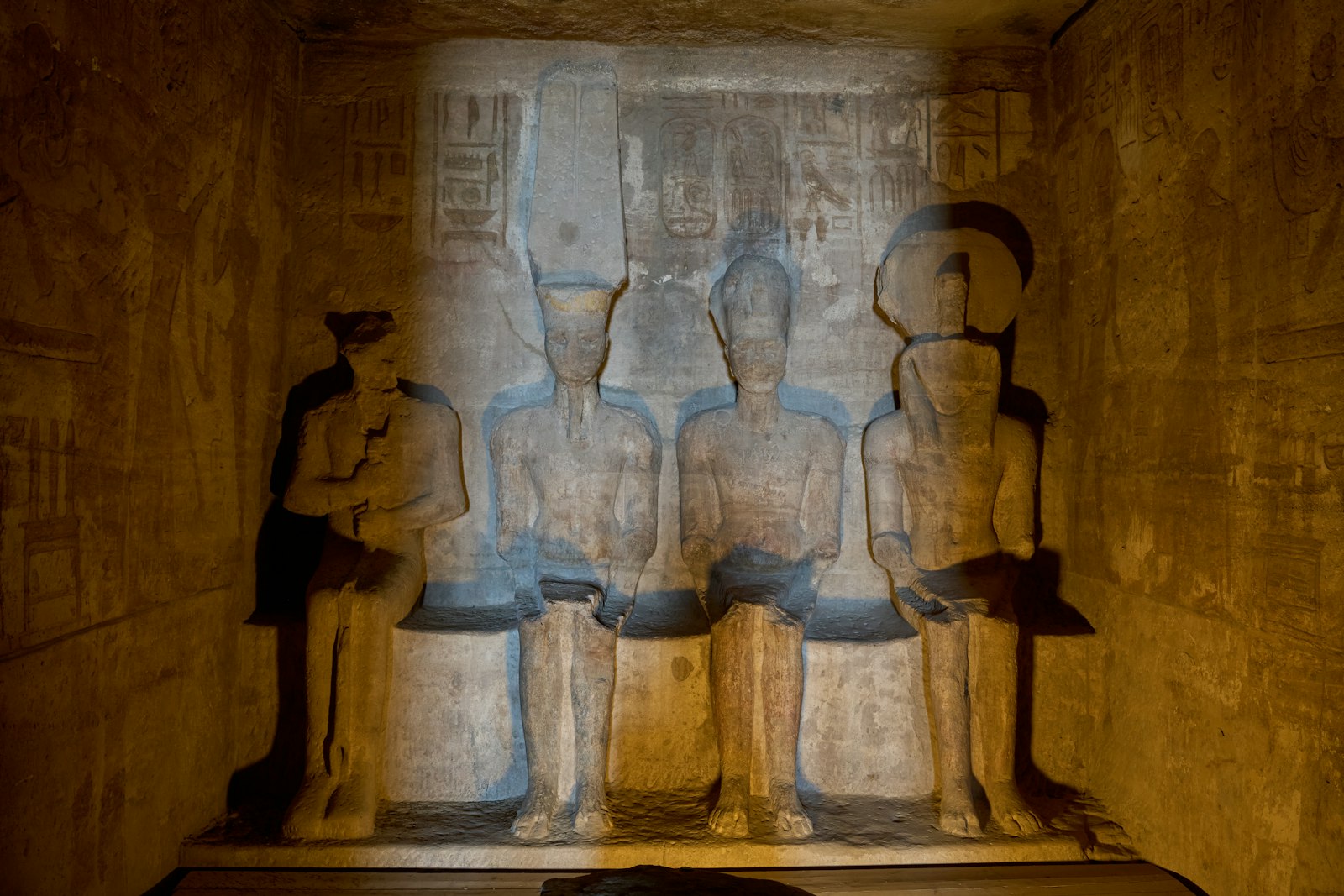
The innermost room of the temple is the sanctuary, a small cell where the cult statue originally stood. On the back wall there is a sculptural group that represents Ramesses II sitting among the main deities of the temple. This tripartite composition, with the pharaoh receiving divine sacralization at the center of the pantheon, is a recurring iconographic formula in the cave temples of Ramesses II, also present in Abu Simbel and in the Temple of Derr.
The Art of Beit el-Wali
The Original Colors
One of the most extraordinary aspects of the Beit el-Wali Temple is the preservation of the original colors on the carved walls. Unlike most Egyptian temples, where the pigments have faded centuries ago, at Beit el-Wali large portions of the decorations still retain the vibrant hues of the Ramesside era. The bright reds of the war chariots, the intense blues of the divine headdresses, the golden yellows of the royal ornaments and the greens of the vegetation create a chromatic effect of great visual impact.
These surviving colors are crucial for art historians, as they provide an understanding of how Egyptian temples originally appeared: not as the monochrome sand-colored structures we see today, but as polychrome buildings of extraordinary vibrancy, where every surface was covered in brilliant colors that must have been dazzling under the light of the Nubian sun.
The Ramesside Style
The Temple of Beit el-Wali is an early example of the Ramesside artistic style, characterized by an expressive grandeur and compositional dynamism that are clearly distinguished from the classical composure of 18th Dynasty art. The battle scenes in the vestibule, in particular, anticipate the great war compositions that Ramesses II would have created in the following decades on the walls of Karnak, Luxor and Abu Simbel.
The liveliness of the Nubian scenes, with their richness of ethnographic details and their almost cinematic narration of the war events, represents one of the peaks of Egyptian narrative art and offers a visual document of inestimable value for the reconstruction of the history and culture of ancient Nubia.
Tips for the Visit
How to Get There
The Beit el-Wali Temple is located in the immediate vicinity of the Kalabsha Temple, on the western shore of Lake Nasser, a few kilometers from the Aswan High Dam. To reach it you need to take a taxi from Aswan city to the dam and then a short boat ride. The visit is generally combined with that of the Kalabsha Temple and the Qertassi Kiosk, all accessible with a single ticket.
The Visit of the Temple
We recommend spending at least an hour visiting the temple, focusing on the battle scenes in the vestibule and the colorful reliefs in the transverse hall. A flashlight is essential to appreciate the details of the decorations in the darkest areas. The temple is small and can get crowded when tour groups arrive at the same time: if possible, try to visit in the early hours of the morning.
Combine with Kalabsha and Qertassi
The ideal visit involves the combination of the three monuments of the site: the Temple of Kalabsha, the Kiosk of Qertassi and the Temple of Beit el-Wali. The entire route takes approximately 3-4 hours and offers a complete panorama of Nubian sacred architecture from the Ramesside era to the Roman period. We recommend starting from Beit el-Wali, the smallest of the three, then continuing towards Kalabsha and concluding with the picturesque Qertassi Kiosk.
Curiosities about Beit el-Wali
The battle scenes of the temple provide valuable information on the military equipment of the Ramesside era: the war chariots, composite bows, spears, shields and armor of the Egyptian soldiers are depicted with such a level of detail as to allow accurate reconstructions of the armament of the pharaonic army. The Nubians, Libyans and Syrians are represented with their respective characteristic armaments and costumes, offering a rare visual testimony of the different military cultures of the ancient Near East.
Visiting the Temple of Beit el-Wali is like leafing through an illustrated book of Egyptian military history carved in stone, an intense and engaging experience that reveals, in its small space, the expressive power of Pharaonic art at its peak.