The Temple of Merenptah: a Hidden Treasure of the Western Bank
The funerary temple of Merenptah, located on the western bank of Luxor between the Ramesseum and the site of the Colossi of Memnon, is one of the most neglected and least visited monuments of the entire Theban archaeological area. And yet, this site conceals a historical importance of the first order: it was here that the famous Merenptah Stele was discovered, also known as the Israel Stele, one of the most significant historical documents of ancient Egypt and of the entire history of the ancient Near East.
Pharaoh Merenptah, the thirteenth son of Ramesses II, ascended the throne at an already advanced age, after having spent decades as crown prince in the service of his long-lived father. His reign (around 1213-1203 BC) was marked by important military campaigns in Libya and Canaan, documented precisely in the famous stele that has made his name famous throughout the world.
The Pharaoh Merenptah
The Son of Ramesses the Great
Merenptah lived in the imposing shadow of his father Ramesses II, who reigned for 66 years and outlived many of his elder sons. When he finally ascended the throne, Merenptah was already an old man, probably in his sixties, but he proved to be a capable and determined sovereign.
His coronation name, Baenre Meriamun ("The Soul of Ra, Beloved of Amun"), reflected the continuity with the religious and political tradition of his father. Merenptah faced significant military challenges: he repelled an invasion of the Sea Peoples allied with the Libyans, a threat that would later contribute to the collapse of the Bronze Age in the following generations.
The mummy of Merenptah, found in the Deir el-Bahari cache, shows a corpulent man with evident signs of arthritis and vascular diseases, confirming his advanced age at the time of death. Despite the brevity of his reign, Merenptah managed to leave a significant mark on Egyptian history.
The Merenptah Stele (Israel Stele)
The most famous object associated with the temple of Merenptah is the great black granite stele, over 3 metres high, discovered in 1896 by the British archaeologist Flinders Petrie among the ruins of the temple. This stele, today preserved in the Egyptian Museum of Cairo, contains a long text celebrating the military victories of Merenptah, but it has become famous for a single line at the end of the inscription.
The line in question reads: "Israel is laid waste, its seed exists no more", the first and only known mention of the name "Israel" in an ancient Egyptian text. This very brief quotation, dated to around 1208 BC, constitutes the oldest extra-biblical testimony of the existence of an entity called Israel in the region of Canaan, making the stele a document of fundamental importance for the history of religions and biblical archaeology.
The stele was originally sculpted during the reign of Amenhotep III and then reused by Merenptah to inscribe his own text on the back, a practice of reuse common in Egyptian history.
The Funerary Temple
The Construction and the Reuse of Materials
The funerary temple of Merenptah was built in large part by reusing materials from the nearby temple of Amenhotep III, one of the largest and most splendid temples ever built on the western bank, of which today only the famous Colossi of Memnon survive. This reuse was due both to the necessity of completing the temple rapidly during the short reign of Merenptah, and to the growing scarcity of resources that characterised Egypt in the late 19th dynasty.
Sculpted blocks, columns, statues and architectural fragments of the temple of Amenhotep III were dismantled, transported and reused in the new construction. This practice, although destructive for the original monument, has paradoxically allowed the conservation of numerous artistic fragments that would otherwise have been lost.
The Original Plan
The temple followed the traditional plan of the funerary temples of the New Kingdom, with an entrance pylon, a peristyle court, a hypostyle hall and a sanctuary at the innermost point of the structure. The original dimensions were considerable, although inferior to those of the Ramesseum or the temple of Amenhotep III.
The archaeological excavations have revealed that the temple was surrounded by an enclosure wall of mud brick that delimited a sacred area also comprising storehouses, dwellings for the priests, workshops and deposits for the ritual offerings. This temple complex was a true economic and religious institution, with permanent personnel dedicated to the daily cult of the deceased pharaoh.
The Current State
Today the temple presents itself as a field of ruins where stone foundations, fragments of columns and sculpted blocks emerge from the sandy ground. The destruction of the temple is due both to the reuse of the materials by later pharaohs (a chain of recycling that continued for centuries), and to natural erosion and the floods of the Nile.
The Swiss-Egyptian Excavations
The Archaeological Campaigns
Starting from the 1970s, a joint Swiss-Egyptian archaeological mission of the University of Basel and the Supreme Council of Egyptian Antiquities has conducted systematic excavation campaigns at the site of the temple. These excavations, directed initially by Horst Jaritz and then by his successors, have radically transformed our understanding of the temple and its history.
The archaeologists have brought to light the complete foundations of the temple, allowing the reconstruction of the original plan. They have also recovered hundreds of sculpted and inscribed fragments, many of which coming from the temple of Amenhotep III, providing precious information on both monuments.
Significant Discoveries
Among the most important discoveries of the Swiss-Egyptian campaigns are fragments of colossal statues of Amenhotep III, reused as building material by Merenptah. Some of these fragments have been assembled and restored, returning a partial vision of the extraordinary statuary that adorned the temple of Amenhotep III.
Fragments of inscriptions have also been found that document the building and ritual activities associated with the temple of Merenptah, shedding light on the religious and administrative life of the temple during its period of activity.
The Open-Air Museum
A Unique Exhibition
One of the most interesting aspects of the site is the open-air museum set up in the area of the temple. The architectural and statuary fragments recovered during the excavations have been arranged along visiting paths that allow one to appreciate the artistic quality of the reliefs and the monumentality of the original sculptures.
The museum includes fragments of columns with hathoric and papyriform capitals, blocks decorated with ritual and military scenes, parts of royal and divine statues, and hieroglyphic inscriptions of great epigraphic interest. The open-air arrangement, although exposing the finds to the elements, creates a suggestive atmosphere that directly connects visitors with the original context of the artefacts.
Fragments from the Temple of Amenhotep III
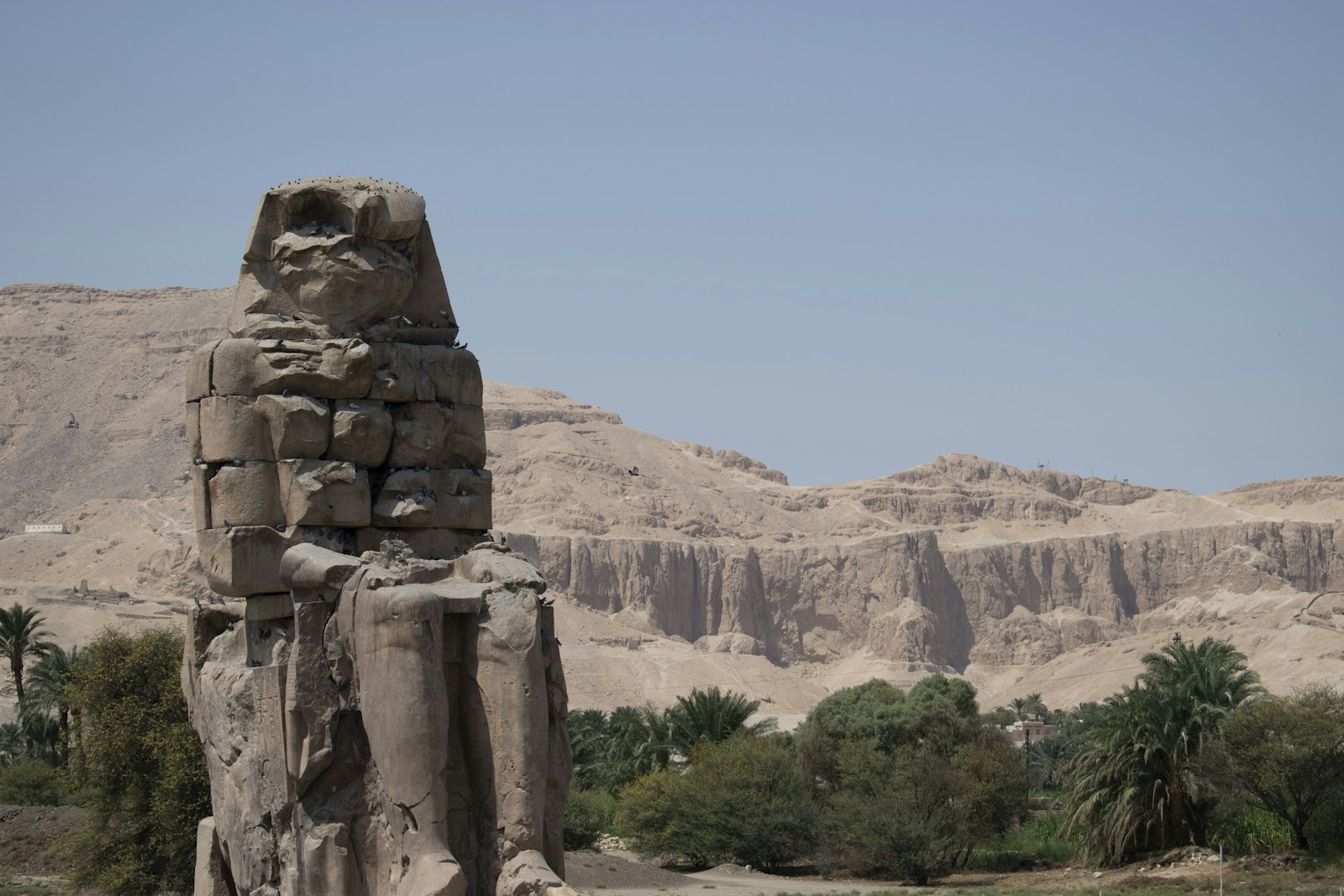
Particularly significant are the fragments coming from the temple of Amenhotep III, which allow one to imagine the magnificence of what was the largest funerary temple of ancient Egypt. Reliefs of extraordinary artistic quality, parts of giant columns and fragments of colossal statues testify to the grandiosity of the original, of which today only the Colossi of Memnon survive in situ.
Historical Significance
The End of an Era
The temple of Merenptah symbolically represents the end of the golden age of pharaonic Egypt. After the long and glorious reign of Ramesses II, Egypt entered a phase of gradual economic and political decline. The reuse of construction materials, the reduction in the dimensions of the temples and the worsening of artistic quality are all signs of an era that was drawing to a close.
Merenptah was the last pharaoh of the 19th dynasty to reign with relative stability. After his death, a series of succession crises and internal conflicts led to the end of the dynasty and the advent of the 20th dynasty, during which the power of the pharaoh continued to weaken progressively.
A Document for the History of Religions
Thanks to the Israel Stele, the temple of Merenptah has acquired an importance that transcends Egyptology in the strict sense, profoundly interesting the history of religions, biblical archaeology and the studies on the history of ancient Israel. For the researchers of these fields, the temple is a place of academic pilgrimage, a point of connection between the history of Egypt and that of the biblical world.
Tips for the Visit
A Site for Enthusiasts
The temple of Merenptah is a site suited above all to visitors with a specific interest in the archaeology and history of ancient Egypt. Unlike more spectacular monuments such as the Temple of Hatshepsut or the Valley of the Kings, here the ruins require a certain effort of imagination to be appreciated. However, for those willing to engage in this exercise, the site offers unique rewards.
How to Arrive
The temple is located along the main road of the western bank of Luxor, between the Ramesseum and the Colossi of Memnon. It is easily reachable by taxi, carriage or bicycle. Its position along the route that connects the main sites of the western bank makes it a convenient stop to insert into a wider itinerary.
Practical Information
The entrance ticket is very economical and the site is almost always deserted, offering a quiet and relaxed visiting experience. There are no facilities for visitors in the immediate vicinity, so bring water and sun protection. The visit requires about 45 minutes to explore the open-air museum and the foundations of the temple.
Combining the Visit
The temple of Merenptah fits perfectly into an itinerary dedicated to the funerary temples of the western bank, together with the Ramesseum, the temple of Seti I at Gurna and Medinet Habu. The proximity with the Colossi of Memnon, the only remains of the temple of Amenhotep III whose materials were reused by Merenptah, creates a direct and fascinating historical connection.
The temple of Merenptah is one of those places where archaeology transforms itself into narrative: among its silent ruins are interwoven stories of pharaohs and prophets, of empires and peoples, of destruction and conservation, in a tale that embraces not only the history of Egypt, but that of all humanity.