The Colossi of Memnon: Millenary Sentinels of the Theban Necropolis
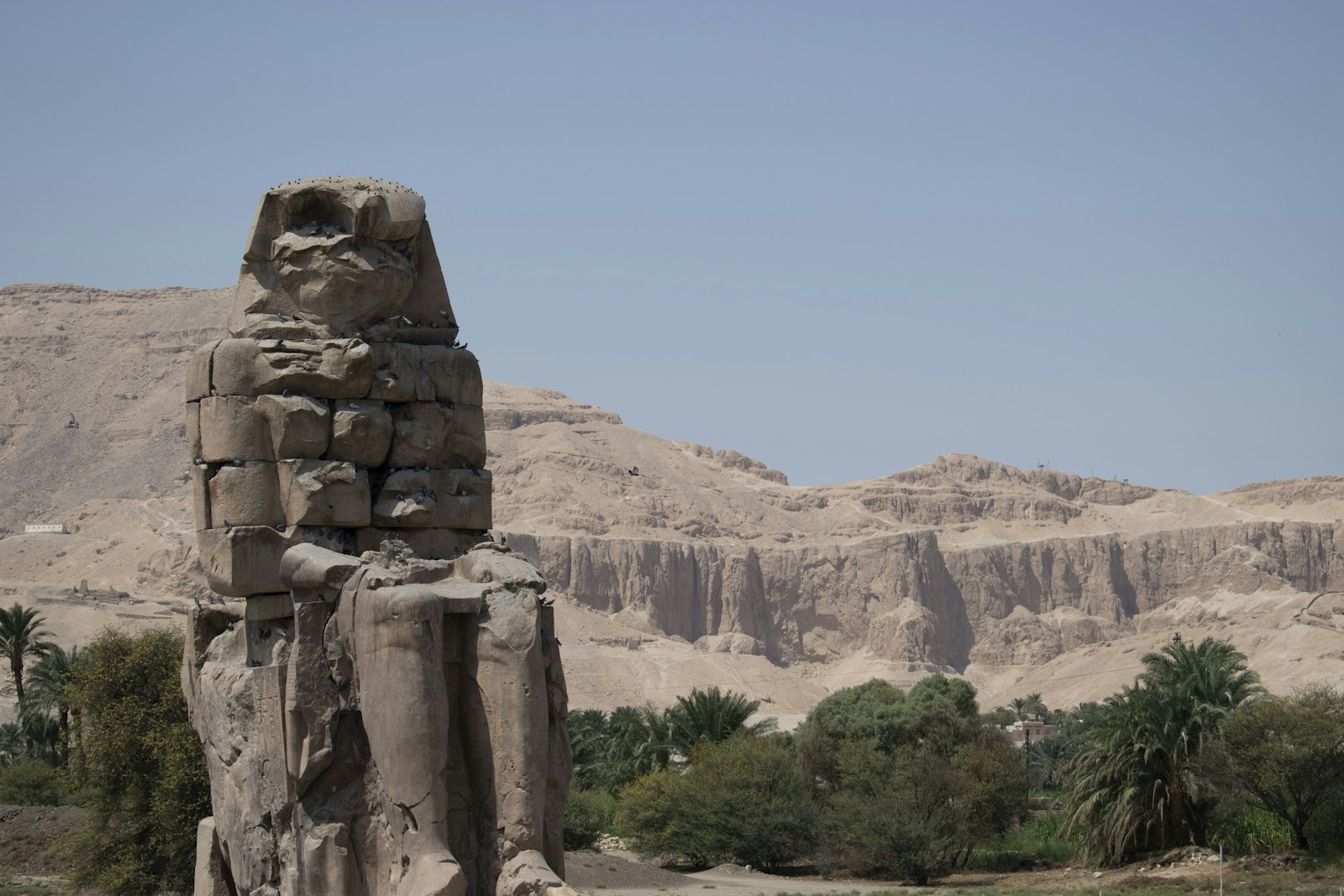
The Colossi of Memnon are among the first images that welcome the visitor on the west bank of Luxor. These two monumental statues, about 18 metres high and weighing about 720 tonnes each, represent the pharaoh Amenhotep III seated on a throne and have guarded for over 3,400 years the access to the Theban necropolis. Originally erected as guardians of the entrance to the vast funerary temple of the pharaoh, the largest ever built at Thebes, the colossi are today all that remains of that once grandiose monumental complex.
Despite the millennia of erosion, earthquakes and looting having erased almost every trace of the funerary temple that housed them, the two colossi continue to dominate the plain with a solemn and imperious presence. Their very survival, in a landscape where the surrounding constructions have disappeared, renders them even more impressive and charged with fascination.
Amenhotep III and His Funerary Temple
The Pharaoh of Luxury
Amenhotep III, ninth ruler of the 18th dynasty, reigned over Egypt from about 1386 to 1349 BC, during a period of extraordinary prosperity and peace. His reign is considered the apex of the power and wealth of New Kingdom Egypt. A great builder and patron of the arts, Amenhotep III was responsible for an impressive number of monumental constructions throughout the country, including the Temple of Luxor and significant enlargements to the complex of Karnak.
The funerary temple that stood behind the colossi was the largest and most sumptuous ever erected on the west bank of Thebes. It covered an area of about 350,000 square metres, surpassing even the complex of Karnak in extension. Inside there were colonnaded courtyards, hypostyle halls, sanctuaries, colossal statues and lush gardens. Unfortunately, the position in the alluvial plain exposed it to the annual floods of the Nile, which over the course of the centuries caused its progressive deterioration. The blocks of the temple were furthermore systematically reused by successive pharaohs for their own constructions.
The Statues
The two statues depict Amenhotep III seated on a throne decorated with the symbols of the unification of Upper and Lower Egypt, represented by the intertwined lotus and papyrus flowers. At the sides of the legs of the pharaoh are sculpted female figures of more reduced dimensions: the Great Royal Wife Tiye and the mother of the pharaoh, Mutemwiya. The colossi were carved from single blocks of quartzite, an extremely hard stone of reddish colour, extracted from the quarries of Gebel el-Ahmar, near present-day Cairo, and transported for over 600 kilometres along the Nile up to Thebes.
The transport of these gigantic monoliths represented an extraordinary logistical feat. Each block, of an original weight of about 720 tonnes, had to be extracted, roughed out, loaded onto river barges and navigated upstream up to Thebes, where it was definitively sculpted and put into position. The entire operation required a perfect coordination of thousands of workers and months of work.
The Myth of the Singing Colossi
The Earthquake of 27 BC
The fame of the Colossi of Memnon in classical antiquity is linked to a mysterious and fascinating phenomenon. In 27 BC, a violent earthquake gravely damaged the northern colossus, provoking a fracture in the upper part of the statue. From that moment, at dawn, the statue began to emit a melodious sound, described as a whistle or a song, which the Greek and Roman travellers interpreted as the lament of the legendary hero Memnon greeting his mother Eos, the goddess of the dawn.
The phenomenon, documented by numerous ancient authors including Strabo, Pausanias and Pliny the Elder, attracted visitors from all over the Roman world. Generals, senators, emperors and simple travellers rushed to listen to the mysterious voice of the statue. Among the illustrious visitors is counted the emperor Hadrian in 130 AD, who waited patiently for the sound and heard it at his third attempt. The inscriptions left by these visitors are still visible on the base of the statues, constituting one of the most ancient examples of tourist graffiti in history.
The Scientific Explanation
The acoustic phenomenon is attributed by modern scholars to the evaporation of the nocturnal humidity in the porous stone fractured by the earthquake. At dawn, the rapid heating of the surface of the statue caused the expansion of the air and water trapped in the cracks, generating sound vibrations. This explanation, however prosaic, takes nothing away from the fascination that the phenomenon exercised for almost two centuries on the imagination of the ancient travellers.
The Roman Repair
Around 199 AD, the emperor Septimius Severus ordered the restoration of the damaged colossus, having the upper part reconstructed with blocks of sandstone. This repair, although well-intentioned, put an end to the acoustic phenomenon, and the colossi ceased to "sing". The decision of Severus has sometimes been criticised as an act of involuntary vandalism that deprived the world of one of its most fascinating marvels.
The Name Memnon
The Greeks associated the statues with Memnon, the Ethiopian king son of Eos (the Dawn) and Tithonus, who according to Homeric mythology fought in the Trojan War alongside the Trojans and was killed by the hero Achilles. The lament heard at dawn was interpreted as the weeping of Memnon calling his mother, or as the response of Eos who wept for the death of her son in the form of morning dew. In reality, the ancient Egyptians did not associate the statues with any Memnon: for them they simply represented Amenhotep III, called in Egyptian "Ruler of Rulers". The name Memnon nonetheless imposed itself in the classical and medieval tradition, and it is the one with which the statues are universally known still today.
The Recent Excavations
In recent decades, an archaeological project directed by Hourig Sourouzian has brought to light numerous fragments of the funerary temple of Amenhotep III, revealing the extension and the magnificence of the original complex. Colossal statues of sphinxes, figures of Sekhmet, remains of columns and floors have been found, which are gradually redefining our understanding of what was one of the most grandiose temples of ancient Egypt. Some of these restored statues have been replaced in their original positions, enriching the archaeological site and offering the visitors a more complete idea of the ancient splendour of the complex.
Tips for the Visit
Access and Costs
One of the particularities of the Colossi of Memnon is that the visit is completely free. The statues are found along the main road that crosses the west bank of Luxor, easily accessible to anyone who goes towards the Theban necropolis. No ticket is necessary and there are no opening hours: the colossi are visible and photographable at any moment of the day and the night.
The Best Moment
The ideal moment to visit the colossi is at dawn or at sunset, when the golden light creates a dramatic effect on the statues and on the background of the Theban hills. The dawn is particularly evocative, evoking the memory of the ancient travellers who awaited the first ray of sun to hear the song of Memnon. At sunset, the statues stand out like black shadows against an inflamed sky, offering spectacular photographic opportunities.
Combining the Visit
The Colossi of Memnon are generally the first or the last stage of a visit to the west bank of Luxor. Their position along the main road renders them a natural stop on the route towards the Valley of the Kings, the Temple of Hatshepsut, Medinet Habu and the Valley of the Queens. A stop of thirty minutes is sufficient to admire the statues, read the ancient inscriptions on the base and take photographs.
Practical Suggestions
Bring with you a guide who explains the history and the meaning of the colossi: without context, the statues may appear simply as imposing ruins, but their history is rich in fascination. Pay attention to the street vendors who surround the site. For a different perspective, observe the statues also from the road, at a distance, to appreciate their scale in relation to the surrounding landscape.
The Colossi of Memnon are much more than simple ruins: they are silent witnesses of millennia of history, from the splendour of the 18th dynasty to the marvels of the Roman epoch, up to modern tourism. Their majestic presence in the plain of Luxor continues to arouse admiration and reverence, reminding us of the grandeur and the ambition of a civilisation that built for eternity.