The Temple of Seti I at Gurna: A Hidden Jewel of Luxor
The mortuary temple of Seti I at Gurna, known to the ancient Egyptians as "Glorious is Seti in the domain of Amun on the West of Thebes," is one of the most underrated and least visited monuments on the west bank of Luxor. Hidden in the shadow of more celebrated sites such as the Temple of Hatshepsut and the Valley of the Kings, this temple preserves some of the most refined and best-preserved reliefs of the entire art of the Egyptian New Kingdom, a true paradise for enthusiasts of ancient history and art.
Built during the reign of Seti I (circa 1294-1279 BC), second pharaoh of the 19th Dynasty, and completed by his son Ramesses II, the temple belonged to the category of "Temples of Millions of Years," mortuary structures intended for the perpetuation of the cult of the deceased pharaoh through daily offerings and religious ceremonies.
History and Construction
The Historical Context
Seti I inherited an Egypt in a phase of reconstruction after the turbulent Amarna period. His father, Ramesses I, had reigned for barely two years, and it was Seti I who consolidated the new 19th Dynasty, restoring temples damaged during the reign of Akhenaten and launching military campaigns in Syria and Palestine to re-establish Egypt's international prestige.
The construction of the mortuary temple at Gurna was part of an ambitious building program that also included the magnificent temple of Abydos, the tomb in the Valley of the Kings (KV17), and important works in the Great Hypostyle Hall of Karnak. Seti I was a patron of the arts with refined taste, and this artistic sensibility is evident in the exceptional quality of the reliefs of the Gurna temple.
The Two-Phase Construction
The temple was begun by Seti I but remained incomplete at his death. It was his son and successor Ramesses II who completed the structure, adding decorations and enlarging some parts of the building. This two-phase construction is clearly visible in the stylistic differences between the decorations: the reliefs of Seti I are executed in thin bas-relief of extraordinary finesse, while the additions of Ramesses II tend to be in sunk relief, more robust but less refined.
This stylistic difference allows attentive visitors to distinguish the two construction phases and to appreciate the evolution of Ramesside art between father and son. The reliefs of Seti I are generally considered among the most beautiful of the entire history of Egyptian art, superior even to those of the temple of Abydos for delicacy of execution.
The Architecture of the Temple
The L-Shaped Plan
One of the most unusual characteristics of the temple of Seti I at Gurna is its L-shaped plan, unique among the mortuary temples of the west bank. While Egyptian mortuary temples generally follow a straight longitudinal axis from the entrance to the sanctuary, the Gurna temple presents a right-angle turn that creates a singular spatial configuration.
This architectural anomaly could be due to the conformation of the terrain, to the need to orient the sanctuary toward a specific point of the sacred Theban panorama, or to the desire to integrate pre-existing structures into the new complex. Whatever the reason, the L-shaped plan gives the temple a character of uniqueness that distinguishes it from all the other sacred buildings of the area.
The First Pylon and the Courtyard
The entrance of the temple was originally preceded by a first monumental pylon, today largely destroyed, and by a porticoed courtyard with columns. The remains of the pylon still show traces of the original decorations, with battle scenes and ritual presentations typical of the royal iconography of the New Kingdom.
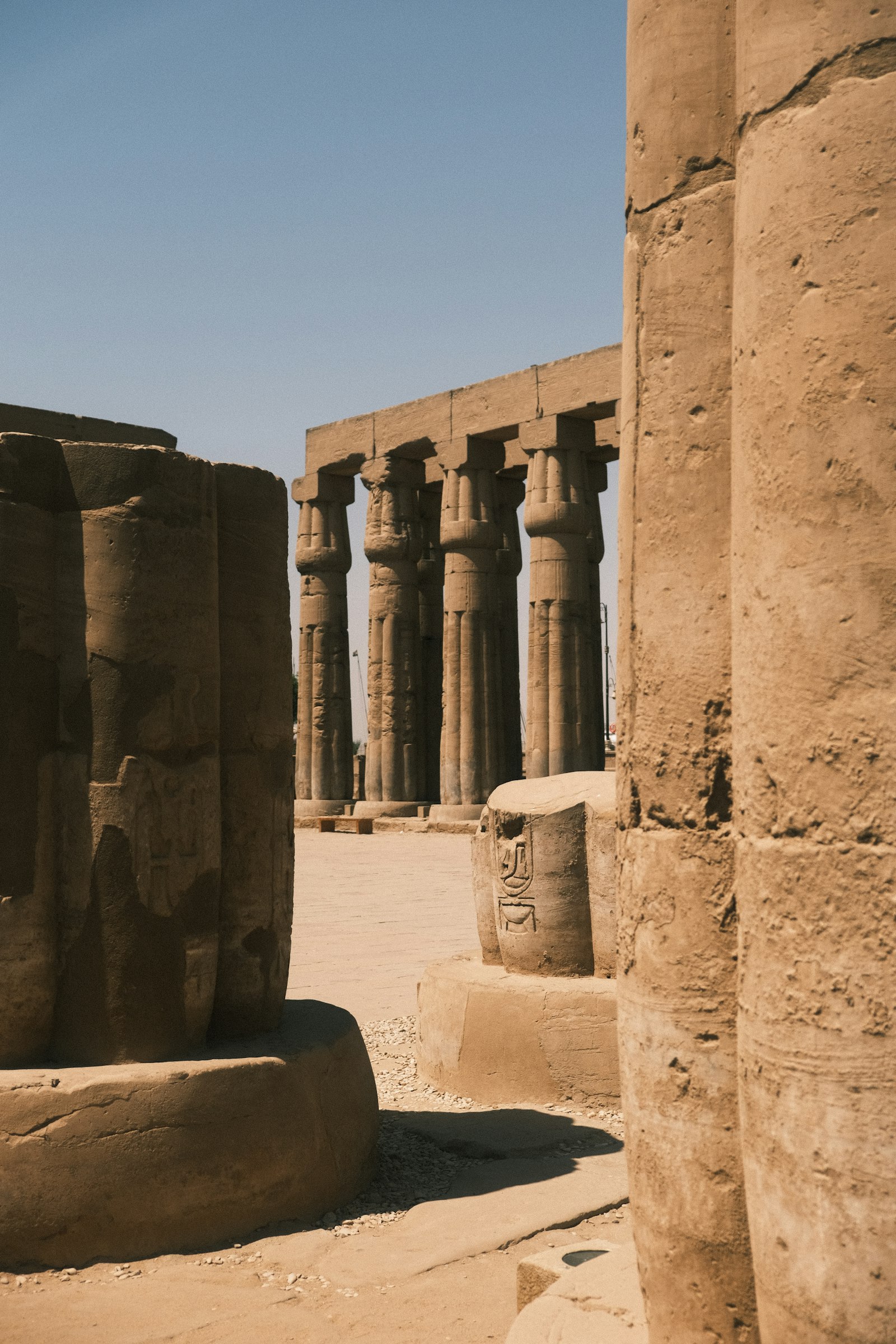
The main courtyard, partially preserved, was surrounded by a portico with sandstone columns that supported decorated architraves. The walls of the courtyard featured scenes that celebrated the military feats of the pharaoh and the ritual ceremonies linked to the cult of the temple.
The Hypostyle Hall
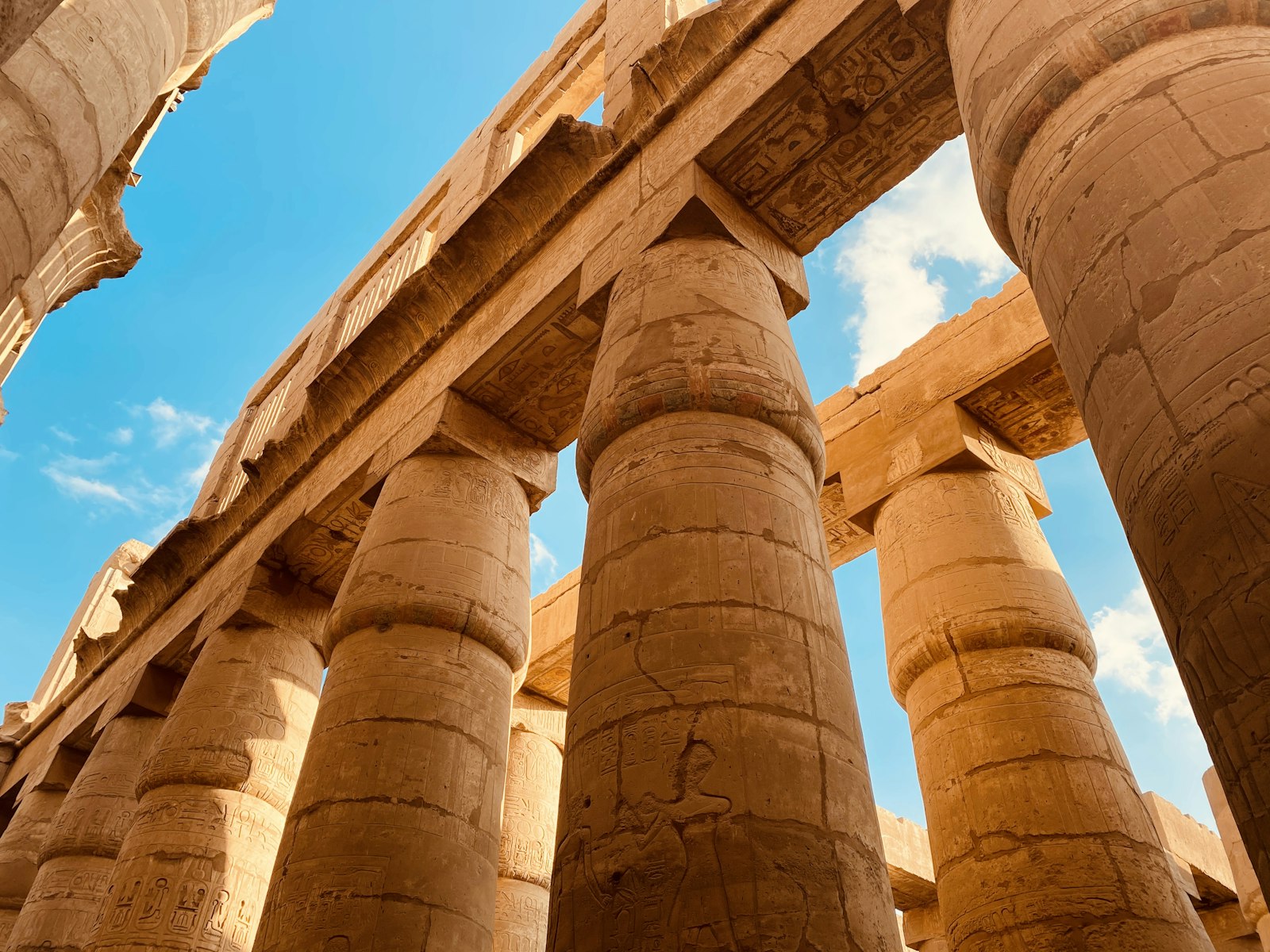
The hypostyle hall of the temple of Seti I at Gurna, although smaller than the celebrated hypostyle hall of Karnak, is an environment of remarkable suggestiveness. The columns with papyriform capitals still support part of the original roof, creating a play of light and shadow that enhances the reliefs of the surrounding walls.
It is in this hall that some of the most beautiful reliefs of the temple are found: scenes of offering in which the pharaoh presents food, drink, incense, and flowers to the deities; processions of priests carrying ritual objects; and representations of the pharaoh in the guise of officiating priest. The delicacy of the modeling, the precision of the detail, and the elegance of the compositions reach levels of perfection that fully justify the artistic fame of Seti I.
The Sanctuary and the False Door
The heart of the temple is the sanctuary, where the daily rituals of the cult took place. This environment contained the naos (shrine) that guarded the statue of the god to whom the temple was dedicated, and the false door, an architectural element of great symbolic importance.
The false door served as a threshold between the world of the living and that of the dead, a point of communication through which the spirit of the deceased pharaoh could receive the offerings deposited in the temple. The false door of the temple of Seti I is carved with particular care, with inscriptions that invoke the deities of the afterlife and magic formulas intended to guarantee the eternal rebirth of the pharaoh.
The Connection with Osiris
The temple of Seti I at Gurna presents a strong connection with the cult of Osiris, the god of the dead and of rebirth. Several lateral chapels were dedicated to Osiris and to the associated deities, and the ritual scenes make frequent reference to the Osirian myths. This connection was fundamental for funerary theology: through identification with Osiris, the deceased pharaoh could obtain eternal life.
The Reliefs: A Comparison between Father and Son
The Style of Seti I
The reliefs executed under Seti I represent the culmination of the technique of Egyptian bas-relief. The figures are modeled with a very thin relief, almost imperceptible to the touch, but capable of creating an effect of softness and naturalness that is extraordinary. The contours are fluid, the anatomical details are rendered with delicacy, and the expressions of the faces communicate a serenity and a nobility that transcend the conventional stylistic rigidity of Egyptian art.
The chromatic palette of the reliefs of Seti I was originally very rich, even though a large part of the color has now disappeared. The remaining traces show warm tones of ocher, red, and yellow, with accents of blue and green, applied with a pictorial sensibility that valued and enhanced the plasticity of the underlying reliefs.
The Additions of Ramesses II
The reliefs added by Ramesses II are easily distinguishable for their more cursive and less refined style. Ramesses II preferred sunk relief, a faster technique that allowed the decoration of vast surfaces in relatively short times, but which produced more schematic and less nuanced results compared to the bas-relief of his father.
This qualitative difference should not be interpreted as a simple artistic decline, but rather reflects a change in priorities: while Seti I privileged the perfection of detail, Ramesses II aimed at grandeur and visual impact on a vast scale, an approach that manifests fully in his mortuary temple, the Ramesseum.
A Rarely Visited Site
The Charm of Solitude
One of the greatest merits of the temple of Seti I at Gurna is its relative absence of visitors. While the Temple of Hatshepsut, the Valley of the Kings, and the Ramesseum daily attract thousands of tourists, the temple of Seti I is visited by very few people, offering an experience of recollection and contemplation impossible in the more crowded sites.
This solitude allows one to appreciate the details of the reliefs with calm, to linger on the artistic nuances, and to immerse oneself in the sacral atmosphere of the temple without the pressure of the crowd. For those who seek a more intimate and meditative contact with ancient Egypt, this temple represents an ideal destination.
Tips for the Visit
How to Get There
The temple is located in the area of Gurna (or Qurna), on the west bank of Luxor, a short distance from the Ramesseum and the Tombs of the Nobles. It is reachable by taxi, carriage, or bicycle from the ferry dock on the west bank.
Practical Information
The entrance ticket is separate from that of the other sites of the west bank. Given the scarce influx of visitors, it is rare that the site is crowded, even during the high tourist season. The visit requires about 45 minutes to explore all the accessible environments of the temple.
What to Bring
Bring a flashlight or use the light of your phone to illuminate the reliefs in the darker areas of the hypostyle hall and the sanctuary. The most subtle details of the reliefs of Seti I are visible only with grazing illumination that brings out the modeling from the plane of the wall. Water, sun protection, and a hat are indispensable for movements in the open air on the west bank.
Combining the Visit
The temple of Seti I at Gurna combines ideally with a visit to the tomb of Seti I in the Valley of the Kings (KV17), creating a thematic itinerary dedicated to this great pharaoh. The proximity to the Ramesseum also allows an interesting comparison between the works of the father and those of the son. For a full day, one can add the Tombs of the Nobles and the Colossi of Memnon.
The temple of Seti I at Gurna is one of those hidden gems that reward the curious traveler willing to move away from the more beaten paths. Here, in the silent shadow of the ancient columns, the reliefs of three thousand years ago still tell, with unchanged grace, the story of a pharaoh who loved art above all things.