The Temple of Khonsu: the Abode of the Moon God at Karnak
The Temple of Khonsu, located in the south-western corner of the great precinct of Amun at Karnak, is one of the most fascinating and best-preserved monuments of the entire temple complex. Dedicated to the moon god Khonsu, the divine son of Amun and Mut in the Theban triad, this temple represents an almost perfect example of New Kingdom Egyptian temple architecture, with all its canonical components arranged in sequence along a straight processional axis.
Built mainly during the reign of Ramesses III (1186-1155 BC) and completed by later pharaohs over the course of several centuries, the Temple of Khonsu offers the attentive visitor a unique opportunity to understand the spatial and symbolic logic that governed the design of Egyptian temples, from the monumental façade to the sanctum sanctorum hidden in the depths of the building.
Khonsu: the God of the Moon
The Celestial Wanderer
Khonsu, whose name means "the Wanderer" or "He who crosses", was the god of the moon in Egyptian religion. Son of Amun, the king of the gods, and of Mut, the great mother goddess, Khonsu completed the divine triad of Thebes, the most important divine family of Egypt during the New Kingdom. As the moon crosses the night sky, so Khonsu was imagined as an eternal celestial traveller who illuminated the darkness of the night.
In Egyptian iconography, Khonsu was generally represented as a young man with a shaved head and the side-lock typical of princes, bearing on his head the lunar disc set within the crescent. In his more ancient forms he could also take on the appearance of a falcon or of a man with a falcon's head, surmounted by the disc and the crescent moon. This multiplicity of forms reflected the different aspects of the moon and the various functions attributed to the god throughout Egyptian history.
Powers and Attributes
Khonsu was associated with multiple powers and functions. He was considered a healing god, capable of driving away the evil spirits that caused illness. The Bentresh stele, a Ptolemaic text recounting a legend set in the New Kingdom, narrates how a statue of Khonsu was sent to the distant kingdom of Bakhtan to heal a princess possessed by a demon, attesting to the therapeutic fame of the god that extended well beyond the borders of Egypt.
Khonsu was also associated with time and its cycles. As god of the moon, he presided over the months and the lunar phases that regulated the Egyptian religious calendar. His influence extended to fertility, to the growth of plants and to conception, all phenomena that the ancient Egyptians connected to lunar rhythms. In late times, Khonsu was also assimilated to the god Thoth, another lunar deity, and acquired attributes linked to wisdom and knowledge.
History of the Construction
The Project of Ramesses III
The construction of the Temple of Khonsu was begun by Ramesses III, the last great warrior pharaoh of Egypt, during the 20th dynasty. Ramesses III, who had already built his grandiose funerary temple at Medinet Habu on the western bank of Thebes, wished to dedicate an independent sanctuary to the god Khonsu within the sacred precinct of Amun at Karnak, where until then the moon god had received worship only in secondary chapels.
The architectural design of the temple followed the canonical model of Egyptian temple architecture in its purest and most systematic form. Ramesses III and his architect conceived a structure that proceeded from the outside towards the inside according to a path of progressive sacralisation: from the monumental gateway to the colonnaded court, from the hypostyle hall to the antechambers, up to the sanctum sanctorum where the divine image of the god was kept.
The Later Completions
At the death of Ramesses III, the temple was not yet completed. The works continued under his successors of the 20th and 21st dynasties, in particular Ramesses IV, Ramesses XI and Herihor, the powerful high priest of Amun who effectively governed Upper Egypt in the last years of the 20th dynasty. It was Herihor himself who completed the decoration of much of the interior walls, representing himself in scenes that were traditionally reserved for the pharaoh, a fact that attests to his extraordinary power.
In the Ptolemaic era, the temple received an important addition: the monumental entrance gateway known as Bab el-Amara, erected by Ptolemy III Euergetes and Ptolemy IV Philopator. This gateway, located to the south of the temple along the processional avenue that connected Karnak to the Temple of Luxor, is one of the best-preserved Ptolemaic structures of the entire Karnak complex.
Architecture of the Temple
The Gateway of Bab el-Amara
Access to the Temple of Khonsu is through the Bab el-Amara, an imposing sandstone gateway erected during the Ptolemaic period. This gateway, about 18 metres high, presents a structure typical of Egyptian sacred architecture with inclined jambs and a lintel crowned by the Egyptian gorge cornice. The external surfaces are decorated with reliefs depicting the Ptolemaic pharaohs in the act of making offerings to the deities of the temple.
The gateway opens onto a short dromos, or processional avenue, flanked by ram-headed sphinxes that originally led to the avenue of sphinxes connecting Karnak to the Temple of Luxor. This physical connection between the two great sanctuaries of Thebes was of fundamental importance during the Opet festival, when the sacred barque of Amun was carried in procession from Karnak to the Temple of Luxor.
The Entrance Pylon
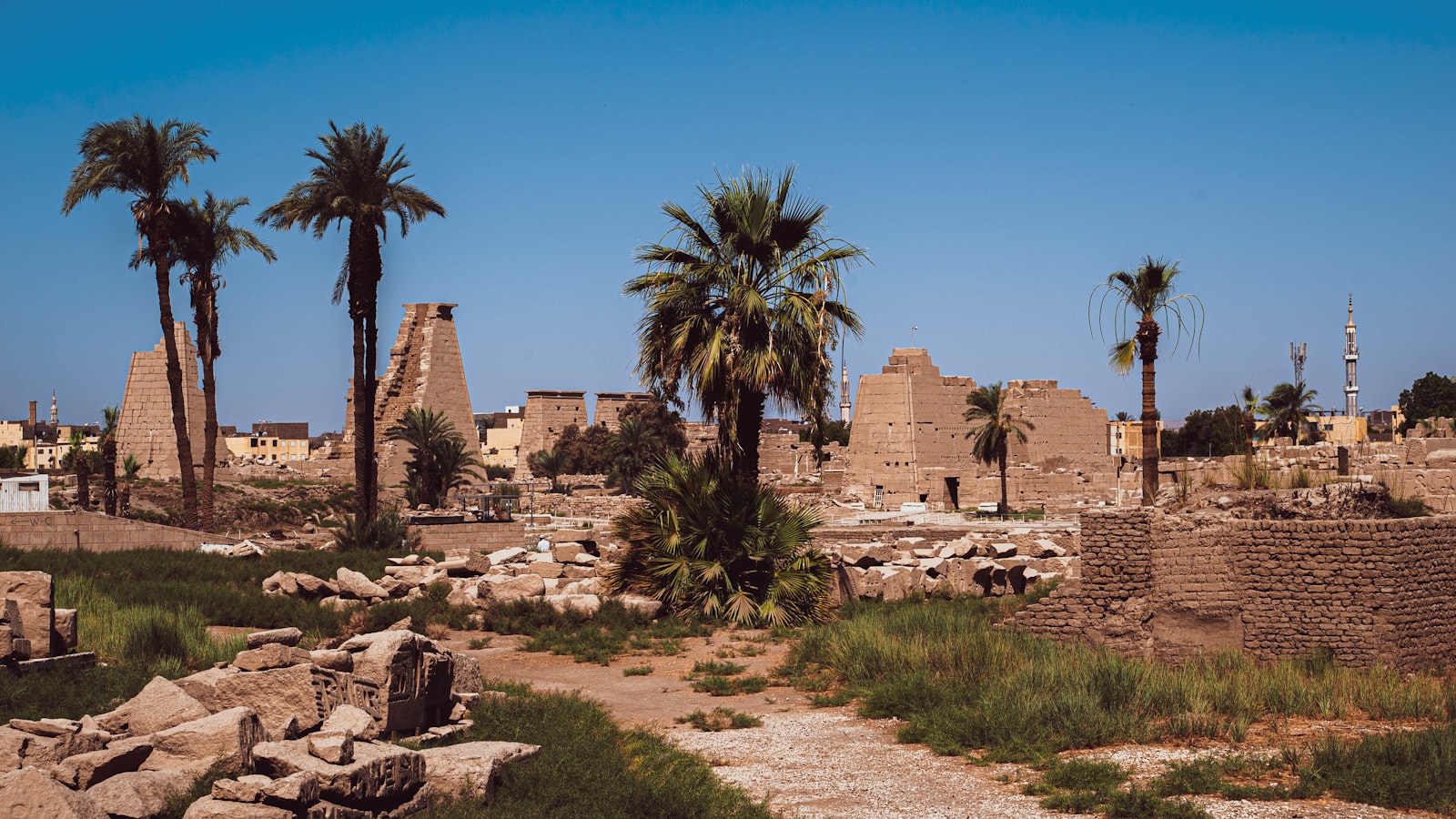
Beyond the gateway rises the temple pylon, the classic trapezoidal tower façade that characterises Egyptian temple architecture. Although more modest in size compared to the great pylons of the main axis of Karnak, the pylon of the Temple of Khonsu is well proportioned and preserves reliefs on the external façade with scenes of military victories and divine offerings.
The Peristyle Court
Having crossed the pylon, one enters the peristyle court, a large open-air courtyard surrounded on three sides by a portico supported by columns with papyrus-shaped capitals. This court served as a transitional space between the profane external world and the sacred internal spaces of the temple. Here the public ceremonies that a part of the people could attend took place, while access to the inner areas was reserved for the priests and the pharaoh.
The Hypostyle Hall
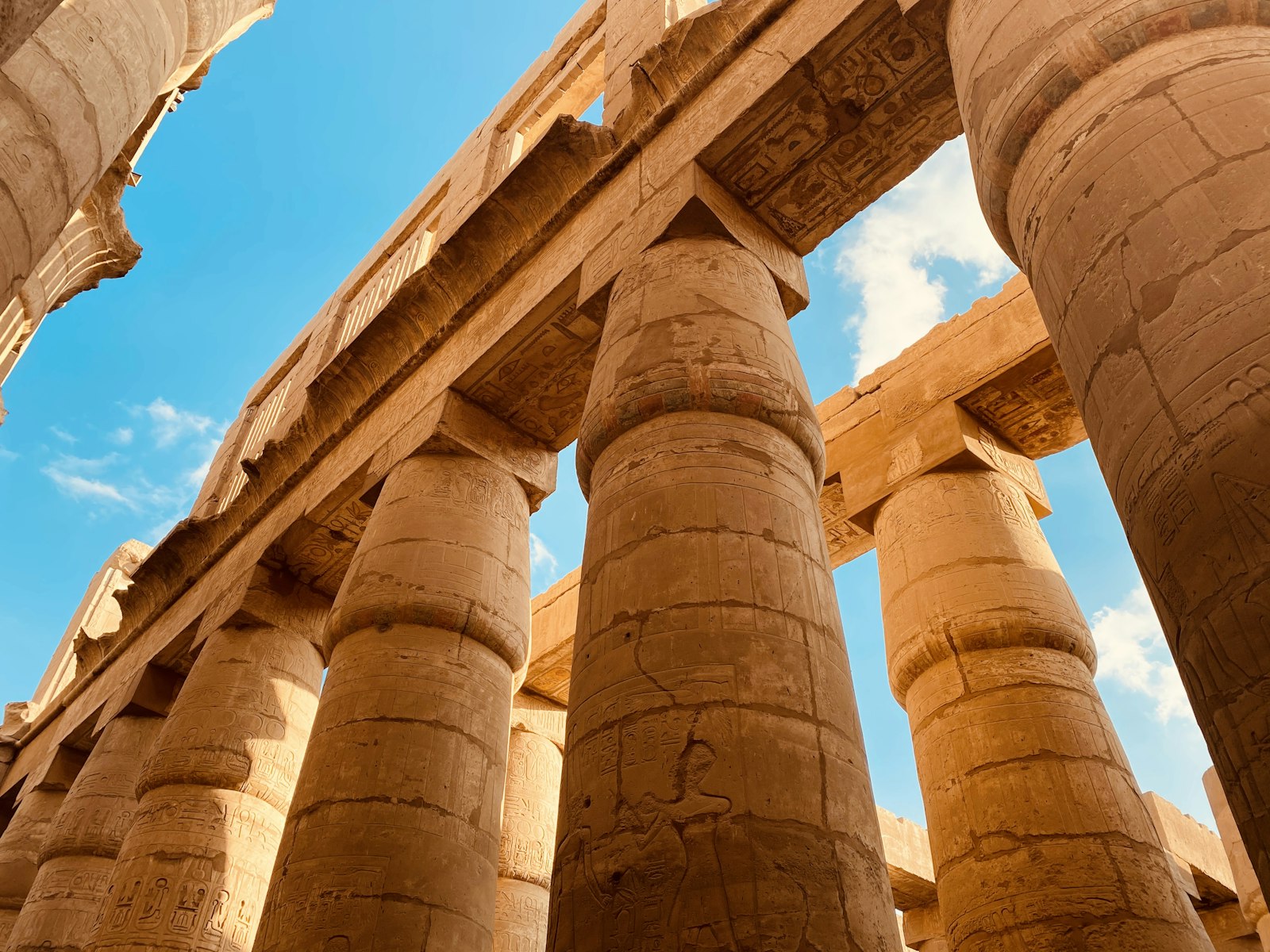
From the peristyle court one passes to the hypostyle hall, a covered hall supported by columns that represents the second level of penetration into the sacred. The columns of this hall have open bell-shaped capitals in the central nave and closed papyrus capitals in the side aisles, creating a play of heights that allowed light to enter through clerestory windows, the same that also characterise the great Hypostyle Hall of the main temple.
The Antechambers and the Sanctum Sanctorum
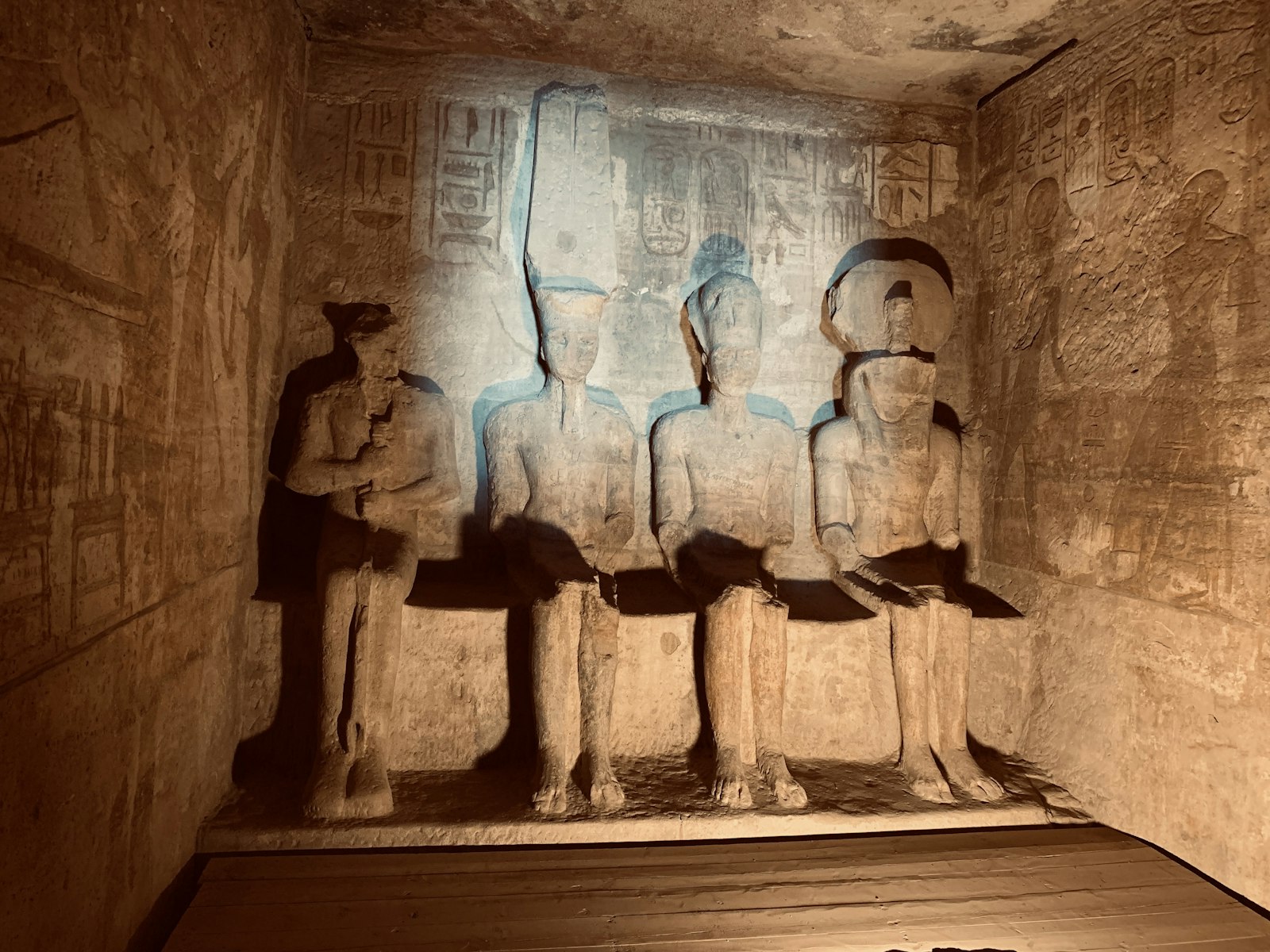
Beyond the hypostyle hall, a series of antechambers leads progressively towards the heart of the temple. The rooms become ever smaller and darker, and the floor gradually rises while the ceiling lowers, creating an effect of spatial compression that symbolised the approach to the divine dimension. In the sanctum sanctorum, the innermost and darkest cella of the temple, was kept the naos with the cult statue of Khonsu, which only the high priest or the pharaoh could approach.
The Reliefs and the Decorations
The Decorative Programme
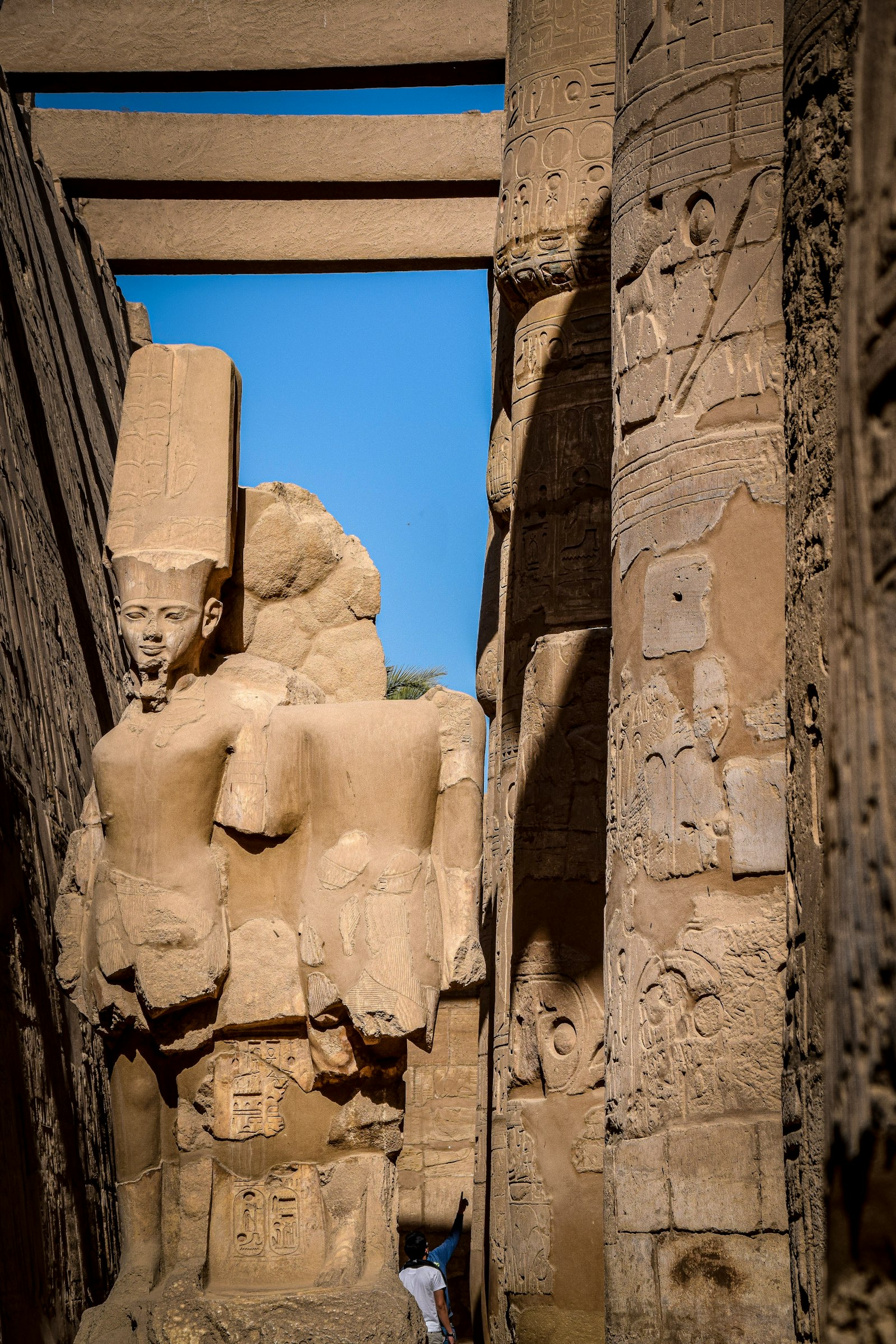
The walls of the Temple of Khonsu are covered by a rich decorative programme that recounts the relationship between the pharaoh and the god. In the court and the hypostyle hall, the reliefs show offering scenes, in which the sovereign presents incense, food, drink and flowers to the god Khonsu and to the other deities of the Theban triad. In the antechambers, the scenes become more intimate and ritual, showing ceremonies of purification and consecration.
The Reliefs of Herihor
Particularly significant are the reliefs executed on behalf of Herihor, the high priest of Amun who completed the decoration of the temple. In these scenes, Herihor has himself represented with the iconographic prerogatives of the pharaoh, including the royal cartouche, despite not having formally ascended to the throne. These reliefs are a fundamental testimony of the growing power of the clergy of Amun in the last years of the New Kingdom, a power that would lead to the division of Egypt between a pharaoh in the north and a priestly theocracy in the south.
The Astronomical Significance
Some scholars have highlighted the possible relationship between the orientation of the temple and astronomical phenomena linked to the moon. The axis of the temple, slightly deviated with respect to that of the main temple of Amun, may have been aligned with a specific point of the horizon where the moon rose at a particular moment of its cycle. This hypothesis, although not unanimously accepted, is coherent with the lunar nature of the god to whom the temple was dedicated.
Tips for the Visit
How to Reach the Temple
The Temple of Khonsu is located in the south-western corner of the precinct of Amun, reachable by following the main axis of the Karnak complex towards the south. For the gateway of Bab el-Amara, access is from the outside along the avenue of sphinxes from the southern area of the complex. The temple is included in the general entrance ticket of Karnak and does not require supplements.
Ideal Times for the Visit
The late afternoon is the best moment to visit the Temple of Khonsu. At that hour, most of the tourist groups have already left Karnak, and the temple can be explored in the quiet it deserves. The warm afternoon light penetrates obliquely into the internal halls, illuminating the reliefs with a suggestive effect that enhances their three-dimensionality.
What to Observe with Attention
Pay particular attention to the spatial progression from the entrance to the sanctum sanctorum: notice how the rooms become progressively smaller, lower and darker. This sequence is not casual, but reflects a precise symbolic programme that represents the journey from the world of mortals to the abode of the god.
Observe also the reliefs of Herihor in the hypostyle hall and compare them with those of Ramesses III and his successors. The differences in style and quality reflect the political and cultural changes that occurred between the 20th and 21st dynasties. Do not fail to raise your gaze towards the ceilings, where traces of the original astronomical decoration are still visible.
Practical Suggestions
Bring a torch to illuminate the reliefs in the more internal halls of the temple, where natural light penetrates with difficulty. Comfortable shoes are essential since the floor is uneven in some points. Dedicate at least forty-five minutes to the visit to appreciate the richness of the decoration.
The Temple of Khonsu is one of those monuments that generously reward the attentive and patient visitor. Less frequented and less celebrated compared to the great monuments of the main axis of Karnak, it offers a more intimate and contemplative visiting experience, allowing one to immerse oneself in the atmosphere of an Egyptian temple with a depth that can hardly be reached in the more crowded spaces of the complex.