The Fortress of Taba: Sentinel of the Gulf of Aqaba
The Fortress of Taba, also known as Saladin's Castle or the Citadel of Pharaoh's Island, rises on a small granite islet in the Gulf of Aqaba, about 250 metres from the Egyptian coast and only 7 kilometres from the border with Israel. This extraordinary medieval fortress represents one of the most evocative and least known historic sites of Egypt, a place where millennial history intertwines with natural panoramas of incomparable beauty.
Pharaoh's Island, also known by the French name of Île de Graye or by the Arabic name Jazīrat Firʿawn, is a rocky outcrop of granite origin about 300 metres long and 150 metres wide. Its jagged coasts and the crystalline waters that surround it create a scenario that seems to come out of an adventure film, with the rosy mountains of Saudi Arabia visible on the horizon and the coasts of four nations — Egypt, Saudi Arabia, Jordan and Israel — meeting in this narrow arm of sea.
History of the Fortress
The Byzantine and Crusader Origins
The island was used as a strategic post since the Byzantine era, when its position at the centre of the Gulf of Aqaba made it an ideal observation point for the control of maritime trade routes. However, it was during the Crusades that the island acquired its fundamental military importance.
In 1116, the Crusader king Baldwin I of Jerusalem ordered the construction of a fortress on the island as part of a defensive system aimed at controlling the Gulf of Aqaba and the trade routes between Egypt and Arabia. The Crusader fortress, called Île de Graye by the Franks, quickly became a crucial point in the network of Crusader castles that protected the Kingdom of Jerusalem.
The strategic position of the island allowed the Crusaders to collect tolls on the merchant ships that transited in the gulf, control Muslim naval movements and protect the route of the Christian pilgrims directed to the Monastery of Saint Catherine on Mount Sinai. The Crusader garrison on the island represented a thorn in the side of the Muslim forces, interrupting the maritime communications between Egypt and the Hijaz.
Saladin's Reconquest
In 1170, the great Muslim commander Salah al-Din Yusuf ibn Ayyub, known in the West as Saladin, recognised the strategic importance of Pharaoh's Island and launched a campaign to conquer it. After a long siege, Saladin's forces managed to storm the Crusader fortress. Saladin immediately ordered the reconstruction and reinforcement of the defences, transforming the castle into a powerful Islamic citadel.
Under Saladin, the fortress was enlarged with the addition of new towers, thicker walls, cisterns for the collection of rainwater and better defensive structures. The architectural project reflected the most advanced techniques of Ayyubid military engineering, combining practical defensive elements with a layout that exploited to the maximum the irregular topography of the island.
The citadel rebuilt by Saladin comprised an upper defensive complex on the most elevated part of the island and a fortified port area in the lower part, with protected docks for the housing of warships. This two-level configuration made the fortress virtually impregnable from maritime attacks.
Decline and Rediscovery
After the end of the Crusades, the fortress maintained a military role under the Mamluks and the Ottomans, although its strategic importance gradually diminished. Over the centuries, the structure was progressively abandoned and fell into ruin, exposed to the erosion of the wind and the sea.
In the 20th century, the island and its fortress attracted the attention of archaeologists and historians. Several campaigns of excavation and restoration, conducted in particular in the eighties and nineties, have allowed the recovery of much of the structure visible today. The restoration works sought to preserve the original character of the fortress, using techniques and materials compatible with the medieval construction.
Architecture of the Fortress
The Upper Complex
The upper part of the fortress, situated on the summit of the island, comprises the main structures of the castle. The keep, or main tower, dominates the entire complex and offers a 360-degree view over the Gulf of Aqaba. From this position it is possible to glimpse the coasts of four nations: Egypt to the west, Saudi Arabia to the east, Jordan (with the city of Aqaba) to the northeast and Israel (with the city of Eilat) to the north.
The walls of the upper complex are built with blocks of local granite, the same material of the island, conferring on the fortress an almost mimetic aspect with the surrounding rock. The angular towers, semicircular in the typical Ayyubid tradition, allowed the defenders to cover every corner of the walls with the firing of arrows.
Inside the upper enclosure are found the remains of dwelling rooms, warehouses, a small mosque and cisterns for the collection of rainwater. This last element was of vital importance: being an island in a desert environment, the water supply represented a constant challenge, resolved with an ingenious system of canalisation that conveyed the scarce precipitations into the underground cisterns.
The Lower Complex and the Port
The lower part of the fortress extends towards the sea and comprises the fortified port, the docks and the service structures. The port was protected by walls that extended down to the water, creating a protected basin where the ships could dock safe from enemy attacks and from storms.
The remains of the stone docks are still visible today and testify to the naval importance of the fortress. From here departed the warships that patrolled the gulf and the merchant ones that transported goods between Egypt and the ports of Arabia.
The Defensive System
The defensive system of the fortress is a remarkable example of medieval military engineering. The walls, up to two metres thick, were designed to resist both land assaults (from possible landings on the island) and naval bombardments. The loopholes and the machicolations allowed the defenders to strike the assailants from protected positions.
The access to the fortress was controlled by a system of successive gates, a typical element of Islamic military architecture known as "bent gate", which forced the attackers to change direction several times while they were exposed to the fire of the defenders from above.
The Coral Reef of the Island
Beyond the historic value, Pharaoh's Island is surrounded by a coral reef of remarkable beauty. The crystalline waters of the Gulf of Aqaba, with visibility that can exceed 30 metres, host a rich marine biodiversity. Tropical fish of vivid colours, hard and soft corals, sea turtles and occasionally dolphins populate the seabeds around the island.
Many visitors combine the visit to the fortress with snorkelling sessions along the coasts of the island. The shallow waters on the eastern side are particularly suited to beginners, while the western side, with deeper seabeds, offers more demanding and rewarding dives. This unique combination of history and nature makes Pharaoh's Island a truly unrepeatable destination.
Tips for the Visit
How to Get There
The Fortress of Taba is reached by boat from the Egyptian coast, with a short journey of about five minutes. The boats depart from the dock near the Taba Heights Resort and the Salah El Din Resort. The island is located about 7 kilometres south of the Taba border with Israel and about 230 kilometres north of Sharm el-Sheikh.
From Sharm el-Sheikh it is possible to reach Taba by car or minibus travelling along the coastal road along the Gulf of Aqaba, a panoramic journey of about three hours that crosses Dahab and Nuweiba. From Eilat (Israel) or Aqaba (Jordan), Taba is reachable by crossing the land border.
Tickets and Hours
The entrance ticket includes the boat transport towards the island and the access to the fortress. It is advisable to visit the site in the early hours of the morning or in the late afternoon to avoid the intense heat and enjoy the best light for the photographs. The fortress is open every day, but it is prudent to verify the hours during Ramadan or the local festivities.
What to Bring
Wear closed shoes with anti-slip soles, since the paths inside the fortress can be steep and slippery. Bring abundant water, sun protection, a hat and a swimsuit if you intend to do snorkelling. A camera is indispensable to capture the extraordinary views from the highest point of the fortress.
View over Four Nations
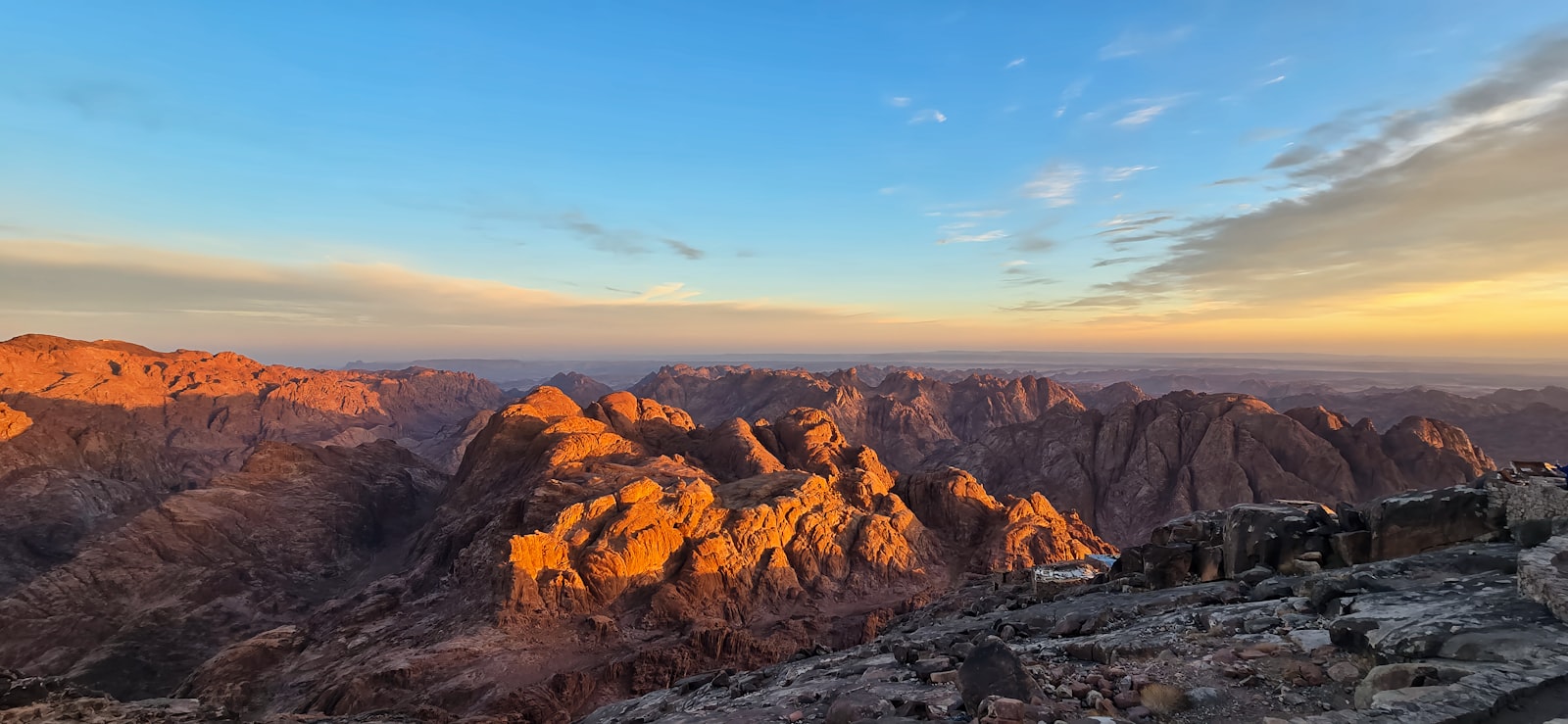
The most spectacular moment of the visit is reaching the summit of the fortress and contemplating the 360-degree panorama. On clear days, the view extends from the mountains of Sinai to the coasts of Saudi Arabia, from the lights of Eilat in Israel to those of Aqaba in Jordan. At sunset, when the mountains are tinged with red and orange nuances, the spectacle is simply unforgettable.
Combining with Other Visits
The zone of Taba offers various attractions that can be combined with the visit to the fortress. The Taba Heights Resort has a golf course, a wellness centre and a casino. The nearby reserve of Wadi Watir offers excursions in the desert, while the Colored Canyon and the White Canyon are reachable with daily excursions organised by the local tour operators.
The Fortress of Taba is a hidden jewel of the Egyptian historic heritage, a place where the millennial stones recount stories of crusaders and sultans, and where nature offers a spectacle of incomparable beauty between sea and desert.